Monday, January 14, 2013

God Matters?

Readers in striking distance of Oxford are warmly invited to join us for a series of talks exploring some of the challenging questions that non-believers sometimes put to people of faith. The talks - which will be given by a number of Dominicans, including Godzdogz's own Br Andrew Brookes - are free, and will take place on six consecutive Tuesdays at 8pm, starting on February 5th. The evenings will include an opportunity for open discussion and questions (as well as some refreshments: Dominicans believe in feeding mind and body!).


All are welcome: you need not be a Catholic, nor even a theist: we hope that this will be an opportunity for all of us to reflect critically on our faith and to grapple with some difficult issues. Of course, those who don't necessarily have any burning questions are welcome to come along and listen (we won't press-gang anyone into sharing their opinions or views). We look forward to seeing you!

Sunday, January 13, 2013

Blackfriars, Canterbury

Canterbury is in some ways the religious heart of England. That was certainly the case when the first Dominican friars arrived on these shores in 1221, the year of St Dominic's death. Yet they did not stay to found their first priory in the city of Augustine, Anselm and Thomas à Becket. They preached before Archbishop Stephen Langton, then made haste to London, the political capital. Again they moved on and did not stop until they came to Oxford, the (then) intellectual capital. Right from the start, we Dominicans have always been attracted to university centres, where our commitment to study and preaching can bear great fruit.
Map of Blackfriars, Canterbury, by Thomas Langdon (1595)

It didn't take us long to return to Canterbury: the first Blackfriars was founded there in around 1236. As the waves of pilgrims to the shrine of St Thomas à Becket increased, in around 1315 the Dominicans built a Guesthouse on a little island in the river Stour, connected to the main priory complex by two wooden bridges (see map above). This building consisted of a main hall with an undercroft, which was later raised a little.

The 1315 Guesthouse, with a modern wing in red and the Marlowe Theatre behind

The Guesthouse passed through several hands after the Protestant Reformation, being used by several different denominations. The English Dominicans obtained the site in the early twentieth century, thanks especially to a certain 'Brother Cuthbert' (probably Fr Cuthbert Bretherton OP), Inside, a beautiful stone inscription by Fr Aelred Whitacre OP commemorates the fact that this building was built under Henry III, destroyed under Henry VIII, and restored under Edward VIII(!), i.e., in 1936. But before long the disrepair was parlous. In 1969, the Guesthouse was bought by Donald and Poppy Beerling, who have subsequently spent enormous amounts of money and energy restoring it.

Old interior of the Guesthouse

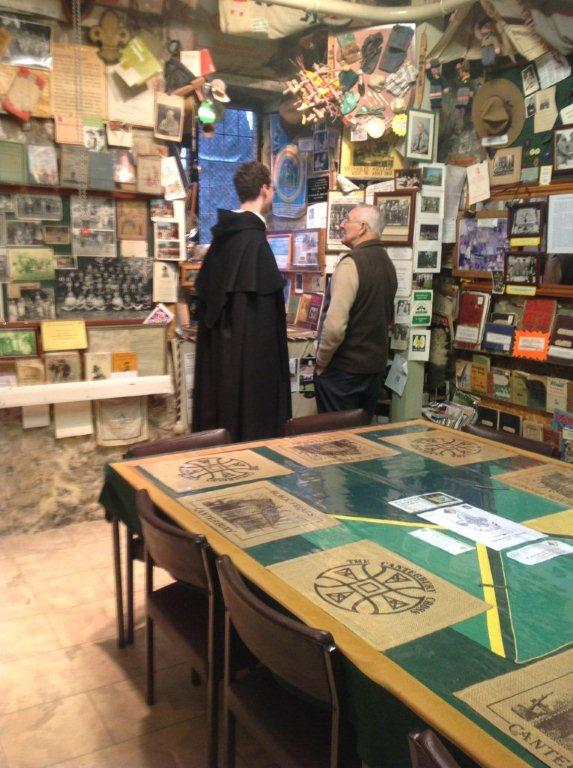
It was the Beerlings who warmly welcomed me, and some of my family, for a visit on 29 December, the feast of St Thomas of Canterbury. They showed me photos and letters from an impromptu visit by an Australian Dominican in 1981, and it seems I'm the first English Dominican to have visited the restored Guesthouse. The Beerlings have put up several displays with information about the medieval religious Orders, alongside many mementoes of the recent past, including the WW2 bombing of Canterbury. I particularly liked the excellent scale model of the medieval priory, which deservedly won a prize for the local schoolboy who made it.

Donald and Poppy Beerling welcome me to Blackfriars, Canterbury
The Cathedral is visible behind

As lifelong stalwarts of the Scouting world, Donald and Poppy also showed me their rich displays of Scouting memorabilia. (I was once a sixer in the 57th Episkopi pack of Cub Scouts.)

Scouting displays

These days the Guesthouse is used as a community hall, hosting small concerts and all manner of local groups on a regular basis. The main hall still boasts the glorious original timber roof, with only a few modern fixings. It would be very interesting to compare this building with the other remains of Blackfriars just over the river, including the medieval Refectory, which are now part of the King's School.

Locations of medieval Dominican priories

As an English Dominican of the 21st century, it is with mixed feelings that I look back on our historic priories. A great deal was lost at the English Reformation, and there are many ruins to remind us. But we should be grateful that some old priories, like Canterbury and Newcastle, are still being used and well looked after today. Meanwhile, the mission of the English Dominicans continues to flourish in other places and in other ways. The last two centuries saw our return to many of our old preaching grounds: London, Newcastle, Leicester, Oxford, Edinburgh, Cambridge, and Glasgow. In modern times the Province has been busy building up new Catholic communities, reaching new audiences, and preaching through new media, as the religious complexion of this country continues to change.

There is no need to be sentimental about the past; neither should our vision of preaching the Gospel today be narrowed by old attachments. Rather, we can joyfully embrace the opportunities and challenges of the Gospel in our contemporary society, while remaining rooted in the fertile traditions we have received down the ages. The ongoing presence of our medieval buildings is a wonderful reminder of that inheritance. May it spur us to be always like 'the owner of house who brings out of his storeroom new treasures as well as old' (Mt. 13:52).


Thursday, January 10, 2013

Dominican Seminar 2013 – Fr Gerald Vann OP

Gerald Vann OP was one of the great Dominican communicators of the last century. Though much of his ministry was exercised as teacher and headmaster of the Dominican school of Laxton, he gained a much wider audience through his books and radio broadcasts on the spiritual life. He was one of that notable generation of Dominicans between the 1930s and Vatican II, which Aidan Nichols OP describes in Dominican Gallery. His writings, above all The Divine Pity, continue to exert great influence on the spirituality of Dominicans today. So, Fr Vann was a good choice for the theme of this year's Dominican Seminar:

Gerald Vann OP and the New Evangelisation

Once again, members of the Dominican Family converged from all corners of Britain and Ireland on Hinsley Hall in Leeds. The programme, as always, includes talks, liturgy, meals and informal social gatherings. The talks all aimed at showing how Fr Vann had communicated the truth of the Gospel so effectively to his generation, in order to learn something about how we might do to same to ours.

Hinsley Hall
Fr Aidan Nichols began by characterising Fr Vann's project as sapiential, seeking to inculcate wisdom and not just knowledge, in the boys he taught at Laxton and those who heard him preach. This wisdom must pay attention to symbols, both natural and supernatural, which help to define us and our place in God's creation.


There followed two talks on the socio-political dimension of the Gospel. Dr Patrick Doyle gave personal insights from his life's work in local politics, and emphasised the need to translate theological jargon into plain language for wider audiences. Sr Helen Alford, Professor of Economics and Business Ethics at the Angelicum, then gave a nuanced perspective on whether Fr Vann would approve of Catholic neoconservative economics, with special reference to the work of Michael Novak, and adding the perspective of the Dominican theorist of social ethics, A. F. Utz. 


Br Andrew Brookes had scoured Fr Vann's corpus for his Mariology, and found that there was no overarching approach to the Virgin Mother. Rather, Fr Vann often speaks of Mary in connection with other themes, particularly that of suffering (hence, the 'seven sorrows' of Our Lady). Suffering, moreover, was the dominant theme of Fr Richard Conrad's talk on the Lenten sermons at Westminster Cathedral in 1947, later published as The Pain of Christ and the Sorrow of God, which open with this powerful statement: 'The history of humanity is a love-story.'


God's loving kindness towards humanity was beautifully represented in a meditative session led by the Irish Dominican Sisters, using Scripture and readings from Fr Vann's work (which is itself thoroughly scriptural). In the final seminar discussion, we focused on The Divine Pity, which connects each of the Beatitudes with a different prayer, Gift of the Holy Spirit, and Sacrament.


I always enjoy the social aspect of these Dominican gatherings, catching up with other Friars, Sisters, Laity and members of the Dominican Secular Institute, some of whom I haven't seen in over a year, and also meeting new people for the first time. The social evening on the last night was an obvious opportunity for singing, dancing and a bit of 'magic', but really the whole seminar is a social occasion. In trying to rediscover Gerald Vann's ability to communicate the Gospel to our contemporary culture, we couldn't do better than start with the joy that comes from our brotherhood and sisterhood in Christ.

Wednesday, January 9, 2013

'What happens in Kavos'?

On Tuesday night #kavos was trending on Twitter, as hundreds of people took the opportunity to issue their criticism of the Channel 4 documentary ‘What happens in Kavos’. I haven’t watched the programme myself, but given that the show’s tagline promises a “behind the scenes look at the sex and debauchery of a Greek party season, [a] glimpse of what really happens in the hedonistic party town away from parents”, it is probably safe to assume that it is what the older moral theology manuals call a “dangerous occasion of sin”, and I’d have been happier if what happened in Kavos had been allowed to stay in Kavos. (For those in need of some more edifying viewing, the Student Master recommends David Attenborough’s new series on Africa, or you could could check out Sr Hyacinthe OP’s recent appearence on Channel 4).

Indeed, it’s not a surprise to learn that many young people choose to spend their free time and money drinking to excess and having casual sex, nor that they prefer to exhibit their wildest behaviour at some distance from their families. Kavos-like behaviour is, to some extent, not a new thing: historians can provide ample evidence of places of sexual antinomianism across the centuries, often coupled with the consumption of alcohol, and prostitution has been referred to as the ‘world’s oldest profession’. A recurring theme of the Tweets, however, was to remark on the apparent irrationality of people’s behaviour in Kavos: “why would somebody want to do this to themselves”, “what can they possibly enjoy about behaving like that”? Sin, of course, always has this irrational quality, because it is contrary to what is good for us. In knowing more deeply the truth, we are able to discern with greater acuity the good to which our wills are attracted.

In reflecting on the behaviour of others who seek out apparently sordid places in which their sins take place on the public stage, however, we are at risk of indulging ourselves in Schadenfreude, diverting attention from the darker areas of our own lives, the places which we have yet to allow the light of Christ to shine into. Thankfully, Our Lord, through the ministry of the Church, provides a safe place for catharsis, renewal, strengthening and forgiveness: the Sacrament of Penance and Reconciliation, in which we are enabled by Christ's grace to bring our darkness into the light, to lighten our crosses without making the crosses of others heavier. In the end times, all our sins will be revealed on the public stage, not as occasions of shame, but as occasions of celebration, for rejoicing in the grace of God’s forgiveness.

A friend recently remarked that he was shocked to find that, as the recession hit and the shops on the High Street of his home town became increasingly vacant, a number of sex shops had moved in. It strikes me that in some of the poorest communities of the world two things are to be found in abundance: pubs and nightclubs, and churches. Both, in their own way, bring a sort of transcendence and a sense of hope. Of course, it is Jesus Christ alone who brings the authentic joy and hope that the world cannot give. But perhaps in the bizarre behaviour in Kavos we can see a glimmer of a misdirected thirst for hope and joy that is answered only in Christ, a deep longing to be wanted, to be needed and to be loved. It is the joy of a Dominican vocation to have a particular call to share this Good News of liberation, but this is not a Dominican joy alone! It is the task of all Christians, that we may help each other to see the truth about God and about ourselves, no matter how beautiful that truth may be.

Tuesday, January 8, 2013

Councils of Faith: Nicaea II (787)

The question of the use of images in the worship of God is one which pre-dates the coming of Christ: the First Commandment forbids the making of ‘a graven image, or any likeness of anything that is in heaven above, or that is in the earth beneath, or that is in the water under the earth’ or the worshipping of them (Ex 20: 4-5). Idolatry is one of the charges frequently levelled against Israel by God, speaking through the prophets, in the Old Testament (e.g. Ezek 23: 49, Jer 16: 11-13), and several of the Psalms mock and condemn the practice of idol-worship (e.g. Pss. 105 [106], 113 [115). However, when the salvation which those same prophets had promised came, it came not by returning Israel to the rejection of any image of God, but rather, God sent his only Son, ‘the image of the invisible God’ (Colossians 1: 15), to reveal to the world the truth of the Trinity, of God who is Love.


We find surviving representations of Christ from as early as the third century (e.g. in the Roman Catacombs), and after the official toleration of Christians in 313, the use of images in the adornment of newly-built churches increased greatly. At the same time, an understanding of the significance of representative symbols of the reality of the Incarnation developed: this incorporated not only pictorial representations of Christ, but the ceremonies associated with the Gospel Book in the Liturgy (as containing the record of the earthly life of the incarnate Son of God, and the words he spoke) and also images and relics of the Saints as those who, filled with the Holy Spirit, embodied through time and space Christ’s continuing presence on earth in the Church, his Mystical Body.


However, the veneration which came to be attached to these objects aroused concern among some Christians (in the light of the Old Testament’s condemnation of idolatry), and in the 720s, a movement to remove the images which had accumulated in churches arose in parts of the Eastern Church. The rise of Islam, with its strict ban on representative art, has been suggested by some historians as a possible explanation for a renewed concern among Christians about their use of images. It is probably also true that, as at the time of the Protestant Reformation in Western Europe, excesses and abuses in the veneration of images led to a reaction against them which went too far, rejecting not only the abuses, but any legitimate place for the veneration of images and other material signs.

The details of the growth of the anti-image Iconoclast movement are somewhat controverted among historians: while the traditional account, for example, blame the Emperor Leo III for starting it, some now claim he might in fact have been in favour of images. What is clear, however, is that his son, Constantine V, who succeeded to the Byzantine throne in 740, was personally opposed to the veneration of images, and gave imperial sanction to a campaign to remove them from churches, as well as calling a council in 754, which purported to be ecumenical (despite the absence of delegates from the Pope or any of the Eastern patriarchal sees) to give doctrinal confirmation for his position.

Only when Constantine V’s daughter-in-law, Irene, took over as regent for her son Constantine VI on the death of his father, Leo IV, could a new ecumenical council be called, this time with the participation of the Western Church, which seems to have remained untouched by the iconoclastic fervour that had engulfed much of the East. This Council, which met at Nicaea in 787, upheld the legitimate veneration of images of Christ and the Saints, of relics and certain liturgical objects, as a means of expressing veneration of the things they represent or symbolise; it condemned the position that no such veneration was consistent with the orthodox faith.

Though iconoclasm resurfaced at the start of the 9th century, being definitively suppressed in 843, it was the decisions of Nicaea II which were reaffirmed at the end of that conflict, celebrated by Byzantine Christians, both Orthodox and Catholic, as the Triumph of Orthodoxy.

Saturday, January 5, 2013

The Epiphany 2012

For all that ‘epiphany’ is one of the few religious words that has passed into modern idiomatic English, surveys suggest that few people know what precisely it is that the Feast of Epiphany celebrates. Indeed, in choosing a peculiar sounding word over the more straightforward ‘Feast of the Three Magi’ (as it is known in Spanish or the sonorous German Dreikönigstag) or ‘Star Day’ (as the Latvians have it), it might seem that we’ve obscured the concrete reality of the events that we commemorate in today’s festival: the finding of a child in a manger at Bethelehem by travellers from afar, who led by the light in which they trusted - a light which came from God - find God Himself made man, the incarnate meaning of their lives, and the hope of all nations.

When we talk about having an epiphany in modern idiom, we are narrating a fairly common experience: a sudden moment of realisation, an interior and striking conviction that changes our perception on the world or a particular problem. There are clear analogies between this common experience and the Magi’s experience of Christ’s manifestation to them by the Father, but there is an important difference: what is made manifest to the Magi comes not from within, from the private realm of hidden interior senses, but from above, from God, taking place on the public stage, in the person of Jesus Christ. Christ is personally the manifestation of God, God’s self-revelation in human history, and thus a personal epiphany. Indeed, some of the earliest accounts of today’s feast (such as that of St Gregory of Nazianzen, writing in the fourth century) don’t call it the ‘epiphany’ at all, but the ‘theophany’, a celebration of the unveiling of God in human history, and a continuation of the Christmas celebration of the divine nativity.

Sometimes those who are questioning whether God exists ask why it is that, if God is truly as we Christians profess him to be - all loving and all powerful - he doesn’t make himself known more dramatically, so that we would all believe. Today’s feast provides something of an answer to that question: what more could God do, than come and dwell among us as man? As the true presence of God in Man, Christ is the unsurpassed and unsurpassable revelation of God, and yet God not only reveals himself in Christ, but he also sends the Holy Spirit, to lead us to faith, to provide for our recognition of Christ as the Word made flesh. So today’s feast might be seen as a celebration of the Holy Spirit, whose mission is conjoined with that of the Son. Whilst the Nativity of Our Lord, celebrated on the 25th December, is the ‘Big Christmas’, celebrating the birth of the incarnate Son and the revelation of the Father amongst us, today is the ‘Little Christmas’, celebrating the birth of Christ within us, through our personal recognition, by the Holy Spirit, of Jesus as the Saviour.

In the time leading up to the birth of Christ, ‘epiphany’ had become a political word. The Seleucid Emperor, Antiochus IV had declared himself to be epiphanes, ‘manifest god’, using a show of political force to desecrate the temple in the most vile of ways, ruthlessly persecuting the Jewish people, and slaughtering those who opposed his rule. (As a token of his tyranny, Antioches’ opponents would nickname him epimanes, ‘manifest lunatic’). Christ, by contrast, does not enter our lives by force. He comes in the silence of Bethlehem, to bring authentic life and the gift of peace, to be accepted in the freedom and joy that he creates. In this year of faith, let us pray for epiphanic lives - lives shaped by the joy of openness to the truth - that in our study and prayerful reflection on the world, we may come to see creation as Christ himself sees it: thoroughly theophanic, telling forth the glory of its creator.

Friday, January 4, 2013

A Christmas hymn

For this Christmas season, the Dominican student brothers at Blackfriars, Oxford have recorded the hymn for Vespers of the Nativity: Veni, Redemptor gentium.

In the liturgy, we do not sing this hymn after the Christmas Octave, which ended on New Year's Day. But, since the Christmas season as a whole is ongoing – at least until the Epiphany (6 January), if not until the Presentation (2 February) – perhaps we can still sing or hum along to this beautiful music for the time being. And which of us could honestly claim never to have sung (or whistled!) one of countless other catchy Christmas jingles, secular or sacred, in all the other months of the year...?


The text can be found here.