Showing posts with label Blackfriars. Show all posts

Thursday, October 23, 2014

Dominican Priories: Oxford (Blackfriars Hall)

The plaque on the outside of Blackfriars highlighting its existence as a Priory, a Studium, and a Hall of the University

In a previous post, Br Oliver explained how Blackfriars in Oxford exists as a Priory, as well as a home to the Studium. Blackfriars is also home to Blackfriars Hall, which is a Permanent Private Hall (PPH) of the University of Oxford. Like the more familiar colleges of Oxford, such as Christ Church and New College, Blackfriars Hall can admit students for degrees from the University. PPHs are generally much smaller than colleges both in physical size and number of personnel, and tend to have a more religious character.

Blackfriars Hall was established in 1994 on 1st January. We Dominicans were involved in the life of the University long before this date (though admittedly with a substantial hiatus in between; but that was not our fault!). After our first priory in Oxford was established in 1221, Dominicans very quickly took up high-ranking positions within the University's theology faculty. 

The Aula at Blackfriars, which is where most lectures take place

The Hall offers an intimate and friendly academic setting for mature undergraduate and postgraduate students, who have the unique opportunity to be taught, particularly in the case of theology and philosophy students, by the brethren, and to study alongside the student friars, as well as the other religious and non-religious students in formation as part of the Studium. 

Before being accepted by the Dominicans, I was a postgraduate student in the Hall reading for my Master's in theology. It was a period in which I was privileged to have had the opportunity to get to know the brethren better and to see a little closer the life they lived, which without question contributed to my wanting to be a Dominican friar. The Hall serves as a special bridge between the religious world of the friars and the secular environment of a modern university, thus existing as a very unique and important form of outreach for us as friars in the English context.

Sunday, October 12, 2014

Academic Mass 2014


The start of the academic year was marked by a votive Mass of the Holy Spirit and Vespers celebrated by the Regent of Studies, Fr. Simon Gaine OP. We prayed for the Holy Spirit to fill us with wisdom and understanding; to sustain us in our desire for knowledge and love of God's truth, and of one another. The occasion was a wonderful opportunity to come together as a community of students and teachers in order to consecrate the work of the term ahead to God.

After Mass, Dinner was served in the refectory and the brethren were able to meet our new students, and catch up with older friends.


Tuesday, July 8, 2014

Ordination of Fr Nicholas Crowe, O.P.


After seven years of education and life in the Dominican Order, our Brother Nicholas Crowe was ordained Priest last Saturday July 5th 2014.


Fr Nicholas had his hands anointed with holy oils and was ordained Priest. Family and friends came to Blackfriars for the Ordination by our Brother Archbishop Malcolm McMahon OP.


Hundreds queued for their first blessing from Fr Nicholas, who will be moving onto new pastures at the start of his Priestly ministry.


As mentioned in the bidding prayers during his first Mass, we pray for Fr Nicholas Crowe who was ordained to the Priestly ministry. May the Lord give him a deep faith, a bright and firm hope, and a burning love which will ever increase in the course of his Priestly life. 

Wednesday, May 7, 2014

Blackfriars Overseas Aid Trust (BOAT) – AGM 2014

The Christian gospel is not just something which affects our personal and family lives. It also sends us out into the world to bring healing and hope. Charitable giving should be a central plank in our spiritual lives as a 'corporal work of mercy' (along with prayer and fasting). As Pope Francis never ceases to remind us, we are in solidarity with the poor; we cannot stand aloof and think that another person's suffering is not our problem. Of course, we cannot help everyone all the time, but we must do what we can.

Last Sunday, 4th May, we held the 2014 AGM of the Blackfriars Overseas Aid Trust – or BOAT, as everyone calls it. BOAT is the charity run by the 9:30 Family Mass congregation at Blackfriars, Oxford, and supports nearly 20 projects around the world. These projects cover many areas of need, including (a) healthcare, especially primary healthcare and preventive medicine; (b) welfare, especially for children, people with disabilities, refugees, and victims of war or poverty; and (c) education, with special attention given to practical skills, women's education, and basic education for children.
Some of the BOAT committee and 9:30 Family Mass congregation at the 2014 AGM

Our principles of giving require that we find projects where our small donations will go a long way, where the injection of financial support will lead to sustainable development, and where we have very good communication links. I think this emphasis on good communication is one of the best distinctive attributes of BOAT. The South African Dominican, Albert Nolan OP, once described four stages of development in our service of the poor. (These stages need not follow sequentially; they may strike us all at once!) We begin with compassion. We are then motivated to effect structural change, without indulging in our anger against 'the system'. Thirdly, we proceed with humility when we discover the poor are often more aware and more capable of the solutions than us, though we must avoid romanticising poverty. Finally, there is true solidarity, no longer seeing the poor and the oppressed as a separate class, but identifying with their problems, struggles, weaknesses and hopes. "Real solidarity", says Fr Nolan, "begins when it is no longer a matter of we and they."

At BOAT, we keep regular communication with our projects to ensure the money is spent wisely and productively. We receive reports and photographs, which we feed back to the congregation (see especially the display at the back of the church), and sometimes a BOAT member is even able to visit a project in person. A few projects happen to be run by Dominicans in their respective countries (Grenada, East Timor, etc.), but this is not a requirement. The BOAT committee are all volunteers and we keep costs to a minimum (just bank transfer fees and the printing of the annual report), so that a full 99% of our income goes straight to the people who are in need.

This recent AGM saw some changes in the composition of the committee. We are sad to see some members move on, but warmly welcome the new members, who bring their own distinctive talents and energy.
You can read more about BOAT here: http://www.bfriars.ox.ac.uk/priory/groups/boat/

Saturday, April 12, 2014

Easter Services 2014

The timings of services during the Sacred Paschal Triduum at the Priory of the Holy Spirit (Blackfriars, Oxford) are given in the poster below. We hope you will be able to join us.

Over the last few days of Passiontide, Godzdogz will continue to offer reflections on the Mass readings of the day. During and after the Triduum we will post some photos of the liturgies, especially for those who are unable to be here.

Monday, June 17, 2013

End of year events at Blackfriars

The end of the academic year is always greeted with a panoply of parties at Blackfriars. Here are some of the highlights.


The Summer Fair was held in our garden on Sunday 9 June, with the enthusiastic participation of the 9.30 Family Mass congregation. As usual there was a BBQ, many games, a bouncy castle and the 'stocks' to punish the friars! The event was a great success and was thoroughly enjoyed by all. It also raised an impressive sum of money for the Blackfriars Fabric Fund (i.e., upkeep of the buildings).


The subprior found some barbecue grills in a suitably joyful colour
Lots of games to try your luck
Fortunately, the rain held off...
...but some friars still got drenched!
'Poop, poop!'
The end of the academic year is a time of mixed emotions for those students of Blackfriars Hall or Studium who are graduating. The garden party, held this year on Friday 14 June, is a way for all of us, whether staying or moving on, to relax together, to laugh about the good times we've had and look forward to future adventures.


And in the evening, the ball gowns and dinner jackets appeared for the Blackfriars Ball, which took the theme of Alice in Wonderland. Students of Blackfriars Hall had drinks and dinner at the priory (together with the brethren), followed by further festivities elsewhere.


Photos: courtesy of Renée Caraviello, Shaun Bailham, and fr. Laurent Mathelot OP

Wednesday, January 30, 2013

Aquinas Lecture, 2013: Matthew Levering - 'Aquinas & the Gospel'

On 30th January Blackfriars held its annual Aquinas Lecture. This year the speaker was Matthew Levering, Professor of Religious Studies at Dayton University, USA. He spoke to a packed hall on the subject of ‘Aquinas and the Gospel’, specifically ‘The Pauline Gospel According to Aquinas’. His major source was the commentary by St Thomas on the letter to the Romans, and he focused on the detailed commentary made by Aquinas on the first three verses of the letter.


Professor Levering set out to explore what was Aquinas’s understanding of the Gospel. He explained that for Aquinas it was good news because it announced the fundamental human good, which is our union with God. More specifically the theme of unity is three-fold: (1) the union of God and man in Jesus; (2) our union with God now; (3) the fulfilment of this union in Heaven and at the end of time. The content of the gospel is Jesus Christ, the union of his full divinity and full humanity being stressed by both Aquinas and Levering. The Gospel comes from God and is first preached by God, in the person of Jesus. While there is a certain newness in the New Testament the gospel also draws its credibility from it fulfilling the Old Testament Scriptures and promises, seen as given through the prophets. As such the prophets had the quality of antiquity (since they spoke long before Jesus came), of reliability (as God inspired them to speak the truth) and of dignity (as God chose and raised them up as holy mediators of grace).

Professor Levering drew out the rich use that Aquinas made of other scriptural texts in his commentary, using the Gospel of John to cast light on Paul’s ideas, and using a variety of Old Testament texts, especially Isaiah, to bring out the depth of the meaning in both the thought of Paul and to express his own ideas.

Discussion followed including a discussion of the extent to which Aquinas’s appeal to antiquity had similarities with modern concerns of historical consciousness, and the extent to which proclaiming the Gospel brings about faith in a way akin to, or different form the way in which celebration of the sacraments brings about sanctification. The Gospel is powerful and listening to it and pondering it can be a huge grace, if done with faith.

After drinks for all our guests, and Evening Prayer, Professor Levering joined the community for supper. He stayed on to give the Aquinas Seminar the next day ‘Milbank and Aquinas on Nature and Grace’. It was all a very enriching experience.

Monday, January 14, 2013

God Matters?

Readers in striking distance of Oxford are warmly invited to join us for a series of talks exploring some of the challenging questions that non-believers sometimes put to people of faith. The talks - which will be given by a number of Dominicans, including Godzdogz's own Br Andrew Brookes - are free, and will take place on six consecutive Tuesdays at 8pm, starting on February 5th. The evenings will include an opportunity for open discussion and questions (as well as some refreshments: Dominicans believe in feeding mind and body!).


All are welcome: you need not be a Catholic, nor even a theist: we hope that this will be an opportunity for all of us to reflect critically on our faith and to grapple with some difficult issues. Of course, those who don't necessarily have any burning questions are welcome to come along and listen (we won't press-gang anyone into sharing their opinions or views). We look forward to seeing you!

Sunday, January 13, 2013

Blackfriars, Canterbury

Canterbury is in some ways the religious heart of England. That was certainly the case when the first Dominican friars arrived on these shores in 1221, the year of St Dominic's death. Yet they did not stay to found their first priory in the city of Augustine, Anselm and Thomas à Becket. They preached before Archbishop Stephen Langton, then made haste to London, the political capital. Again they moved on and did not stop until they came to Oxford, the (then) intellectual capital. Right from the start, we Dominicans have always been attracted to university centres, where our commitment to study and preaching can bear great fruit.
Map of Blackfriars, Canterbury, by Thomas Langdon (1595)

It didn't take us long to return to Canterbury: the first Blackfriars was founded there in around 1236. As the waves of pilgrims to the shrine of St Thomas à Becket increased, in around 1315 the Dominicans built a Guesthouse on a little island in the river Stour, connected to the main priory complex by two wooden bridges (see map above). This building consisted of a main hall with an undercroft, which was later raised a little.

The 1315 Guesthouse, with a modern wing in red and the Marlowe Theatre behind

The Guesthouse passed through several hands after the Protestant Reformation, being used by several different denominations. The English Dominicans obtained the site in the early twentieth century, thanks especially to a certain 'Brother Cuthbert' (probably Fr Cuthbert Bretherton OP), Inside, a beautiful stone inscription by Fr Aelred Whitacre OP commemorates the fact that this building was built under Henry III, destroyed under Henry VIII, and restored under Edward VIII(!), i.e., in 1936. But before long the disrepair was parlous. In 1969, the Guesthouse was bought by Donald and Poppy Beerling, who have subsequently spent enormous amounts of money and energy restoring it.

Old interior of the Guesthouse

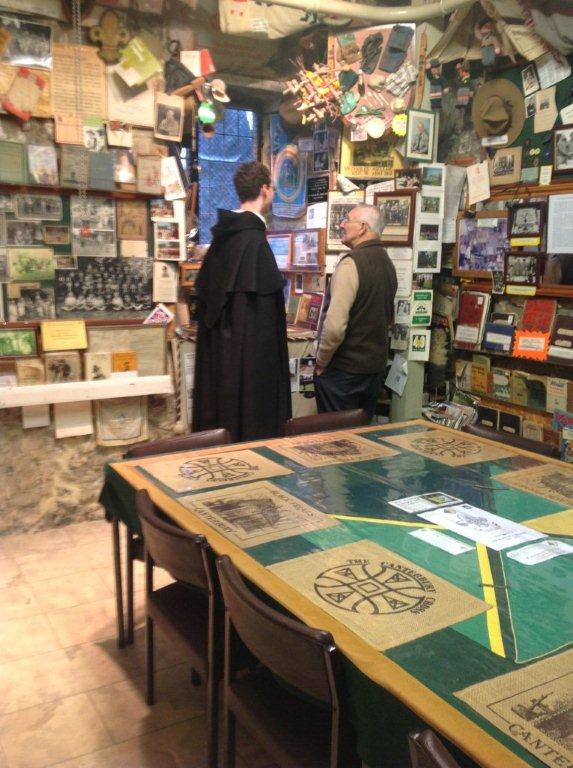
It was the Beerlings who warmly welcomed me, and some of my family, for a visit on 29 December, the feast of St Thomas of Canterbury. They showed me photos and letters from an impromptu visit by an Australian Dominican in 1981, and it seems I'm the first English Dominican to have visited the restored Guesthouse. The Beerlings have put up several displays with information about the medieval religious Orders, alongside many mementoes of the recent past, including the WW2 bombing of Canterbury. I particularly liked the excellent scale model of the medieval priory, which deservedly won a prize for the local schoolboy who made it.

Donald and Poppy Beerling welcome me to Blackfriars, Canterbury
The Cathedral is visible behind

As lifelong stalwarts of the Scouting world, Donald and Poppy also showed me their rich displays of Scouting memorabilia. (I was once a sixer in the 57th Episkopi pack of Cub Scouts.)

Scouting displays

These days the Guesthouse is used as a community hall, hosting small concerts and all manner of local groups on a regular basis. The main hall still boasts the glorious original timber roof, with only a few modern fixings. It would be very interesting to compare this building with the other remains of Blackfriars just over the river, including the medieval Refectory, which are now part of the King's School.

Locations of medieval Dominican priories

As an English Dominican of the 21st century, it is with mixed feelings that I look back on our historic priories. A great deal was lost at the English Reformation, and there are many ruins to remind us. But we should be grateful that some old priories, like Canterbury and Newcastle, are still being used and well looked after today. Meanwhile, the mission of the English Dominicans continues to flourish in other places and in other ways. The last two centuries saw our return to many of our old preaching grounds: London, Newcastle, Leicester, Oxford, Edinburgh, Cambridge, and Glasgow. In modern times the Province has been busy building up new Catholic communities, reaching new audiences, and preaching through new media, as the religious complexion of this country continues to change.

There is no need to be sentimental about the past; neither should our vision of preaching the Gospel today be narrowed by old attachments. Rather, we can joyfully embrace the opportunities and challenges of the Gospel in our contemporary society, while remaining rooted in the fertile traditions we have received down the ages. The ongoing presence of our medieval buildings is a wonderful reminder of that inheritance. May it spur us to be always like 'the owner of house who brings out of his storeroom new treasures as well as old' (Mt. 13:52).