Showing posts with label community. Show all posts

Thursday, October 30, 2014

Dominican Priories: Leicester. 'A history of Tom, Dick and Harry!'


Holy Cross Priory, Leicester. 


When looking upon our modern Priory of Holy Cross, Leicester, it is so easy to forget the rich and varied history that explains its existence today. I am going to attempt to 'dig up' then a little of the history of the Dominicans in Leicester, which along the way 'uncovers' everything you need to know about Tom, Dick and Harry!

The first Dominicans arrived in Leicester around 1247. They soon set up shop, so to speak, in St Clement's Parish Church, which had been given to them by the Augustinian Canons who controlled all of the parishes within the medieval town walls. St Clements was a poor parish that sat neatly between the two arms of the River Soar. It was under the benefaction of two patrons, that of Simon de Montfort, 6th Earl of Leicester and (get ready for it)... Harry, who liked to be referred to as King Henry III of England.

Manuscript showing the coronation of King Henry III ('Harry')

And so the Priory grew up around St Clement's Parish, which the first friars used as their conventual church. One of the earliest written accounts of this medieval foundation refers to the priory as 'The Blak Frears in the Ashes', not a reference to outcomes of inquisitorial justice, but rather because of the pleasant ash trees that could be found in its grounds.

At its medieval height the community numbered thirty-three strong and hosted a total of three provincial chapters, which shows further the wider importance of Leicester at this time. But alas, the growth of the medieval Priory came to a halt on the 10th November 1538, when the Priory was surrendered to the king's agents as part of the inevitable waves of dissolution. Those among our friars who did not apostatise fled to neighbouring Flanders.

The Dominicans finally returned to Leicester after the Reformation, the new friars coming from Bornhem, which was founded in 1657, in what was then the Spanish Netherlands. The founder went by the name of Phillip Thomas Howard, or Tom for short.


Phillip Thomas Cardinal Howard OP

Phillip Thomas Howard was born in 1629 into the family of the Dukes of Norfolk. In 1645 the young Phillip took the habit of our Order, much to the displeasure of the Earl himself. His purpose would be to restore the English Province, and it was for this reason that he managed to persuade the Master of the Order and the General Chapter to allow him to seek a patron, the Count of Bornhem, to make the first foundation of English Dominicans since the Reformation. He was made Cardinal in 1675 and died in Rome as Cardinal Protector of England and Scotland in 1694.


Bornhem was eventually abandoned as an English Catholic Boys school, a noviciate, and as a study house for the Order in 1794, due to the arrival of the French Revolutionary Army. The Brethren and the Dominican Nuns of Brussels fled to England to the current site of the modern Priory back in Leicester. It was Benedict Caestryck OP who founded the permanent mission of Holy Cross, Leicester, buying land there in 1817, and he began to build the church, which opened in 1819, and a presbytery in 1824. The Parish and the modern Priory took the name of Holy Cross, the dedication of the Priory and Church at Bornhem.

The interior of Holy Cross Priory Church. 

Holy Cross was finally established as a priory in 1882. During this period the friars opened Mass-centres right across the city. Subsequently, all of the Roman Catholic parishes in Leicester find their origin in being Dominican foundations. In 1929 the construction of the Priory Church you see today began under fr Vincent McNabb OP. The conventual church was finally completed and consecrated on 14 May 1958.

Today Holy Cross Priory is the largest parish in the city centre, and also serves a 14th-century chapel in Woodhouse, which has a lively congregation. The current Friars' mission includes two university chaplaincies, that of Leicester and De Montfort; the Catholic University Chaplaincy is thriving in an annex to the priory itself. The friars are also chaplains to the Leicester Royal Infirmary and a local prison; and a healthy relationship is maintained with Holy Cross Primary school, which used to reside on the Priory site.

But where in the name of Richard is Richard III? (aka Dick)

King Richard III
Alas, the finding of the remains of the last Plantagenet Monarch, King Richard III in the city of Leicester could not go unmentioned, in regard to the history that is still being written for our Priory in Leicester.

Richard's remains were found underneath a car park, which used to be the site of the old Greyfriars Church, in the city centre in September 2012. Plans for King Richard's remains to be reinterred in Leicester Cathedral are under way.

For Holy Cross Priory this means:

  • on Monday 23rd March, Vincent Cardinal Nichols will celebrate Mass for the repose of the soul (a ‘Requiem Mass’) of Richard III in Holy Cross Church. The Choir from St Barnabas’ Cathedral, the Cathedral of the Diocese of Nottingham, will sing at this Mass, which will be open to the public 
  • and On Tuesday 24th March the Dominican friars will sing Vespers, the Catholic Church’s evening service, in Leicester Cathedral; this is in addition to the daily celebration of Mass and the divine office in Holy Cross Church. 
  • and finally On Wednesday 25th March, Father David Rocks OP, the current parish priest and prior at Holy Cross Church, will preach at the lunchtime Eucharist in Leicester Cathedral. 

The excavation site where the remains were found.

So there we have it, a potted history of our Leicester Priory, including the likes of Tom, Dick and Harry!


A new window in the north transept of Holy Cross Priory, Leicester which shows the post-Reformation history of the Dominican Order in the city. In the top panel, Christ is surrounded by Dominicans past and present. On the left, a procession of Dominican led by St Dominic and on the right a young friar brings people to Christ. In the bottom panel, Fr Francis Xavier Chappell, OP disguised as a coster selling vegetables, during Penal times when it was illegal for Catholic priests to minister in this country. In his basket he hid his chalice and he initially said Mass in a factory. He served the Catholics of Leicester from 1785-1815. Next along, we see a Flemish Dominican, Benedict Caestryck, who moved to a small house in Wellington Street, where he said Mass. Under his inspiration, building began on the first Holy Cross Church in 1817. This was opened in 1819. Holy Cross was established as a priory in 1882. By 1929 the first Holy Cross church proved to be too small for the congregation. So, in the final bottom panel we see the famous preacher and author, Fr Vincent McNabb, OP who started to raise money for a larger church. Its foundation stone was laid in 1929. - Photograph and description by fr Lawrence Lew OP.


Friday, October 24, 2014

The Godzdogz Team 2014-15

The Godzdogz Team, 2014-15

We are pleased that the Dominican community at Blackfriars has grown to 27 this year. The Godzdogz Team (i.e. the student brothers) is larger thanks to new vocations in the English Province. Earlier this month, Brothers Joseph Bailham OP and Christopher Pierce OP began their studies in the Blackfriars Studium, having made Simple Profession in Cambridge.

We also welcomed Br Richard Steenvoorde OP, who recently made Simple Profession in Zwolle for the Province of the Netherlands, having completed his novitiate in Cambridge. Br Jean-Baptiste Régis OP joined us from the Province of France, having made his Solemn Profession in Lille last month, and will study in Oxford for the next two years. From Poland, Br Mateusz Grzelczak OP has come for a year to continue his studies.

We also have more priests in the community. Fr Irenaeus Vincent OP has moved from London to continue his Doctoral studies. There are three priests from the Province of St Joseph (USA), two of whom are on sabbatical: Fr Albert Paretsky OP, Biblical scholar, and Fr Thomas Joseph White OP, director of the Thomistic Institute at the Dominican House of Studies in Washington. Fr Gregory Schnakenberg OP has begun a Master's in Medieval Studies at the University of Oxford.

Deo gratias.

Thursday, October 23, 2014

Dominican Priories: Oxford (Blackfriars Hall)

The plaque on the outside of Blackfriars highlighting its existence as a Priory, a Studium, and a Hall of the University

In a previous post, Br Oliver explained how Blackfriars in Oxford exists as a Priory, as well as a home to the Studium. Blackfriars is also home to Blackfriars Hall, which is a Permanent Private Hall (PPH) of the University of Oxford. Like the more familiar colleges of Oxford, such as Christ Church and New College, Blackfriars Hall can admit students for degrees from the University. PPHs are generally much smaller than colleges both in physical size and number of personnel, and tend to have a more religious character.

Blackfriars Hall was established in 1994 on 1st January. We Dominicans were involved in the life of the University long before this date (though admittedly with a substantial hiatus in between; but that was not our fault!). After our first priory in Oxford was established in 1221, Dominicans very quickly took up high-ranking positions within the University's theology faculty. 

The Aula at Blackfriars, which is where most lectures take place

The Hall offers an intimate and friendly academic setting for mature undergraduate and postgraduate students, who have the unique opportunity to be taught, particularly in the case of theology and philosophy students, by the brethren, and to study alongside the student friars, as well as the other religious and non-religious students in formation as part of the Studium. 

Before being accepted by the Dominicans, I was a postgraduate student in the Hall reading for my Master's in theology. It was a period in which I was privileged to have had the opportunity to get to know the brethren better and to see a little closer the life they lived, which without question contributed to my wanting to be a Dominican friar. The Hall serves as a special bridge between the religious world of the friars and the secular environment of a modern university, thus existing as a very unique and important form of outreach for us as friars in the English context.

Monday, October 20, 2014

Dominican Priories: London


The Priory of Our Holy Father St. Dominic in Haverstock Hill, London, is the base of a vibrant and diverse preaching apostolate of the dozen or so Friars assigned there.
Attached to the priory is the Parish Church of Our Lady of the Rosary and St. Dominic, serving the local communities of Gospel Oak, Haverstock Hill, Chalk Farm and Belsize Park. The parish includes some of the most economically deprived areas in the country. The Church building is one of the largest in London. It runs 200 ft long, 80 ft wide and 100 ft high, and, as such, stands as a significant landmark for the surrounding area. 


Interior of St. Dominic's Church, looking down the nave
In 1862, the Dominicans purchased three acres of land in obedience to Cardinal Wiseman’s request that religious orders establish missionary foundations in London to serve the growing number of Irish migrants. The foundation stone of the church was laid the following August according to Gothic designs by Gilbert Blout. He died during construction in 1876 and the mantle was passed to a new architect, Charles Buckler. Buckler, a convert to the Catholic faith, had the advantage of having no fewer than three brothers who joined the Order and oversaw the remaining construction whilst making some significant alterations to the original plan. His revisions drew inspiration from Dominican churches in the Low Countries. After twenty years in the making, the vast church was consecrated in 1883 by which time his brother, Fr. Albert Buckler OP, was Prior. One of a number of impressive features of the Church is the side chapels around the perimeter, dedicated to the fifteen mysteries of the Rosary and paid for by local benefactors. Charles Buckler, the architect, paid for the Chapel of the Annunciation out of his own pocket - a token that demonstrates the fondness he clearly had for his great work.

Chapel of the Annunciation, St. Dominic's Church

Today, the parish is thriving. In addition to the provision of the sacraments, our ministry includes  pastoral work, and providing other opportunities for prayer and study. The parish also serves two primary schools, St. Dominic's and The Rosary School  The current Prior of the community, Fr. Timothy Calvert OP, also serves as Parish Priest - a task in which he is assisted by two of our former contributors, Fr. Gregory Pearson OP, and the newly ordained, Fr. Nicholas Crowe OP, amongst others. You may also recall that St. Dominic's hosted our Studentate Parish Mission, Pray 4, last year, which was a resounding success.

St. Dominic's Priory
Aside from Parish ministry, other brothers carry out their preaching mission in hospital chaplaincy at University College Hospital, and the nearby Royal Free Hospital; university chaplaincy at Imperial College (a position which our brother, Fr. Timothy Radcliffe OP, once held); school teaching and chaplaincy; and in studying towards postgraduate degrees. 

Our London priory has been the home of several notable Dominicans who have lived in our the Priory include Fr. Bede Jarrett OP, Fr. Vincent McNabb OP, Fr. [John Dominic] Alan Cheales OP, Archbishop Malcolm McMahon OP, and St. Dominic's is also the home of the present Prior Provincial, Fr. John Farrell OP.

On a more personal note, St. Dominic’s is one of the places where I came to know the Order. My housemates and I would rise early and get the number 46 bus from Grays Inn Road up to Southampton Road for the 7.30am Mass. I was always amazed at the edifying homilies given before sunrise. Apparently Friars at St. Dominic's eat Weetabix for breakfast! It was often on the bus back saying the Rosary that I prayed about my direction in my life. I will be forever indebted to the Church and community of St. Dominic’s for assisting me in the discernment of my vocation.


Friday, October 17, 2014

Dominican Priories: Edinburgh

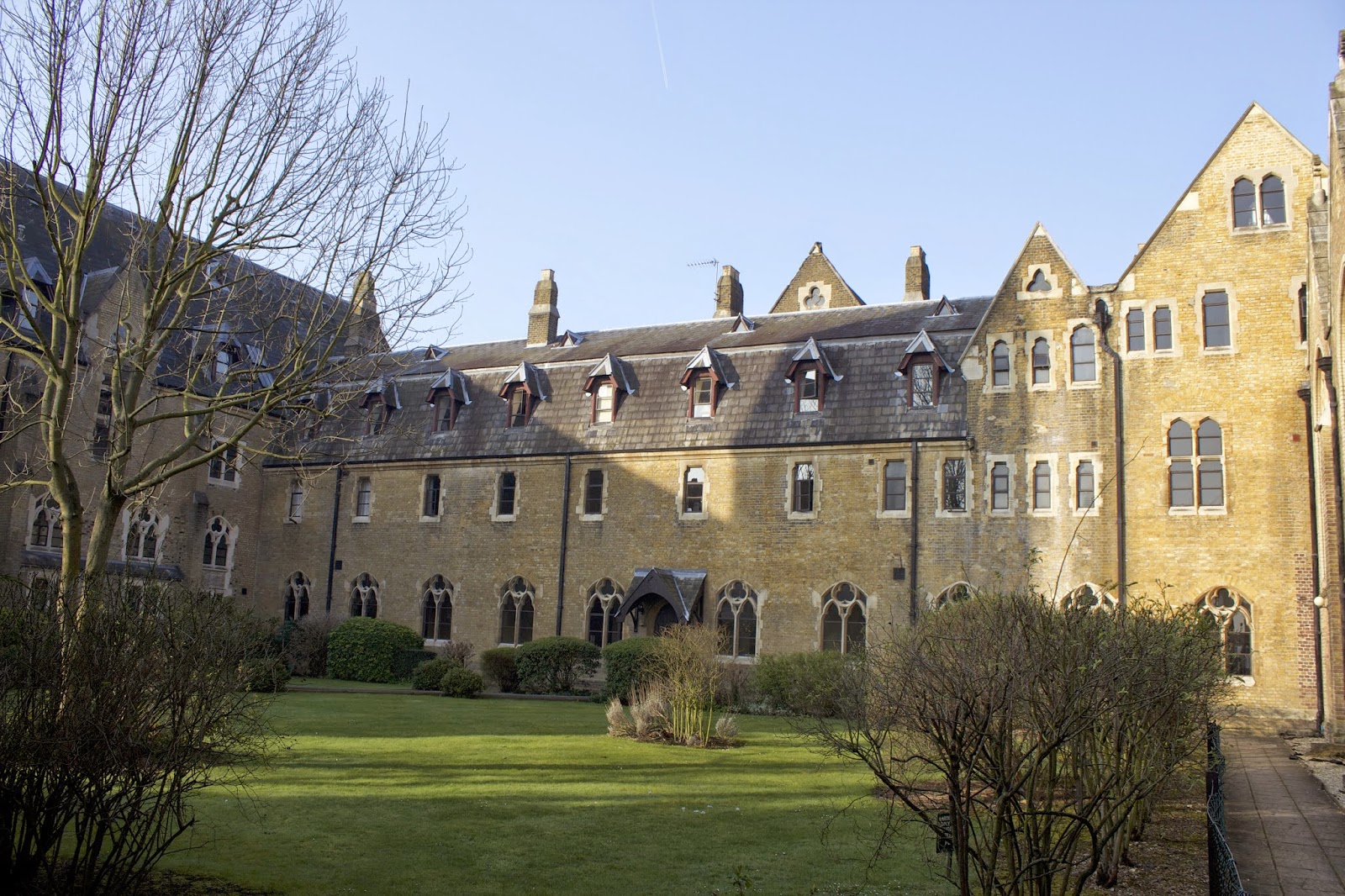
St Albert's Priory as viewed from George Square
The Edinburgh Priory was first founded about 1230-1, in the reign of King Alexander II. The Priory was subsequently destroyed in 1559, during the reformation. The Priory was re-founded in 1931, when the English Province of the Order of Preachers acquired No 24 George Square in Edinburgh, thanks to the generosity of founding benefactors, Canon John Gray, Marc-André Sebastien Raffalovich, and Mrs Charlotte M Tytus (a trio of donors who each led fascinating lives, the former two Catholic converts and the latter also the purchaser of the site of the current Oxford Priory for the Order).

So, after an absence of almost 400 years, the Dominican friars were back, and at the invitation of Archbishop Andrew Thomas Joseph McDonald OSB, they established a Catholic Chaplaincy for the students and staff of Edinburgh University. From the beginning, the Georgian town house at 24 George Square was thought to be ideal for a new chaplaincy centre because it boasted what was reputedly "the largest drawing room in Edinburgh", and this first-floor room, with an apse-like bay window, served as the chapel of the priory and chaplaincy until 2012.

Despite such a large drawing room, from an early stage it was, understandably, the hope that a purpose-built chapel might be built at some point. However, these plans were a long time in the realisation. For many years the best was made of a less-than-ideal situation. Indeed, prior to the Second Vatican Council, the furnishings of the chapel would not have looked out of place in a minor basilica. However, in the last decade the current set-up was starting to become untenable. The chapel had just become too small for the number of Mass-goers, and furthermore there was no disabled access.

The Chapel in the drawing room

It was thus with great joy that after a significant fundraising campaign, on 15 August 2012, precisely 781 years after the first Dominican priory opened in Edinburgh, the new chapel of St Albert the Great was dedicated by the Archbishop. Whilst it was a long wait it has been worth it, and the Priory’s garden is now home to one of the finest modern chapels in the country; a fact recognised by numerous architectural awards, but more importantly the number of people who wander in from the meadows to sit in the chapel and pray during the day, as well as the appreciation of the regular congregations.

The new Chapel in the garden with Nativity Scene
From 1981 to 1999 Edinburgh was also home to the Novitiate of the English Province and most of the current office holders in the Province completed their novitiates there, before it moved to Cambridge. A full list of all the friars who have formed the community in Edinburgh is available here: http://scotland.op.org/edinburgh/past_members.php

The Priory hosts four busy Masses on a Sunday in its role as the Parish of the University as well as two daily Masses during term term-time (one outside) and public celebration of Lauds and Vespers each day.

Preaching at the Student Mass

Running the university chaplaincies is the major apostolate of the house and it is currently thriving. As well as acting as a home from home for students, the Chaplaincy, most crucially, is a centre dedicated to forming people in the Faith for the world, today and tomorrow. The Student Mass on a Sunday evening is preceded by half an hour of Adoration of the Blessed Sacrament, and the new Chapel (built as large as planning permission would allow) is standing room only with around 140 students in attendance. The liturgy is beautifully celebrated and this is a greatly assisted by the excellent student-run choir. After this Mass there is well-attended social event in the Student’s Common Room located on the ground floor of the Priory. The Common Room has a well-stocked library for the students as well as a kitchen, and is much appreciated place for socialising throughout the week. 

Students prepare the midweek meal

One of the most impressive features of the Chaplaincy is the level of involvement beyond the Sunday obligation. On average there are around twenty students at Morning Prayer each day who then have their breakfast in the Common Room before heading off to lectures, the library, or back to bed. Lunchtime Mass is also well attended and a meat-free jacket potato lunch is held each Friday. As well as Mass and the Divine Office, there is also a student-cooked meal each Wednesday night and Bible study, or other catechesis, is a feature of many other nights of the week as well various other socials.

Some students and friars on Arthur's Seat

The students and the friars also have good links with the local convent of St Catherine. This convent run by the Mercy Sisters plays a key part in the provision of food for the homeless in Edinburgh, along with other services: http://www.mercycentre.org.uk

Other student activities include Cups of Compassion, another initiative with the homeless, as well as a recently founded Scout Group which is part of the Scouts of Europe – a Catholic movement. There is also a vibrant pro-life society open to members of all religions and none, but in which the Catholic students play an integral part: http://www.edinburghlifesociety.co.uk

Not only do the friars minister to the spiritual needs of the University of Edinburgh, Edinburgh Napier University and Queen Margaret University, but they have also have also provided a Rector to the University of Edinburgh and Fellows of the Faculty of Divinity. In addition the friars are also on-call chaplains for the local hospital.

Choir practice

The Priory also plays host to the recently founded Albertus Institute, which aims to contribute to the contemporary discussion between religion, the sciences and other intellectual disciplines. The Institute encourages public debate in this area by sharing the Christian, and in particular the Catholic, view in an open and welcoming way and by listening to other points of view in the same spirit. The Institute provides a platform for this debate through public lectures, seminars and conferences. As the work of the Institute develops, its website will provide access to various resources such as lecture materials, podcasts, discussion points and more. The next conference which it is hosting is on Faith and Cosmology: http://albertusinstitute.org

Like most of the other houses of the Province, the Priory also hosts the local Lay Dominican chapter: http://www.laydominicans.org.uk

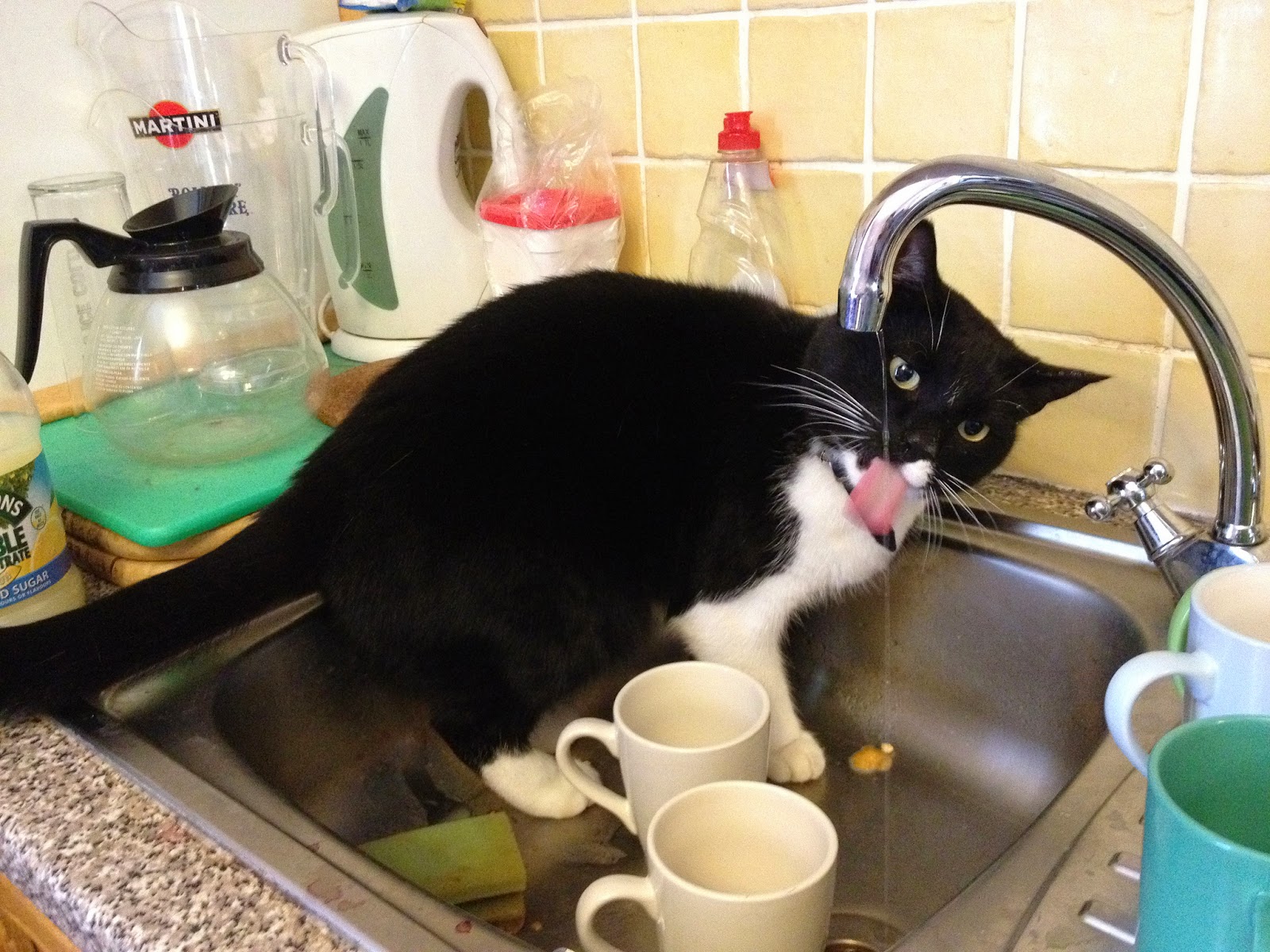
Last, but not least the Priory is home to two cats, one of whom can lay claim to being Edinburgh’s most famous cat. Unlike the friars, and despite permanently wearing his black and white habit, he is not particularly evangelical and keeps his Dominican name and identity secret. However, appropriately enough for a Dominican cat, he is often to be found in the University Library philosophising, where he goes by the name of Library Cat. Perhaps to the chagrin of those who provide a home and food to him, his facebook page has more followers than any other member of the Priory: https://www.facebook.com/pages/Library-Cat/1425194534381693?ref=br_tf

All that philosophy can be thirsty work


Wednesday, October 15, 2014

Dominican Priories: Oxford


“At the University of Oxford where I am presently staying, Our Lord has given [us] the promise of a great catch…” These words of the year 1230, written by Jordan of Saxony—St. Dominic’s first successor as Master of the Order—could just have well been written by his 84th Successor, fr Timothy Radcliffe, a member of today’s Dominican community in Oxford. By the time of Jordan’s visit, the brethren had been settled in Oxford for nine years and were already looking to build a larger house to replace the one they’d established on 15th August 1221. ‘Friar Fever’ had swept the city, with many new recruits signing up. John of St Giles was so overcome by fervour that in the middle of a sermon he was preaching on poverty, he was clothed in the habit. His biographer notes that he eschewed much more lucrative work to lecture in the Blackfriars Studium (plus ça change).


It was St. Dominic himself who sent the brothers to England, and who gave explicit instructions that they should settle in Oxford first. On 6th August, the day of Dominic’s death, the brothers had presented themselves to the Primate at Canterbury; by August 10th they were passing through the seat of royal power at London. It was with some haste, however, that they made their way to their final destination of Oxford, already the country’s intellectual capital. It was here that the then highly innovative Dominican way of life was established at the heart of the nascent University, preaching the Gospel of Our Lord to the opinion formers of their time. In time, three of the friars would become Chancellors of the University, including John Bromyard OP, who holds the unique distinction of having been both Chancellor of Oxford and a more modern University situated the other side of Milton Keynes (excuse the anachronism). The brethren’s work was, of course, not limited to a narrow intellectual and liturgical apostolate: by 1250, Dominicans had established a reputation as defenders of the marginalised (particularly the Jews); by 1246 Oxford was designated by the Order as an international study house, a studium generale that attracted brethren from across Europe. We were welcoming international students to Oxford long before anyone else.


Writing in 1662, Anthony Wood tells us that “there was not so much as one stone to give testimony to the world that so famous a place as the college of the Dominicans of Oxon was there once standing”. There remains nothing of our first priory, and no monument or plaque records where it stood; the remnants of the second are not worth writing home about, although the names of some roads hint towards its presence. But the pains and divisions of this sad interruption to our Dominican life in Oxford need not be dwelt upon here, save to pray that we learn the lessons of the past. The inscription above the gate to the third and current Blackfriars reads, “[h]aving returned after a long exile, the Friars Preachers, established this second new convent on 15th August 1921, the same date that the former was founded in the year of Our Lord 1221”. This return was made possible by the vision of then provincial Fr Bede Jarrett OP and the generosity of an American widow, Mrs Charlotte Jefferson Tytus. The innocuous gate on St Giles conceals a unique three-fold institution—Dominican Priory, Oxford University Hall, Studium Generale—and a community of prayer and study, dedicated to preaching at the heart of the University and in service of the townsfolk. As well as study, brothers are engaged in apostolates across the University and town; the twenty-seven current members of the Blackfriars of today are conscious of the past, grateful for the way of life that has been bequeathed to us by our elder brothers, and yet convinced that the faithful proclamation of the Gospel is as essential in the University of the future as it is throughout the world of today. “Not so much as one stone”?!

Tuesday, October 14, 2014

Dominican Priories: Durham

St Cuthbert's Catholic Church, Old Elvet, Durham

We begin our series on Dominican Priories with the newest and smallest house in the English Province: St Cuthbert's in Durham. Erected on 28 September 2012, with fr. Benjamin Earl OP as Vicar, this is a Filial House of the Newcastle Priory, meaning that the two houses form one single Dominican community. The brethren meet regularly in order to foster these bonds, even when their pastoral work keeps them busy in different places and apostolates.

Durham Cathedral seen from Old Elvet

St Cuthbert's, of course, is named after the great monk-saint whose shrine is found at the high altar of the magnificent Durham Cathedral. The relics of King St Oswald and Saint Bede the Venerable, the finest scholar of his generation and a Doctor of the Church, are also in the Cathedral. St Cuthbert's Catholic Church is located on Old Elvet, one of the more ancient parts of the city and a centre of Catholic activity even in the periods of state persecution, which led to several martyrdoms. By the 17th century, Jesuits were running a chapel in this area, and in the 19th century it was possible for the first Catholic church since the Reformation to be built here, replacing the two Elvet Chapels.

The Venerable Bede, in the Canon Brown window by Harry Clarke (1931)

Today, St Cuthbert's also houses the Durham University Catholic Chaplaincy. It is well situated near the University buildings, especially the Students' Union. The pastoral opportunities and the intellectual climate (Durham University is home to the Centre for Catholic Studies) make this a natural environment for Dominicans, as chaplains, teachers or students in theology.

Members of Durham University CathSoc with the Chaplain

The house has space for up to four brothers, having a more domestic feel than our large priories elsewhere. But this is enough to sustain an active religious life, including the daily singing of the Divine Office. There is daily Mass and Office, as well as regular Adoration and Confession, and a packed Student Mass at 6.30pm on Sundays for which there is a growing student choir.

Mass with the Bishop

The Chaplaincy has space for study and socialising, to which students can have access. The CathSoc organises a varied programme of events throughout term, including CathSoc Night on Wednesdays, billed as "the best night in in Durham!" A high proportion of Catholic students participate in some way or other in the life of the Chaplaincy, and there is no doubt that they and the parish benefit from their symbiotic link. St Cuthbert's in Durham may be our newest house but it must be one of the most dynamic.


Pope Francis photobombs the CathSoc selfie
You can find more information on the relevant websites:
Parish websites: http://www.stcuthberts-durham.org.uk
University Chaplaincy: http://www.durhamcatholic.org
Centre for Catholic Studies, Durham University: https://www.dur.ac.uk/theology.religion/ccs/
Diocese of Hexham and Newcastle: http://www.rcdhn.org.uk


Sunday, October 12, 2014

Academic Mass 2014


The start of the academic year was marked by a votive Mass of the Holy Spirit and Vespers celebrated by the Regent of Studies, Fr. Simon Gaine OP. We prayed for the Holy Spirit to fill us with wisdom and understanding; to sustain us in our desire for knowledge and love of God's truth, and of one another. The occasion was a wonderful opportunity to come together as a community of students and teachers in order to consecrate the work of the term ahead to God.

After Mass, Dinner was served in the refectory and the brethren were able to meet our new students, and catch up with older friends.


Friday, October 10, 2014

Dominican Priories: a new series on Godzdogz

The Priory of the Holy Spirit, Oxford

Where will you be sent after you're ordained?

As Dominican brothers studying for the priesthood in Oxford, we often get asked this question. The ultimate answer is: 'Anywhere in the world!'

When a man is clothed in the habit of St Dominic and becomes a Dominican friar, he immediately finds himself a member of a global Order, an international brotherhood. Indeed, as a member of the Dominican Family he also discovers he has many sisters and brothers in all its branches. As a friar preacher, his obedience is owed to the Master of the Order, presently fr Bruno Cadoré OP, who can assign him to any house or mission run by friars, anywhere in the world.

But the new Dominican also becomes a son of a particular Province. In our case, the student brothers at Godzdogz are generally sons of the English Province, but we also have among our number student brothers from other Provinces. A Province is composed of various communities, called priories and houses, and is an important level of governance for the strategic planning of our mission. The Prior Provincial is the 'ordinary' superior, who assigns brethren to a particular place according to both the needs of the mission and their particular capabilities.

The Master with the Godzdogz team last year

There is normally a process of discussion between each brother and the Provincial, to discern where that brother might be maximally useful. But, in the final analysis, religious obedience means we have to go where we are sent! And rightly so. We might think that we desperately want to be assigned to one place, only to find that a different assignment makes us flourish in ways we had not imagined. After experiencing this very situation, an older and wiser Dominican brother told me: 'God does not give us what we want; he gives us what we need!'

In practice, we are likely to be assigned within our own Province. That means, for the English Province today, there are several places where we might go: London, Cambridge, Leicester, Durham, Newcastle, Edinburgh, Glasgow, and the West Indies – not counting Oxford, where we might return on a future assignment.

In this new series, we would like to introduce you to these different priories and houses, offering a bit of historical context but focusing mainly on our present apostolates, with the challenges and opportunities they entail. At one level these are just our homes, where we happen to live; but the way we live together, and the things we do in and from these places, all contribute to our mission to preach the Gospel.

So, as our medieval brethren put it, the priory itself becomes a praedicatio, a preaching of the Gospel!

The Priory of St Albert the Great, Edinburgh

Monday, September 29, 2014

Simple Professions 2014

On the Feast of the Exaltation of the Holy Cross, Sunday 14 September 2014, we rejoiced at the Simple Professions of two of our brothers at the Priory of St Michael in Cambridge. fr Joseph Bailham and fr. Christopher Pierce made their vows – a commitment for three years – in the hands of the Prior Provincial, fr John Farrell, for the Province of England. frs Joseph and Christopher have now arrived at the Priory of the Holy Spirit, Oxford, where they will begin their formal studies in the Order. We therefore welcome them to the Godzdogz team this year!


We are also delighted to report the Simple Professions of two of our Dutch brothers, fr Richard Steenvoorde and fr Matthijs Meeuwsen, at the Dominicanenklooster, Zwolle, in the Netherlands, having completed their year-long novitiate in Cambridge. fr Matthijs will do pastoral work in the Netherlands and continue his studies there, while fr Richard has moved to Oxford for his studies and will join the Godzdogz team.

Please keep all the newly professed brothers in your prayers.


Also in Cambridge, two new novices have been clothed in the habit of our holy father Dominic, one for the Province of England and one for the Province of the Netherlands. Please keep them, including the formation communities of Cambridge and Oxford, in your prayers.

Deo gratias!


Friday, September 19, 2014

Solemn Professions 2014

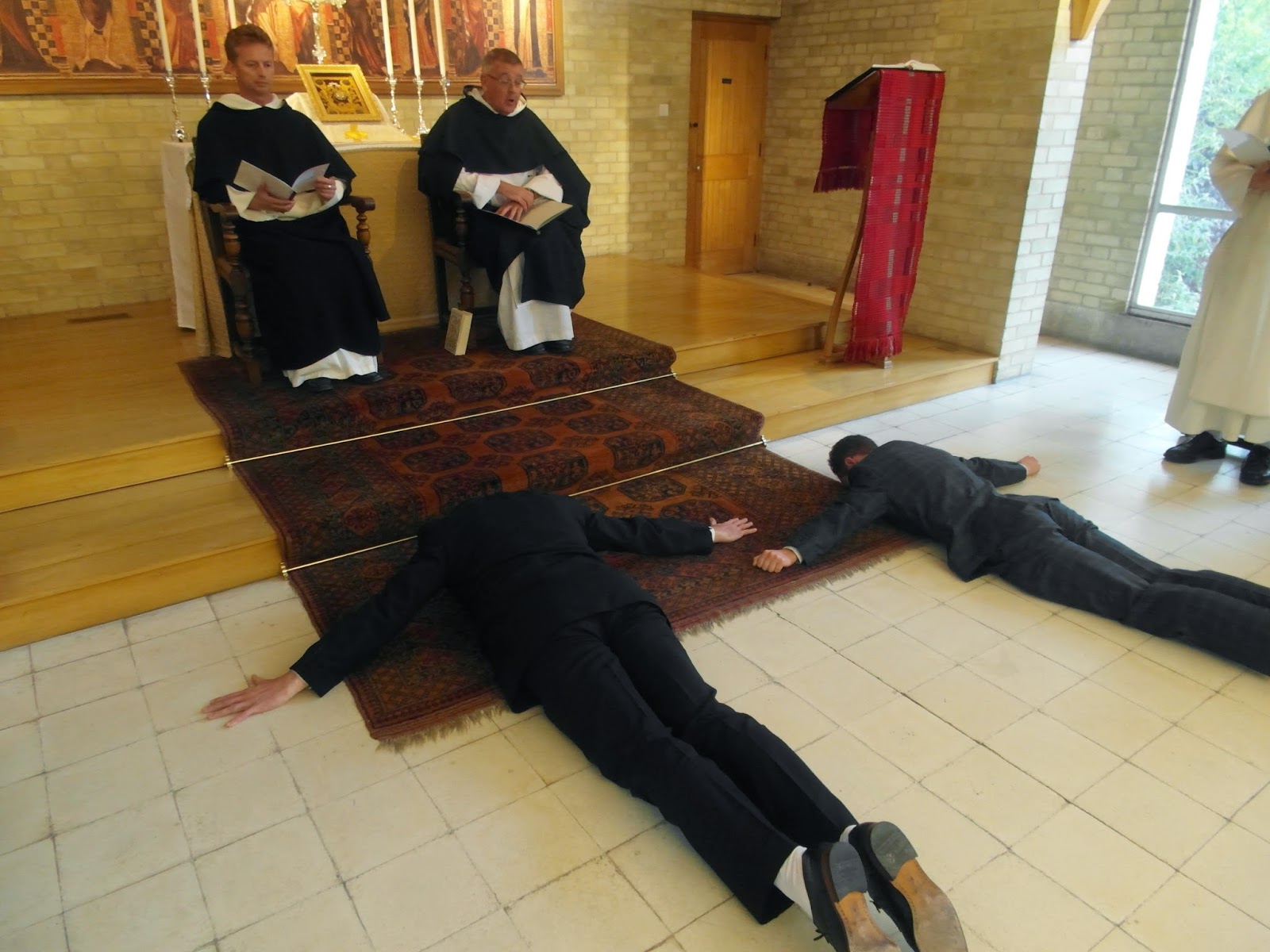
On 6 September 2014, fr. Oliver James Keenan and fr. Matthew Theophilus Jarvis made Solemn Profession in the Order of Preachers at the Priory of the Holy Spirit, Oxford. Many friars, sisters, and lay Dominicans, as well as the families and friends of the two brothers, came to celebrate with them. 


Solemn Profession is the final commitment of a brother to remain a Dominican for life – or, in the words of the profession formula, 'until death' (usque ad mortem). He promises obedience to God, to Blessed Mary, to Blessed Dominic, and to the Prior Provincial, who takes the place of the Master of the Order, and to his successors. Thus, Solemn Profession is about committing one's whole future to the Order, to serve the Church and the world through this band of Dominicans. 


As our brother Thomas Aquinas says, to take a vow is the only way to give our future, which must be lived successively through time, in the single moment of the present (see ST 2-2.186.6 ad 2). You could say that this is the greatest gift of oneself, the greatest use of our 'present'. Married couples, similarly, can attest to the importance of their vows as an act of total generosity towards each other.


Little wonder, then, that the Solemn Profession and the reception afterwards were very joyful! Some people travelled great distances to be in Oxford for the day, and many others also showed great kindness and generosity.


Please keep fr. Oliver and fr. Matthew in your prayers as they make this new beginning as fully committed Dominican friars in the service of God.

Deo Gratias!

Here are some more pictures of the celebrations: