Showing posts with label Dominicans. Show all posts

Friday, October 10, 2014

Dominican Priories: a new series on Godzdogz

The Priory of the Holy Spirit, Oxford

Where will you be sent after you're ordained?

As Dominican brothers studying for the priesthood in Oxford, we often get asked this question. The ultimate answer is: 'Anywhere in the world!'

When a man is clothed in the habit of St Dominic and becomes a Dominican friar, he immediately finds himself a member of a global Order, an international brotherhood. Indeed, as a member of the Dominican Family he also discovers he has many sisters and brothers in all its branches. As a friar preacher, his obedience is owed to the Master of the Order, presently fr Bruno Cadoré OP, who can assign him to any house or mission run by friars, anywhere in the world.

But the new Dominican also becomes a son of a particular Province. In our case, the student brothers at Godzdogz are generally sons of the English Province, but we also have among our number student brothers from other Provinces. A Province is composed of various communities, called priories and houses, and is an important level of governance for the strategic planning of our mission. The Prior Provincial is the 'ordinary' superior, who assigns brethren to a particular place according to both the needs of the mission and their particular capabilities.

The Master with the Godzdogz team last year

There is normally a process of discussion between each brother and the Provincial, to discern where that brother might be maximally useful. But, in the final analysis, religious obedience means we have to go where we are sent! And rightly so. We might think that we desperately want to be assigned to one place, only to find that a different assignment makes us flourish in ways we had not imagined. After experiencing this very situation, an older and wiser Dominican brother told me: 'God does not give us what we want; he gives us what we need!'

In practice, we are likely to be assigned within our own Province. That means, for the English Province today, there are several places where we might go: London, Cambridge, Leicester, Durham, Newcastle, Edinburgh, Glasgow, and the West Indies – not counting Oxford, where we might return on a future assignment.

In this new series, we would like to introduce you to these different priories and houses, offering a bit of historical context but focusing mainly on our present apostolates, with the challenges and opportunities they entail. At one level these are just our homes, where we happen to live; but the way we live together, and the things we do in and from these places, all contribute to our mission to preach the Gospel.

So, as our medieval brethren put it, the priory itself becomes a praedicatio, a preaching of the Gospel!

The Priory of St Albert the Great, Edinburgh

Friday, October 3, 2014

Sermon for the Funeral of Fr Bede Bailey OP

Sermon for the Funeral of Fr Bede Bailey OP, 19th August 2014 

by Fr Richard Conrad OP

Readings: Isaiah 25:6-9 and John 6:51-58

With the death of Fr Bede Bailey at the age of 97, we have lost an important link to a key part of our English Dominican history, for Bede was the last surviving Dominican to know, personally, Fr Bede Jarrett, who, as Provincial, brought us back to Oxford and Edinburgh. I presume David Bailey, as he then was, met Fr Bede Jarrett through growing up near Hawkesyard. His mother became a Catholic early on; his father, courageously, did so some years after her, and was instructed by Thomas Gilby. David Bailey was schooled at Ampleforth, but he decided to join the Order of Preachers. That was at the time Fr Bede Jarrett was ill, too ill in fact for David to visit him in hospital. Bede Jarrett died in 1934; David entered the novitiate a year later, and was delighted to “inherit” the earlier Fr Bede’s religious name. This went well with his veneration for what might be called “continuity of line”.


Priory Church of St Dominic, Newcastle, where Fr Bede was Prior in the 1950s

Bede studied at Hawkesyard and Oxford; he was pleased that his “ordination line” took him back to Archbishop Ullathorne and, through him, to the Vicars Apostolic – a precious part of English Catholic history.

Bede’s ordination was followed by a dizzying series of moves, eight in sixteen years. In each place he was assigned, he held several jobs at once. Often he was cantor, owing to his musical voice and, I guess, the feel for the chant he had picked up at Ampleforth. For some of the time he was in Edinburgh where, decades later, he taught the novices to sing, and used to encourage them to “soften their endings” – not always with success.

The job of guest-master was also often undertaken by Bede, going well with his sense of hospitality – and with his skill at being “conversible”. When I was in Edinburgh with him, I noticed that if he was away we didn’t always know what to talk about at supper, whereas when he was present there were no embarrassing silences.

Bede also had a pastoral streak: he was often assigned roles such as curate or air-force chaplain – and (in those early years and later) he was sometimes chaplain to the St. Vincent de Paul Society. He had a real concern for the poor: when he was Prior in Newcastle he was proud that the men’s club in the parish had good, and cheap, beer; and he was assiduous in visiting the poor.

During a short time in Oxford around 1948, Bede worked with Conrad Pepler for Blackfriars Publications, and, because of Conrad’s Ditchling connections, I’m sure this helped develop Bede’s interest in Eric Gill and David Jones. But his interest in the work of these craftsmen would also have struck a family chord, for Bede’s father had been managing director of Royal Doulton.

At that same period, Leonard Boyle was a student in Oxford, and remembered later how easy it was to tease Bede, who was rather solemn, and very English.

When I was Prior in Cambridge in the early 90s, Bede visited and complained, “When I was young I had to kow-tow to the old, and now I am old I have to kow-tow to the young.” But he glossed over the middle period of his life, when he made something of a career of being Prior himself in various places! – though I am not sure to what extent people did kow-tow to him, given that he always seemed to have to take on himself several jobs he should have been able to delegate.

This phase of Bede’s ministry began in 1956, when he became Prior of Newcastle; he held that post for six years. After two years as parish priest in Woodchester, he was Prior in Oxford for three years. Then after three years as university chaplain in Leicester he was Prior there for three years. He spent two years as chaplain to the Dominican nuns in Carisbrooke, then returned to Newcastle as curate and after two years was elected Prior there again.

It was in 1965, when he was Prior of Oxford, that Bede became Archivist of the Province. He was given two shoe-boxes of materials, and set himself to build up the archives. He was not trained as an archivist – he used to boast that he only had two letters after his name, O.P., and none of these pretentious doctorates – but several publications emerged from his time as Archivist, notably the entry on Gerald Vann in the great Dictionnaire de Spiritualité, and of course the letters and other papers of Bede Jarrett that he selected for publication in “Dominican Sources in English”. Bede had a profound interest in our heritage, and a passion for its preservation. His time as Archivist began traumatically: we had closed our novitiate house at Woodchester, and a certain brother sold off a great deal of the library, including some rare books that were very valuable for our history. Bede tried, without much success, to recover some of them, and years later was still trying to make good some of the gaps. He went to Rome once or twice around 1990 to obtain replacements for some items, and was received kindly, but was much distressed at the state of the library in our mother-house at Santa Sabina: “The library,” he wrote, “is in a most disgraceful state, and is used more by the [book]worms than by the brethren.”

After his final three years as Prior in Newcastle, Bede returned to Carisbrooke. I visited the nuns there a couple of times, and put up some extra shelves for the archives. There were two friars living there: Bede – and the brother who had dispersed the Woodchester library! I was amazed at how kind and solicitous Bede was to the older brother, despite what had happened. He could be critical, he could recognise mistakes and injustices; with a deft turn of phrase he could sum up people’s foibles (he sometimes referred to the Provincial Council as “that quango”) – but he was also aware of the need to forgive, and to put the past into the past. When he was around 75, he wrote about the importance of “denying oneself the right of disappointment even for five minutes or so,” and about how brooding can destroy one’s obedience to the brethren – and can even destroy oneself in some degree.

When Carisbrooke closed, Bede and the archives moved to Edinburgh. He filled a huge basement with material relevant to our history, to the context of our history, and illustrative of our influence.

Bede’s interest in our past went with an interest in people – a wide-ranging, and largely non-judgmental interest, an attitude which also made him a very kind confessor. All sorts of people came to visit Bede and the archives.

Of course Bede was upset by things like betrayal of confidence, and by the Order’s failures to appreciate and cherish its past and the people who were important to it, notably David Jones. He was (rightly) angered by stupidities and injustices in the Church. It was notable that along with his interest in the past, he was in many ways forward-looking. He was struck by the work of Conrad Pepler at Spode House, and how this prepared English Catholics for Vatican II. Bede was aware that many old rigidities and fussy rules would have to go – I guess he saw them as unnecessary, un-Dominican, un-English. His three years as Prior of Oxford, 1964-67, were rather traumatic, and I am not sure he ever referred back to them.

Bede was also interested in ecumenism, and when he was in Oxford set up some joint lectures with Pusey House. Later he invited Michael Ramsey to lecture in Newcastle. Bede was himself a visiting lecturer for a term at Lincoln Theological College.

In 1996, at the Diamond Jubilee celebration that Bede shared with Columba Ryan and Bernard Jarvis, Malcolm, then Provincial, spoke of the determination that had kept them faithful for 60 years, a determination born of love of the brethren, love of the project set for us by St. Dominic, and above all love of the Divine Word whom we have to preach. That determination kept Bede faithful during tough periods. But a few years earlier he had written, “I am quite convinced that I have been given more happiness by the Order ... than most people in life experience, and I am happy and hope to help in other people being happy… our province is blessed more than most in that. On the whole we don’t seem to bicker.” Then he added, “One has to prepare for old age just as one has to prepare all the time for dying, and dying happy.” That fits with a story Bede sometimes told of a renowned monk and teacher at Ampleforth, who was asked what he was concerned to impart to the young, and replied, “I prepare them for death.”

Almost exactly 10 years ago, Bede reported that his doctor had said he might live another ten years – “A prospect that does not fill me with enthusiasm.” But he was given all of 97 years. I feel that the last eight or so of them were years of waiting, in the spirit of our first Reading: “Lo, this is our God; we have waited for him, that he might save us.” So we pray that Bede will “be glad and rejoice in [God’s] salvation.”

A great deal of Bede’s ministry was of course sacramental, and he had a profound sense of the power of the Sacraments. He once remarked to me that if we had to choose between keeping Mass going without preaching, or keeping preaching going without Mass, the Mass would do more to build up the Church. It is that Eucharistic Sacrifice that we now offer for the repose of his soul, that Eucharist which, as we heard in the Gospel reading, is the pledge and cause of the final resurrection. Here, the Word who became flesh still lives among us, to impart grace and love. This grace and love must “take flesh” in the fabric of our lives and relationships, in our historical “locatedness”. Bede could see how grace and love “took flesh” in the lives of real people, not bypassing their characters and their connections, their strengths and their foibles. He could see how grace and love had to “take flesh” in the life of the Province, the Order and the Church – and often had to empower the forgiveness of mistakes, betrayal, injustice, enabling us to build for the future rather than brood on past hurts. We saw grace and love “take flesh” in Bede’s own life and ministry, not bypassing his own talents and foibles. So we pray that God “who began the good work in” him, may “bring it to completion in the Day of [our Lord] Jesus Christ” (Phil. 1:6).

Monday, September 29, 2014

Simple Professions 2014

On the Feast of the Exaltation of the Holy Cross, Sunday 14 September 2014, we rejoiced at the Simple Professions of two of our brothers at the Priory of St Michael in Cambridge. fr Joseph Bailham and fr. Christopher Pierce made their vows – a commitment for three years – in the hands of the Prior Provincial, fr John Farrell, for the Province of England. frs Joseph and Christopher have now arrived at the Priory of the Holy Spirit, Oxford, where they will begin their formal studies in the Order. We therefore welcome them to the Godzdogz team this year!


We are also delighted to report the Simple Professions of two of our Dutch brothers, fr Richard Steenvoorde and fr Matthijs Meeuwsen, at the Dominicanenklooster, Zwolle, in the Netherlands, having completed their year-long novitiate in Cambridge. fr Matthijs will do pastoral work in the Netherlands and continue his studies there, while fr Richard has moved to Oxford for his studies and will join the Godzdogz team.

Please keep all the newly professed brothers in your prayers.


Also in Cambridge, two new novices have been clothed in the habit of our holy father Dominic, one for the Province of England and one for the Province of the Netherlands. Please keep them, including the formation communities of Cambridge and Oxford, in your prayers.

Deo gratias!


Friday, September 19, 2014

Solemn Professions 2014

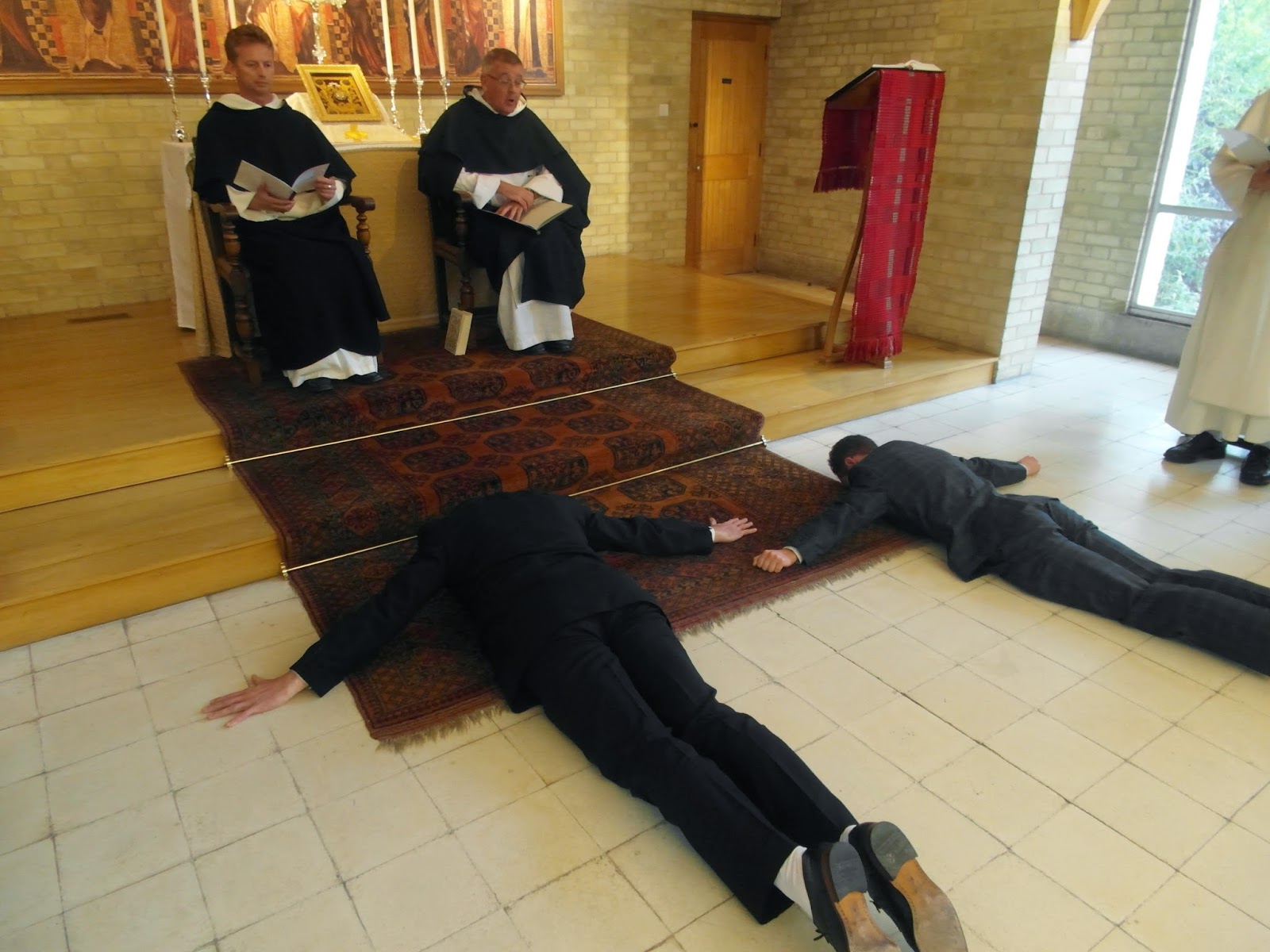
On 6 September 2014, fr. Oliver James Keenan and fr. Matthew Theophilus Jarvis made Solemn Profession in the Order of Preachers at the Priory of the Holy Spirit, Oxford. Many friars, sisters, and lay Dominicans, as well as the families and friends of the two brothers, came to celebrate with them. 


Solemn Profession is the final commitment of a brother to remain a Dominican for life – or, in the words of the profession formula, 'until death' (usque ad mortem). He promises obedience to God, to Blessed Mary, to Blessed Dominic, and to the Prior Provincial, who takes the place of the Master of the Order, and to his successors. Thus, Solemn Profession is about committing one's whole future to the Order, to serve the Church and the world through this band of Dominicans. 


As our brother Thomas Aquinas says, to take a vow is the only way to give our future, which must be lived successively through time, in the single moment of the present (see ST 2-2.186.6 ad 2). You could say that this is the greatest gift of oneself, the greatest use of our 'present'. Married couples, similarly, can attest to the importance of their vows as an act of total generosity towards each other.


Little wonder, then, that the Solemn Profession and the reception afterwards were very joyful! Some people travelled great distances to be in Oxford for the day, and many others also showed great kindness and generosity.


Please keep fr. Oliver and fr. Matthew in your prayers as they make this new beginning as fully committed Dominican friars in the service of God.

Deo Gratias!

Here are some more pictures of the celebrations:


Monday, August 25, 2014

The Dominican Way - Arundel to Canterbury


From 7 to 17th August, a group of more than 20 young pilgrims walked from Arundel to Canterbury, a distance of about 130 miles. This was The Dominican Way, the national event for the Dominican Youth Movement this summer, bringing together young Catholic adults from all over the country and even from overseas. In fact, we calculated that between us some 12 nationalities were represented!


The pilgrimage was inspired by the Routes Dominicaines run by the French brethren, but was adapted to the English context. Canterbury is in many ways the heart of English Christianity and was frequented by thousands of pilgrims a year following the shocking martyrdom of St Thomas Becket in the cathedral on 29th December 1170. At the the other end, Arundel is the the seat of the Dukes of Norfolk, the premier Catholic noble family in the land, and has an inspiring recusant history - the skyline is dominated by their castle as well as the magnificent cathedral dedicated to Our Lady and St Philip Howard, Earl of Arundel and martyr during the penal times. In between, we visited many religious communities, shrines and other places of great historical and religious interest.


But this pilgrimage was not just about discovering the glories of a historic Christendom. It was a living adventure, through which we young Catholics entered more deeply into our spiritual heritage and received blessings and inspiration for our mission as Christians in the 21st century. Along the way we encountered countless strangers and friends who shared our passion for the Faith, or simply offered us their kindness and hospitality. In particular, we were very grateful for the warm welcome we received at the places we stopped for the night, including cathedrals, religious communities, Catholic and Anglican parishes - and some individual parishioners even welcomed us into their own homes.


The pilgrimage aimed to realise the four pillars of Dominican life - community, prayer, study, preaching - while on the road. So, besides the obvious benefit (and challenge!) of walking some 20 miles a day, we were making friends and learning to live together; learning about the places we were visiting; being schooled in the lives of the saints; praying the Divine Office using our Dominican melodies; sharing short thoughts from our experiences; and preaching in diverse ways to people we met along the way - in the countryside, in churches, and even in pubs!


After successfully navigating several perils of the English countryside - including hornets, black sheep, and Brother Jordan singing - we arrived safe and sound in Canterbury. The joy of reaching our destination quickly outshone the memories of the difficult terrain we had traversed. This short pilgrimage gave us perhaps a foretaste of that greater destination we hope to reach at the end of our pilgrim lives on earth. But meanwhile, we look forward to the next DYM pilgrimage!


Here are some photos to give you a glimpse of what we did. You can find more through the Facebook page for The Dominican Way.


Saturday, August 16, 2014

Saint Hyacinth

St. Hyacinth
About the same time that Dominican brothers came to England founding their first priory in Oxford they also came to Poland. The first priory was established in Cracow by St. Hyacinth, who was the first Polish Dominican and whose feast day is celebrated on 17 August. Hyacinth was born about 1183 in Kamień Śląski near Opole (southern part of Poland) in a noble family. He studied in Paris and Bologna and after his return to Poland he became a priest and a canon of the cathedral of Wawel in Cracow. In 1220 he accompanied Iwo Odrowąż, who was bishop of Cracow, to Rome where they met St. Dominic. There in 1221 he received the religious habit from St. Dominic himself. After a short stay at Santa Sabina he came back to Poland. On his way Hyacinth established a Dominican priory in Friesach in Carinthia. In 1223 he settled at the Holy Trinity church in Cracow where he founded the first Dominican priory in Poland that since that time has been existing without interruption.


The statue of St. Hyacinth on Bernini's colonnade in Rome
St. Hyacinth was a tireless apostle and a great missionary. He established Dominican priories in many Polish dioceses as well as he went to Prussia, Ruthenia and Lithuania spreading the faith. Because of his zeal and evangelizing work a lot of people were converted and  many churches and priories were built. He came back to Cracow in 1243 and he died there on 15 August 1257. He was beatified by Pope Clement VII in 1527 and he was canonized by Pope Clement VIII in 1594. His tomb is in the Dominican church in Cracow.


The tomb of St. Hyacinth
There are many legends associated with St. Hyacinth. One of them explains why he is very often depicted with a monstrance containing the Blessed Sacrament and with a stone statue of Our Lady. This legend says that during a Tatars attack on Kiev Hyacinth wanted to prevent a sacrilegious attack, so he went to the chapel to take and save the Blessed Sacrament from the tabernacle. But at the same time he heard the voice of Mary asking him why he takes her Son, but he leaves her. Hyacinth was worried, because the statue was very heavy, it was made of alabaster, but Mary promised him to make it very light and so it was, so Hyacinth could carry it. For this reason he is usually shown holding a monstrance and a statue of Our Lady.

There is also an interesting fact that St. Hyacinth is the only Polish saint whose statue can be found among statues of other saints on Bernini's colonnade surrounding St. Peter's Square in Rome.


Ave, florum flos, Hyacinthe,
omni flore purior.
Ave, gemma pretiosa,
cunctis gemmis clarior.
Ave, protector omnium
ad te confugientium.
Ave, caelestis incola:
succurre prece sedula.
O Hyacinthe sanctissime,
o Confessor dulcissime.

Saturday, August 2, 2014

Friars' Walk: Coast-to-Coast Pilgrimage update

Many of you will be following the Friars' Walk blog which is charting the progress of our four brothers walking Coast-to-Coast across England, including two members of the Godzdogz team.

You can now click the icon to the right of this page to reach that blog, or follow the link below:

http://friarswalk.wordpress.com

Here's a quick illustrated digest of what they've achieved so far....


24/07/14 – Feast of the Cumbrian Martyrs

10.30pm

Our Four walking Friars, two from Cambridge and two from Oxford, met at Carlisle at 2.30pm to take the Cumbrian Coast Line to Corkickle, which takes in some spectacular views over the Irish Sea to the West and Lakeland foothills to the East.


A hearty welcome awaited us at St. Begh’s, Whitehaven... Fr. Joseph Parkinson OSB and Deacon Stephen Scott received us at the Presbytery before allocating us to parishioners who, showing famous Northern hospitality, took us into their homes. Thank you to Sue, Sandra & Ian, and Roy. Special thanks also to Deacon Stephen for all his efforts in putting these arrangements together.

We met again for Mass at 6pm at St. Begh’s where Fr. Richard Finn OP preached on the significance and meaning of parables. He referred to the parable-like Dominican charism and our mission both generally and on this walk. After Mass, parishioners showed great generosity of spirit, wishing us well on our trek, and generously contributed to our fundraising efforts.

DAY ONE: 25/07: Feast of St. James

St. Bees to Ennerdale

An auspicious day (St James is the patron saint of pilgrims) to start our Coast to Coast fundraising pilgrimage!

We pray for vocations, our fundraising efforts, and the intentions of our benefactors and friends. Today we also remember Iraqi Christians especially in our prayers.

DAY ONE: Arrived at Ennerdale Bridge

In the glorious Cumbrian sunshine, we reached today’s destination at Ennerdale Bridge! We were delighted to be joined by Mary Clarkson who was wonderful company!! We encourage others to join us if possible. Details here: https://mapsengine.google.com/map/edit?mid=zDj7ZFPT0-gc.kAbXsCg0_28Y

Please tell us via Twitter or Facebook if you would like us remember any intention in a decade of the rosary.

Our route today took us along the spectacular coastland from St. Bees to Whitehaven. ...

In the afternoon we scaled Dent Fell, looking out over a West Cumberland to the West and the daunting fells that awaited us to the East. The views were spectacular. A steep descent from Dent brought us finally to Ennerdale Bridge.

On arriving at Ennerdale, we were taken back to Cleator by our invaluable support crew consisting of John and Sue Collins from our Cambridge Priory and Br. Andrew Brookes OP

Vespers, a shower, Dinner and a drink rounded off a very successful first day. Thanks be to God!!

DAY TWO: 26/07: St. Joachim & St. Anne

Ennerdale Bridge to Rosthwaite

We contined to pray for the intentions of our benefactors and friends. The intentions entrusted to us, each of which is remembered at a decade of the Rosary, are often very grave. It was a comfort to us that we could pray for people who are facing all manner of difficulties; we hope it will be a comfort for them. ...

Over the next 1/2 mile, we climbed 340m, as we took the steps up Loft Beck. We met Australians Sue and Elaine near the top. They were in their 70s, and doing the Coast to Coast walk for third time! They were in a spot of bother because the steps seem to disappear and Elaine couldn’t work out where to place her feet in a particularly demanding scramble up the mountain stream. When we reached the summit, after some help and encouragement, they reported that they were now quite convinced of the existance of Guardian Angels!!

DAY THREE: 27/07: 17th Sunday of the Year

Rosthwaite to Patterdale, via Grasmere

...This promised to be one of the most demanding days of walking before us, a walk of over 17 miles over some long and step climbs.

The first major ascent is Lining Crag, a glacier smoothed fell of some 1778 ft. Upon reaching the top, we were greeted by a wonderful belvedere, a sort of hidden valley within a valley.

We then descended into Far Easdale before continuing to the outskirts of Grasmere at Goody Bridge. After a hard morning’s walking, the team felt it entirely necessary (!) to avail ourselves of the opportunity for tea in one of Grasmere’s many tea shops.

After a welcome breather, we began the formidable climb up beside two fells known as the Lion and the Lamb. Then we came up the Tip of Great Tongue, before traversing to Grisedale Tarn, a lake at the top of the mountain with views of the Old Man of Conniston.

There followed a long and invigorating descent leading to the valley of Patterdale, named after St. Patrick. William Wordsworth’s poem Brothers Parting is carved in stone in the valley: the evocative poem describes the parting of Wordsworth and his brother, John. ...


DAY FOUR & DAY FIVE

See here for some photos from the last couple of days.

DAY SIX: 30/07: OT.17.Wednesday


Kirkby Stephen to Keld

After a night of camping at Takoma Campsite, and a bacon muffin, we prayed Lauds with Maria, our host. Fellow campers awoke to the chanting of the Benedictus, which must have been something of a surprise!

... we met a British couple, Dave and Jacqui, and an American couple, John and Caroline. We spoke about our mission and the walk, speaking over the strong winds, which blew across the valley.

Both couples, like many other walkers we have met, were kind enough to make donations to our cause. Incidentally, anyone wishing to make donations can do so here, through Just Giving.

Our route continued across the boggy moorland, through the clouds. Once we emerged from the clouds, the views were impressive, if not somewhat bleak. As we came down from the higher ground, we stumbled across a wonderful farm at Ravenseat, which served that delightful English staple, “Cream Tea”. It would have been rude not to have availed oneself of the opportunity to sample such an idle pleasure.

We learnt that the remote farm was famous and had been the subject of television programmes and a book. During our short tea-time, we met some delightful friends including Denise Rowland a Catholic lady from Carlisle, with her friend Doris, and her granddaughter – also called Denise. One brother also made friends with Pippin, the farm hound.

When we arrived at the sleepy village of Keld, we discovered that our wonderful support team of John and Sue Collins had found Caroline (of the aforementioned American couple) injured by the roadside, and – playing the role of the Good Samaritan – conveyed her and her husband, John, to Keld by car.

Our support team then took us to St. Catherine’s Penrith where we spent the night.

DAY SEVEN: 31/07: Feast of St. Ignatius of Loyola

Keld to Reeth

Today’s walk was a relatively easy stroll along the riverside through the Swaledale Valley from Keld to Reeth, covering just over 10 miles. Since we have not scheduled any rest days in our 12 day trek, a lighter day was a pleasant contrast to some of the more intense earlier legs through the Lakes. The landscape of the Yorkshire Dales, though similar, is altogether more gentle.

Just before we set off from the small village of Keld, a young chap approached us for a photograph. He said he had heard about some walking friars at the youth hostel where he was staying with a friend. His friend, however, had decided to take a rest day and not walk this particularly stretch. “Let’s have a photo so I can show my friend”, said the young chap, “he’ll be so jealous that he’s missed you!” Word is getting round, it seems!

...The gentle rolling hills, trickling streams, and dry stone walls made for a most pleasant walk. On the Feast of St. Ignatius of Loyola, that great Saint, one was reminded of verses from the hand of the Jesuit poet, Gerald Manley Hopkins “Glory be to God for dappled things..”

DAY EIGHT: 01/08: Feast of St. Alphonsus Liguori

The day’s walk was much the same as yesterday in that we meandered through fields and countryside hamlets en route to Richmond. We stopped for Midday Office under the protection of a large tree as the rain came down around us.


Next, we continue to our overnight accommodation at Catterick Garrison.

Thursday, July 24, 2014

Could you sponsor the Friars to help train new priests?

Today, four Dominican Friars will take the first steps on a 190-mile trek across England. This is a final plea for sponsors – many men are currently joining our Order, and we urgently need to raise money to fill a gap we have in our funds for training them.

So far we have reached 76% of our sponsorship target - £15,196 out of £20,000. Could you help us get closer to our goal?

https://www.justgiving.com/teams/TheFriars

http://www.catholicherald.co.uk/news/2014/06/06/order-asks-for-1m-to-fund-rise-in-vocations/


Friday, June 27, 2014

Thank you for your generosity!

We're delighted to report that over £800 has already been donated online to support our Dominican preaching apostolates on the internet. THANK YOU to everyone who has donated so generously!

We now need less than £1200 to raise to reach our £5000 target for our dynamic new website. Please consider supporting us by clicking on the picture below.


Today is also the Solemnity of the Sacred Heart, and you can read about it in a post earlier this year by Br Samuel Burke in our Popular Piety series. Happy feast to all!

Altarpiece of the Dominican church of the Holy Rosary, near the Vatican, showing our Risen Lord with two Dominican saints, Pope Pius V and Bishop Antoninus.