Showing posts with label Dominican history. Show all posts

Thursday, October 30, 2014

Dominican Priories: Leicester. 'A history of Tom, Dick and Harry!'


Holy Cross Priory, Leicester. 


When looking upon our modern Priory of Holy Cross, Leicester, it is so easy to forget the rich and varied history that explains its existence today. I am going to attempt to 'dig up' then a little of the history of the Dominicans in Leicester, which along the way 'uncovers' everything you need to know about Tom, Dick and Harry!

The first Dominicans arrived in Leicester around 1247. They soon set up shop, so to speak, in St Clement's Parish Church, which had been given to them by the Augustinian Canons who controlled all of the parishes within the medieval town walls. St Clements was a poor parish that sat neatly between the two arms of the River Soar. It was under the benefaction of two patrons, that of Simon de Montfort, 6th Earl of Leicester and (get ready for it)... Harry, who liked to be referred to as King Henry III of England.

Manuscript showing the coronation of King Henry III ('Harry')

And so the Priory grew up around St Clement's Parish, which the first friars used as their conventual church. One of the earliest written accounts of this medieval foundation refers to the priory as 'The Blak Frears in the Ashes', not a reference to outcomes of inquisitorial justice, but rather because of the pleasant ash trees that could be found in its grounds.

At its medieval height the community numbered thirty-three strong and hosted a total of three provincial chapters, which shows further the wider importance of Leicester at this time. But alas, the growth of the medieval Priory came to a halt on the 10th November 1538, when the Priory was surrendered to the king's agents as part of the inevitable waves of dissolution. Those among our friars who did not apostatise fled to neighbouring Flanders.

The Dominicans finally returned to Leicester after the Reformation, the new friars coming from Bornhem, which was founded in 1657, in what was then the Spanish Netherlands. The founder went by the name of Phillip Thomas Howard, or Tom for short.


Phillip Thomas Cardinal Howard OP

Phillip Thomas Howard was born in 1629 into the family of the Dukes of Norfolk. In 1645 the young Phillip took the habit of our Order, much to the displeasure of the Earl himself. His purpose would be to restore the English Province, and it was for this reason that he managed to persuade the Master of the Order and the General Chapter to allow him to seek a patron, the Count of Bornhem, to make the first foundation of English Dominicans since the Reformation. He was made Cardinal in 1675 and died in Rome as Cardinal Protector of England and Scotland in 1694.


Bornhem was eventually abandoned as an English Catholic Boys school, a noviciate, and as a study house for the Order in 1794, due to the arrival of the French Revolutionary Army. The Brethren and the Dominican Nuns of Brussels fled to England to the current site of the modern Priory back in Leicester. It was Benedict Caestryck OP who founded the permanent mission of Holy Cross, Leicester, buying land there in 1817, and he began to build the church, which opened in 1819, and a presbytery in 1824. The Parish and the modern Priory took the name of Holy Cross, the dedication of the Priory and Church at Bornhem.

The interior of Holy Cross Priory Church. 

Holy Cross was finally established as a priory in 1882. During this period the friars opened Mass-centres right across the city. Subsequently, all of the Roman Catholic parishes in Leicester find their origin in being Dominican foundations. In 1929 the construction of the Priory Church you see today began under fr Vincent McNabb OP. The conventual church was finally completed and consecrated on 14 May 1958.

Today Holy Cross Priory is the largest parish in the city centre, and also serves a 14th-century chapel in Woodhouse, which has a lively congregation. The current Friars' mission includes two university chaplaincies, that of Leicester and De Montfort; the Catholic University Chaplaincy is thriving in an annex to the priory itself. The friars are also chaplains to the Leicester Royal Infirmary and a local prison; and a healthy relationship is maintained with Holy Cross Primary school, which used to reside on the Priory site.

But where in the name of Richard is Richard III? (aka Dick)

King Richard III
Alas, the finding of the remains of the last Plantagenet Monarch, King Richard III in the city of Leicester could not go unmentioned, in regard to the history that is still being written for our Priory in Leicester.

Richard's remains were found underneath a car park, which used to be the site of the old Greyfriars Church, in the city centre in September 2012. Plans for King Richard's remains to be reinterred in Leicester Cathedral are under way.

For Holy Cross Priory this means:

  • on Monday 23rd March, Vincent Cardinal Nichols will celebrate Mass for the repose of the soul (a ‘Requiem Mass’) of Richard III in Holy Cross Church. The Choir from St Barnabas’ Cathedral, the Cathedral of the Diocese of Nottingham, will sing at this Mass, which will be open to the public 
  • and On Tuesday 24th March the Dominican friars will sing Vespers, the Catholic Church’s evening service, in Leicester Cathedral; this is in addition to the daily celebration of Mass and the divine office in Holy Cross Church. 
  • and finally On Wednesday 25th March, Father David Rocks OP, the current parish priest and prior at Holy Cross Church, will preach at the lunchtime Eucharist in Leicester Cathedral. 

The excavation site where the remains were found.

So there we have it, a potted history of our Leicester Priory, including the likes of Tom, Dick and Harry!


A new window in the north transept of Holy Cross Priory, Leicester which shows the post-Reformation history of the Dominican Order in the city. In the top panel, Christ is surrounded by Dominicans past and present. On the left, a procession of Dominican led by St Dominic and on the right a young friar brings people to Christ. In the bottom panel, Fr Francis Xavier Chappell, OP disguised as a coster selling vegetables, during Penal times when it was illegal for Catholic priests to minister in this country. In his basket he hid his chalice and he initially said Mass in a factory. He served the Catholics of Leicester from 1785-1815. Next along, we see a Flemish Dominican, Benedict Caestryck, who moved to a small house in Wellington Street, where he said Mass. Under his inspiration, building began on the first Holy Cross Church in 1817. This was opened in 1819. Holy Cross was established as a priory in 1882. By 1929 the first Holy Cross church proved to be too small for the congregation. So, in the final bottom panel we see the famous preacher and author, Fr Vincent McNabb, OP who started to raise money for a larger church. Its foundation stone was laid in 1929. - Photograph and description by fr Lawrence Lew OP.


Monday, October 20, 2014

Dominican Priories: London


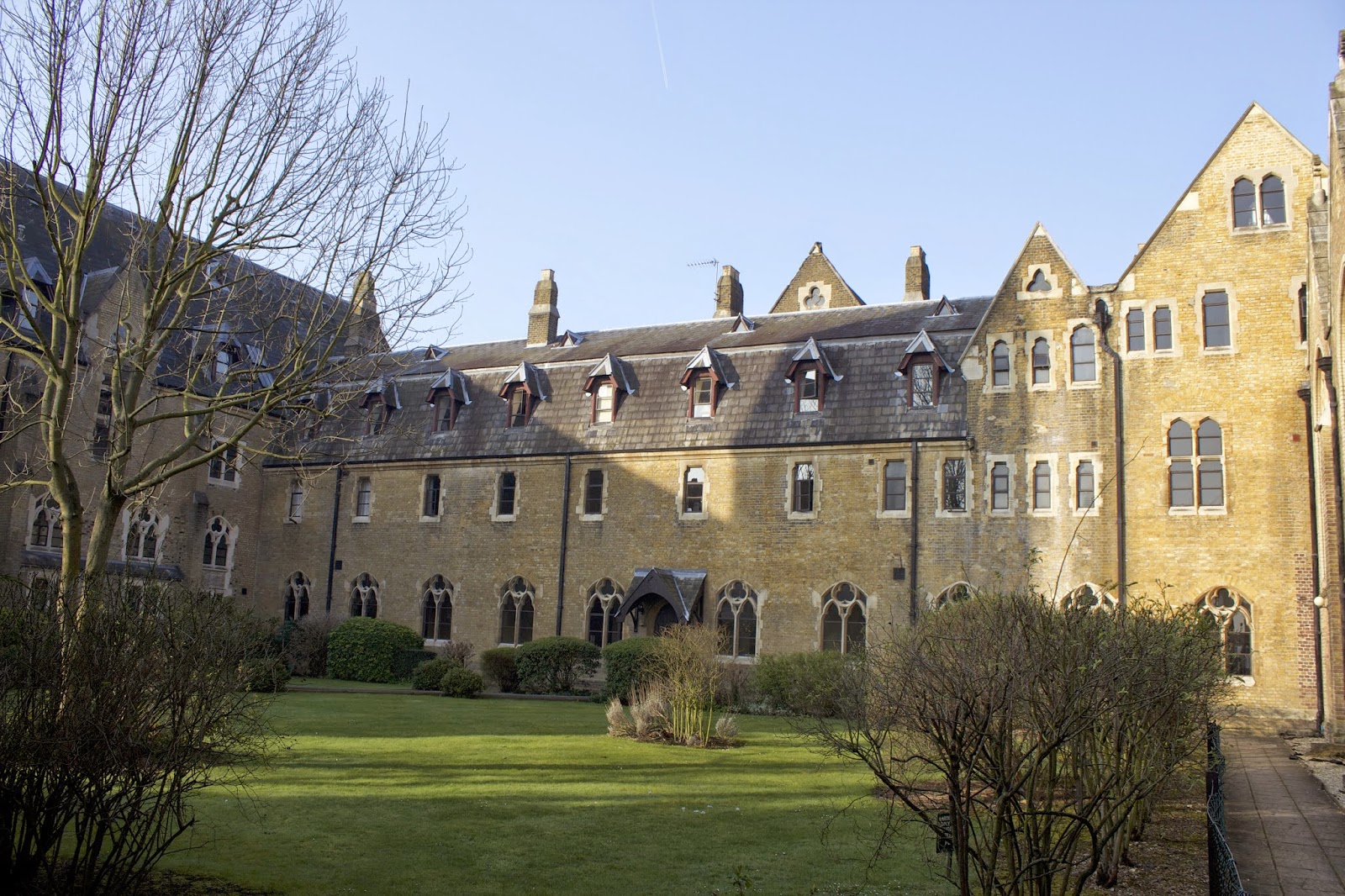
The Priory of Our Holy Father St. Dominic in Haverstock Hill, London, is the base of a vibrant and diverse preaching apostolate of the dozen or so Friars assigned there.
Attached to the priory is the Parish Church of Our Lady of the Rosary and St. Dominic, serving the local communities of Gospel Oak, Haverstock Hill, Chalk Farm and Belsize Park. The parish includes some of the most economically deprived areas in the country. The Church building is one of the largest in London. It runs 200 ft long, 80 ft wide and 100 ft high, and, as such, stands as a significant landmark for the surrounding area. 


Interior of St. Dominic's Church, looking down the nave
In 1862, the Dominicans purchased three acres of land in obedience to Cardinal Wiseman’s request that religious orders establish missionary foundations in London to serve the growing number of Irish migrants. The foundation stone of the church was laid the following August according to Gothic designs by Gilbert Blout. He died during construction in 1876 and the mantle was passed to a new architect, Charles Buckler. Buckler, a convert to the Catholic faith, had the advantage of having no fewer than three brothers who joined the Order and oversaw the remaining construction whilst making some significant alterations to the original plan. His revisions drew inspiration from Dominican churches in the Low Countries. After twenty years in the making, the vast church was consecrated in 1883 by which time his brother, Fr. Albert Buckler OP, was Prior. One of a number of impressive features of the Church is the side chapels around the perimeter, dedicated to the fifteen mysteries of the Rosary and paid for by local benefactors. Charles Buckler, the architect, paid for the Chapel of the Annunciation out of his own pocket - a token that demonstrates the fondness he clearly had for his great work.

Chapel of the Annunciation, St. Dominic's Church

Today, the parish is thriving. In addition to the provision of the sacraments, our ministry includes  pastoral work, and providing other opportunities for prayer and study. The parish also serves two primary schools, St. Dominic's and The Rosary School  The current Prior of the community, Fr. Timothy Calvert OP, also serves as Parish Priest - a task in which he is assisted by two of our former contributors, Fr. Gregory Pearson OP, and the newly ordained, Fr. Nicholas Crowe OP, amongst others. You may also recall that St. Dominic's hosted our Studentate Parish Mission, Pray 4, last year, which was a resounding success.

St. Dominic's Priory
Aside from Parish ministry, other brothers carry out their preaching mission in hospital chaplaincy at University College Hospital, and the nearby Royal Free Hospital; university chaplaincy at Imperial College (a position which our brother, Fr. Timothy Radcliffe OP, once held); school teaching and chaplaincy; and in studying towards postgraduate degrees. 

Our London priory has been the home of several notable Dominicans who have lived in our the Priory include Fr. Bede Jarrett OP, Fr. Vincent McNabb OP, Fr. [John Dominic] Alan Cheales OP, Archbishop Malcolm McMahon OP, and St. Dominic's is also the home of the present Prior Provincial, Fr. John Farrell OP.

On a more personal note, St. Dominic’s is one of the places where I came to know the Order. My housemates and I would rise early and get the number 46 bus from Grays Inn Road up to Southampton Road for the 7.30am Mass. I was always amazed at the edifying homilies given before sunrise. Apparently Friars at St. Dominic's eat Weetabix for breakfast! It was often on the bus back saying the Rosary that I prayed about my direction in my life. I will be forever indebted to the Church and community of St. Dominic’s for assisting me in the discernment of my vocation.


Friday, October 10, 2014

Dominican Priories: a new series on Godzdogz

The Priory of the Holy Spirit, Oxford

Where will you be sent after you're ordained?

As Dominican brothers studying for the priesthood in Oxford, we often get asked this question. The ultimate answer is: 'Anywhere in the world!'

When a man is clothed in the habit of St Dominic and becomes a Dominican friar, he immediately finds himself a member of a global Order, an international brotherhood. Indeed, as a member of the Dominican Family he also discovers he has many sisters and brothers in all its branches. As a friar preacher, his obedience is owed to the Master of the Order, presently fr Bruno Cadoré OP, who can assign him to any house or mission run by friars, anywhere in the world.

But the new Dominican also becomes a son of a particular Province. In our case, the student brothers at Godzdogz are generally sons of the English Province, but we also have among our number student brothers from other Provinces. A Province is composed of various communities, called priories and houses, and is an important level of governance for the strategic planning of our mission. The Prior Provincial is the 'ordinary' superior, who assigns brethren to a particular place according to both the needs of the mission and their particular capabilities.

The Master with the Godzdogz team last year

There is normally a process of discussion between each brother and the Provincial, to discern where that brother might be maximally useful. But, in the final analysis, religious obedience means we have to go where we are sent! And rightly so. We might think that we desperately want to be assigned to one place, only to find that a different assignment makes us flourish in ways we had not imagined. After experiencing this very situation, an older and wiser Dominican brother told me: 'God does not give us what we want; he gives us what we need!'

In practice, we are likely to be assigned within our own Province. That means, for the English Province today, there are several places where we might go: London, Cambridge, Leicester, Durham, Newcastle, Edinburgh, Glasgow, and the West Indies – not counting Oxford, where we might return on a future assignment.

In this new series, we would like to introduce you to these different priories and houses, offering a bit of historical context but focusing mainly on our present apostolates, with the challenges and opportunities they entail. At one level these are just our homes, where we happen to live; but the way we live together, and the things we do in and from these places, all contribute to our mission to preach the Gospel.

So, as our medieval brethren put it, the priory itself becomes a praedicatio, a preaching of the Gospel!

The Priory of St Albert the Great, Edinburgh

Tuesday, October 22, 2013

Was Frère Jacques a lazy Dominican?

Frère Jacques must surely be the most famous French song in the world. Even the English know it! In fact, it isn't just a French song now, as it has been translated and adapted into other languages all over the globe. The origins of this catchy round, however, are obscure. Several theories abound, but perhaps the most likely (if unimaginative) one is that the protagonist was simply a religious brother who didn't get up to ring the Matins bell, as the song describes. More specifically, was Frère Jacques a lazy Dominican?

And why might he be a Dominican? Quite simply, the Dominican friars in France have for centuries been known as 'Jacobins', after the first Dominican priory in Paris on the Rue Saint-Jacques, which led south towards Santiago de Compostela. The name was subsequently applied to other Dominican priories, including the Couvent des Jacobins in Toulouse where St Dominic established his first community of friars, and another Parisian priory, the Couvent de l'Anonciation in the Rue Saint-Honoré, where a revolutionary club met in 1789 and acquired the name 'Jacobin' – under which the notorious Reign of Terror was then perpetrated, especially against the Church. Today, the 22nd October, is in fact the anniversary of the dedication of that great priory in Toulouse, whose importance is to some extent indicated by the fact that St Thomas Aquinas OP is buried there.

http://www.bbc.co.uk/programmes/b01sj122
To investigate this theory about Brother James (or Jack, not John), BBC Radio 3 came to Blackfriars Oxford earlier this year. Here they interviewed Fr Richard Ounsworth OP (Editor of Godzdogz) about the ancien régime friars, and recorded both our morning Office and also three brothers singing the song as a canon.

In the programme, Fr Richard discusses the centrality of common prayer and the spirit of fraternity in our Order. He admits that Brother James could have been a lazy friar who didn't get up in the morning, and adds a playful dig at 'the younger brethren' today. Such brethren have no excuse, I suppose, since morning prayer in Oxford begins at 7.45am these days, not the 3am customary in earlier centuries!

Incidentally, Oxford is not the only English priory with a bell; Holy Cross, Leicester has a carillon including the great bell, named Malcolm, after Bishop Malcolm MacMahon OP of Nottingham Diocese.

The section on the Dominicans can be heard from 6'35" to 11'17" here:

Enjoy the programme!

Monday, January 28, 2013

Councils of Faith: Lateran IV (1215)

The Fourth Lateran Council (November 1215) represents a high-point in ecclesiastical governance in the Middle Ages. It is also of special interest to us here as it formed the backdrop to the establishment of the Order of Preachers in 1216. 

Commonly referred to in canon law as the 'General Council of Lateran', this great convocation was presided over by Pope Innocent III, who, some, argue was the most powerful pope in history. Innocent ensured that the papal privileges and ecclesiastical liberties claimed by the first three Lateran Councils were now consolidated and extended. The prestige of the pope, combined with a long period of convocation (April 1213 to November 1215), meant that Lateran IV was the best attended of all the medieval councils and could strongly claim to be 'ecumenical'. There were present: 71 patriarchs and metropolitans, including those of Constantinople and Jerusalem; 412 bishops; some 900 abbots and priors; delegates from the patriarchs of Antioch and Alexandria; and envoys from the Holy Roman Emperor and several other Christian states. Seventy decrees or canons were drawn up in advance and were easily approved.


Europe was changing fast in the early thirteenth century. The growth of towns was matched by a burgeoning mercantile class and the spread of literacy. Together with the proliferation of new religious orders through the 12th century, this gave the impetus to a new rationalisation of legal codes, especially the canon law Decretals compiled by Gratian. While official structures were waxing to meet these new challenges, a revival of popular piety was bringing many ordinary people back to a more internalised Christianity. This aimed at rediscovering the Scriptural roots of the faith, and was often expressed through a commitment to evangelical poverty. Lay movements, such as the beguines, flourished. But many turned to heretical doctrines and openly challenged Church authority. The Waldensians, for instance, repudiated the sacraments, oaths, the cult of the saints, and Purgatory.
It is unsurprising, then, to find concern for true Christian teaching and practice at the heart of Lateran IV's decrees. Canon 1 reiterated the the creeds, including an important reference to Transubstantiation, at a time when many Eucharistic miracles were being reported. Other canons insisted that relics had to be verified before acceptance, by documentary evidence and (if necessary) trial by fire or water. To neutralise the heretics' greatest critiques, clerical discipline was tightened: Lateran IV forbade the clergy dishonest pursuits, attendance at frivolous entertainments, games of chance, and visits to taverns. This last exclusion did not apply to 'necessary' visits, namely while travelling – which perhaps explains why the early Dominicans were keen to be itinerant preachers! The clergy were also banned from meting out or participating in death penalties; which is why the capital sentences of Inquisitions were always carried out by secular authorities, not the Church. However, ecclesiastics themselves were only to be tried by Church courts, even for criminal actions; and this remained the case right up to the French Revolution.

Sacramental practice was newly enjoined upon all the faithful, especially Communion at Easter and Confession to one's parish priest at least once a year. This merely confirmed existing legislation and custom, but Lateran IV had such clout and was so widely enacted that this particular canon (21) has historically been seen as a significant step. 

Canons 4-5 exhorted the Greek Orthodox to unite with Rome, and reiterated papal primacy, while Canon 1 dogmatically defined the Filioque. Interestingly, Rome now acknowledged Constantinople as the second see of Christendom, ahead of Alexandria, Antioch and Jerusalem. This is largely explained by the Fourth Crusade and its disastrous sack of Constantinople in 1204, which put the eastern capital under Latin rule. Under these unhappy circumstances, we should be wary of claiming too strong an ecumenical success for Lateran IV.

Finally, there are two canons of special significance for Dominicans. Canon 13 forbade the establishment of new religious orders with new rules, forcing St Dominic to adopt his familiar Rule of St Augustine as the foundation of Dominican life. But it is Canon 10 that stands out with its call for bishops to appoint preachers to support them in their ministry of the Word. Where bishops suffer from overwork, illness, external hostility, or ignorance(!), they are to

provide suitable men, powerful in work and word, to exercise with fruitful result the office of preaching; who...diligently visiting the people committed to them, may instruct them by word and example.

These men are to be the bishops' coadjutors and assistants, not only in the office of preaching but also in hearing confessions, imposing penances, and in other matters that pertain to the salvation of souls.


So, when the Dominican Order was established by Pope Honorius III just a year later, its Primitive Constitutions emphasised the fact that it was 'known from the beginning to have been instituted especially for preaching and the salvation of souls.' In 1215, the great days of the mendicant friars were just beginning, but here was a timeless call for new workers in the Lord's vineyard. Lateran IV set the tone for those first generations of Friars Preachers, and even now, centuries later, the call to continue the apostolic preaching can still be heard.

Sunday, January 13, 2013

Blackfriars, Canterbury

Canterbury is in some ways the religious heart of England. That was certainly the case when the first Dominican friars arrived on these shores in 1221, the year of St Dominic's death. Yet they did not stay to found their first priory in the city of Augustine, Anselm and Thomas à Becket. They preached before Archbishop Stephen Langton, then made haste to London, the political capital. Again they moved on and did not stop until they came to Oxford, the (then) intellectual capital. Right from the start, we Dominicans have always been attracted to university centres, where our commitment to study and preaching can bear great fruit.
Map of Blackfriars, Canterbury, by Thomas Langdon (1595)

It didn't take us long to return to Canterbury: the first Blackfriars was founded there in around 1236. As the waves of pilgrims to the shrine of St Thomas à Becket increased, in around 1315 the Dominicans built a Guesthouse on a little island in the river Stour, connected to the main priory complex by two wooden bridges (see map above). This building consisted of a main hall with an undercroft, which was later raised a little.

The 1315 Guesthouse, with a modern wing in red and the Marlowe Theatre behind

The Guesthouse passed through several hands after the Protestant Reformation, being used by several different denominations. The English Dominicans obtained the site in the early twentieth century, thanks especially to a certain 'Brother Cuthbert' (probably Fr Cuthbert Bretherton OP), Inside, a beautiful stone inscription by Fr Aelred Whitacre OP commemorates the fact that this building was built under Henry III, destroyed under Henry VIII, and restored under Edward VIII(!), i.e., in 1936. But before long the disrepair was parlous. In 1969, the Guesthouse was bought by Donald and Poppy Beerling, who have subsequently spent enormous amounts of money and energy restoring it.

Old interior of the Guesthouse

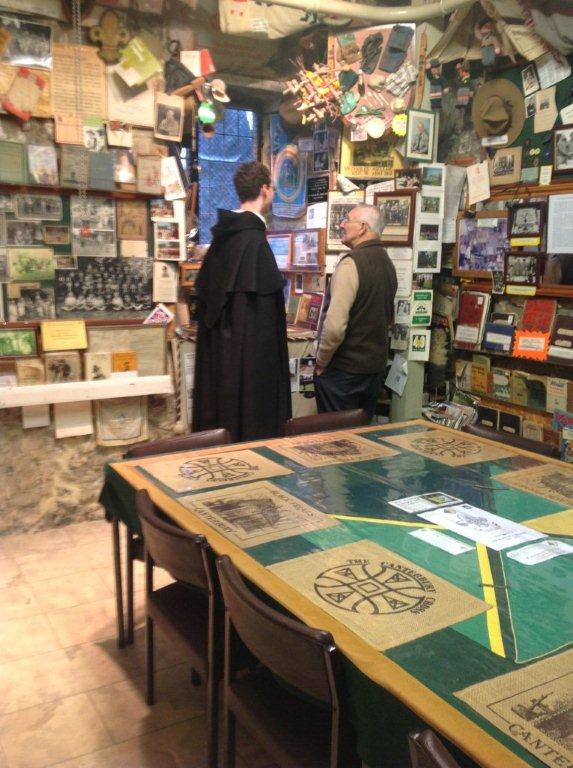
It was the Beerlings who warmly welcomed me, and some of my family, for a visit on 29 December, the feast of St Thomas of Canterbury. They showed me photos and letters from an impromptu visit by an Australian Dominican in 1981, and it seems I'm the first English Dominican to have visited the restored Guesthouse. The Beerlings have put up several displays with information about the medieval religious Orders, alongside many mementoes of the recent past, including the WW2 bombing of Canterbury. I particularly liked the excellent scale model of the medieval priory, which deservedly won a prize for the local schoolboy who made it.

Donald and Poppy Beerling welcome me to Blackfriars, Canterbury
The Cathedral is visible behind

As lifelong stalwarts of the Scouting world, Donald and Poppy also showed me their rich displays of Scouting memorabilia. (I was once a sixer in the 57th Episkopi pack of Cub Scouts.)

Scouting displays

These days the Guesthouse is used as a community hall, hosting small concerts and all manner of local groups on a regular basis. The main hall still boasts the glorious original timber roof, with only a few modern fixings. It would be very interesting to compare this building with the other remains of Blackfriars just over the river, including the medieval Refectory, which are now part of the King's School.

Locations of medieval Dominican priories

As an English Dominican of the 21st century, it is with mixed feelings that I look back on our historic priories. A great deal was lost at the English Reformation, and there are many ruins to remind us. But we should be grateful that some old priories, like Canterbury and Newcastle, are still being used and well looked after today. Meanwhile, the mission of the English Dominicans continues to flourish in other places and in other ways. The last two centuries saw our return to many of our old preaching grounds: London, Newcastle, Leicester, Oxford, Edinburgh, Cambridge, and Glasgow. In modern times the Province has been busy building up new Catholic communities, reaching new audiences, and preaching through new media, as the religious complexion of this country continues to change.

There is no need to be sentimental about the past; neither should our vision of preaching the Gospel today be narrowed by old attachments. Rather, we can joyfully embrace the opportunities and challenges of the Gospel in our contemporary society, while remaining rooted in the fertile traditions we have received down the ages. The ongoing presence of our medieval buildings is a wonderful reminder of that inheritance. May it spur us to be always like 'the owner of house who brings out of his storeroom new treasures as well as old' (Mt. 13:52).


Sunday, May 8, 2011

'Great houses make not men holy'

See here for an interesting account of the pre-Reformation foundations of Dominicans and Franciscans at Oxford.