Showing posts with label saints. Show all posts

Sunday, November 2, 2014

All Saints - Exsultate Justi!

In England and Wales, the feast of All Saints is being celebrated today (and All Souls tomorrow). With the music of our prayers let us lift our hearts to God, as we praise him with all the saints in heaven.

The following piece, Exsultate justi, is a setting by Ludovico da Viadana (1564-1645) of Psalm 32:1-2:

Exsultate justi in Domino: rectos decet collaudatio. 
Confitemini Domino in cithara. In psalterio decem chordarum psallite illi. 
 Cantate ei canticum novum: bene psallite ei in vociferacione.

Let the just rejoice in the Lord: it is fitting for the upright to praise him.
Sing to him to the psaltery and the ten-stringed lute.
Make him a new song: sing to him well with strong voice.


Sung by the Cantoria Sine Nomine di Castelnuovo (Italy), directed by Carlo Andriollo

Saturday, August 16, 2014

Saint Hyacinth

St. Hyacinth
About the same time that Dominican brothers came to England founding their first priory in Oxford they also came to Poland. The first priory was established in Cracow by St. Hyacinth, who was the first Polish Dominican and whose feast day is celebrated on 17 August. Hyacinth was born about 1183 in Kamień Śląski near Opole (southern part of Poland) in a noble family. He studied in Paris and Bologna and after his return to Poland he became a priest and a canon of the cathedral of Wawel in Cracow. In 1220 he accompanied Iwo Odrowąż, who was bishop of Cracow, to Rome where they met St. Dominic. There in 1221 he received the religious habit from St. Dominic himself. After a short stay at Santa Sabina he came back to Poland. On his way Hyacinth established a Dominican priory in Friesach in Carinthia. In 1223 he settled at the Holy Trinity church in Cracow where he founded the first Dominican priory in Poland that since that time has been existing without interruption.


The statue of St. Hyacinth on Bernini's colonnade in Rome
St. Hyacinth was a tireless apostle and a great missionary. He established Dominican priories in many Polish dioceses as well as he went to Prussia, Ruthenia and Lithuania spreading the faith. Because of his zeal and evangelizing work a lot of people were converted and  many churches and priories were built. He came back to Cracow in 1243 and he died there on 15 August 1257. He was beatified by Pope Clement VII in 1527 and he was canonized by Pope Clement VIII in 1594. His tomb is in the Dominican church in Cracow.


The tomb of St. Hyacinth
There are many legends associated with St. Hyacinth. One of them explains why he is very often depicted with a monstrance containing the Blessed Sacrament and with a stone statue of Our Lady. This legend says that during a Tatars attack on Kiev Hyacinth wanted to prevent a sacrilegious attack, so he went to the chapel to take and save the Blessed Sacrament from the tabernacle. But at the same time he heard the voice of Mary asking him why he takes her Son, but he leaves her. Hyacinth was worried, because the statue was very heavy, it was made of alabaster, but Mary promised him to make it very light and so it was, so Hyacinth could carry it. For this reason he is usually shown holding a monstrance and a statue of Our Lady.

There is also an interesting fact that St. Hyacinth is the only Polish saint whose statue can be found among statues of other saints on Bernini's colonnade surrounding St. Peter's Square in Rome.


Ave, florum flos, Hyacinthe,
omni flore purior.
Ave, gemma pretiosa,
cunctis gemmis clarior.
Ave, protector omnium
ad te confugientium.
Ave, caelestis incola:
succurre prece sedula.
O Hyacinthe sanctissime,
o Confessor dulcissime.

Monday, May 26, 2014

St Augustine of Canterbury - 27 May

Growing up in Kent, in a Christian family, the story of how St Augustine brought Christianity back to England seems to have been genetically implanted in me. Today, I am happy that we celebrate the feast of St Augustine, the Apostle to the English, who died around this date in 604. But we should be neither nostalgic nor purely academic when we remember this great saint. Instead, I believe St Augustine provides us with a powerful example of Christian witness in difficult circumstances. Just as he brought Christianity from Rome to the pagan Anglo-Saxons, who had displaced Roman British Christianity, English Catholics today have the task of re-evangelising our drifting post-Christian culture in the early 21st century.

Saints Gregory and Augustine
And what exactly is Augustine's story, and how is it relevant to us? Although we call him Augustine of Canterbury, he was originally a Roman monk. His early life is obscure and he first comes to notice as a member of the Benedictine community established by St Gregory the Great on his own family estate on the Cælian hill. It is Gregory who takes the principal role in establishing the English mission. He seems to be personally concerned that, despite its remoteness, Britannia has been part of the Roman Empire and therefore deserves to be restored to the Catholic faith. He knows little, it seems, of the British church still surviving on the Celtic margins. But these Christians lack vital connections with the Apostolic See, celebrate Easter on a different day, and have made no effort to evangelise the Anglo-Saxons. As a result, the potential converts among the pagans will have to be won by a direct mission from Rome.

Augustine is Prior of his community and has shown himself an able superior. So, in 596, Gregory chooses him to lead a band of monks to bring the Gospel north. They are to convert the king of Kent, Ethelbert, whose wife Bertha is of Frankish origin and already a Christian; to preach for the conversion of the Kentish people; and to establish monasteries and schools. At this point, we see another side of Augustine's character. Not long after leaving Rome, he and his brethren begin to get cold feet and want to go home. 'For they were appalled at the idea of going to a barbarous, fierce and pagan nation, of whose very language they were ignorant', we are told by St Bede (HEGA 1.23). But Pope Gregory sends Augustine back on his way, urging him that 'it had been better not to undertake any high enterprise than to abandon it once begun' (Ep. VI, 50a). Augustine obeys.

Augustine preaching to Ethelbert
Their target, King Ethelbert, is a formidable man. As Bretwalda (overlord) over several Anglo-Saxon kings, his authority stretches as far north as the Humber, and he will reign in Kent for 56 years. No doubt, his wife exercises a certain influence over him which ensures a decent welcome to the missionaries. But Ethelbert is a god-fearing pagan and, superstitiously believing that Augustine might try magic on him, insists on meeting the monk in the open air. Such fears are disarmed by Augustine's prayerful and peaceable manner. The king remains cautious and does not immediately convert. But that meeting on the isle of Thanet results in his offering the missionaries provisions and property to establish themselves in his capital, Canterbury, and the freedom to preach to the people. Soon, the people are coming in droves to be baptised, inspired by the apostolic example of the fledgling Christian community. As Bede reports, the missionaries 'regarded worldly things as of little importance and accepted only the necessities of life from those whom they taught. They practised what they preached, and were willing to endure any hardship, and even to die for the truth which they proclaimed.' (HEGA 1.26) Compare this with the cowardly band that left Rome just a few months previously, and you begin to see the extraordinary grace of God at work in these men.

It reminds me of the early Dominican brethren who, six centuries later, would meet with similar success across Europe. The simplicity of their lives and their gospel zeal – these two attitudes can be seen in the pattern set by Augustine for the early English church, and both are relevant to us today. Of course, Augustine was not perfect. Some historical discussion, for instance, revolves around his meeting with the bishops of the old British church, in which he offended them by remaining seated, whereas they had been looking for a sign of his humility. His attitude was appropriate, perhaps, given his apostolic authority from Rome, but it was a regrettable diplomatic faux pas. Such initial tensions would then be sustained by wider political circumstances.

After his death, Augustine was quickly recognised as a saint and his cult developed at the shrine in his abbey in Canterbury. Sadly, that was destroyed in the Protestant Reformation, but happily a new national shrine of St Augustine has been established as recently as 2012, in a beautiful church by Pugin, not far from the spot where Augustine first landed.

Sancte Augustine, ora pro nobis.

-----
Historical Note


The Angles in Rome: the blonde hair hypothesis
(opus sectile in Westminster Cathedral)
Of course, I've left out the most famous episode in the Gregorian mission. Before becoming pope, Gregory saw some boys or youths of fair complexion being sold in the market. Hearing they were 'Angles', he is famously said to have replied, Non Angli, sed angeli. Not Angles, but angels! In fact, the accounts in Bede and in the Whitby Life of Gregory the Great record a whole series of witticisms. The line about angels was originally longer: 'they have angelic faces, and it is right that they should become joint-heirs with the angels in heaven'. (HEGA 2.1) Then, since their king was called Aelli, so 'Alleluia, God's praise must be heard there.' Finally, on being told that their tribe was called Deira, Gregory quipped, 'They shall flee from the wrath of God (de ira dei) to the faith.' (Whitby Life, ch. 9)

And, for bonus points, there is a little detail that often gets misreported. The boys or youths were not 'fair-haired', as many modern accounts say. The text in Bede certainly says they had fair skin (pueros...candidi corporis) but their hair he describes as 'remarkable heads of hair' or 'beautiful hair'. The Latin says capillorum...forma egregia – what we might call 'an impressive shock of hair'! Nothing there about being blonde.

Monday, April 28, 2014

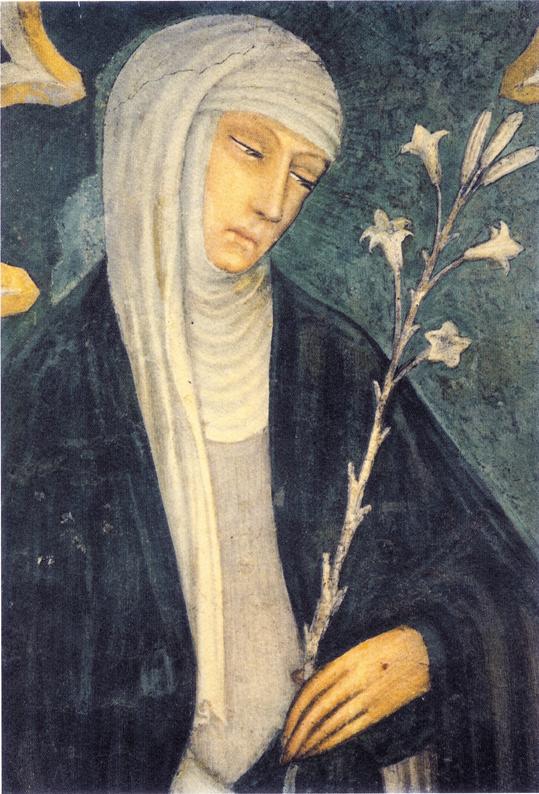
Catherine of Siena

"Be who God meant you to be and you will set the world on fire." So was today's Dominican Saint, Catherine of Siena, quoted by the Anglican Bishop of London at a recent wedding. That the words of an illiterate Italian mystic of the fourteenth century, recorded by amanuenses, should be quoted at the wedding of the future King and Queen of an apparently post-Christian country is remarkable. Still more remarkable, however, is the influence that Catherine had in her own lifetime. Befriending popes and politicians through correspondence from the seclusion of her austere cell and through her adventurous travels, Catherine decisively engaged the political landscape of her day, playing an important role in resolving the Avignon schism. Catherine, then, had surely taken her own advice and discovered the gift and mystery of herself: daring to be a Daniel, speaking the truth to the powerful and mighty on behalf of the poor and marginalised, she was as concerned by the rights of political prisoners as she was by the unity of Christendom, and all this before her early death aged thirty-three.  

Without any lack of admiration for this great mystic and theologian of our Order, however, I must confess that I find Catherine's heavily stylised writings very difficult to digest. Some of the images she deploys, particularly to narrate her mystical marriage to Jesus, are, perhaps, not immediately engaging to today's reader of Anglo-Saxon temperament. Nonetheless, there can be no denying that Catherine's admonition to us to 'become who we are' resonates deeply with the spiritual longings of modernity, which seem to be governed by the un-ending quest for self-realisation and self-determination. Some might even see in Catherine a medieval anticipation of Dr. Seuss: "Be who you are and say what you feel, because those who mind don't matter and those who matter don't mind." 
Yet, for Catherine, self-realisation is emphatically not a matter of self-determination. If there is a single theme that unites her life and writings, it is that of discernment, the capacity to hear God's call in the individual particularity of daily life. Catherine's teaching on discernment is indebted to the thought of her brother, St Thomas Aquinas (mediated by her spiritual director, Raymond of Capua OP), and yet develops in a way that anticipates the later writings of St. Ignatius of Loyola, founder of the Society of Jesus. In an era when the spiritual vocabulary of many of her contemporaries had shifted to speak primarily in terms of the moral virtue of prudence, Catherine prefers the more old-fashioned category of discrezione, usually translated as 'discernment'. Whilst the English 'discernment' suggests some sort of introspective search for hidden signals from the divine, Catherine's discrezione (perhaps more adequately rendered as 'discretion') is a much more expansive and thoroughly bodily reality: morality and mysticism, thought and action, coinhere in obedience to truth. For Catherine, true discretion, as the pathway to self-realisation, is primarily a matter of obedience to God: we do not realise our own potential by inward discovery, but through reception of the gift and obligation of ourselves in being personally claimed by God. 
It was not, then, for simply historical reasons that Pope St. John Paul II named Catherine as a patroness of Europe in 1999. The crisis of European Christianity—perhaps even graver today than the crisis that faced the Church in Catherine's day—demands the type of spiritual reform and radical obedience that characterised Catherine's life and ministry. If Christianity is to be something other than an antiquarian curiosity, or one amongst a smorgasbord of options on the salad bar of postmodern spirituality, then we too—collectively and as individuals—must experience the gift of self-realisation through obedience to Christ. This liberating experience of obedience will be, as St John Paul II put it, "the new experience, the powerful experience, that will generate, through [us], a more just society and a better world."

Saturday, December 21, 2013

Fourth Sunday of Advent: St. Joseph

Readings: Isaiah 7:10-14; Psalm 23:1-6; Romans 1:1-7; Matthew 1:18-24


On the fourth Sunday of Advent, we read St. Matthew’s Gospel in which the role of St. Joseph is brought into focus. In order to understand the situation in which Joseph found himself, a little background is needed. He was betrothed (in Hebrew, ‘qiddushin’ meaning consecrations) to Mary, Our Lady. In Jewish culture at that time, this had a greater significance than the modern day equivalent of an engagement because it carried with it the legal and moral effects of marriage itself. During this time of betrothal the bride-to-be lived with her parents - in Mary’s case with Saints Joachim and Anne. It was only at the celebration of the wedding that the wife would be led in procession to her husband’s house after which time they “came together” [RSV Mt 1:18].

We are not told in Matthew’s Gospel or any other for that matter, how Joseph discovered Mary was “with child”. Perhaps Mary told him and tried to explain; perhaps it was through an intermediary; perhaps he realised it by himself? Regardless, the situation no doubt appeared bleak initially. There were - seemingly - two possibilities to explain Mary’s pregnancy: either Joseph had lacked the self-control to remain chaste before the wedding, or Mary had been unfaithful. The former would have been a cause of shame and reproach on both Mary and Joseph; the latter was more serious still for the penalty for a “betrothed virgin” lying with another man was death by stoning [Deut 22:23-24].  The stakes were very high indeed.

How does Joseph navigate this crisis? As a “just man”, he decides he will end the relationship discreetly by divorcing Mary. He did not seek the retribution for which the law provided - being “unwilling to put her to shame” - but, in the midst of this dramatic scene, he displayed a kindly disposition. St. Thomas Aquinas and others have interpreted this disposition as a sign that he realised that somehow God was behind all of this - perhaps there was a third possibility after all?

Even so, “Why me?” “Why would it have to be my wife who became pregnant, and leave me in this quandry?” I suspect Joseph uttered such words or words to a similar effect. The answer, of course - as Joseph discovered by the message of angel in a dream - is that it was God’s plan. It was God’s plan that Joseph, the “son of David”, the heir to the Davidic promise, would be the Father of Jesus. It was God’s plan that Mary who had already been conceived without original sin would be His Mother. It was God’s plan that His son would be named “Jesus” (Jeshua) meaning “the Lord saves”. It was God’s plan that He would save His people from their sins. And all this was the fulfillment of Isaiah’s oracle, God’s plan foretold.

As if Joseph wasn’t bewildered enough by Mary’s pregnancy, he now learns that the Father of Mary’s child is God Himself, and that he, Joseph, is to be guardian. The human mind boggles at such an awesome message, a breathtaking responsibility. Certainly, it was not for nothing that the angel said to him, “do not fear”.

Joseph’s example is a remarkable one. He was, in every sense but biological, the Father of Our Lord Jesus Christ, and husband of Our Lady. In the remaining days of Advent, in our contemplation of how our Saviour came to be born, all of us might reflect on Joseph’s witness and role in the history of salvation. Pope Benedict XVI encouraged this devotion: "meditation on the human and spiritual journey of Saint Joseph invites us to ponder his vocation in all its richness, and to see him as a constant model for all those who have devoted their lives to Christ in the priesthood, in the consecrated life or in the different forms of lay engagement.”

Sancte Joseph, ora pro nobis.


Joseph's Dream, Gaetano Gandolfi (c.1790)

Thursday, February 28, 2013

St David, Patron of Wales

Philippians 3:8-14; Ps 1; Mt 5:13-16.

The earliest substantial account of St David that we have access to is the Buchedd Dewi, written by Rhygyfarch in the late 11th century. Rhygyfarch claimed it was based on documents found in the cathedral archives. Historians have been able to use this and other materials to put together the life of David along the lines I am outlining here.


St David was a Celtic monk, preacher, teacher and bishop, who was born around 500 and died around 589. He was of a noble family, his mother being St Non. He was taught by St Paulinus. He wrote a strict monastic rule, inspired by Egyptian monasticism, and founded a monastery at what is now St David’s in Menevia in South West Wales. The monks were to drink only water and eat only bread with salt and herbs, and spend the evenings in prayer, reading and writing. No personal possessions were allowed. Asceticism was stressed. The rule even required monks, not animals, to pull the plough. Once he was made a bishop he stayed with his community. A cathedral still stands on the site.


Despite what looks like a focus on self-improvement by will-power in these monastic practices, he was a renowned defender of our need of God’s grace against the Pelagian heresy that put forward a view of man as capable of much without God’s help. As a bishop, he presided over two synods to combat Pelagianism, the first at Brefi around 560 and the second at Caerleon (the “Synod of Victory”) around 569.


Under his inspiration and influence monks were sent out to establish monasteries and to evangelise what were then pagan area across Wales, Cornwall, Ireland and Brittany and adjacent provinces in France.


It is recorded that in his last sermon he exhorted his followers thus: these as "Be joyful, and keep your faith and your creed. Do the little things that you have seen me do and heard about. I will walk the path that our fathers have trod before us." It points to a man, who illuminated by the truth of the Gospel as formulated in the Orthodox faith of the Church, was aware of his dependence on God, and found great joy in that dependence, a dependence that, lived in a child-like spirit, allowed him to do each task as just one more small request and gift from God who would bring his efforts to completion by grace. "Do ye the little things in life" ("Gwnewch y pethau bychain mewn bywyd") is today a very well known phrase in Welsh.


Let us ask God for a share in David’s spirituality that we too may be lamps lighting up the house, and cities built on a hill, drawing people to God by the visibility of divine grace at work in us.

Thursday, February 21, 2013

Feast of the Chair of St Peter: Binding and loosing on earth and in heaven.

1 Peter 5:1-4; Ps 23; Mt 16:13-19. 


Today’s feast is very important despite its name perhaps suggesting it is merely about furniture. The item named refers to the chair upon which bishops sat to exercise their authority. All bishops, as successors of the apostles have chairs or thrones as symbols of their apostolic authority. Peter had a specific authority among the apostles. As such, today’s feast celebrates the specific role and grace which St Peter was called to exercise as the leader of the Church, a role continued in large part by those who lead the same see he had responsibility for at the end of his life, i.e. the popes as bishops of Rome.


Today’s gospel, in a few succinct lines, brings out many key features of that ministry. Let me begin with ‘binding and loosing on earth and in heaven’ (v 19). Although the terms could refer to binding demons and loosing people from their demonic grip, Jewish usage of that era most commonly used the terms of the teaching and also juridical roles of rabbis and teachers as interpreters of the Law. With respect to teaching, the words mean what was ‘forbidden’ or ‘permitted’, this being the more common sense; in the sphere of judging, it meant to ‘put in fetters’ or to ‘acquit’. The latter was seen in terms of dealing with sinners, and the power to forgive and also excommunicate, a power given to all the apostles in Mt 18:18. It was the rabbinic conviction that God and the heavenly court recognised the decisions and judgements of rabbinic courts. Hence what is bound or loosed on earth is bound or loosed in heaven. In the gospel context, it speaks of the graced nature of this apostolic ministry, and of the close links between heavenly and earthly realms, which have been united in Christ.


One thing that is striking about this power is that it is contrasted with the attempts of the scribes and Pharisees to exercise a similar ministry as in Mt 23:13. There Jesus chastises them as hypocrites who shut up the Kingdom of Heaven, not going in themselves and also preventing others going in. What then is the difference here with Peter? Peter has been given supernatural revelation to grasp something of the true identity of Jesus (Mt 16:16-17). This supernatural faith is the reason Jesus picks for giving Peter a pivotal role in the Church, though other graces are linked to it, filling out the Petrine ministry. He is able to interpret the Scriptures and Law based on a clear grasp of who Jesus is, and of what Jesus himself taught and how he interpreted the Scriptures. The truth of Jesus and the grace given to keep people in his truth is the difference between Apostolic and rabbinic ministry. Peter also has to encourage people to live by this truth.


Though the apostles share in such a role (see also Mt 19:28; 28:16-20) Peter has a special role within this ministry of teaching but also governance. Upon him will the Church be built. He is given the keys, which in line with Isaiah 22:22ff means he is the prime, or first, minister under the King.

Let us give thanks for the grace given to Peter, for the role he played in the Church, and for the role played by his successors, the Popes. Let us ask for God to make clear who is he is calling to be the next Pope and let us resolve to live our Christian faith in union of mind and heart with the see, or chair, of St Peter.

Wednesday, February 13, 2013

14th February - SS Cyril and Methodius

So here we are, a day into Lent, and in Europe at least, our attention is already being distracted (you might say) by the feast of two of Europe’s patrons, Saints Cyril and Methodius. In one sense, of course, it’s true to talk about this feast as an interruption – to the Lenten cycle of readings, for example, to the purple vestments at Mass and, perhaps, in a relaxation of our fasting.

But in another sense our celebration of these great saints – of their missionary zeal which brought the Gospel to the Slavic peoples – can serve to put our Lenten observance in context and remind us what it’s all about.

For in the eagerness of these saints to share the good news of salvation with those who had not yet heard it, together with the joy and gladness with which it was received by the pagans in today’s reading from Acts (13:48) and, we may conclude from subsequent history, by the Slavs, we are reminded what a great gift has been given to us in our Baptism into faith in Christ.

Our Lenten abstinence, then, is apart from anything else a recognition and expression of the immeasurable greatness of Christ’s gift to us – a share in the life of the Holy Trinity – compared to any of those other good things, be it food and drink, material comfort or whatever else, that we enjoy. But of course the example of the Saints and their eager converts not only encourages us to express the greatness of God’s gifts to us, but also prompts us to recognise our failure on so many occasions to acknowledge this truth. Thus our Lenten undertakings become both a work of penance, expressing sorrow for our past failures, and also a means of refocusing our attention on our life in Christ – that life which he gives to us through his Death and Resurrection (for the celebration of which this season prepares us) and of which we see an abundance in the apostolic zeal of SS Cyril and Methodius.

Monday, January 28, 2013

Feast of St. Thomas Aquinas

I could not let today pass without saying a quick word about St. Thomas Aquinas, my intellectual hero and generally one of my favorite saints.

Aquinas was born in 1224/5 to a noble family at a time of political tension between the Papacy and the Holy Roman Emperor. Because Aquinas’s family supported the Emperor in this struggle they sent the young Thomas, after some initial schooling at the famous Benedictine Abbey Monte Casino, to study at the imperial university in Naples. Unlike the ecclesiastical universities, students at Naples were allowed to study Aristotle, whose writings were just beginning to filter back in to the Latin West via the Muslim World.

There was a perception at this time that Aristotelian science lead to conclusions that contradicted revelation and in some circles this science was therefore considered to be a threat to traditional Augustinian theology. It was the genius of Aquinas to synthesize these two streams of thought, the Augustinian and the Aristotelian, by showing the complementary nature of faith and reason.

The result is a liberating vision of the world and human life in which God holds all things in being through his creative love, and calls human beings to live in friendship with him in this life, and eternal happiness with him in the next.

Saturday, October 6, 2012

Feast of St Francis of Assisi


On the 4th October, the feast of St Francis, six of the Dominican friars from Blackfriars set out across Oxford to join our Franciscan brothers at Greyfriars for the celebration of their founder’s feast day. As is traditional, one of the Dominicans preached at the Mass (as a Franciscan does for us on the feast of St Dominic), and afterwards, we joined the Franciscans, as well as members of the Secular Franciscan Order and some parishioners of Greyfriars, for a festal meal in their refectory. This tradition of visiting each other on our respective founders’ feast days dates back to the earliest days of the two orders – indeed, St Francis and St Dominic themselves met during their lifetime – and it is wonderful to be able to continue it here in Oxford.

Below is an extract from the homily:

In the readings the Church has appointed for today’s feast (Ecclus 50:1-6; Gal 6:14-18; Mt 11:25-30), our attention seems to be being drawn to St Francis’s founding of the Friars Minor, to his rebuilding of a ruined church – the Portiuncula – to his bearing the Stigmata, and to his evangelical simplicity.

Of these four, rebuilding a ruined church seems to be on rather a different level from founding an order, bearing the Stigmata, and exemplifying the words of Christ. And yet, in some ways, I think it can tell us quite a lot about St Francis and his significance for the Church. We have to remember, after all, that the late twelfth and early thirteenth centuries were a time when many people in different parts of Western Europe were seeking a renewal of Christianity in reaction to the laxity and opulent lifestyle of many of the clergy. For some, this meant a complete rejection of the Church’s institutions, and in its most extreme form, a complete denial of the goodness of material things.

In contrast to these heretical movements, then, one of the first things St Francis did on embracing his life of voluntary poverty was to rebuild the little ruined church which had been given to him by a local Benedictine abbot. In the first place, then, we see how from that early point St Francis’s life bears witness to the true purpose and meaning of poverty: it’s not about denying the goodness of material things – indeed, we see that they can be a way of giving glory to God – but rather a sign of total commitment to God’s kingdom, and a means of avoiding the temptation to which the ownership of material things can subject us. And, of course, those famous stories of St Francis preaching to the birds and his singing of ‘Brother Sun’ and ‘Sister Moon’ all remind us too of the delight which he took in the world around him as God’s creation.

But his rebuilding of that little church doesn’t simply show St Francis’s desire to give glory to God through the things he has created – it’s also symbolic of the significance of his life for the Church of his day, and through her subsequent history. St Francis and the Order he founded were a central part of the renewal of Church in the thirteenth century, a renewal which came about not through political manoeuvring or a dissenting rejection of the authority of the clergy, even if many of them were corrupt, but through a simple-hearted response to the call of Christ.

Tuesday, August 7, 2012

Solemnity of Our Holy Father St Dominic

We Dominicans have not always been very good at promoting devotion to Our Holy Father St Dominic: that’s why our constitutions explicitly remind the brethren of our duty to foster a deeper appreciation of St Dominic’s life and ministry. Even at his birthplace in Caleruega, it feels like there is greater devotion to his mother, Blessed Jane of Aza, than there is to St Dominic, whose legacy as a preacher and founder of a religious order has left a deep impression on the history and intellectual culture of Europe. There is, however, something appropriate about this: St Dominic was, above all, a preacher and the life of good Christian preachers consists largely in learning to point away from themselves, so as to become translucent to the light of Christ’s truth, and repeat John the Baptist’s “He must increase; I must decrease” (Jn 3:30) in each successive era. So it is that St Dominic, the founder of the Order of Preachers, never draws attention to himself, but - as his early biographers observed - lived an entirely God-centred life, speaking only to God or about God. 

In Segovia too, the cave in which St Dominic devoted himself to prayer and penitential exercises is now hidden in the middle of a modern campus university. Although Dominic probably wouldn’t recognise the modern academy, his motley band of sons - who have continued century after century to follow in his footsteps - have contributed much to the development of the university system. The presence of the cueva, a place of prayer and penance, at the heart of the University in Segovia is a reminder, however, that for Dominicans, study is always understood as a spiritual and an ascetic discipline. It may seem that the cave is the grit around which the pearl of the University develops, but in fact our study is the grit, and our preaching the pearl. Thus for Dominic study was not an end in itself, nor was it primarily about amassing facts, gaining advanced qualifications, or becoming learned, but rather about discerning the voice of God, speaking primarily through the Scriptures and Tradition of the Church, but also in - and to - our culture. This listening, because it is a listening to the voice of God, is one that demands obedience, an obedience which sends forth the listener for preaching and teaching. Throughout Dominic’s life, and the life of the brothers gathered around him, listening and preaching always go together: Dominicans preach as listeners, and listen as preachers, for no man is sent as an apostle without having first been called as a disciple. 

From the outside, I expect that from time-to-time it seems like St Dominic has been eclipsed by the Order he founded. Sometimes, I suspect, it seems like we talk about our brother St Thomas Aquinas more than we do about our father St Dominic. Even during his own lifetime, Dominic’s vision that lay brothers should assume the burdens of leadership, in order to free the ordained for preaching, was rejected by his brothers meeting in General Chapter, a decision which Dominic accepted in humility. I suspect many subsequent Dominican superiors will have tasted such ‘defeat’ at the hands of the brothers, but this isn’t really a defeat at all, since our way of life commits us to discerning the will of God as a community of brothers. What Dominic bequeathed to the Order, and which we must never lose, is the sense of the radical urgency of our task. The type of urgency with which one puts water on a burning building is the type of urgency with which the sons of St Dominic approach this task of prayerful preaching: it is the single priority of our lives, and it is in following Christ in the task of proclaiming his Good News that we - like St Dominic - find our essential identity.

This sense of urgency does not derive from an obsession with doctrinal purity. Rather, St Dominic saw with great acuity that the world in which we live is the very world in which we encounter God, and that it is this simple principle that is so often threatened. The resurrection of Jesus Christ is not an event in the same order as the resurrection of Lazarus: Christ does not return to the same old unchanged creation, but to a new and transfigured one, shot through with new possibility. No matter what new and innovative ways we find to scourge our world with the sins of violence and hatred, these can be healed and corrected by a faithful preaching of the Gospel. This Good News that we proclaim is not an abstract truth, but one that has brought us freedom, and a gift that we share with our brothers and the world, “that our joy may be complete” (Jn 15:11). Thus, like St Dominic, our lives together should be lives of joy and laughter. Ours is not the cheap laughter of the drunkard, but the costly laughter, purchased for us by Christ’s passion and given freely to us, the laughter of those intoxicated by the sharing of God’s word, and thus of a joy that is born of authentic hope, itself born of faith in the gospel. 

So, while there are very few people who espouse the strange doctrines of the Manicheans that Dominic dedicated his life to preaching against in the South of France, there are plenty who follow them in denying the possibility of God’s presence in the world. Many of our fellow countrymen stand on one of two metaphorical beaches: either they stand with Matthew Arnold on Dover Beach, watching the tide of faith apparently recede, or they stand with the Manic Street Preachers on Porthmadog Sands, singing ‘this is my truth, tell me yours’. At the heart of both these positions - the modern and the postmodern - there is a rejection of the presence of God and his Truth in the world. Supported by the prayers of Our Holy Father, then, may we be faithful in our task of preaching, pointing out the presence of God in our midst, that - in the word of Francis Thomas’ poem - Jacob’s ladder is pitched “betwixt heaven and Charing Cross”, and “Lo! Christ walks upon the water, not of Genesareth but Thames”.

Friday, March 16, 2012

St Patrick

Readings: 1 Peter 4:7-11; Psalm 96:1- 10; Luke 5:1-11

Of all patron saints, perhaps St Patrick is the most emblematic. Today is the one day of the year in which we celebrate all things Irish. The fact we do this on the feast day of a Catholic saint is a reminder of the great influence Catholicism has had on the Irish identity. But also St Patrick's day is an opportunity to remember the influence the Irish identity has had on Catholicism. St Patrick's missionary spirit continued for centuries after his death and has left an indelible mark on the Church throughout the world. It was Irish missionaries who popularized the penitential practice of private confession. Celtic monks were instrumental in spreading the Gospel in Western Europe and laying the foundations of medieval monastic culture. From the 16th Century, the Catholic Church in Ireland suffered terrible persecution, but generation after generation held firm to the Faith and so lead the way to a Catholic revival in the 19th Century. As the Irish people have spread throughout the world, they have taken their faith with them. The fact that my family is Catholic is because my great great grandfather fell in love with an Irish lass for Cork.

The difficulties the Catholic Church in Ireland faces today shouldn't make us forget the great debt we owe to St Patrick. The account of his call to evangelise the Irish should give us hope for the future:
I was in Britain with my family. And there I saw in a vision of the night, a man coming as it were from Ireland, with countless letters, and he gave me one of them, and I read the beginning of the letters, which ran “the voice of the Irish”; and as I was reading the beginning of the letter aloud I thought I heard at that very moment the voice of those who lived beside the wood of Voclut, which is near the Western sea, and thus they cried out as with one voice: “we beg you, holy youth, to come and walk once more among us”.

With the knowledge of St Patrick's willingness to respond to this call and of the deep love the Irish have for him, we can trust that through the prayers of St Patrick, God will continue to call Holy people to preach the Gospel to the people of Ireland.

Wednesday, February 29, 2012

Feast of St David

Saint David, or Dewi Sant – monk, abbot, bishop, confessor, and patron of Wales – seems to have led a holy life surrounded by lots of other saints.

Born to St Non, who was possibly a niece of King Arthur, the young David was baptised by St Elvis of Munster, schooled by St Illtyd then by St Paulinus (whom he cured of blindness with the sign of the cross), and apparently went on to teach St Finnian. St Scythun saved him from poisoning. St Teilo and St Padarn accompanied him to Jerusalem, where the Patriarch anointed him archbishop. There too he met up with St Dubric and St Daniel and helped them confound the Pelagian heresy.

St David teaching St Finnian
It seems anybody who was anybody in those days must be a saint! Certainly, this reflects the priorities of the historians and hagiographers who wrote down St David's life. Chief among them is perhaps Ricemarchus, or Rhyghfarch, who recounts David's many wondrous miracles, such as when a hill rose under his feet so that the great crowd could hear and see him preach. Although the reliability of Rhyghfarch's account, written some 500 years after David's death, is doubtful, we can still aspire to follow in St David's footsteps today, for we are all capable of holiness. When the histories and legends of the 2010s are written hundreds of years from now, I hope they will be full of saints like Illtyd, Paulinus, and David.

David's legendary achievements may seem beyond us: he helped evangelise the pagan Celtic tribes in Wales, England, Ireland and Brittany; founded or restored twelve monasteries; enacted a rigorously ascetic Rule in his monastery at Glyn Rhosyn (now St David's in Pembrokeshire); became Bishop of Menevia; died aged over 100, on 1st March sometime in the late sixth century; and was canonised by Pope Callistus II in 1120.

But holiness is not about achievement. It is an orientation of faith, gratitude and love towards God and neighbour. So there is no reason we cannot be just as holy as David in our own humble ways, especially if, during this Lent and beyond, we take to heart his dying words, and be found 'doing the little things in God's presence with conscientiousness and devotion'.


Sunday, January 22, 2012

Week of Prayer for Christian Unity - Martyrs of Disunity or Unity?

In the 16th and 17th centuries it is a sad fact that, amidst a complex religious and political situation, at various points Protestants and Catholics executed each other in connection with the specific form of a person’s faith in Jesus. The Church has seen fit, after due examination, to officially recognise a number of these Catholic martyrs, canonising or beatifying them. When the Church does this, she proposes them to us as models of Christian life to be learned from and imitated. God may call us to imitate them in our deaths as actual martyrs but in the first place we are firstly to imitate them in the manner of our lives. How are we to do this? Some may think that it ought to be by a firm rejection of and opposition to current Protestants; or, if not this, by as much distance and as little contact as possible. Even if ignorance tends to breed contempt, and distance may tend to harden our hearts which may in turn lead to indifference, disrespect or worse, some may nonetheless consider it a strategy worth risking, as a ‘softer’ approach might dishonour our martyrs and the wishes of the Church that canonised or beatified them.

But the declared wishes of the Church challenge this and point in another direction. The Church, most authoritatively in the Decree on Ecumenism of Vatican II, and in more recent documents and in the ministry of Popes since then, has recognised that Protestants are real Christians, live in the grace of Christ and are our spiritual brothers and sisters in Christ. We are to recognise them as such, and to work towards unity with them, a unity Christ prayed would be among all his disciples. We are to pray and reflect together and also practically co-operate where possible. By committing ourselves to such ecumenism in authentic ways we become more Catholic and not less Catholic, more loyal to the work of Christ and the Church and not betrayers of it. How then are we to imitate our martyrs? We do not need to ignore them but can learn from them to positively engage ecumenically. We may do so now by our lives as the manner of our deaths are in God’s hands.

The martyrs in general offered their deaths as the final act of a life lived in love of God and neighbour, as an instrument of God to bring salvation to those around them. Thus they lived and died seeing others as made in and for Christ, they lived and died encouraging fellow believers to a generous and risk-taking, costly love. Do we?

Many of them died, expressing their own sinfulness, and seeking God’s mercy: we need to be the same and to seek mercy for any hostility or disrespect to other Christians on our part. We need to be mindful of the contribution, sometimes sinful, by Catholics to the problems in church and violence in society of that period of history. We live with the legacy and need God’s mercy. Do we seek it and to remove the plank from our own eyes?

The martyrs witnessed to the truth of the Christian faith. Our witness to the fullness of our faith matters too, and the strong convictions of martyrs should be noted, shared and learned from. At the same time, we need to appreciate that many Protestants died for what they sincerely believed to be Christian truth and good practice. When examining the execution of Christians by Christians in the 16th and 17th centuries, we should also seek to understand the way the political and cultural issues of the times polarised Christian views and convictions and shaped actions. Error does need to be pointed out on occasions but we also need to listen and to appreciate that Truth has many aspects and there are often different ways of articulating and living it, and also that truth can be packaged with error. The Truth is Jesus, the saving love of God for us; the martyrs, spoke that Truth in love, in keeping with its nature. Do we?

They invited and challenged persecutors to come to faith, but did not impose their faith and did not use violence or political machinations to defend themselves. They witnessed to the power of forgiveness. Some specifically prayed at the scaffold for the unity of the Church to be restored, though, among other factors, the politics of their situation made that very difficult to envisage indeed. If we are to imitate them we need to forgive and to seek reconciliation at various levels. We have far more opportunity for practical co-operation than the martyrs did due to the politics of their time. Will we make ourselves vulnerable and take risks to bring reconciliation?

The martyrs looked to heaven for God to reward them and to vindicate them in his own way. We too are called to look to heaven and to trust God’s providence. But in looking to heaven, we need to realise we will share it with all whom God has called, justified, sanctified and glorified and that will most likely include Protestant brothers and sisters, including ones from this bloody period of Christian history. We will be fully reconciled in Heaven. This should encourage us and give us hope, and inspire us to seek to build a church that not only looks to this, but seeks to build it upon earth and so witness to just how much reconciliation and unity God wants to bring about among people.

The situation facing the martyrs was complex and presented them with difficult and often conflicting emotions. Their legacy and our situation of disunity and the call to unity creates a complex situation with difficult and conflicting emotions. Let us be inspired by their compassion and also candour, their courage and also good cheer, their constancy and also courtesy, and by Christ-like integrity, humility, sensitivity, generosity and wisdom which bind these together and direct them, so that we may renew all of the Church, and deepen its visible unity, that Jesus Christ may be seen the more clearly in our world.

Thursday, January 12, 2012

Christ Crucified our Bridge: the spiritual teaching of St Catherine of Siena.


On Tuesday 10th January, I, Br Andrew, went to our priory & parish in London to give a talk on St Catherine of Siena. See attached photos including a close up of the statue of St Catherine in our London church. Amongst other themes I explained some of Catherine’s teaching in the Dialogue. Here is a summary of some of what I said.

Catherine puts forward Christ Crucified as a bridge. It is seen ‘horizontally’ as getting us across a river, saving us from being swept away in its powerful current and it is also seen ‘vertically’ as connecting earth and heaven. As we journey through life with Christ we also journey towards Heaven. In both cases Christ Crucified rescues us from the river which is understood as sin and even life in hell.

Although there is a visual focus on Christ crucified, the Christ we are called to encounter is also referred to as Risen, and Ascended and giving us the Spirit. In short, we encounter the whole mystery of Christ, from the moment of the Incarnation onwards, if represented most strikingly through his form on the cross.

Catherine draws attention to us meeting him at three specific points as we mount the cross and ‘ascend’ his body. These are his feet, his side and thus his pierced heart, and his head and especially his mouth. The order is significant and points not to the order of events in the crucifixion of Jesus – if so we would end at the heart – but to steps in our Christian journey.

Thus encountering Christ at his feet is what we do when we turn from sin, or, in her imagery, pull ourselves out of the river of sin. We are particularly aware of the damage sin has done to us and want to escape this. We have sorrow for sin on this basis and turn from vice. We also commit ourselves to Christ and to God’s way, in a way nailing ourselves there, as Jesus is nailed. We see that Jesus suffered to save us. She sees us as servants of God, characterised significantly by fear.

We can then move up to the heart or breast. Here we encounter the love of God and experience it. She sees us entering the heart of Jesus and abiding there, in its ‘cell’. She also sees us as being nourished by the love of God and God’ s mercy as though Christ is breast-feeding us with this love as a mother looks after her child. Here we come to know both the extent of God’s love and mercy for us and a true knowledge of ourselves, including our dignity but also sin, in the light of this. This is real self-knowledge. We conceive the desire for virtue and she characterises us as friends of God, more intimate with God than before.

We then move up to the face of Jesus and particularly to his mouth. We receive his kiss and peace but also hear his words. These form and instruct us in wisdom but also commission us to go out on mission with his mind and attitude to bring his love and salvation to others. As Jesus said “ I thirst” we too are to thirst for souls. Virtue is now produced concretely in us as we are sent out. It is here that she sees as children of God, most intimate with God and most like God as well. We have both increased trust, generosity and also boldness, to go with added responsibility.

Overall, suffering has changed. We have moved from seeing (some) suffering as resulting from our own sin, to being moved by the suffering of Jesus for us, to being willing to suffer to bring others to encounter Jesus and enter into salvation.

This progression can be seen as stages over time through life. But she stresses it can happen quickly, especially once we have reached the feet of Jesus, and at other times Catherine suggests that people move back and forth, between these dynamics of a complete encounter with Jesus. Each can be deepened. I will end by suggesting that once we have begun to encounter the whole mystery of Christ, Catherine’s proposed encounter with Christ Crucified, our bridge to God, can form part or our regular, even daily, spiritual life.

Wednesday, November 30, 2011

1st December - St Edmund Campion

Readings: Isaiah 26: 1-6; Psalm 117; Matthew 7: 21, 24-27

On the 1st December 1581 Edmund Campion, alongside two of his brother priests, suffered execution at Tyburn. He was forty-one years old. His life, though short, was truly remarkable, and it is not without good reason that his name is still remembered so well and his sacrifice duly honoured. Campion was a gifted scholar, educated at Christ’s Hospital, London and St John’s College, Oxford where he became a junior fellow aged only seventeen. It was whilst at Oxford that he won the attention of Queen Elizabeth and the patronage of the highly influential William Cecil. He consequently became a deacon in the established church, though his discomfort at doing so took him to Ireland where he pursued more study and finally to Douai in the Low Countries where he was ultimately reconciled with the Catholic faith.

On leaving Douai in 1573, he made pilgrimage to Rome where he entered the Society of Jesus. The Jesuits had no English Province at this time, so his novitiate, ongoing studies, and ordination took place at Brunn in Moravia. It was here that he was prepared for his mission to preach in England. He was a man of intense energy, of fervour in faith and given to impetuosity. But it was this zeal and commitment to the faith that would serve him well in his mission to England. Disembarking in London on 24th June 1580 Campion, disguised as a jewel merchant, faced an almighty struggle. The mission had already been compromised and the hunt for him and his companions was on. Undeterred, he pressed on and preached with zeal in the counties of Oxfordshire, Northamptonshire, Berkshire, and Lancashire. He issued his Challenge to the Privy Council to set forth his aims, and then a refutation of Protestantism, the Decem Rationes ("Ten Reasons"), which caused considerable controversy. Not least, a great sensation was caused when four-hundred copies were found on the benches of St Mary’s, the University Church here at Oxford, in 1581.

A vast manhunt ended when he was caught preaching, at Lyford Grange in Berkshire, by the spy George Eliot. His imprisonment nearly ended after a mere four days when he accepted Elizabeth as monarch; however he would not renounce his adherence to the Catholic faith, even though he was offerred the Archbishopric of Canterbury if he would. Four months of torture and interrogation followed and he was finally sentenced to death for treason on 14th November 1581. When sentenced he sang the Te Deum. On December 1st, he was hanged, drawn and quartered at Tyburn. The cruelty of such a death is hard to imagine yet he went to it gladly; such courage, such selflessness and commitment to the faith is rarely seen. It inevitably leads one to question; what would I do in such circumstances; how deep is my commitment to the faith? As we give thanks for his witness, and prepare for Christ’s coming, should we not also ask if we sometimes allow our lives, our problems, to escape a reasoned sense of perspective.