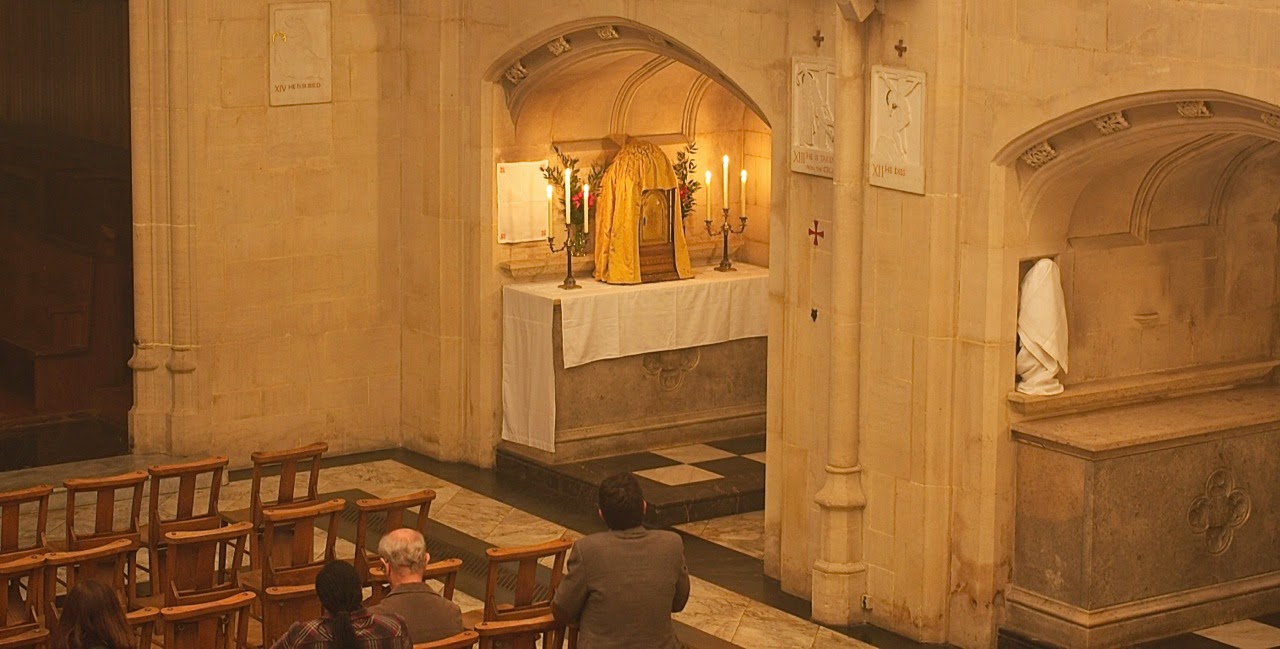
Here are some pictures of the Mass of the Lord's Supper celebrated last night (Maundy Thursday) at the Priory of the Holy Spirit, Oxford. The washing of the feet (Mandatum) occurred as usual, though it is not shown below.
The empty tabernacle and the high altar
The ministers, and the vessels for Communion
The Deacon begins to prepare the altar
The choir sang Ubi caritas by Duruflé and Ave Verum by Byrd
The altar of repose, where the brethren and others watched till midnight
On Maundy Thursday, Good Friday, and Easter Saturday, the Morning Offices of Matins and Lauds take a slightly different form. The offices are combined and become Tenebrae, meaning "darkness" or "shadows". The liturgy is so called because it takes place in darkness or at least no additional light save for a triangular hearse upon which 15 unbleached candles are lit. As the office proceeds, each of the candles are gradually put out until all are extinguished at the end, representing the abandonment of Christ by his disciples.
The hearse with unbleached candles in the Priory Church
Solemnity, sorrow, stillness - these are the hallmarks of this "Office of Darkness". It is a fitting way, in addition to the other great liturgies of the Triduum, to enter more deeply into the mystery of Christ's Passion and Resurrection.
Below is a recording of the Third Responsory from this morning's liturgy (Maundy Thursday, Year B), in which we sung, with a sizeable congregation, the words:
R. Revelabunt caeli iniquitatem Iudae
et terra adversus eum consurget
et manifestum erit peccatum illius in die furoris Domini
cum eis qui dixerunt Domino Deo
recede a nobis scientiam viarum tuarum nolumus.
V. In diem perditionis servabitur malus
et ad diem furoris ducitur.
This Latin text can be translated into English as:
R. The heaves will show forth the iniquity of Judas
and the earth will rise against him
his sin will be published on the day of the Lord's wrath,
together will those who said to the Lord:
"Away from us. We do not want to know your ways."
V. He is reserved for the day of doom
and he is to be brought to the day of punishment.
We will continue to post some highlights of Tenebrae over the Triduum. Please join us if you are near Oxford. Click here for details.
The third responsory, Revelabunt cæli, from the Tenebrae service on Maundy Thursday
It often surprises both Catholics and non-Catholics alike to learn just how much of what we say and hear every time we come to Mass is drawn from the Bible. Indeed, the Church’s liturgy is so suffused with Scripture that can think of the liturgy itself as a kind of performance or acting out of the history of our salvation as revealed in the Scriptures. However, unlike a play or a film, the Church’s liturgy does not simply re-tell the story of our salvation: our re-enactment of the Scriptures re-presents the saving life of Christ to the present moment. In other words, it is through the liturgy that the merit of Christ’s one sacrifice is applied to the here and now.
This sense that the liturgy is a dramatic re-presentation of salvation history through which Christ becomes really present is true of all the Church’s liturgies. The drama is especially ‘full’, however, during the Easter Triduum when we trace in detail the events that led to Jesus’s death, and then on to the glory of his Resurrection. We tell this story so carefully during this Easter season because through a deep involvement and immersion in the true story of our salvation, we become better disposed to embrace more deeply the new life of the Resurrection that Christ offers us. The liturgy invites us to put ourselves in the story and see the history of our salvation not as a gift given to a people that lived long ago, or to humanity corporately, but to each one of us personally.
Yet if we are to put ourselves into the story of this Easter Triduum then this immediately raises the question of which part we are to play, and as we know there are a wealth of characters to choose from. Some loyally stand by Jesus as he prays, they follow him to his trial, they help him carry his cross, they stand beside the cross in sorrow as he dies, they take care of his body and lay it in the tomb. Others sympathize with Jesus’s predicament but do not care enough to get involved and wash their hands of the affair. Still others plot his downfall and demand his crucifixion. In today’s Gospel we confront perhaps the most tragic figure of all, Judas, who sold both his friend and his hope for thirty pieces of silver.
Now Judas’s betrayal is a warning to us that we ought not to approach this Easter season too complacently and assume too quickly that we always stand on the side of righteousness. Over the course of our Christian lives most of us, to a greater or lesser extent, will play most of the roles I have outlined above: there will be times when we serve Christ with enormous generosity and love; there will also be occasions when through weakness we betray him. In our Gospel reading, all the apostles ask when they learn that there is a betrayer among them: ‘Surely not I?’ Yet all would be scattered when Jesus’s hour finally arrived. Crucially, however, all bar Judas had the courage to repent and come back: and Christ perfected these frail foundations and upon them built his Church.
Readings: Mt 21:1-11 (Procession Gospel); Is 50:4-7; Ps 22; Phil 2:6-11; Mt 26:14-27:66
Has it ever bothered you that Jesus on the Cross seems to be abandoned by his Father in heaven? I have certainly wondered why on earth Jesus would cry out, My God, my God, why have you forsaken me? After all, we believe he is the eternal Son of God, who never left his Father's side in heaven even while he walked on earth as a man. Even if in some sense we accept that the divinity of Jesus means he can never be truly separated from the Father, nevertheless we may still be troubled by the apparent aloofness of the Father. How could a loving Father look on while his only Son was tormented and crucified, without doing anything to stop it? In other words, we can easily find ourselves joining the chorus of mockers: He saved others, he cannot save himself.... He trusted in God; let him deliver him now if he wants him. For he said, 'I am the Son of God.'
El Greco, The Crucifixion
It is astonishing how quickly we find ourselves on the wrong side! How easily we slip into the mindless stampede of the herd! We are barely into Holy Week, which begins with the crowds chanting Hosannah to the King of Kings, and already we find ourselves echoing the words of the mob on Good Friday: Crucify! Crucify! It is not just the Lectionary which encourages us to connect these two scenes, by giving us both Gospel readings on the same day. It is our very own patterns of thought and behaviour which betray us, which reveal how fickle our hearts truly are. We see a man in distress and think he must have deserved it somehow. This is exactly the attitude Jesus was trying to extirpate in the story of the man born blind, which we heard two Sundays ago. We succumb to this attitude time and again, thinking we are competent to judge the moral or spiritual worth of another, when only God can do that. And that is why we are fickle: we are too quick to acclaim, too hasty to condemn.
But where does that leave us with the cry of Christ from the Cross? The first thing to notice is that it is a quotation, the opening lines of Psalm 22. Jesus knew the Scriptures – and is indeed, as God, their ultimate author – and knew exactly what he was saying. So, what does Psalm 22 mean? Following St Augustine, we can say that the psalms can be analysed in terms of the different voices, or personae, which they adopt. Very often, a psalm will change voice suddenly, without warning, and the reader must be attentive to the shift in position. Modern editions, of course, can use quotation marks and paragraph breaks to suggest how the text should be read; but this does not clear things up entirely. Augustine also insisted that we read the psalms in the light of Christ. They are either about Christ, the head of the Church, or about the Church, which is Christ's body. Sometimes, we hear speaking the whole Christ (totus Christus): Christ united with the Church.
Now, Psalm 22 begins with a pitiful lament, and Augustine argued that Christ is speaking here, not for himself, but on behalf of sinful humanity. And then we can notice the crucial thing: it is not God who has abandoned humanity (let alone Jesus, his beloved Son), but we who have abandoned God. In his own humanity, Jesus takes on the full weight of our fallen state – all the sin and wretchedness of the ages, past, present and future – and can speak truly for humanity when he cries out to reveal how deeply we have cut ourselves off from God. It is as though he is saying, My God, my God, see how far we have run away from you! But that is not the end. Read to the end of Psalm 22 and you will see the darkness turn to light, the lament into praise and thanksgiving. For he has not despised or abhorred the affliction of the afflicted; and he has not hid his face from him, but he has heard, when he cried to him (v. 24). The moral of the story of Psalm 22 is that the upright person will be vindicated by God. They will be glorified, no matter how afflicted they seem at present to us. To achieve this in our own lives, we must first empty ourselves before God. Although God fills us with life, so often we try instead to be fulfilled without God. The readings from Isaiah and Philippians show us a better way: Christ humbled himself, offering no retaliation to his beastly tormenters, but being obedient to the point of death, even death on a cross. In his loving obedience, Christ was perfectly united with his Father, not abandoned by him. And so, in the moment of his final agony and death, that is when the bystanders recognise him for who he really is: the Son of God. Let us walk together towards the Cross this Holy Week, and join our sufferings with Christ, in order to share his glory in the Resurrection.
The timings of services during the Sacred Paschal Triduum at the Priory of the Holy Spirit (Blackfriars, Oxford) are given in the poster below. We hope you will be able to join us.
Over the last few days of Passiontide, Godzdogz will continue to offer reflections on the Mass readings of the day. During and after the Triduum we will post some photos of the liturgies, especially for those who are unable to be here.
It is amazing how we can read the Old Testament in the light of the New Testament and vice versa. In this way we are able to understand better not only the unity of the Holy Scriptures, but single biblical passages as well. Today's readings give us a very good example of that, in terms of the attitudes of Moses and Jesus.
The main point of the first reading is a conversation between God and Moses. God is going to punish Israel, because they turned away from Him. They made a molten calf, worshiping it and sacrificing to it. They forgot how God had brought them out from the land of Egypt. Moses as the leader of Israel tries to defend people against God’s wrath. As we can see in today’s Gospel, Israel rejected God not only in the desert. The Gospel shows in some sense a continuation of this story, because most of his Jewish contemporaries didn’t recognize and accept Jesus, the Son of God, who was sent by his Father. Jesus speaks to the Jews about his mission and testimony. He says that the best testimony are the works that the Father gave him to accomplish. They testify that He is sent by the Father. Nevertheless these Jews, who knew the Scriptures very well didn’t discover in them testimony about Jesus. In his speech Jesus refers also to Moses who was for the Jews a very significant figure. He proves to them that if they really had believed in Moses they would have believed Him too, because his words testify about him.
The Jews saw how God brought them out of the land of Egypt, but they didn’t believe Him. They saw Jesus’s life and works, but also in this case they didn’t believe him. They see and hear God’s works. They knew the Scriptures very well, but nevertheless they didn’t believe. How did it happen? Jesus gives an answer to this questions: "How can you believe, when you accept praise from one another and do not seek the praise that comes from the only God?" (John 5.44). They didn’t seek the praise and glory of God, but only their own praise, and because of that they weren’t able to believe God. Only if we seek God, who is our Creator and Redeemer, as well as his praise and glory, will we be able to find our own praise living with Him in eternal life.
Today, St. John’s Gospel presents us with a miracle and a controversy. Miracles are controversial enough in themselves, but Jesus seems to be especially provocative in this encounter.
First: the miracle. The miracle takes place at the pool of Bethzatha (or Bethesda) on the outskirts of Jerusalem, near the Sheep Gate, which was on the North-Eastern section of the city wall. This is confirmed by a nineteenth century excavation in which the remains of the site described by St. John were discovered. The man who languished before Jesus is in a bad way. We are told he has been ill for thirty eight years, and the man’s protracted suffering is evident to Jesus. But what exactly is he doing at this pool? The explanation is given in passing and is also to be found in the absent latter part of verse 3 (3b) and verse 4, which the Editors omitted from the the New Vulgate and RSV due to their absence in earlier manuscripts. Though not part of the Bible, or today’s Gospel reading, the verses give some useful context: “...waiting for the moving of the water. [4] For an angel went down at a certain season into the pool, and troubled the water: whosoever then first after the troubling of the water stepped in, was made whole of whatever disease he had.” So the man was waiting to be healed, waiting to be the first one in the bubbling water but without anyone to help him in. One could be forgiven for thinking that his waiting would survive this episode - certainly, even the man himself seems sceptical of his chances. But he was desperate. He had no other hope, it seemed.
Confronted by this tragic scene, Our Lord takes pity. He heals him with the command: “Rise”. Now in so doing, Jesus had broken the law of the sabbath. This was not the first time he had done so (c.f. Luke 6:1-12). And Jesus does not stop there. After, “Rise” he continues, “take up your pallet, and walk”. In adding the first of these two additional instructions, Our Lord further contravenes the law of the sabbath since the carrying of one’s pallet was expressly forbidden.
Why? Why does Jesus break the law? He does so in order to provide a new understanding of the sabbath. The Catechism of the Catholic Church explains: “The Gospel reports many incidents when Jesus was accused of violating the sabbath law. But Jesus never fails to respect the holiness of this day. He gives this law its authentic and authoritative interpretation: ’The sabbath was made for man, not man for the sabbath.’ With compassion, Christ declares the sabbath for doing good rather than harm, for saving life rather than killing. The sabbath is the day of the Lord of mercies and a day to honor God. ‘The Son of Man is lord even of the sabbath’” (CCC 2173).
To this we might add some comment from St. Thomas Aquinas: “[Those Jews] in their desire to imitate God, did nothing on the sabbath, as if God on that day had ceased absolutely to act. It is true that he rested on the sabbath from his work of creating new creatures, but he is always continually at work, maintaining them in existence[...] God is the cause of all things in the sense that he also maintains them in existence; for if for one moment he were to stop exercising his power, at that very moment everything that nature contains would cease to exist” (Commentary on the Gospel of St. John, ad loc.) Thus immediately after today’s Gospel reading, Jesus says in his own words, “My Father is working still, and I am working” (v. 17). Our Lord’s teaching in this passage is audacious, in that it challenged the Jewish conventions and provoked enmity; new, in that he provided a modified interpretation of the Sabbath - one that represented a significant departure from what preceded it; and true, in that as St. Thomas reflects, it is not as though God ceased to act at all on the sabbath, and likewise His Son, Jesus, did not cease to act when he met a child in need. In Jesus's teaching we find a profound lesson for ourselves. We may not work miracles, but we can act with charity - even when it seems awkward or somehow 'inappropriate'. Put crudely: love is a trump card, and we should play it whenever we can!
Lord Jesus, grant us to see as you see. Prompt us to help those who are needy. Let us never withhold our charity out of misplaced obedience to convention.
Readings: Isaiah 65:17-21; Psalm 29:2,4-6,11-13; John 4:43-54
Today’s Gospel finds Jesus back in Cana, scene of the first miracle of his public ministry. Once more we have a miracle, and once more the dialogue preceding the miracle is troubling at first sight. An official has made the journey from Capernaum to ask Jesus to cure his son who is ill at home. Surely this is an act of faith which merits a more understanding response than Jesus’s seeming rebuke: “Unless you see signs and wonders you will not believe” (John 4:48)? Surely the effort to find Jesus and to ask him to heal his son is sign of the official’s belief? In any event, the official persists in his request and Jesus commands him to leave, telling him that his son will live - words which are, of course, then fulfilled.
Perhaps it says something about me and the blasé attitude which can form in me to ‘another miracle’ that the preparatory dialogue to the miracle is what immediately grabs my attention. Is there, however, some explanation for the harsh initial words? There is a potential clue in the penultimate verse of the passage where we are told that on hearing that the healing of his son occurred at the time of his conversation with Jesus, the official “himself believed and all his household” (John 4:53). Perhaps Jesus sensed a faith in the official that was incomplete, one that was dependent on seeing signs, and not a faith based on Jesus’s word? This is the explanation offered by the Venerable Bede who sees in the passage an allegory of our faith being formed gradually. He suggests that the official’s faith begins with the asking; grows when he believes Jesus’s words and returns home, but only reaches its maturity on hearing the servants’ confirmation that his son is in fact well again.
However, maybe there is another more vital lesson that we might take if the dialogue between Jesus and the official troubles us and we spend our time struggling to understand it. This time is valuable if it turns into a contemplation on who Jesus is and leads to a deepening of our relationship with Him. The danger, though, lies in the mental effort being expended on trying to make Jesus palatable to our sensibilities, seeking to ensure that He fits within our mould of what God should be like. We do well to remember who is made in whose image!
What then do we learn about Jesus from this miracle, what does this sign tell us about the one that performs it? It is the message that we will hear many times from this point on in John’s Gospel, that Jesus is life-giving. Where Jesus is to be found, life is renewed and restored, if only we will have faith. All our words pale in comparison to this healing and life-giving Word of God.
The English Dominican Simon Tugwell once observed in his excellent little book Ways of Imperfection (1984) that there is a sense in the sayings of the desert fathers and mothers, the great ascetics of the early Church, that the most dangerous kinds of sins involve not so much our actions as our attitudes to those actions. To put this another way, if we are able to recognize and confess that our sins are indeed sins, if we are able and willing to acknowledge that we have done wrong, then even if we succumb to the same temptations time and time again the venom of these sins is to a large extent drawn. The fact that we are able to acknowledge our guilt in itself opens us up to forgiveness and mercy.
On the other hand, if we are unable to acknowledge when we are at fault and instead direct our energies towards justifying ourselves and excusing ourselves even when we have done what is wrong, then we risk putting ourselves beyond God’s mercy and forgiveness simply because we refuse to accept our need for this mercy. In short, we risk refusing God’s grace through overconfidence in our own righteousness.
In our Gospel reading, the tax collector leaves the temple at rights with God because he has had the courage to look his sins in the eye and ask for mercy, beating his breast. The Pharisee, on the other hand, is so blinded by self-congratulation that he repents of nothing and does not ask for forgiveness. Now it is clear that the Pharisee is in many ways a good man, it seems that there is much in his life that ought to be commended. Nevertheless, he is a proud man and this pride prevents him from becoming intimate with God, it impedes his journey to holiness. Traditionally, Lent is a season where we make an extra effort to make a good confession. Let us not be like the Pharisee, and allow complacency or pride to prevent us from seeking out God’s mercy. Instead, let us be like the tax collector and have the courage to ask for God’s forgiveness in humility and truth.
Readings: Jeremiah 7:23-28; Psalm 95:1-2, 6-7, 8-9; Luke 11:14-23
Among many paradoxical sayings of Jesus, this is one of the most challenging: ‘He who is not with me is against me, and he who does not gather with me scatters’ (Lk 14:23). Isn’t it so much more comforting for us to recall that other saying of his: ‘he that is not against you is for you’ (Lk 9:50)?
I’m not going to resolve this tension in such a short reflection. There are long sermons and books out there which explain the deep unity and wisdom of these sayings of Christ. At least, paradox is not the same as contradiction – this much is clear from such writers as G. K. Chesterton, R. H. Benson, and Henri de Lubac. Paradox is the product of a unified truth being seen under different aspects, as when equally sized circles seem different in the context of an optical illusion. But as a brief comment, one could see the ‘uncompromising’ saying as a subjective call – ‘follow thou me’ – while the ‘compromising’ saying refers to the objective fact – let God alone judge who is really on his side.
For now, though, we should grasp this particular horn of the paradox: Jesus is saying there can be no compromise with those who do not follow him. He is under attack from a crowd of unnamed antagonists, who call him an agent of the Devil. Likewise, St Luke was writing for an early Christian community under great pressure. So the Gospel writer must reassure his audience that Jesus was claiming for himself divine power, not demonic possession. Jesus is the ‘stronger’ one who defeats and despoils the Devil, who would otherwise hold our weak humanity in thrall.
Finger of God
In John’s Gospel (14:30), Jesus warns his disciples that ‘the ruler of this world is coming’, but immediately reassures them that ‘he has no power over me’. This is because Jesus operates a divine power, driving out devils by ‘the finger of God’ (Lk 11.20), echoing Exodus 8.15 (LXX) and revealing Jesus to be the new and definitive liberator of his oppressed people. Whereas his opponents believe in contradictions, thinking that the Devil could or would drive out his own devils (how absurd!), Jesus presents us with a clear choice. We must follow him wholeheartedly, and encourage others to do the same: to gather with him, not to scatter.
Our Gospel reading today is from chapter 4 of John’s Gospel: Jesus’ encounter with the Woman of Samaria, also known as the Woman at the Well. Now St. John goes out of his way to remind us that the fact that Jesus should have such a conversation with a Samaritan woman is in itself surprising, as St. John himself says, ‘Jews had no dealings with Samaritans’ (John 4:9). This historical enmity between Jews and Samaritans had deep roots that reached far back into Israel’s history to the moment when the twelve tribes, briefly united under Saul, David, and Solomon, once again divided as Rehoboam, son of Solomon, took the throne. We read in chapter 12 of the first book of Kings that the ten northern tribes had sought assurances after Solomon’s death that his son would reduce the heavy load of hard labour inflicted on the people through Solomon’s various building projects. Rehoboam refused, and so the ten northern tribes rebelled against the house of David and instead made Jeroboam their King, leaving only the tribes of Judah and Benjamin loyal to David’s line.
Yet this new northern Kingdom of Israel faced a problem: the temple in Jerusalem still dominated the religious life of the northern tribes, yet Jerusalem was the capital city of the house of David and the Kingdom of Judah. Jeroboam, the new King of the northern tribes, feared that if he allowed his people to continue to worship in the south then slowly his authority would be undermined, so he fashioned two golden calves and set them up at Dan and Bethel in the north, declaring to the people:
‘You have gone up to Jerusalem long enough. Behold your gods, O Israel, who brought you up out of the land of Egypt’ (1 Kings 12: 28).
This sin is referred to again and again in the Old Testament as the sin or way of Jeroboam: it is the sin of idolatry, of worshiping what is not God, and throughout the Old Testament idolatry is presented as a kind of adultery. The northern Kingdom is an adulterous nation that has turned away from the Law and instead worshiped the work of its own hands.
Now the Samaritans are the descendants of these ten northern tribes of Israel that rebelled against the House of David. The name ‘Samaritan’ refers to the capital city of this northern Kingdom, Samaria, built by King Omri in the early ninth century before Christ. Samaria was eventually destroyed by the Assyrians around the year 722 BC, and its inhabitants were deported. The Assyrians replaced these deported Israelites with similarly displaced peoples from all over their empire. Now the Jews of the southern Kingdom would later allege that those members of the ten northern tribes that were not deported when Samaria fell collaborated with their conquerors, and rather than maintaining their racial purity, intermarried with the various peoples and nations that the Assyrians resettled among them. As a consequence, hardliners among the Judeans of the south believed that the people of the northern Kingdom had forfeited the right to be called ‘Israelite’. Instead they referred to them as ‘Samaritans’ after the principal city that Omri had built. For the hardliners among the Jews, then, Samaritan history began with political and religious infidelity, and culminated in dubious sexual morals.
There is a sense in our Gospel reading, then, that the personal history of the Woman of Samaria mirrors the history of her people. In the course of her conversation with Jesus, we discover that this Samaritan woman has had five husbands, yet the man she lives with now is not her husband. The Church fathers saw in this number five a reference to the five books of the Pentateuch, the books of the Law: as the Samaritan woman had left five husbands and now lived in adultery, the Samaritan people had been married to the Law of God, the five books of the Torah, but now they lived in idolatry. This division between the faithful Jews and the idolatrous Samaritans was manifested in racial segregation, especially when it came to worship and liturgy. The woman tells Jesus: ‘Our fathers worshiped on this mountain, yet you say that in Jerusalem is the place where men ought to worship (John 4: 20).
Yet Jesus replies that he will overcome these ancient divisions. He tells the woman: ‘The hour is coming when neither on this mountain nor in Jerusalem will you worship the Father. You worship what you do not know; we worship what we know, for salvation is from the Jews. But the hour is coming, and now is, when the true worshipers will worship the Father in spirit and truth, for such the Father seeks to worship him’ (John 4: 21-23).
The reconciliation wrought by Jesus will re-found Israel: Samaritans, Jews, even Gentiles will be united in the blood of the New Covenant, and in the waters of Baptism that flowed from Jesus’s side on the cross, the living water that wells up to eternal life (John 4:14; John 19: 34). We can think of this passage, then, as Jesus calling back God’s wayward bride, Jesus calling back God’s lost sheep in Samaria.
Some of the great figures in Israel’s history found their wives at wells, usually at a time when sheep, or cattle, or camels are being watered. The servant of Abraham, for example, met Rebekah whom he takes home to be the wife of Isaac at the well outside the city of Nahor (Genesis 24). Jacob meets his wife Rachel by at a well in the ‘land of the people of the East’ (Genesis 29). Moses too met his wife Zipporah at a well in Midian (Exodus 2: 14-22). Now Jesus himself is meeting a Woman at a well, but this time the union in question is the marriage between God and Humanity that Jesus himself brings about.
Readings at Mass: Micah 7:14-15, 18-20; Luke 15:1-3, 11-32
Today’s reading is taken from Luke’s Gospel and the parable is often referred to as the Prodigal Son. The parable could equally be termed the parable of the two brothers and the good father.The prodigal son first of all requests or indeed demands his share of the property, and the father divides up the inheritance. The son travels to a ‘far country’ and squanders away his share on wine, women and luxurious things. This son just wants to enjoy himself, and deplete the goodness that has been given. The good father is widely perceived as being God the Father, and the sons represent elements of humanity. This is a similar contrast to rebellion against God and religion, we want our freedom and are given it, and are free not to obey authority or do as commanded. But when a famine hit the far off country, the son is left with nothing. This false autonomy then leads to the son taking a job feeding a herd of pigs even just to survive. From riches to rags, the prodigal son realises that he has made mistakes with his life and returns home to his father. On his return home, the father sees the son from far off, indicating that the father has either been anticipating the return of his son, or been on edge awaiting some sign of return. The joy that the father shows to his son on return is akin to the lost son being an image of all of us, as we are received into the father’s house. After just a short confession of all he has done, the father gathers the servants together and has a fattened animal killed and a feast for the son who has returned.
But there is also the other son who has stayed faithful to the father. Once he returns from working in the fields and sees this great feast the father has put on for the other son, he quite understandably feels anger and resentment. The father responds with kind words and reassures the son who remained loyal, with ‘Son, you have remained with me, and what is mine is yours’. There are two messages here: the first is for the prodigal son, who has come to realise he has not used his freedom and wealth wisely. There is a message of hope, for even in the worst scenario of the prodigal son being left destitute and starving, he can return to the father's house and be forgiven. The second message is for the son who has stayed, that he should rejoice in the fact his brother has returned, and take more joy in the faith he placed in his father and give thanks for what he has.
Readings: Jeremiah 17:5-10; Psalm 1:1-4, 6; Luke 16:19-31
I find this one of the most uncomfortable passages in the Gospels, and I expect you do, too. I feel far closer to the ‘rich man’ than to the poor man, Lazarus, who has nothing to eat or drink and lies helpless and in pain. The problem is heightened, in fact, when we notice that Jesus is notmoralising about the situation. Jesus does not explicitly say that the rich man has done wrong towards Lazarus, nor that Lazarus is a good man. He simply juxtaposes their wealth and poverty, and shows a terrifying reversal of fortunes in the afterlife.
Is it any comfort to realise that all who hear this parable are supposed to identify with the rich man? If we are hearing it, then we are probably not lying outside a rich man’s gate, presumably crippled, with dogs licking our sores to get some meagre hydration under the boiling sun. Lazarus is a desperate man, utterly helpless. So, the hearers of the parable are almost certainly in the relative position of the rich man vis-à-vis someone like Lazarus. Practically all of us are in the same boat.
Hendrick ter Brugghen, The Rich Man and the Poor Lazarus
And what can we do about it? Yes, you could ‘sell everything you have and give to the poor’ (Lk 18:22). But such dramatic gestures are not appropriate to all. What is required of us all is a firm commitment to social justice. We must not ignore the needy and helpless in our society. That is one of the basic attitudes of the Old Testament, and it is the standard according to which the rich man was judged (Lk 16:29-31). The rich man did indeed do wrong to Lazarus. But it is not only about social justice.
Jeremiah shows us what the Old Testament attitude means: we must love and serve God, and this will flow into our actions towards our neighbours. ‘Blessed is the man who trusts in the Lord...He is like a tree planted by water...it does not cease to bear fruit.’ (Jer. 17:7-8) In the end, like the rich man, the Lord will ‘give to every man according to his ways, according to the fruit of his doings.’ If that is a scary thought, let us now turn to the Lord again, turn to our neighbour in need, and we will find a blessing.
Readings: 2 Samuel 7:4-5,12-14,16; Psalm 88:2-5,27,29; Romans 4:13,16-18,22; Matthew 1:16,18-21,24 or Luke 2:41-51
Next Tuesday we will be celebrating the Annunciation of the Lord, and we will rightly ponder on the faith-filled words of Mary the Mother of God. Today, however, we celebrate the Solemnity of her spouse Joseph, one of the great saints of the Church, and yet a man from whom we have no recorded words, just his powerful example.
Pope Francis, in the inaugural Mass of his pontificate, described St Joseph “as a strong and courageous man, a working man, yet in whose heart we see a great tenderness, which is not the virtue of the weak, but rather a sign of strength of spirit and a capacity for concern, for compassion, for genuine openness to others, for love.”
We observe many of these qualities in today’s Gospel when we read: [Jesus’s] mother Mary was betrothed to Joseph; but before they came to live together she was found to be with child through the Holy Spirit. Her husband Joseph; being a man of honour and wanting to spare her publicity, decided to divorce her informally” (Mt 1:18-19).
This example is something which today’s society finds difficult to grasp and one which causes difficulties for us in the proclamation of the Gospel. If one opens today’s papers doubtless there will be a callous castigation of some public figure who has failed to live up to the standard demanded of him. This barely disguised glee in censuring the shortcomings of others is something which rightly reviles many; yet the common reaction to this – that we ought to do away with all morality whatsoever – is unhelpful and causes society to fall apart all together. Joseph was a ‘just man’ who saw no contradiction between love and the law, but rather saw that they only fully function when brought into unity.
I think this example of St Joseph is one which Pope Francis is consciously trying to follow in his pontificate. In his inaugural homily he goes on to describe Joseph as exercising the role of protector “discreetly, humbly and silently, but with an unfailing presence and utter fidelity, even when he finds it hard to understand”. It is an approach which opens him up to misinterpretation, but in a context where there are divisions in the Church, and between the Church and the rest of society, there is so much that we would all do well to follow in these words.
“They preach but do not practise” [Mt 23:3] says Our Lord in today's Gospel, describing the Pharisees. These words send a shiver down the spine as they remind us of the times in which we fall short of Christ’s teaching, which we proclaim to the world. But the sentiment is perhaps especially applicable to Bishops, Priests and Deacons who exercise both authority in the Church, and a teaching ministry. As St. Thomas Aquinas says in his commentary on this Gospel passage, “a prelate is given a position of authority so that he may teach not only by his doctrine, but also by his life”. If our lives do not reflect the values we preach, we lack integrity. If we lack integrity, we lose credibility. If we lose credibility, people will not listen to us. So it is only when we practice what we preach that we become effective communicators of the Gospel. I once heard Gil Bailie, a thoughtful American scholar, put it this way: "The ultimate success of every effort to Christianise the world will be commensurate with the personal sanctity of those making the effort." The way to avoid the example of the Pharisees is to have the integrity to put into practice that which we profess.
Our Lord has more to say than simply castigating the Pharisees, however. There is another element, linked to integrity, which he wants to put into the thoughts of his listeners: humility. Humility, according to St. Thomas , is a “restraining moral virtue” [ST II-II, Q. 161, Art. 1]. Humility stops us getting ahead of ourselves, and becoming proud. Christ’s example is one of perfect humility. His life and loving sacrifice places our own shortcomings in sharp relief. "If the greatest of all, Incarnate God, chooses to be the servant of all, who would wish to be the master?” as Malcolm Muggeridge once asked. Service is humility in action, which is incumbent upon “He who is greatest among you”, and, in fact, all of us who wish to follow Christ. In St. Augustine's words, "We are leaders and servants: we lead when we serve”[Sermones, 340a].
In these two sentiments, there is an echo of the Old Testament Prophet, Micah: “He has showed you, O man, what is good; and what does the Lord require of you but to do justice, and to love kindness, and to walk humbly with your God?” [Mic 6:8]. During Lent, we renew our efforts to serve God and man in our actions as well as our words; to live as authentic disciples; to be Christians with integrity, and humility.
What on earth is St. Peter thinking? In the middle of this mystical scene, a moment of profound and unique encounter with God, Peter seems to be concerning himself with practicalities, interrupting the Lord's discourse with Moses and Elijah to talk about camping. It’s tempting to suppose that this is yet another example of the apostolic ineptitude that we see throughout the gospels, of St. Peter getting so close to the truth but then dramatically missing the point. Anyway, isn’t that what we’d expect from Peter, the one who confessed Jesus and then denied him, who tried to defend Jesus with the sword, whose first words to Jesus in St. Luke’s gospel were “leave me alone” (Lk 5.8)?
There’s certainly something in that reading, but on this occasion I wonder whether we might be a little hasty in dismissing St. Peter’s desire to get busy camping. However bizarre we might find Peter’s talk about tents, it nonetheless seems to pre-empt God’s own action: just as Peter suggests they build three tents, God himself builds a single tent over all present, covering them in the shekinah cloud. Whereas Peter’s suggestion keeps apart the messianic figure of Christ, Moses (representing the law) and Elijah (representing the prophetic tradition), God’s action houses them together: Christ personally reflects the fulfilment of the three-fold tradition of priesthood, prophecy and kingship, because he is—as the voice in the cloud says—“God's beloved Son”. The transfiguration of Christ is a moment of revelation and manifestation, in which the three disciples’ knowledge of who Jesus is for them is deepened: just as Moses’ face glowed in reflection of God’s glory after he spoke with the Lord, Christ’s face glows of its own accord and his garments reflect his own glow, because he is the Lord, truly God in human history.
In the Greek, St. Peter’s remarks about tents don’t so much emerge as offering an interjection as providing an answer (apokrinomai). This remarkable scene has challenged Peter, interrogating his presuppositions. Indeed, the gospel writer explicitly locates the event on the mountain as occurring six days after Peter's confession of Christ's messianic identity at Caesarea Phillipi, days in which Jesus has filled Peter's nascent messianic faith with content, first revealing that his messiahship—despite what Peter may have initially thought—will involve suffering, and now making manifest a foretaste of the glory of the resurrection. In St. Matthew’s account of the incident, we are left wondering what Our Lord discussed with Elijah and Moses. St Luke, however, fills in some of the details, reporting that they were discussing Christ’s exodus (his “departure” from this world, Luke 9:31). Against this backdrop, building a tent makes much more sense as a symbolic gesture: the Jewish festival of booths (sukkoth) recalled those Exodus years of wandering in the wilderness with God, dwelling in tents alongisde the Lord who dwelt in his own tent (the tabernacle).
Peter’s vocation as the first Pope will, of course, involve building a shelter where man can rest with God. But as at Tabor, so today, it is God's activity that predominates. The cloud descends, preventing Peter from focusing on the distant scene, forcing him to see what is before his eyes. Our Lenten penance should also help us to see what is before our eyes more clearly, but the cloud that descends on the mountain is like no natural cloud that merely conceals and hides, but constitutes a place of light that, in concealing, also reveals the glory of God. It is part of the Christian mystery that in those moments in which God reveals himself most fully he seems most un-Godly: in the incarnation, God’s full revelation in human history, God conceals himself in revealing himself as a helpless baby. The Church too is a place of transfiguration, elevating creation to God in Christ, and thus making it radiant with the Glory of God. We don't wander round sparkling with the dazzling radiance of the Lord’s glory, of course, but the Church remains the place where God reveals himself in the institution that can easily seem to be a concealment.
But, leaving theology aside, there's a human level on which I hope I would have responded as Peter did. His words—“Lord, it is good for us to be here”—reveal a heart fully alive, a moment in which Peter experiences the fullness of life and love in God. Why wouldn't we want to hold on to such a moment of encounter with God, to prolong this joy, to stay in God's presence a while longer, even if it meant building a tent? Yet Christ’s words to Peter suggest that we ought to be wary of such selfishness with regard to the desire for mystical experience: we might be lucky and find that we are singled out for a moment of closeness to God, but then we too will have to head down the mountain. The three disciples are singled out as the inner core of Christ’s followers, those who will become the leading Apostles and have to squarely face up to the difficult task of spreading the gospel to the whole world. They receive this transfiguration as gift, a pledge to secure their hope, but they are sworn to secrecy only until their moment comes. The joy that they receive is a joy to be passed on, to be shared: they taste the promised resurrection before the cross, but the cross will certainly come.