Showing posts with label Advent2013. Show all posts

Tuesday, December 24, 2013

Christmas Eve: Rorate Caeli

Reading: Luke 1:67

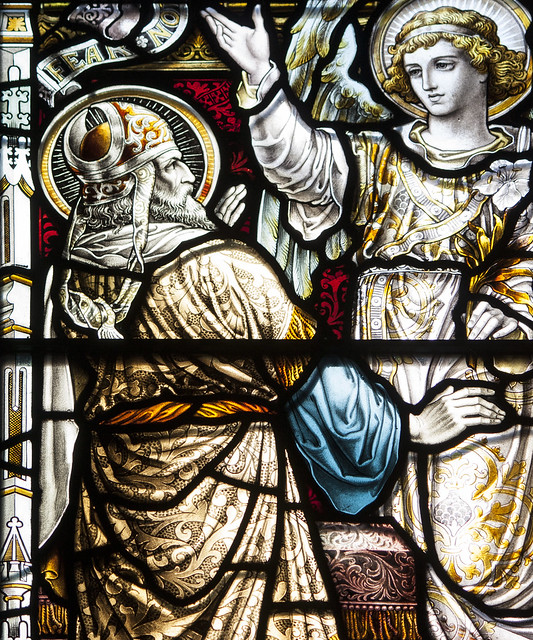
Blessed be the Lord the God of Israel.’ So begins the Gospel of Christmas Eve, the song of Zechariah, father of St. John the Baptist. These are the first words Zechariah speaks after his being struck mute by the angel, for his lack of belief in the foretold conception of his son, John.

It might be presumed that any praise would be offered in thanksgiving for birth of a boy, or even for the end of an ordeal. However, St. Luke tells us that in fact these are not the mere words of a man but the song of the Holy Spirit, who filled Zechariah and bestowed upon him the power of prophecy. For Zechariah does not speak first of his new born son, as we might expect, rather he says, continuing from before, ‘for he has visited his people and redeemed them.’ The new prophet sings of Jesus as if he had already been born; he talks about his mission as if it had already been completed.

St. Luke’s Gospel is, in many ways, the most like a conventional story, it has a straightforward and easy to follow narrative. However, from a story-reader’s point of view it does seem to have a slight flaw: St. Luke gives away the ending right at the start! Zechariah announces to all around him what he has seen; the coming of the saviour, his victory over evil and the reconciliation of man with God. Though it is St. John who prepares the way for the Lamb, it might be thought that his father rather stole his thunder.

Is it somewhat curious that this is the Gospel for the final day of Advent? Advent, a season of preparation and anticipation is crowned with a reading that seems to undermine all that excitement. Before we get to the Nativity of Our Lord we are told, in a sense, “and they all lived happily ever after.” Isn’t this robbing us of the fruits of our eager anticipation? Don’t we get the ending before we are ready?
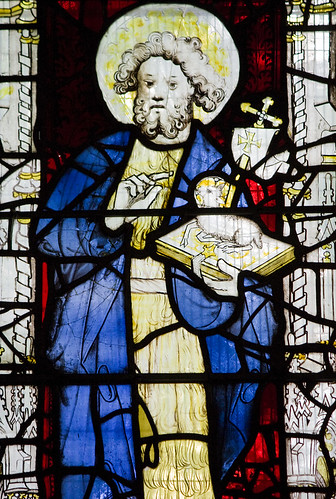
Perhaps the reason for this peculiar anti-climax is to serve as a lesson. We could rejoice in the joy of the redemption before it was accomplished, as Zechariah did, because the redemption of man was never in doubt. It was always in God’s hands. As Zechariah said, ‘thus he has shown the mercy promised to our ancestors, and remembered his Holy Covenant’.  Any person who shares the faith of Abraham knows this, though sometimes only implicitly, that the God of Israel does not fail, and he shall never abandon his people.

Of course, this fact is constantly in the mind of the Church throughout the Advent season, as she sings her Advent Prose, the Rorate Caeli. The Rorate calls upon God to see the affliction of his people, to consider their pitiable state and to send to them the one who can lift the yoke of their captivity. This petitionary prayer, based upon the words of Isaiah, allows the Church to liturgically recreate the sense of longing and desire held by those holy prophets from of old. However, like St. Luke’s Gospel, it too has its Zechariah moment. At the end of the prayer, God responds:

‘Be comforted, be comforted, my people; thy salvation shall speedily come. Why wilt thou waste away in sadness? Why hath sorrow seized thee? I will save thee; fear not: for I am the Lord thy God, the Holy One of Israel, thy Redeemer.’
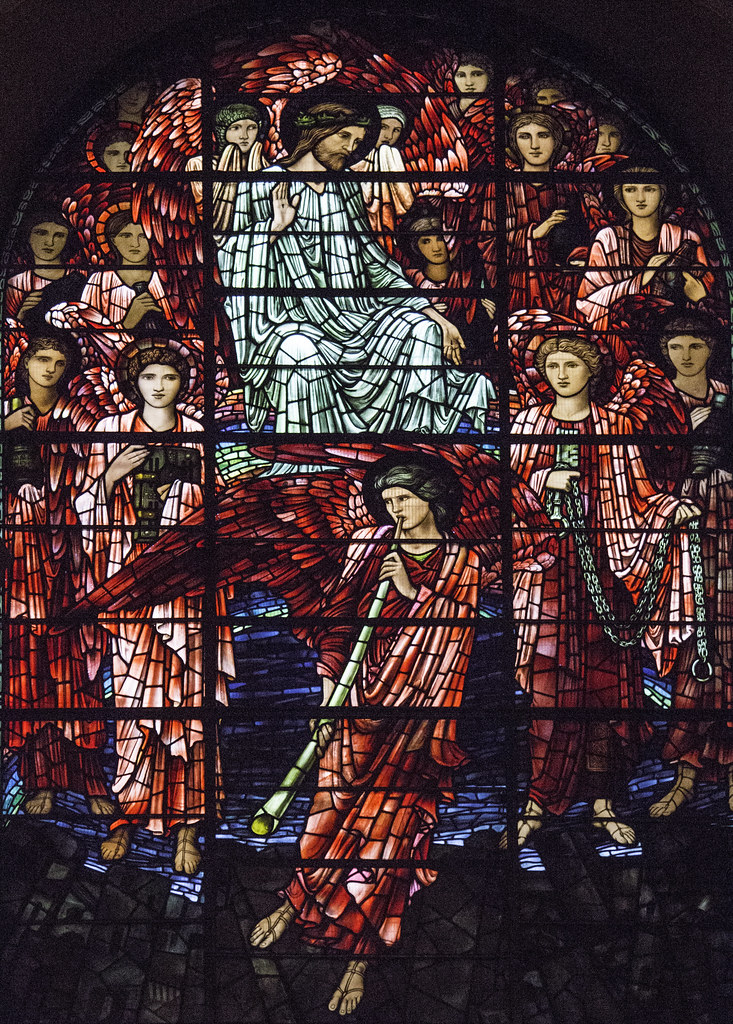

On the last day of Advent the Church proclaims with Zechariah the truth which all the children of Abraham have rejoiced in, that the Holy One of Israel is God indeed, and he shall save us from our sins.


So, by taking time to prepare ourselves to mark the Incarnation we learn what it means to be repentant, what it means to trust in the Lord’s goodness and even, through Zechariah, how we can rejoice in God’s bounty before we have received it in its fullness.

Now, Advent doesn’t really stop on Christmas Eve, it doesn’t even stop at the Nativity of Our Lord. In fact, it points forward to the end of time, to the return of Jesus Christ. The Church teaches the faithful through her liturgy to pray for his return in genuine humility, with reverent fear but also with joyful hope. Like those who cried out for the Redemption we too sin, we are brought into periods of trial and often find ourselves wasting away in grief. However,  Advent has taught us how to get through this, by looking to the Lord’s second coming and trusting that he will save us from our iniquities, if only we turn away from sin and cry out each day, ‘Drop down dew, ye heavens, from above, and let the clouds rain the Just One.

Sunday, December 22, 2013

Advent 2013: "O Emmanuel"

O Emmanuel, Rex et legifer noster, exspectatio gentium, et Salvator earum:
veni ad salvandum nos Domine Deus noster.

O Emmanuel, our King and Lawgiver, the Expected of the Nations and their Saviour,
come to save us, O Lord our God.

Today at Vespers we will sing the last of the beautiful “O Antiphons” and the acrostic will be completed; for if we put together backwards the first letter of each of Antiphons - Emmanuel, Rex, Oriens, Clavis, Radix, Adonai, Sapientia – we can form the words “Ero Cras”, that is, “Tomorrow, I will come”. And tomorrow indeed, at Midnight Mass, we will celebrate that moment when God entered the world as an innocent child, one still night, in the little town of Bethlehem . . . and it changed everything. Nothing would ever be the same again.

This O Antiphon, like each of those that preceded it, both refers to a title of the Messiah and to a prophecy of Isaiah on the coming of the Messiah.

Emmanuel means “God is with us”, and with the birth of the Saviour, this beautiful idea becomes reality in a way beyond compare. Whilst it is true that God has always been with us, the Incarnation radically changed His manner of being “with us.” The most sacred item for the people of the Old Testament was the Ark of the Covenant, but from the moment of the Incarnation, when the Holy Spirit overshadowed the Blessed Virgin Mary (the Ark of the New Covenant) she held within her womb the Word of God in the flesh.

So as we near the end of Advent, the prophecy of Isaiah (7:14) nears its fulfilment:

The maiden is with child
and will soon give birth to a son
whom she will call Emmanuel,
a name which means “God-is-with-us”


Chinese-christian-nativity-painting

What then is the appropriate response to this fact, the entry of God into human history? It should be rejoicing. Let us rejoice in one another, let us rejoice in the fact that each of us is willed and loved by God, and let us rejoice in the proof of this, the sending of His Son to save us. Thus as the preparation and joyful anticipation of Advent reaches its magnificent culmination, let us rejoice and sing with relish once more that great hymn in which all the themes of the O Antiphons are brought together:

O come, O come, Emmanuel,
and ransom captive Israel
that mourns in lonely exile here
until the Son of God appear.
R: Rejoice! Rejoice! Emmanuel
shall come to thee, O Israel!

O come, Thou Wisdom, from on high,
and order all things far and nigh;
to us the path of knowledge show,
and teach us in her ways to go.


O come, O come, Thou Lord of might,
who to Thy tribes on Sinai's height
in ancient times did give the law
in cloud and majesty and awe.


O come, Thou Rod of Jesse's stem,
from ev'ry foe deliver them
that trust Thy mighty power to save,
and give them vict'ry o'er the grave.


O come, Thou Key of David, come
and open wide our heav'nly home;
make safe the way that leads on high
that we no more have cause to sigh.


O come, Thou Dayspring from on high,
and cheer us by thy drawing nigh;
disperse the gloomy clouds of night
and death's dark shadow put to flight.

O come, Desire of the nations, bind
in one the hearts of all mankind;
bid every strife and quarrel cease
and fill the world with heaven's peace.

Saturday, December 21, 2013

Fourth Sunday of Advent: St. Joseph

Readings: Isaiah 7:10-14; Psalm 23:1-6; Romans 1:1-7; Matthew 1:18-24


On the fourth Sunday of Advent, we read St. Matthew’s Gospel in which the role of St. Joseph is brought into focus. In order to understand the situation in which Joseph found himself, a little background is needed. He was betrothed (in Hebrew, ‘qiddushin’ meaning consecrations) to Mary, Our Lady. In Jewish culture at that time, this had a greater significance than the modern day equivalent of an engagement because it carried with it the legal and moral effects of marriage itself. During this time of betrothal the bride-to-be lived with her parents - in Mary’s case with Saints Joachim and Anne. It was only at the celebration of the wedding that the wife would be led in procession to her husband’s house after which time they “came together” [RSV Mt 1:18].

We are not told in Matthew’s Gospel or any other for that matter, how Joseph discovered Mary was “with child”. Perhaps Mary told him and tried to explain; perhaps it was through an intermediary; perhaps he realised it by himself? Regardless, the situation no doubt appeared bleak initially. There were - seemingly - two possibilities to explain Mary’s pregnancy: either Joseph had lacked the self-control to remain chaste before the wedding, or Mary had been unfaithful. The former would have been a cause of shame and reproach on both Mary and Joseph; the latter was more serious still for the penalty for a “betrothed virgin” lying with another man was death by stoning [Deut 22:23-24].  The stakes were very high indeed.

How does Joseph navigate this crisis? As a “just man”, he decides he will end the relationship discreetly by divorcing Mary. He did not seek the retribution for which the law provided - being “unwilling to put her to shame” - but, in the midst of this dramatic scene, he displayed a kindly disposition. St. Thomas Aquinas and others have interpreted this disposition as a sign that he realised that somehow God was behind all of this - perhaps there was a third possibility after all?

Even so, “Why me?” “Why would it have to be my wife who became pregnant, and leave me in this quandry?” I suspect Joseph uttered such words or words to a similar effect. The answer, of course - as Joseph discovered by the message of angel in a dream - is that it was God’s plan. It was God’s plan that Joseph, the “son of David”, the heir to the Davidic promise, would be the Father of Jesus. It was God’s plan that Mary who had already been conceived without original sin would be His Mother. It was God’s plan that His son would be named “Jesus” (Jeshua) meaning “the Lord saves”. It was God’s plan that He would save His people from their sins. And all this was the fulfillment of Isaiah’s oracle, God’s plan foretold.

As if Joseph wasn’t bewildered enough by Mary’s pregnancy, he now learns that the Father of Mary’s child is God Himself, and that he, Joseph, is to be guardian. The human mind boggles at such an awesome message, a breathtaking responsibility. Certainly, it was not for nothing that the angel said to him, “do not fear”.

Joseph’s example is a remarkable one. He was, in every sense but biological, the Father of Our Lord Jesus Christ, and husband of Our Lady. In the remaining days of Advent, in our contemplation of how our Saviour came to be born, all of us might reflect on Joseph’s witness and role in the history of salvation. Pope Benedict XVI encouraged this devotion: "meditation on the human and spiritual journey of Saint Joseph invites us to ponder his vocation in all its richness, and to see him as a constant model for all those who have devoted their lives to Christ in the priesthood, in the consecrated life or in the different forms of lay engagement.”

Sancte Joseph, ora pro nobis.


Joseph's Dream, Gaetano Gandolfi (c.1790)

Friday, December 20, 2013

Advent 2013: 'O Oriens'


Advent 2013: O Oriens

Today’s O antiphon, translates in english to: “O Morning Star, splendour of light eternal and sun of righteousness: Come and enlighten those who dwell in darkness and the shadow of death”. Today is the shortest day in terms of daylight hours, and marks the peak of winter. And how good it must be, to sit beside a log burning fire and look outside at the falling snow, whilst enjoying whatever is on the television. Darkness, Death…Downton Abbey Christmas Special is on next!

The shadow of death and prevalence of disease would have been much worse in the past than what we might experience now. With no electricity, homes and churches would be lit only with candles, and would be colder in the winter without central heating. Without the medical advances that we have today, or a universal healthcare system, death and disease would have been a far more immediate concern. In Eamon Duffy’s book, Stripping of the Altars, he provides a historical background to religious practice and the life of the typical pious lay person in late medieval England. The liturgy for major feasts and solemnities were aligned with the seasons of agriculture, reflecting the fact that peasants worked solidly throughout the year. When human hands laboured so heavily just to produce enough to sustain a family, ‘darkness and the shadow of death’ probably had a more profound meaning in the daily lives of the lay person and the clergy than today. Just imagine the colder months of winter that meant the faithful would attend Churches with floors lined with straw to keep warm, whilst praying their devotions and attending the advent Mass. Indeed, charcoal burners used in medieval times for providing some indoor heating would have produced toxic carbon monoxide. The churches were probably of sufficient height, however, that it didn’t build up to a level that would cause asphyxiation of the congregation!

In our modern advanced economy, we are far more distant from working the land and the seasons of farming and harvest. Yet, despite our advancements, we live in the midst of a fragile system. Our ability to live on cheap energy reserves is fast decreasing, and we are often warned of the likelihood of increasing gas and electricity costs. Not to mention the possibility of power shortages. The world’s depleting oil resources may mean a future that is not such a comfortable or lengthy life such as we have known and expected for the last few generations. I hope and pray that we can continue with living standards comparable to now, but the reality may be somewhat different. 

So, what should the Catholic response be to this darkness on the horizon? The answer is resilience. In both this world and in preparation for the life to come. Resilience in our places of worship. What can we offer people in religion, when the machinery of consumerism and an electrified and brightly lit world starts to break down? Do we offer boring, banal liturgy and speeches on good citizenship? Or do we offer resilience in being determined with our faith, having meaningful and ornate liturgy to strengthen us when the real darkness and reality of death arrives. Resilience in the world, with the Church working alongside Governments to address energy and food security issues that are ahead of us, which could be devastating for the poor if left unmitigated. And of course, maintaining resilience in that foundation of society - the family - which gets us through the challenges life throws at us. 

Wednesday, December 18, 2013

Advent 2013: 'O Radix Iesse'

O Radix Iesse, qui stas in signum populorum, super quem continebunt reges os suum, quem gentes deprecabuntur: veni ad liberandum nos, iam noli tardare.

O Root of Jesse, set up as a sign for the peoples, before whom kings will stop their mouths, to whom the nations will pray: Come to set us free, delay no more.

What kind of Christian are you, or would you like to be? Would you call yourself a radical Christian?

Just as political radicals call for 'root-and-branch' reform, the radical Christian is a witness to the root-and-branch transformation of life by the power of Christ's love. According to its Latin derivation, to be 'radical' means to be rooted, to go to the roots, to be thorough and profound. It's no good being a half-hearted Christian. Of course, we are all sinners. But unless our heart is truly, deeply in the right place, then all the goodness of life itself – let alone the celebration of Christmas – might somehow pass us by. The Bible contains a stern warning against half-heartedness: 'So, because you are lukewarm, and neither hot nor cold, I will spit you out of my mouth' (Rev. 3:16). And the only way to avoid being a lukewarm Christian, is to be a radical Christian.
The Root of Jesse in the former Dominican priory at Hawkesyard, Staffs.
So, in today's antiphon, O Radix Jesse, we hear the prophecy of Isaiah about the 'Root of Jesse' who will be a sign for the reconciliation of all the nations (cf. Is. 11:10). Jesse of Bethlehem was the father of King David, and so the 'root' refers to one of the Davidic descendants. In the New Testament, Jesus Christ is identified as that 'Root of Jesse' by St Paul (Rom. 15:12) and the 'Root of David' by St John (Rev. 5:5). In the same chapter of Isaiah (11:1-3), the one who comes from Jesse will have the 'Spirit of the Lord' resting upon him – and this happened visibly, in history, at Jesus' baptism (e.g. Mt. 3:16).

And how can we be radical Christians in the 21st century? One essential ingredient will be prayer. Prayer is the most radical thing you can do, because prayer is communion with God, and God is (so to speak) 'at the root' of everything. We must always remember that apart from God, the Almighty Creator, we are nothing. Like the Root of Jesse, a new image is offered by Our Lord himself: Jesus is the Vine and we are the branches (Jn. 15). We must be grafted onto Jesus if we wish to share his divine life. We have absolutely no life in us without him. Without Jesus, we are no better than withered branches for the fire (Jn. 15:6). The path of life is certainly not easy and the world may hate us for it (see Jn. 15:18-25), just as Jesus the Vine was nailed to the Tree of the Cross. In the end, however, that tree has become the Tree of Life for us.
St Catherine of Siena, OP

Our nothingness without Jesus is imaginatively described by St Catherine of Siena, the Dominican mystic, in a discourse about the 'cell of self-knowledge':

This cell is a well in which there is earth as well as water. In the earth we recognise our own poverty: we see that we are not. For we are not. We see that our being is from God. O ineffable blazing charity! I see next that as we discover the earth we get to the living water, the very core of the knowledge of God's true and gentle will which desires nothing else but that we be made holy. So let us enter into the depths of this well. For if we dwell there, we will necessarily come to know both ourselves and God's goodness. (L T41, The Letters of Catherine of Siena, trans. Noffke, I, 7-8)

The mysteries of divine Providence, drawing trees out of roots, water out of muddy earth, life out of death – these are at the root of the radical Christian life.


O Root of Jesse, come to set us free from our lukewarm attitudes, set us on fire with your blazing charity, and do not delay!

Tuesday, December 17, 2013

Advent 2013: 'O Adonai'

In these last days before Christmas the sense of expectation in the Church’s liturgy intensifies as a treasure trove of biblical imagery is drawn together to convey the sense of a people longing for the coming of their saviour, longing for the coming of Christ. The famous ‘O antiphons’ that we sing at vespers from the 17th December until the 23rd are an excellent example of this. Each ‘O antiphon’ is based around one of Isaiah’s prophecies of the coming Messiah. Tonight, for example, we will sing: 

O Adonai, and leader of the House of Israel, who appeared to Moses in the fire of the burning bush and gave him the law on Sinai: Come and redeem us with an outstretched arm. 

Now ‘Adonai’ is a Hebrew word that simply means Lord. Traditionally this word was pronounced whenever the Hebrews came across the Divine name in the Scriptures. Israel never uttered the Tetragrammaton - the name God revealed to Moses at the burning bush - as a sign of their devotion and respect. God is so holy that even his name is consecrated, set apart. Yet Israel continued to hope that this God who is so far above us that we do not dare speak his name might someday rescue his people. In our first reading we heard this hope expressed by Isaiah who prophesied that the Lord will raise up ‘a righteous shoot of David’, and that in his days ‘Judah shall be saved, and Israel shall dwell in security’. 

The beginning of this saving intervention through the Son of David is recounted in tonight’s Gospel from Matthew which is of course so familiar to us. Mary was betrothed to Joseph, son of David, but ‘before they lived together she was found to be with child through the Holy Spirit’. This took place to fulfil what the Lord has said through the prophet: 

‘Behold, the virgin shall be with child and bear a Son, and they shall
name him Emmanuel’ which means ‘God with us’.

And the wonder of the Incarnation is that ‘God is with us’, not in the sense that God was with King David all those years before, it is not just that God strengthened and supported the Messiah so as to save his people. God took human nature in Mary’s womb and so is with us, as one of us. Now we can pronounce the name of God: we can pronounce the name of Jesus, the name at which every knee shall bow, because in Jesus God has become part of our human family. In Jesus, God enters the human community. He became like us so that through Him with Him and in Him, we can address God not only as our Lord, but also as our Father.

Monday, December 16, 2013

Advent 2013: 'O Sapientia'

At times life can seem so bewildering and mysterious that it feels as if we are lacking a vital piece of knowledge, something that would ‘unlock’ the secrets of the world around us and bring its mysteries into the clear light of day. Indeed, many of us will have experienced the wonderful gift of a sagacious friend, someone who sees a problem from a new and insightful perspective, and—looking at things in a new way—offers shrewd advice in times of trial and indecision. Many modern approaches to wisdom, perhaps influenced by Freudian psychology, share a common supposition: wisdom is found by uncovering the power of our untapped inner resources that lie in our subconscious, by looking inwards to the mystery of ourselves.


The Christian understanding of wisdom, exemplified by St Thomas Aquinas OP, treats wisdom as part of God’s gift of the virtue of charity (which Thomas understands as friendship with God). For Thomas, wisdom is the very opposite of introspection: it comes by God’s drawing us out of ourselves, into life-giving communion with him and our brothers and sisters. As a virtue, wisdom is not simply a fact, but a habit and disposition: the wise woman knows wisdom in the way that an honest man knows honesty, by being made in someway alike to it. As wisdom is most properly found in God himself, it is by being made alike to God—by being sanctified by the action of his grace—that we are made truly wise. Christ, as God made man, is Wisdom Himself. Building on the gifts of knowledge and understanding, this authentic wisdom allows us to contemplate the world by reference to its first cause in God, to see how the edifice of creation hangs together, by gaining a glimpse of the divine plan. 

As a fruit of the incarnation, true wisdom is always a Trinitarian gift: it is a consequence of our being drawn into the inner life of the Blessed Trinity, of participation—by the Holy Spirit—in the Son’s knowledge of the Father, and the Father’s knowledge of the Son. God’s gift of wisdom admits us to a partial and fragmentary participation in a God’s-eye view of the world, contemplating the mystery of ourselves and human history from the eternal perspective of God the Father. But whilst wisdom is given to particular people in abundance, it is nonetheless part of the normal life of the baptised, albeit one that is often pushed out by sin and restored by the Sacrament of Reconciliation: it is the gift of wisdom that allows us to penetrate the inner logic of the list of names that make up the genealogy of Jesus in today’s Gospel, to see how they cohere to form part of God’s saving will toward humanity and to recognise its implications for our own lives. Wisdom is not only speculative, but always practical and moral: its fruits are peace—‘the tranquility of order’ found paradigmatically in the Trinity—an end perceived and contemplated by wisdom. 

As we move into these final days of Advent, then, we might contemplate ourselves as modern-day Magi, journeying toward the birth of the Christ at Christmas, seeking to gather around the person who offers us the key to understanding ourselves and the world in which we live. The litany of things that trouble our hearts, compete for our affections and draw us away from Christ can be placed, by the gift of wisdom, in Trinitarian perspective: how will my fears and anxieties look sub specie aeternitatis, from the perspective of the eternal life in the Trinity, promised to us by the babe of Bethlehem?

Sunday, December 15, 2013

Third Monday of Advent: The Coming of Our King

Readings: Num. 24: 2-7,15-17A; Mt. 21: 23-27

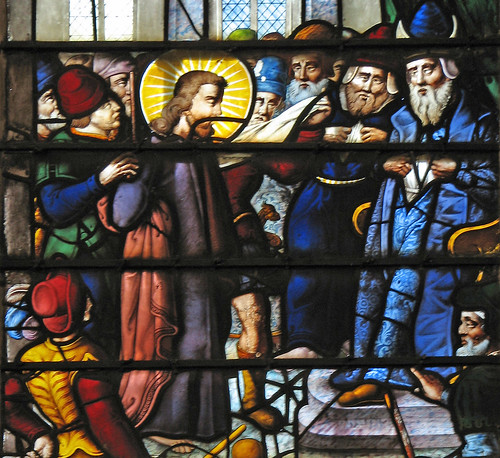
Christ before the High Priest.

In today's Gospel Jesus is challenged to justify to men his teaching, miracles and works; 'by what authority do you do these things?' ask the Chief priests and elders of Jerusalem.

This question is in itself of some interest, though it's not obvious. When a man shows up and performs unquestionably amazing deeds very few people are prone to ask 'who gave you the right to do this?' Rather we tend to inquire somewhere along the lines of  'who are you?' Or 'where do you come from?' Indeed, earlier in the Gospel men, upon hearing Jesus's teaching, ask 'is this not the carpenter's son?' (Mt. 13:55). So, what can be made of the chief priests' concern, not for Jesus's provenance but for the identity of the one who sent him?

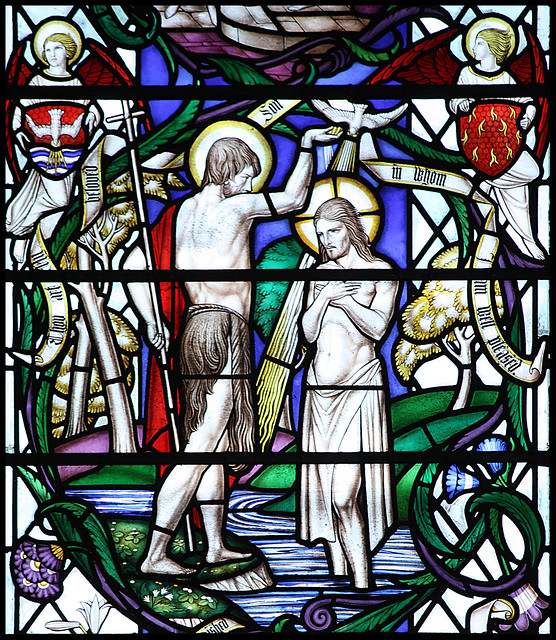
Baptism of St. John.
On one level it implies a recognition of a kind of legitimacy. The priests recognise that someone with jurisdiction permitted Jesus to act as he did. St. John Chrysostom identified two powers at work in the world, that of God and that of Satan. So who sent Jesus? Christ had answered this question before, in the twelfth chapter of this Gospel the Lord asked that if Satan cast out Satan, how could his kingdom stand? On the other hand, if it was by the spirit of God that he cast out demons, then, he said, 'the kingdom of God is upon you.' (Mt. 12:26-28)

When Jesus addressed the issue of the devil he wasn't answering a question, rather he responded to thoughts he perceived. This isn't surprising, if you ask an agent of the deceiver if they are in fact an agent of the deceiver; we know what answer you'll get!

So, it's plausible to suppose that the Jews knew, at least implicitly, who they were talking to. What they were seeking, perhaps unconsciously, was some kind of confirmation of their fears. Further evidence of this appears in the way Christ responded to their inquiry: was John's baptism of heavenly or human origin? A question they cannot answer, not because they don't have an opinion but rather because it is not propitious to offer it. Jesus gave the elders a chance to speak plainly, but what is made plain is their duplicitous nature. In another place he says, again in regard to questions of his provenance, 'it is my Father who glorifies me... If I said, I do not know him, I should be a liar like you' (John 8: 54-55).

The priests and elders feared the coming of the Christ, perhaps as much as Herod the Great who attempted to kill the prophesied messiah, for the sake of human glories. Yet, these were the holy men of the day. The keepers of the traditions of Israel, the men who sat on the seat of Moses, how could they get things so wrong?
Christ Reigns from a Tree.

Advent is a time for joyful anticipation, as we gather our thoughts and prayers in preparation for rejoicing the incarnation of the Son of God. However, it is also a time for a kind of pious trepidation. Alongside our joy we practise fasting and spiritual examination. Jesus's exposure of the holy men of his day demands that we turn towards him and away from distractions that could blind us to his very presence, it warns us to avoid their mistakes. We recognise in Advent that we are to often too attached to the world and its comforts, we are faced with that most blatant reminder that our King wasn't born in a palace but in a barn, he wasn't carried to a throne but hung upon a tree.

St. John of the Cross tells us that for fellowship with Christ we must walk the way of the cross: let us offer up then what little sacrifices we can, that we might be more like the one who loved us, that we might be better prepared to kneel by the manger forsaking the comfort and pride of our world and its glories.


Saturday, December 14, 2013

Third Sunday of Advent: Gaudete Sunday

Readings: Isaiah 35:1-6,10; Psalm 145:6-10; James 5:7-10; Matthew 11:2-11

Gaudete Sunday takes its name from the latin ‘gaudete’ which means “rejoice”. The entrance antiphon of the Mass today begins with “Gaudete in Domino semper: iterum dico, gaudete”. This can be translated as “Rejoice in the Lord always; again I say, rejoice”. Pope Benedict XVI highlighted that these words of St Paul urge Christians to rejoice because the Lord is coming, his glorious return is certain and will not be delayed. We wait with hope, certain of Christ’s second coming because we have experienced his first.
In preparation for the Solemnity of Christmas Day and the peak of Advent, most of us will at some point be rushing around trying to find presents for people, buying a turkey (or perhaps a vegetarian alternative). Rushing from one shop to another to get those last minute items, sometimes our consumer mission is interrupted by a street preacher or someone shouting about the need to repent, with seemingly random bible passages on the second coming. Certainly the first thought to enter my head is “I’d better walk on the other side of the street” or sometimes there might be a slight increase in my stress levels depending on what message or agenda they are trying to convey. I suspect most people walk past street preachers without giving too much notice. If serious questions were to be asked, then people aren’t usually going to ask them in the context of rushing around the high street.

In this Sunday’s Gospel, we see Jesus affirm John the Baptist as the messenger who prepared the way for Jesus the Christ. He was, perhaps, the equivalent of today’s street preachers with signs around them saying ‘repent and your sins will be forgiven’. John the Baptist denounced immoral marriage, lifestyles of vice and sin, and he demanded the repentance and baptism of his hearers on the banks of the river Jordan. The same message could perhaps be heard outside shopping centres today, but one of the key differences is the credibility and authority of John the Baptist and his preaching on what was to come. Not just another mad man wearing funny clothes, eating locusts and shouting about the end of the world. He was taken so seriously that he baptised many hundreds of people, including Jesus. Indeed, his influence extended so far that he ended up in prison for causing offence to those who held power in Galilee. John the Baptist made his hearers stop and think about their need to repent. So, as he was in prison, John could rejoice in the fact Jesus was now taking over the preaching role, but this time being much more than a prophet or messenger: someone with a deep and real working knowledge of what it is going to be like after we die, and what we can do on this world to gain access to the kingdom of heaven and everlasting life.

Perhaps in our Christmas consumer rush, we need to stop at this point of Advent and take note of what the genuine preachers are saying to us. The end of the world may be at hand, but what today is about is rejoicing about this rather than being in a state of fear. We do need, on occasion, to step back from a consumer-driven Christmas and focus on the Gospel of Christ. It is the annual cliché of course, but there is more to the festive period than buying vast amounts of presents, eating and drinking too much. We need to tune in to what preaching message challenges us, forget the deep-filled mince pies, as they don’t really matter. What does matter is that we are prepared for the end of the world, and then we can rejoice always. 

For strangely dressed, genuine preachers and the chance to repent, visit a Dominican priory near you!

Friday, December 13, 2013

Second Saturday of Advent: Things as they are


Readings: Sirach 48:1-4, 9-11; Psalm 80:2-3, 15-16, 18-19; Matthew 17:10-13


“Richard, when will you see things as they are?!” – so Richard’s parents berate him in the wonderful novel by Paul Horgan, Things As They Are. Richard’s parents are exhausted by his constantly seeing the magical in the mundane, the extraordinary in the ordinary. They aim to drum this out of him, to get him to be sensible and to live in reality. Yet a creeping awareness dawns on us, as we see Richard losing his child-like innocence, that really it is Richard who gets it. It is Richard who has the Catholic sensibility to detect the divine at work in the everyday.
In today’s Gospel, Jesus laments that “Elijah has come already and they did not recognise him, but treated him as they pleased; and the Son of Man will suffer similarly at their hands” (Matt 17:12)
It is a similar lack of vision to Richard’s parents that can lead us to ignore the prophetic actions of others in our midst. Brother Samuel in his post yesterday reflected on how the actions of John the Baptist and Jesus challenge us. When confronted by challenging people there can often be a tendency to write off their actions as merely eccentric or even mad. We do not want our version of a comfortable reality disturbed. When the light shines brightly, as it did for Peter, James, and John at the Transfiguration, the temptation can be to shut our eyes.

Transfiguration in St Cross, Oxford


Thus at one end of the spectrum we refuse to see the magnificence in all creation and, at the other, we dismiss that which is evidently out of the ordinary as errant or impossible. Why?  Perhaps it is because deep down we know that, when Jesus says Elijah is to restore all things, (Matt 17:11) this is not going to be a tinkering around the edges. It is not the time for God to order things in accordance with our will, but rather for us to prepare for the coming our Lord and Saviour, the one who will inaugurate the Kingdom of Heaven by his presence on earth. It is we who must have a conversion of heart and we might do well to mimic the example of those around us whom we might normally dismiss. All around us there is evidence of the Kingdom of Heaven, if only we would see things as they are.

Thursday, December 12, 2013

Second Friday of Advent: Fasting and Feasting

Readings: Isaiah 48:17-19; Psalm 1:1-4,6; Matthew 11:16-19

You just can’t please some people. One can sense Our Lord’s frustration in today’s Gospel as he rebukes the crowds for their unbelief. Their hard-heartedness has left them unable to see an exemplar and prophet in their midst in the person of St. John the Baptist. Rather than be impressed by his austerity and observance of the law, they dismissed him thinking he was possessed.  

Similarly, and more troubling still, the crowds fail to accept Jesus Christ, “the Son of man”. He who, in contrast to John, had worked miracles before them - changing water into wine, and had preached a compelling message of compassion and love. Their response was to brand him “a glutton and a drunkard”, echoing the rebellious good-for-nothing type described in the book of Deuteronomy [21:18-20].  

Neither John’s abstinence nor Jesus’s mildness satisfied them. Like obstinate children, they refused to be moved. “Why?”, one might well ask. John and Our Lord were impressive all right, but perhaps they were a bit too challenging; they made the crowds feel uncomfortable. Perhaps John seemed too zealous, whereas Jesus was thought perhaps too radical - breaking all the laws.  And, after all, one wouldn’t have wanted to rock the boat too much lest the powers-that-be might get wind of it. The problem, then as now, was fear.  Maybe this is why Jesus says time and again in Scripture, “Do not be afraid!”

St. John the Baptist, Giovanni Barbieri
Given that Jesus is the person who we are called to follow, one might well wonder at the significance of John the Baptist in this account. Why did the Lord choose a more lenient life and through John demonstrate a harsher one? St. Thomas suggests three reasons. First, John did not perform miracles so he needed to lead an impressive life so that his testimony, which prepared a way for the Lord, would be accepted. Secondly, John showed one way of living the good life through abstaining from human carnal desires. John was a man of purity. But Jesus was God, and if he had taught severity, he would not have been shown to be also man so he assumed a life which emphasised his humanity. What could be more human than food and drink? Thirdly, John represented the end of the Old Testament, in which heavy burdens were imposed; but Christ was the beginning of the New Testament - with a new law - which proceeds by way of meekness.


Jesus holds up both John’s example of fasting, and his own example of eating and drinking - or feasting. Each have their place and time. In this season of Advent, we are presented with an opportunity to fast and abstain from certain pleasures in order to focus our minds on the coming of the Christ child - preparation never more needed than in contemporary culture. Such preparation will have the additional benefit of making the great feast that celebrates the the birth of Our Saviour all the more fitting.

Las Casas Lecture by Jean-Jacques Perennes OP - "the message of the martyrs of Algeria", and a reflection on the film Of Gods and Men

This evening at 5pm in the Aula at Blackfriars, Oxford, the Las Casas Institute is delighted to be hosting Jean-Jacques Perennes OP, who will be giving a lecture entitled: “Witness of the Gospel in a world of violence: the message of the martyrs of Algeria”. All who can make it are most welcome to attend.

Jean-Jacques is a Dominican Friar of the French Province, but lives in Cairo where he is the director of the IDEO. Established by the Dominican Order in 1953 at the request of the Holy See, the Dominican Institute for Oriental Studies (Idéo) comprises a team of scholars and researchers wishing to promote a better understanding among Christians and Muslims.

Jean Jacques has a particularly strong link with the martyrs of Algeria, being a personal friend and for 10 years assistant to his fellow Dominican, Bishop Pierre Claverie of Oran, Algeria, who was assassinated in 1996 at the hands of the Islamic Salvation Front. In 1991, the ISF had won Algeria's first free national elections, only for the results to be voided by the military, secular government. During the 1990s, in retaliation an extreme fundamentalist Muslim group known as the Armed Islamic Group committed violent atrocities aimed at more secular Muslims and the Christian minority.

Jean Jacques has written a biography of his martyr-friend, entitled, A Life Poured Out. In his book we learn that Bishop Claverie was only too aware of the danger he faced due to the dramatic tensions in Algerian society. "Reconciliation is not a simple affair," he wrote in 1995. "It comes at a high price. It can also involve, as it did for Jesus, being torn apart between irreconcilable opposites. An Islamist and a kafir (infidel) cannot be reconciled. So, then, what's the choice? Well, Jesus does not choose. He says, in effect, 'I love you all,' and he dies."

Those words proved chillingly prophetic. Bishop Claverie was killed on 1 August 1996, just two months after the brutal beheading of seven Trappist monks in Tibhirine, Algeria. He died alongside his Muslim friend and driver, Mohamed Bouchikhi, when a bomb exploded in the bishop's residence. These Trappist monks have recently been brought to far greater prominence by the beautiful film, Of Gods and Men.

With a view to tomorrow’s talk some of the friars sat down with students of the Hall to watch the film yesterday evening. What follows is a brief narrative and reflection on the heroic qualities of these monks as depicted in the film.

The early scenes of the film give us a sense of the daily life in the monastery, the work, the production of goods for sale to provide a livelihood, the positive relations with the local people, both in terms of trade, but also the provision of medical services, clothing and wise counsel as needed.

One of the most touching scenes in the whole film, and one which tells us a great deal about the vocation to religious life, is a dialogue between the elderly monk-physician, Brother Luc, and a young girl hesitant about arranged marriage. After a pause in their conversation on the nature of love, she asks him, “Ever been in love?”

The old monk leans over and replies, “Yes, several times. And then I encountered another love, even greater. And I answered that love. It’s been a while now. Over 60 years.”

The monks in the film are not given some idealised portrayal. They are very human and easy to relate to: at times we see them vacant, a million miles away from the task at hand; we see them scared; we see them argue, we see them going about their daily chores; we see them forgive, and most importantly we see them pray. It is their prayer in common and individually which is so obviously the source of heroic decision to remain in their monastery, in spite of great danger to themselves. It is prayer which enables them to discern where God has asked them to be.

The film charts their dawning realisation of how grave the risk is to them, when, after a spate of killings of foreign workers outside the monastery, they themselves are confronted at gunpoint. In a poignant moment as the terrorists are leaving, Christian, the Abbot calls out to them to let know that tonight, Christmas Eve, is the night the Prince of Peace was born. The terrorists who arrived with violent clamour leave in silence.

Silence is, in fact, a recurring theme in the film. One of its most beautiful aspects is the regular juxtaposition of the silence of monks’ lives and the noise outside. Even when the chaos of the world threatens the monastery, and the noise crashes in, there is still a quietness in the gentle determination which meets it. This is typified by Abbot Christian when he refuses to dialogue with the terrorists inside the bounds of the monastery, after they refuse to lay down their weapons.

As the film progresses the choice between flight or the strong possibility of martyrdom becomes ever more stark. As a community, they discuss how each of them feels about leaving or staying. It is the eldest monk who reminds that they need not take a snap judgment, but should pray and reflect on it.
It is not a straightforward process, the heroic path rarely is. The youngest monk after witnessing roadside killings has a Gethsemane moment, he prays fervently to God “Help me, help me” as he is feverish with fear. In a subsequent conversation with the Prior he laments how fear of death prevents him from sleeping, he wonders what purpose his death would serve. The Prior responds that staying would be mad, mad as becoming a monk! He reminds him that he has already given his life to God. The young monk responds that he does not understand what purpose martyrdom would serve. The Prior reminds him that they stay out of love not desire for martyrdom, and that love endures everything.

This last point is important - the monks do not seek martyrdom, they are clearly scared of a violent death, but they have a stronger motivation than their fear – love. It is the love of Christ which gives them the strength to accept martyrdom if that be the cup from which they must drink, it is the love of Christ who they see present in the surrounding people that puts them at their service regardless of the cost.

Eventually as a community they come to a decision to remain. As they reflect on the time since the initial violent intrusion the Abbot remarks that they have found their salvation in their daily tasks, the work, the prayer, the Mass, the cooking, the cleaning, the service for others – all at the service of God. It is for this that they stay and in staying faithful to Christ and to these tasks they give the ultimate gift of their lives. In closing all I can say is that if you have not seen this film yet, you must! And if you have, watch it again, it gives more with every viewing.

If you wish to learn more about the Martyrs of Algeria, short biographies of the martyrs between 1994 and 1996, who are drawn from many different Orders can be found here - http://www.africamission-mafr.org/sang_martyrgb.htm.


Wednesday, December 11, 2013

Second Thursday of Advent: On the way

Readings: Is 41, 13-20; Ps 145; Mt 11:11-15.

I have almost finished my first term. I write 'almost', because I have to pass the exams and then I will be able to say that this is the end, but not yet. Now I am on the way to get to this goal. There are a lot of very similar situations in our life. We are always on the way trying to achieve something what seems very valuable. The purpose and awareness of its realization mobilizes us and give us strength.

It is exactly the same with our faith. We are called by God to reach the kingdom of heaven. The destination is defined very clearly. We just need to know how to get there. The answer to this question can be found in today's gospel. Jesus says that the kingdom of heaven has been taken by force by the violent (cf. Mt 11:12). But these words about 'force' and 'violence' don't sound good: does it mean that we have to be violent and we need to use force?

A violent person is very determined to achieve his goal. The kingdom of heaven should be the most important goal in our life. Sometimes this may be very difficult, because others can't understand it. Sometimes we may be also rejected by others. Nevertheless today's gospel emphasizes the dynamic aspect of our faith and encourage us to be active. Churches and our homes are not the only spaces for our faith. The space of our faith is our life.

"I, the Lord your God, hold your right hand; it is I who say to you, 'Fear not, I will help you' " (Is 41:13).

Tuesday, December 10, 2013

Second Wednesday of Advent: Work to Live!

Readings: Isaiah 40:25-31; Psalm 103:1-4, 8, 10; Matthew 11:28-30

Come to me, all you who labour and are burdened,
and I will give you rest.

My room is getting messier, the to-do lists longer, and all the burdens on my time much heavier. There is so much I simply have to get done before Christmas. I’ve finished my academic work for the term, but all the things I’ve been putting off for months with the excuse, ‘I can’t do that during term’, are now piling up with a vengeance.

So this invitation from Jesus to rest is immediately attractive – and yet problematic. How can I rest when there is so much to be done?

Bouguereau, Rest at harvest (1865)
Perhaps I need to re-order my priorities. Do I rest in order to work, or work in order to rest? Activity and achievement are not the only important things. Jesus regularly took time away from the crowds to pray (e.g. Luke 5:16). I can learn from his example and see that activism is not the be-all and end-all.

In our culture, especially as we get busier towards Christmas, we need to avoid a utilitarian focus on work. Our common expressions about restfulness as 're-charging my batteries' or a potential 'waste of time' may reveal that we live in order to work. This is unfortunately the modern tendency, as noted by Max Weber in his Protestant Ethic and the Spirit of Capitalism (1905). An older and wiser philosophical tradition (especially since Aristotle) teaches instead that we should work in order to live

Ultimately, we must work to have leisure. This point was made excellently by Josef Pieper in Leisure, the Basis of Culture (1952), arguing that leisure is the foundation for all civilised existence. And it is the basis of religion, which ‘sanctifies’ or ‘sets aside’ time and space gratuitously for the worship of God. The temple or church is an unproductive space, and the Sabbath is an unproductive day, and that is why we must cherish them – that is why we offer them freely and generously back to God. What's more, the same gratitude to God can be expressed in prayer anywhere and anytime.

Getting things done is, of course, a good aim. Work is no bad thing in itself. But it should be sanctified with an attentiveness to God. We can pray before and after work, and even make of our work a prayer in itself. If we work for Christ and in Christ, our labours will be a joy and a blessing. And then Christmas will be a truly restful celebration. 

Monday, December 9, 2013

Tuesday of the Second Week of Advent: The Vulnerable Flock


In today’s Gospel Christ, the good shepherd, invites us to think of his mission as like a search for missing sheep: 

If a man has a hundred sheep and one of them goes astray, will he not leave the ninety-nine in the hills and go in search of the stray? (Matthew 18: 12-14). 

Now of course, the answer to this question may very well be ‘no’. There are all sorts of reasons why a prudent shepherd might choose to accept the loss of one miscreant rather than put the rest of his flock in jeopardy by abandoning them to undertake a search. The fact that Jesus uses this image tells us something, then, about how we are to understand both his own mission and the vocation of the Church. 

To be merciful is to go beyond what is demanded from us in justice; it is to go the extra mile. Jesus is recklessly merciful. He is not obliged to go looking for us when we go astray. He would be well within his rights, as it were, to leave us to the consequences of our sin. Yet his mercy is so great that he comes searching when we lose ourselves. He continually holds out to us the opportunity of repentance and conversion, he gives us time and opportunity to return to Him, to choose life and love. 

Against this background, we gain perhaps the smallest glimpse of why Jesus allows the Church to suffer in this life. In Matthew 10: 16 Jesus tells his disciples: ‘Behold, I send you like sheep among wolves’. While the shepherd is searching for the lost sheep, the ninety-nine He leaves behind are vulnerable to wolves and thieves. It seems to me that in a similar way, the Church will always be vulnerable to persecution and oppression as long as Jesus is offering sinners the time and opportunity to accept his invitation of love, for this invitation may well be rejected. 

As Christ was crucified by those that rejected his offer of love, so his Body the Church will be crucified whenever this re-presented invitation is rejected after the Resurrection. Persecution, then, is an occupational hazard of a Gospel centred life: whenever the Church truly re-presents Christ to the world it runs the risk of being crucified. Yet this is a time of vulnerability because it is a time of conversion: God has given us this time so that he might draw us closer to him, and draw his lost sheep closer to him. If we embrace this vulnerability and return only love when persecution comes, then we co-operate in the Good Shepherd’s saving work both in our own lives and in the lives of those around us: we ourselves become instruments of salvation. 

We are in a time of waiting, then, between the victory over death and evil at the cross and the final judgement at the second coming. In a certain sense, our entire Christian lives are an Advent, a waiting for the coming of Christ: but it is a wait that is slowly producing good fruit both in us and in others. May this season of Advent do the same.

Sunday, December 8, 2013

The Immaculate Conception of the Blessed Virgin Mary

The Immaculate Conception of the Blessed Virgin Mary is a topic which can sometimes cause Dominicans a little bit of embarrassment. Why should this be so? Well, historically it was the theologians of the Dominican Order, following the Angelic Doctor St. Thomas Aquinas, who have been the most hesitant to declare Mary, from the moment of her conception, free from Original Sin. So much so that, even when the majority of the Church celebrated the Conception of Mary, the Order of Preachers did not include the feast in its liturgical calendar.

For many centuries the Church debated whether Mary had been preserved from the stain of sin. On the one hand, the idea seemed quite logical; how could the pure and holy Son of Man be borne in a corrupted vessel, that is to say Mary’s womb? Then again, St. Paul had said ‘all have sinned and fall short of the glory of God’ (Romans, 3:23), if Mary had never suffered from the stain of Original Sin then in what sense did she need to be saved and how did St. Paul’s teaching apply to her?
Pope Pius IX
It is this question which vexed St. Thomas, and it is worth remembering that many of those of St. Thomas’s contemporaries who supported the Immaculate Conception did so with the understanding that Mary was exempt from the need for a redeemer, a notion neither accepted nor allowed for by the Church. So, what has the Church told us? Well, Bl. Pius IX defined on the eighth of December 1854 that the Blessed Virgin Mary ‘in the first instance of her conception, by a singular privilege and grace granted by God, in view of the merits of Jesus Christ, the Saviour of the human race, was preserved exempt from all stain of Original Sin.

God bestowed on Mary a great and unique gift: not only was she to carry the Son of God, she was held pure from the moment she came into existence. We might wonder: God might choose to preserve Mary from Original Sin, but if he did that then in what way did she need to be saved? Surely if she never contracted the guilt of sin, she had nothing to atone for? We might dare to say that Christ’s redemptive sacrifice made little difference to her…

The Angelic Doctor
This is not an unfair point, and the answer isn't obvious. St. Thomas offered one response in his Summa, he proposed that Mary was conceived with the stain of sin but sanctified in the womb before her birth. In this scheme we can admit that Mary needed to be redeemed but still say she was extraordinarily holy during her life, and therefore a fitting mother of the Redeemer.

St. Thomas, when writing his Summa, wanted to firmly demonstrate that Mary needed to be saved by Jesus, which is true. However, it was for Bl. Duns Scotus to take up where Thomas had left off and offer the full picture of Mary’s conception. Surely, asked the ‘subtle doctor’, it takes a physician of greater skill to prevent a disease rather than merely to cure it? Does not Mary receive the greatest experience of redemption by being preserved by Grace from sin? Mary experienced the supreme redemption by virtue of the merits of the Cross, it was Jesus who saved her; he made her pure and spotless who was to carry him in her womb.

No one can deny the beauty of the care that Jesus showed for his mother. He gave her the greatest gifts of all, and protected her from the moment she came to be. Indeed, this example of God’s abundant love was well known to St. Thomas, for he wrote towards the end of his life, commenting on the Archangel Gabriel’s salutation, 'For she (the Blessed Virgin) was most pure in the matter of fault and incurred neither original nor mental nor venial sin.'


St. Thomas, without the benefit of Duns Scotus’s argument or the Church’s solemn definition of 1854, knew what all Christians now understand when they hear the words ‘Hail Mary, full of Grace’. The Blessed Mother of God the Virgin Mary was preserved in Grace, by the merits of Jesus’s death, from every sin, original, mental and venial, so that she might be the pure and unblemished vessel of the Son’s entry into the world.

Saturday, December 7, 2013

Second Sunday of Advent: Prepare the way of the Lord

On this Second Sunday of Advent, Br Toby Lees OP explains the true trajectory of Advent as a preparation for Christmas.


Prepare the way of the Lord, make straight his paths” (Matthew 3:3)

One of the great joys, and there have been many, since joining the Dominicans in September last year, has been the chance to fully live the Church’s liturgical year. A kaleidoscope of liturgical colours marks the passing of feasts and seasons, the food on the table alters and excitingly wine glasses appear on the table on Solemnities.

It was only last year that I truly realised that for most of my adult life I’d lived Advent and the Christmas Octave back to front. Working as a solicitor in the City for 7 years, Advent had been marked by client socials, office parties, and the attempt somehow to fit in drinks with the friends who I really wanted to see as well. It was exhausting . . . and fattening. Christmas could feel like one last jaded push and then one could have a few days of respite and recovery before a final hurrah for New Year’s, followed by the onset of the January doldrums. Last year all that changed. For a start Advent was marked by the exciting change to my brand new blue breviary for the Divine Office – the cycle of prayer that punctuates our daily lives as religious – having used the brown volume of Ordinary Time for the previous 26 weeks. The psalms remained the same but the changing antiphons – the introductory lines to the psalms – and hymns were a constant reminder that we were getting ready to celebrate something truly momentous; the coming of Our Saviour. One that excited me and still remains fixed in my head is a verse from First Vespers of Christmas Day:

The rose of grace and beauty of which Isaiah sings,
Is Mary, virgin mother, and Christ the flow'r she brings
By God's divine decree
She bore our loving Saviour, who died to set us free.

That first year in religious community, Advent became a time of preparation, and not just a countdown to Christmas. There were not quite the same number of “before Christmas” Christmas party invites; what there was, instead, was plenty of time to reflect and prepare for a true celebration of the full Christmas Octave. I am acutely aware that religious life puts you in a privileged position in this respect. For the first time I realised that Christmas was too significant to be celebrated, and its enormity absorbed, in just one day. It was a time of genuine rejoicing with my new brethren and, thanks to the generosity of many parishioners, those wine glasses which mark the most significant of days were ever-present at the community meal. It was a truly joyous time.

In today’s Gospel we hear Matthew designating John the Baptist as that one who was spoken of by Isaiah, the prophet. He is that voice crying out in the wilderness: “Prepare the way of the Lord, make his paths straight” (John 3:3). We are reminded to “Repent for the Kingdom of heaven is at hand”(John 3:2) having been cautioned in last week’s Gospel “to be ready for the Son of man is coming at an hour you do not expect.” (Matthew 24:44)
Crucifix with John the Baptist, Chapter Room, Priory of the Holy Spirit, Oxford
Now I am not advocating that we should use the fact that over 3 weeks remain until Christmas as a delaying tactic, lest the Son come sooner(!), but hopefully in the remaining time of Advent, amongst the festivities and the good of meeting with friends and family, we can put aside some time for preparation and for a renewed fervour in our faith. We can use the time to reflect on where we have gone wrong and how to put it right. Any time is a good time to seek the Sacrament of Reconciliation, but Advent particularly so. Advent has traditionally been a time of fasting, perhaps we might consider this as a way of making the spiritual feasting, and mealtime feasting if we are fortunate enough, of Christmas more pronounced.

Pope Benedict wrote that: “Advent invites us once again, in the midst of many difficulties, to renew our awareness that God is present: He came into the world, becoming a man like us, to bring His plan of love to fullness. And God demands that we become a sign of his action in the world. Through our faith, our hope, our love, He wants to enter the world again and again He wants to shine His light in our night.” We mark Advent each year not because Jesus did not come once and for all, but because he keeps on coming, wherever we are in our lives he is there for us, just waiting to be let in. As Elizabeth Scalia, one of my favourite Catholic writers, reflects: “Yes, it has 'already happened'. But if God is outside of time, and we know He is, then that momentous event 'is happening' even as you hear this. Right now, a star is shining brightly; a people are moving toward the places from whence they came; a young woman is great with child; wise men are lifting their eyes to heaven and wondering. The place of our own origin, from whence we came, beckons; it sends a flare as a guide! And the One who is All in All is moving toward us — in breathtaking humility — to show us the way back."

So this Advent let us try and put aside a little time each day to take comfort and be grateful for the fact that each one of us is truly loved, loved so much that God should give “his only-begotten Son, that whoever believes in him should not perish but have eternal life.” (John 3:16)
Baptistery, Church of St James, Castres
On Jordan's bank the Baptist's cry
announces that the Lord is nigh;
awake and hearken, for he brings
glad tidings of the King of kings.

Then cleansed be every breast from sin;
make straight the way for God within,
prepare we in our hearts a home
where such a mighty Guest may come.