Showing posts with label popular piety. Show all posts

Tuesday, January 21, 2014

Popular Piety: Litanies and Novenae

“When you pray, do not keep on babbling like pagans, for they think they will be heard because of their many words” (Matthew 6:7). These words of Our Lord are often cited by opponents of the traditional practices of Novenae—which involve the repetition of set prayers on nine consecutive days—and Litanies—with their repeated invocations and responses. These forms of prayer are inherently repetitious and predictable; they are often caricatured as monotonous and lengthy (‘litany’, for example, has passed into idiomatic secular English: “the customary litany of complaints having duly been received…”). 

It would be quite wrong to suppose that Litanies and Novenae are possessed of some magic efficacy, to slip into the belief that they ‘work’ on the basis that if we say something often enough God will eventually give in and grant us our requests. Rather, they are a gift of God to the Church, a way of praying particularly suited to our human condition: it is good for us to turn repeatedly to God, to bring to mind our friendship with Christ in the midst of everyday life and implore his mercy again-and-again. The repetitious nature of litanies helps us to manage distraction and to move more deeply into prayer, as the words begin to flow over us, drawing us beyond the words themselves into a deeper contemplation; the familiar text of a novena becomes an ‘old friend’, a comfort and a guide for our journeying. 

In moments when we can’t find words for ourselves (yes, even garrulous Dominicans find this happens sometimes!), we make our own these well-worn words, tested in the crucible of centuries of Christian witness and endorsed by the Church. We insert ourselves into the community of saints whose names we invoke to pray with us and for us; we recognise that there are others who will say ‘amen’ to our prayers as we say ‘amen’ to theirs. So whilst I have to admit that there are times when I’ve neglected these traditional devotions—and it is certainly important to develop our friendship with Christ through mental prayer—it might be worth me pondering whether I’m more likely to babble like a pagan in my own extemporaneous prayers, or when I turn to these prayers recognised by the Church as a gift of Our Lord.

Sunday, January 19, 2014

Popular Piety: The Sacred Heart of Jesus

The Sacred Heart of Jesus is an image etched deeply in the minds of many Catholics. The devotion emphasises the perfect, redeeming love of Jesus, and the living water which flows from His heart (cf Jn 7:37-39).


The origins of this longstanding piety lie in the Medieval period.  It was promoted by, amongst others, the Flemish Mystic St. Lutgarde of Aywieres (1182-1246) and St. Gertrude the Great (1256-1302). It was not until the seventeenth century, however, that the devotion became more widespread in its popularity through its promotion by these two notable individuals, and the Society of Jesus more generally. St. John Eudes (1601-1680) a Frenchman who was educated by the Jesuits, wrote The Life and Royalty of Jesus in the Christian Soul in 1637 and composed the Office of the Sacred Heart in 1668. Both works served to dramatically increase the numbers of people honouring the Sacred Heart. Another French saint, St. Margaret Mary Alacoque (1647-1690), had visions of the Sacred Heart and her writings led to the twelve promises of Our Lord made to those devoted to His Sacred Heart. The Jesuits saw in the Sacred Heart a powerful antidote to Jansenism, which emphasised the futility of life; their followers enkindled a sense of God’s remoteness and the soul’s predestination to heaven or hell.

Since 1856, the Church has kept the Solemnity of the Sacred Heart of Jesus on the Friday which follows the Second Sunday after Pentecost. The entrance antiphon we say at Mass reads: “The thoughts of His Heart last through every generation, that He will rescue them from death and feed them in time of famine” (Ps. 31:11,19). 

Our Lord is compassion and love. Devotion to the Sacred Heart stirs us to call upon Him who provides all things, and to dedicate ourselves to Him in loving humility. We have in the Sacred Heart of Jesus, therefore, a timeless devotion which we would do well to make our own.

Prayer to the Most Sacred Heart of Jesus
O most holy heart of Jesus, fountain of every blessing, I adore you, I love you, and with lively sorrow for my sins I offer you this poor heart of mine. Make me humble, patient, pure and wholly obedient to your will. Grant, Lord Jesus, that I may live in you and for you. Protect me in the midst of danger. Comfort me in my afflictions. Give me health of body, assistance in my temporal needs, your blessing on all that I do, and the grace of a holy death. Amen.

Popular Piety: The Sacred Heart of Jesus

The Sacred Heart of Jesus is an image etched deeply in the minds of many Catholics. The devotion emphasises the perfect, redeeming love of Jesus, and the living water which flows from His heart (cf Jn 7:37-39).


The origins of this longstanding piety lie in the Medieval period.  It was promoted by, amongst others, the Flemish Mystic St. Lutgarde of Aywieres (1182-1246) and St. Gertrude the Great (1256-1302). It was not until the seventeenth century, however, that the devotion became more widespread in its popularity through its promotion by the two notable individuals, and the Society of Jesus more generally. St. John Eudes (1601-1680) a Frenchman who was educated by the Jesuits, wrote The Life and Royalty of Jesus in the Christian Soul in 1637 and composed the Office of the Sacred Heart in 1668. Both works served to dramatically increase the numbers of people honouring the Sacred Heart. Another French saint, St. Margaret Mary Alacoque (1647-1690), had visions of the Sacred Heart and her writings led to the twelve promises of Our Lord made to those devoted to His Sacred Heart. The Jesuits saw in the Sacred Heart a powerful antidote to Jansenism, which emphasised the futility of life; their followers enkindled a sense of God’s remoteness and the soul’s predestination to heaven or hell.

Since 1856, the Church has kept the Solemnity of the Sacred Heart of Jesus on the Friday which follows the Second Sunday after Pentecost. The entrance antiphon we say at Mass reads: “The thoughts of His Heart last through every generation, that He will rescue them from death and feed them in time of famine” (Ps. 31:11,19). 

Our Lord is compassion and love. Devotion to the Sacred Heart stirs us to call upon Him who provides all things, and to dedicate ourselves to Him in loving humility. We have in the Sacred Heart of Jesus, therefore, a timeless devotion which we would do well to make our own.

Prayer to the Most Sacred Heart of Jesus
O most holy heart of Jesus, fountain of every blessing, I adore you, I love you, and with lively sorrow for my sins I offer you this poor heart of mine. Make me humble, patient, pure and wholly obedient to your will. Grant, Lord Jesus, that I may live in you and for you. Protect me in the midst of danger. Comfort me in my afflictions. Give me health of body, assistance in my temporal needs, your blessing on all that I do, and the grace of a holy death. Amen.

Popular Piety: Scapulars and Medals

 “… I suppose they try to make you believe an awful lot of nonsense?”
“Is it nonsense? I wish it were. It sometimes sounds terribly sensible to me.”
“But my dear Sebastian, you can’t seriously believe it all.”
“Can’t I?”
“I mean about Christmas and the star and the three kings and the ox and the ass.”
“Oh yes. I believe that. It’s a lovely idea.”
“But you can’t believe things because they’re a lovely idea.”
“But I do. That’s how I believe.”

This wonderful conversation between Sebastian and Charles in Brideshead Revisited might easily have been triggered by scapulars and medals. To those outside the Church they are often viewed as confirmation of the lunacy of Catholics, and indeed to some within they are viewed as an expression of an out-dated medieval mindset of superstition. Yet properly considered, they are an expression of the fact that God meets us in the physical as well as the spiritual – that The Word became flesh. As Chesterton wrote in one of his columns: Whenever men really believe that they can get to the spiritual they always employ the material. When the purpose is good, it is bread and wine; when the purpose is evil, it is eye of newt and toe of frog. It is worth being aware of a tendency - that I certainly find present in myself - to credit God with so much in His Creation and in His Incarnation and then to express incredulity at small marvels and signs.

Scapulars...

A scapular is a kind of sacramental: a prayer, action, or thing which, through the prayers of the Catholic Church, can assist us in receiving God's grace The word "scapular" comes from the Latin word for "shoulder." In its original form, the scapular is a part of the monk or friar’s habit. However, in popular piety scapulars are most often composed of much smaller pieces of cloth. Technically, these are known as the "small scapulars". Each small scapular represents a particular devotion and often has a certain indulgence or even a revealed "privilege" (or special power) attached to it.

The most famous of the small scapulars is the Scapular of Our Lady of Mount Carmel (the "Brown Scapular"), revealed by the Blessed Virgin Mary herself to St. Simon Stock on July 16, 1251. Those who wear it faithfully as an expression of devotion to the Blessed Virgin Mary, it is said, will be granted the grace of final perseverance. 


A scapular is not a magic amulet or a lucky charm: rather, when worn with devotion, scapulars have the capacity to help us in our Christian life because they can inspire good thoughts and thus increase devotion. Whilst some scapulars are associated with a particular message, it must be remembered that since sacramentals are not magic, the efficacy of the scapular and its guarantee depends on the faith and appropriate intentions of the wearer. The Vatican Directory on Popular Piety describes it thus: “The Brown Scapular is an external sign of the filial relationship established between the Blessed Virgin Mary, Mother and Queen of Mount Carmel, and the faithful who entrust themselves totally to her protection, who have recourse to her maternal intercession, who are mindful of the primacy of the spiritual life and the need for prayer.”

Medals....

Among the various medals, the most popular is the "Miraculous Medal". Its origins go back to the apparitions in 1830 of Our Lady to St. Catherine LabourĂ©, a novice of the Daughters of Charity in Paris. The medal was struck in accordance with the instructions given by Our Lady and has been described as a "Marian microcosm" because of its extraordinary symbolism. It recalls the mystery of Redemption, the love of the Sacred Heart of Jesus and of the Sorrowful Heart of Mary. It signifies the mediatory role of the Blessed Virgin Mary, the mystery of the Church, the relationship between Heaven and earth, this life and eternal life. The Church blesses such objects of Marian devotion in the belief that "they help to remind the faithful of the love of God, and to increase trust in the Blessed Virgin Mary". 


Tuesday, January 14, 2014

Popular Piety: Processions


In the Catholic Church processions are part of the liturgy and they have a religious character. They are public acts of homage to God, to give honour to Him, or to the Mother of God or to the saints. The word 'procession' comes from the Latin word 'procedere' which means to go forth or to proceed. In this case it emphasizes the dynamic character of the liturgy which in turn reflects the dynamic nature of our faith. Processions express the physical and spiritual condition of human beings who are pilgrims on this earth and who are always on the way.


Liturgical processions have some important Biblical precedents. For example, 1 Chronicles 15 and 2 Samuel 6 describe the procession with the Ark of the Covenant into Jerusalem, carried by the people with music, dancing and shouts of joy. The Psalmist sings of a  procession to the Sanctuary of the Altar with the singers, the musicians and the congregation. Not all Biblical processions were joyful. We also find references to funeral processions, for example Luke 7. All four Gospels describe a procession forming as Jesus rode into Jerusalem on a donkey.


There are two Biblical processions that have a particularly deep significance. The first was when Israel went out from Egypt and God led them to the promised land for forty years. The second is the Way of Cross when Jesus went to the place where he was crucified.


Processions are also part of the Eucharist. There is a procession at the beginning of the Mass, with the Book of the Gospels, and another when people bring the gifts before the offertory. During the liturgical year there are a few processions. The best known is the procession on the solemnity of Corpus Christi. There are also processions on Palm Sunday and after the Easter Vigil to announce the Resurrection of Christ. There may also be processions ordered on special occasions, for example the feast of the dedication of a church, processions with relics because of the feasts of saints, as well as thanksgiving or penitential processions.

Friday, December 27, 2013

Christmas Customs in Poland

The Polish culture is very rich in Christmas customs. A lot of them have their own history as well as their symbolic, religious and national meanings. Some of them have changed and even disappeared, but Christmas is still very beautiful and profound time. In Poland we start celebrate Christmas at Christmas Eve. This day is called in Polish 'Wigilia' and this name comes from Latin 'vigilare' which means waiting, because we wait for the birth of Jesus. This day has very family character. In the evening there is a supper which starts when in the sky will appear the first star. This is the symbol of the Bethlehem Star when the wise men from the East saw the star in the sky and this star led them to place where Jesus was born.
At the beginning of supper there is a prayer for God's grace and welfare for the members of the family. After that is read the passage from the Gospel about Jesuss' birth. Then we share the Christmas Eve wafer, which is a kind of bread having very similar consistency to hosts used during the Eucharist. The Hebrew word 'Bethlehem' means 'House of Bread'. The Polish name of this wafer is 'opłatek' and it comes from the Latin word 'oblatum' what means 'an offering'. The head of family distrubutes a piece to each person at the table. Then he breaks the wafer and wishes each member of the family all the best. Then the other family members greet one another in the same way. The breaking of bread is a symbol of charity and unity, as well as forgiveness.

We put some hay under the tablecloth, because Jesus was born in a stable. On the table there is one plate more than persons in the family. This plate is for unexpected guest, because on this day no one should be alone. We also light candles. Traditionally on the table there are 12 dishes and everybody should taste all of them during the Christmas Eve supper. Because of the special character of the day there is a traditional fast. One of the most important dishes is one of fish species called in Polish 'karp' and there is also a beetroot soup with little dumplings called in Poland 'barszcz z uszkami'. There is dried fruit compote to drink and after the main course there are cakes.
Before Christmas we decorate the Christmas tree and under it after Christmas Eve supper there are presents to be unwrapped. We also sing Christmas carols. In the Polish culture Christmas carols are part of the national tradition and there is a great collection of various Christmas songs. Very important is the Midnight Mass called in Poland 'Pasterka' and this name comes from the Polish word means 'shepherds' who were the first to greet baby Jesus. In this special night animals speak with a human voice and those that were in a stable when Jesus was born genuflect at midnight. Christmas Eve starts the celebration of Christmas and in Poland there are two Christmas days, 25th and 26th of December, this time we spend we our families.

Thursday, November 28, 2013

Popular Piety in Advent: facts, threats and opportunities.

Advent is the opening liturgical season of the Church’s year. It has its own distinct character and popular piety should be informed by it, and lead towards it. In some ways popular piety can be seen as a bridge between the things of God and the things of the world, suffusing the world with Christian truth and values, and lifting the world to God, in praise, offering and an exchange of blessing. As a specific liturgical time, there are forms of popular piety that are specific to Advent, and others that take on a particular hue and mood in Advent. It is a time of waiting, conversion and hope. We wait to celebrate Christmas, the first coming of the Lord in human flesh, while assessing the way in which we wait for his return in glory at the end of time. The former leads us to focus on the past and the memory of salvation history, the latter leads us to focus on hope, if also vigilance and generosity, aware of a coming so glorious it can scarcely be imagined. Conversion, including almsgiving and penance and a focus on simplicity, is how we prepare for the coming of the Lord, be it now or in the future.

The Advent wreath, which the faithful can put up at home and school and perhaps at work, builds the sense of expectation, as successively we light candles reminding us of the faith, hope, role and message of the patriarchs, prophets, john the Baptist and the Virgin Mary. The candles take up the theme of God’s light coming into a dark world, a theme given extra depth in the northern hemisphere in the dark days of winter. Religiously themed Advent Calendars, perhaps with Scriptural texts and images, could be powerful too, and an effective catechesis. Make your own if they are not available! In some countries Advent processions are important. Attention to the Virgin Mary readily catches the popular imagination, and the Celebration of the Immaculate Conception can be an early focus for this, though she is not a major part of the Advent liturgical readings until the final Octave of preparation before Christmas. Preparation of the crib is one final act, and one that children find attractive, Christmas plays at school being another.

The challenge we face in Post-Christian cultures is not letting Advent be swamped by the secular celebration of Christmas, which is materialist and hedonistic in tone.  It is in full swing throughout Advent these days. There is, I think, a lot to be said for cultivating forms of piety that are prophetic in regard to this slide into secularism, offering an alternative vision and to some extent also protecting ourselves from its excesses.

Advent should persuade us that we are pilgrim people, who receive life as a gift and look to its fulfillment in God. The coming of Christ brought, and will bring, this about but is also to transform how we live now. Mary’s pregnancy had its difficulties, Christ had no home at first and was soon a refugee. Christ entered the world a poor person in solidarity with the poor, and his story draws attention to the plight of the poor and homeless in our world. If we are to welcome Christ, with faith at Christmas, then our piety should find expression in Advent by our attention to the poor and homeless, and with a resolve to embrace simplicity, and not be over-materialistic at Christmas.

We need to allow Advent to be Advent – and Christmas to be Christmas. It too is a whole season, not just one day followed by a huge hangover.  There is a lot to be said for having Advent themed hymn-music-word services in Advent, and keep Carol services proper for the Christmas season - though I realise there are pastoral reasons to adapt this (for instance, in schools shut over all the Christmas season).  Perhaps sending Christmas cards could be postponed  until the Christmas season, and the giving of presents spread across the Christmas season, or focused upon the feast of the Epiphany and its link to the Magi giving gifts to Christ, as happens in some Christian cultures.  Such changes would simplify life in Advent and allow greater focus on its own features.

In offering these suggestions, I do not wish to be a kill-joy. I know that we live in the world, if we are not of it, alongside others and making connections matters. In regard to preparation for Christmas I realise that parents of children are probably under particular pressure to conform to worldly expectations and the demands of the advertisers. Popular piety is inspired in the hearts of each of us, and in new ways in new situations, by the Holy Spirit, so each of us can come up with appropriate forms of it. Nonetheless, there are real challenges to, and opportunities for, popular piety at Advent: it can be swamped by secularism but equally it can play a crucial role, and a developing one, in helpful us celebrate the true meaning of Advent (and Christmas for which it is the preparation), enabling us to shine like stars in a darkened world offering Christ to it (cf Phil 2:15-16), and being ready for his return.

Happy Thanksgiving

In our Oxford priory we celebrate Thanksgiving Day with a big dinner with all the students of Blackfriars Hall, many of whom come from the USA. We provide the turkeys and the students bring lots of side dishes and accompaniments. For many of them it might be the first Thanksgiving away from their family, so we make an effort to create a festive atmosphere here while keeping the families in our prayers.

The essential meaning of the event – to give "Thanksgiving and Praise to our beneficent Father who dwelleth in the Heavens", according to Abraham Lincoln's proclamation in 1863 – transcends national and cultural boundaries. And yet the particular traditions of Thanksgiving can seem strange to an Englishman. None more so, perhaps, than the (fairly recent) public 'pardon' of the 'National Thanksgiving Turkey' by the President. Here's the video of President Obama performing the ceremony yesterday.


It is especially curious to see President Obama's uncertainty about the ritual dimension of the act: he holds out one hand as though in blessing, like a priest. Then, unsure how to finish, he even makes a surreptitious sign of the Cross!

It is an unthinking parody that may irritate some Catholics. But at least it is a testimony to the universal relevance of liturgy. Our culture cannot truly express itself without liturgical acts. Prayers and speeches are one thing, but the physical signs that accompany them (which in the real liturgy become sacramental) can make all the difference in the world.

Godzdogz wishes all its American readers a very happy Thanksgiving!

Thursday, November 21, 2013

Popular Piety: Icons and Images

Liturgical icons can be found not only in Catholic Churches; in our homes also we can find a lot of images depicting the saints, the Mother of God or Jesus Christ. We might ask why and for what purpose we need them? What is their role in our faith? Probably many of us keep photos of our families member in our wallet or have a family album at home. We do this, because we love these people and we would like to have something to remind us of them especially if they are far away.


There is a very similar rationale in the case of the images and their role in our devotion. Portraits of saints help us to follow their example by reflecting on their life. They are similar to photos of our friends who are in heaven and intercede for us. The same is is true in the case of images of the Mother of God or Jesus Christ. They give us some sense of the reality that is in some way beyond us, and make them more accessible.                                                              


In the Bible we can find some passages concentrating on this issue. In the Old Testament, God ordained (the ark of the covenant, the cherubim) or permitted ("You shall not make for yourself an idol, whether in the form or anything that is in heaven above, or that is on the earth beneath, or that is in the water under earth" - Dt 5:8) the making of images. In the New Testament, one fact has a great and important meaning for us when we talk about sacred painting, that is the Incarnation of Jesus Christ, when God received flesh and became a man. And St. Paul writes in his letters "He being found in human form" (Phil 2:7) and "He is the image of the invisible God" (Col 1:15).


In the history of Church there is one very well-known image of Christ and this is very unusual picture, because Jesus Christ Himself is its co-author. This is the picture of the Merciful Jesus. One time he appeared to Sister Faustina and said: "Paint an image according to the pattern you see: with the signature: Jesus, I trust in You". Jesus desired this image and with it made special promises for anybody who prays and puts their trust in Him before this sacred icon.

We have to remeber that "the honour paid to sacred images is a 'respectful veneration', not the adoration due to God alone" (CCC 2132). The great Dominican, St. Thomas Aquinas writes: "The worship of religion is paid to images, not as considered in themselves, nor as things, but as images leading us to God incarnate. Now movement to an image as image does not stop at the image, but goes on to the thing it represents" (Summa Theologica II-II, 81, 3, ad 3).


Wednesday, November 13, 2013

Popular Piety: Relics


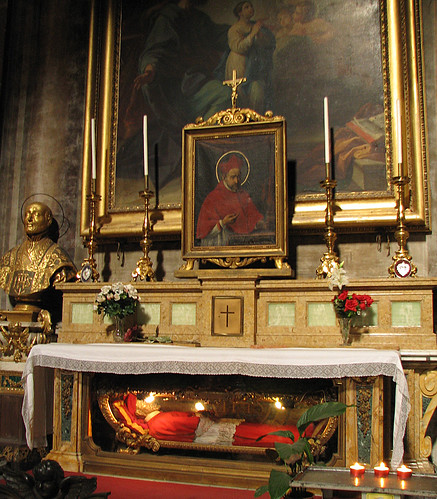
The body of St. Robert Bellarmine.
When it comes to popular piety little has been as used, abused, misunderstood and misrepresented as the keeping of relics. Indeed, since the sixteenth century the preservation of relics has come to seem like a peculiarly Catholic thing to do. So, we might well ask, what’s it all about?

Well, perhaps it is worth just describing what we mean by the word ‘relic’. Simply put, we are discussing the remains of a person who is no longer with us, or in some cases an object associated with that person. Already we perceive that relics are not confined to Catholic experience; indeed, everyone offers respect to the remains of the dead, and most of us will come to inherit small keepsakes or heirlooms to remind us of our ancestors or friends who’ve passed before us. Relics really are a natural part of human experience!

Put in this neat way we might suppose relics to be rather dull. However, there is more: Catholics recognise that the remains of Holy People, or objects they came into contact with, have some special significance. The incorrupt body of St Bernadette of Lourdes or the hair-shirt of St. Thomas More excite in Catholics a reaction which the umbrella of Neville Chamberlain or the fake moustache worn by Charlie Chaplin do not.

So why do Catholics keep and venerate the remains of saints, and why do we afford them a special significance we don’t offer the remains of other people? As the Council of Trent explained it, relics are the remains of holy men and women who ‘while they lived were Temples of the Holy Ghost (1 Cor. 6:19) which are due to be awakened by Him and to be glorified’ (Trent sess. XXV).

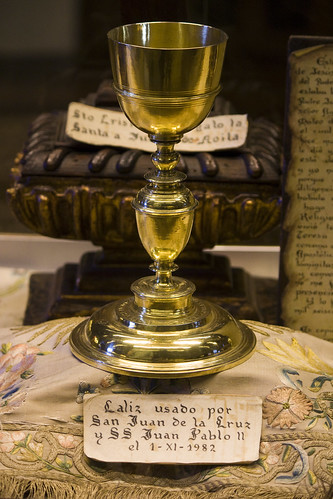
The chalice of St. John of the Cross.
The remains of the saints function as heavenly signposts: they are reminders of a past manifestation of God’s love and a promise of a future one. No wonder then that we make use of relics in our adoration of God as we contemplate the wonders he has worked and is working for us. The body of St. Bernadette was a Temple of the Spirit and it will be again.

But God doesn’t just point the way to Heaven, he actually helps us get there, and he brings the saints to our aid. Now, as God’s love was made manifest through the lives of the saints, why not of their remains? 

Catholics recognise that relics can be used by God as conduits to work miraculous wonders of healing, inspiration and so on, and it is for this reason that we have recourse to them when praying to God in supplication. It is important to note here that the objects themselves do not possess some magical qualities that make amazing things happen, but rather, God works wonders through them, in the same way he chose to heal the lame through Peter’s shadow (Acts 5:15) or to raise the corpse from the dead that touched the bones of Elisha (2 Kings 13:21).

So we Catholics keep relics because we honour God’s work, and we venerate the remains of the saints because we hope he will share with us the blessings he shared with them.


All Holy Men and Women, pray for us!

Saturday, November 2, 2013

Popular Piety: the Dead

Why do we pray for the dead or “Holy Souls”, as they are sometimes called?  In brief terms, we pray for the dead because we believe in the immortality of the soul; we believe that nobody can be received into heaven without having first been purified of the consequences of their sins in purgatory; and, we believe that God hears the prayers of his children whether those prayers are offered for themselves or for others.  So, we pray for the Holy Souls in purgatory with confidence that God hears us.  And the reason that we do this is simply because we love them, and wish them to be in heaven.

We can trace the genealogy of this prayer back to scripture.  In the Old Testament we read in the second book of Maccabees how Judas Maccabee, the Jewish leader, prayed for the sins of his fallen soldiers: “For if he were not expecting that those who had fallen would rise again, it would have been superfluous and foolish to pray for the dead.  But if he was looking to the splendid reward that is laid up for those who fall asleep in godliness, it was a holy and pious thought.  Therefore he made atonement for the dead, that they might be delivered from their sin.” (2 Macc 12:44-45)  Moreover, the Christian Church has from its foundation “honoured the memory of the dead and offered prayers in suffrage for them, above all the Eucharistic sacrifice, so that, thus purified, they may attain the beatific vision of God”. (CCC 1032)

Praying is one of a number of things Christians do for the dead.  Besides prayer, we can give alms in their honour, obtain indulgences and undertake works of penance.  Once a very central theme of Christian worship, these practices were suppressed at the Reformation.  As Prof. Eamon Duffy remarks in his recent book “Saints, Sacrilege and Sedition: Religion and Conflict in the Tudor Reformations” the effect of rejecting purgatory, the cult of the Saints, and prayers to and for the dead, at the Reformation, was to “[reduce] Christianity to the mere company of the living.” (p.33)

The Dominicans have a particular devotion to the Holy Souls.  Along with the rest of the Church, the souls of the faithful departed are remembered each day at Holy Mass.  Additionally, the Constitutions of the Order devote a whole article to Suffrages for the Dead (LCO Ch.2, Art.III).  From particular Mass intentions (e.g. for deceased parents of the Friars on 7th February) to praying daily the De Profundis, the Order places great emphasis on praying for the dead, especially its own Brothers and Sisters, as well as friends, familiars and benefactors.

In the month of November the Church remembers the Holy Souls in purgatory.  It is a worthwhile opportunity for each of us to renew our commitment to pray for the dead so that we may hope, as that saintly Pastor, Archbishop Fulton Sheen is reported to have said, “As we enter heaven we will see them, so many of them coming towards us and thanking us. We will ask who they are, and they will say, a poor soul you prayed for in purgatory.”

Tuesday, October 29, 2013

Popular Piety: Marian Devotions


I remember hearing my grandmother tell a story of the terrible two nights during the Clydebank Blitz, when the German Luftwaffe launched a bombing raid in March 1941. My grandmother, along with relatives and neighbours, sought refuge in an Anderson shelter, which was designed to withstand anything except a direct hit. As a devout Catholic, she prayed the Rosary repetitively through the night, to pray for protection and survival through the Blitz. When she had finished one of the mysteries of the Rosary, with the sound of bombs falling nearby, her protestant neighbour who was beside her in the shelter asked “can you start saying those prayers again?”

Marian devotions have been used by Catholics since the tenth century, and praying using beads is an ancient custom. Marian devotions have developed over centuries into what we have in modern times. Whether in times of despair or distress, needing protection, or in times of joy and thanksgiving, the Blessed Virgin Mary is a sacred space in the Catholic faith. Indeed, St John’s Gospel records that, as he suffered on the cross, he told his mother, “Woman, behold thy son”, and he then told the beloved disciple “Behold thy mother” (Jn 19:26-27). With these words, Mary is given as a Mother to the Church and the Church is entrusted as a mystical child to the woman.

The meditations of the Rosary were created in their modern form in 1483, by a Dominican Friar who published Our Dear Lady’s Psalter. Since then, the Dominicans have greatly promoted the Rosary as a practical and simple prayer, containing the Glorious, Sorrowful and Joyful mysteries. The Luminous mysteries were added in 2002 by Pope John Paul II. 

Other Marian devotions include hymns such as the Salve Regina, which is about the immaculate and perfect Church that is above and beyond our ordinary, broken lives. As the Queen of Heaven, Mary represents the Church perfected by Christ: she already is what the Church as a whole will become at the end of history. Pope John Paul II observed that “no one has ever devoted himself to the contemplation of the face of Christ as faithfully as Mary”. Despite what we may face in our lives, the Blessed Virgin Mary is there for us in prayer, as perfect as a human can possibly be. 


For a prayer sheet on how to recite the Rosary, visit: www.medjugorje.org/rosary.pdf


Saturday, October 26, 2013

Popular Piety: Eucharistic Adoration

‘I look at him and he looks at me.’ This is what a certain peasant of Ars used to say to his holy CurĂ© about his prayer before the Blessed Sacrament reserved in the tabernacle. In Eucharistic Adoration, we are privileged not just to contemplate Christ in the tabernacle, but to have Christ physically present before us, so that we may gaze upon Our Lord and Saviour with adoring eyes.
The origins of this popular devotion have several sources. Its initial form derives from Holy Thursday and watching at the altar of repose, following the celebration of the Mass of the Lord’s Supper, in which way we beautifully bear witness to the connection between the celebration of the memorial of the Lord's Sacrifice and his continued presence in the Sacrament of the Altar.

Around the fourth century monasteries began to reserve the Eucharist, and by the 11th century, reservation, mainly for the Viaticum, was a regular feature in churches. However, it is not until the late 11th or early 12th Century, and the refining of the Church’s teaching on the Eucharist at Lateran IV, prompted by the false teaching being proclaimed by the monk, Berengar of Tours, that we really see a strong devotion developing for prayer in front of the Blessed Sacrament. From this point on we see numerous Eucharistic devotions like processions, visits to the Blessed Sacrament, and other prayers focused on the reserved Sacrament, becoming part of Catholic life.

About a century later, to counter the falsehood being promulgated by Peter Cantor, that transubstantiation of the bread only took place when the priest had pronounced the words of consecration over both the bread and wine, a custom arose and spread of adoring the Host immediately after the words, Hoc est enim corpus meum, and by a natural transition the practice of showing it to the people for this purpose arose. Times of extended exposition of the Blessed Sacrament, outside the Mass, grew out of this action, born out of a natural desire to spend longer gazing upon Our Lord. Eventually a blessing with the exposed Eucharist, or Benediction, developed.


Eucharistic Adoration has continued unabated since that time and continues to bear great fruits in the lives of faithful individuals and of movements associated with it. In fact at the present time there seems to be a resurgence of Adoration amongst many of those who wish to have a deeper relationship with Christ. For, as people become ever more aware of the unceasing distractions of the world, it seems even more important to “spend quality time” (in modern parlance) with our loved ones, lest our relationship wither.

Finally, the fitting way for any Dominican to end a reflection on Eucharistic Adoration is with these words of St Thomas Aquinas OP, familiar throughout the Universal Church:


Tantum ergo Sacramentum
veneremur cernui:
et antiquum documentum
novo cedat ritui:
praestet fides supplementum
sensuum defectui.

Genitori, Genitoque
laus et jubilatio,
salus, honor, virtus quoque
sit et benedictio:
Procedenti ab utroque
compar sit laudatio.

Down in adoration falling,
Lo! the sacred Host we hail,
Lo! oe'r ancient forms departing
Newer rites of grace prevail;
Faith for all defects supplying,
Where the feeble senses fail.

To the everlasting Father,
And the Son Who reigns on high
With the Holy Spirit proceeding
Forth from each eternally,
Be salvation, honour blessing,
Might and endless majesty.

Wednesday, October 23, 2013

Popular Piety: Blessings

'Blessed be the God and Father of our Lord Jesus Christ, who has blessed us in Christ with every spiritual blessing in the heavenly places’ (Ephesians 1: 3).

A blessing is a divine and life-giving action which has the Father as its source. This means that in the fullest sense of the word the whole of creation is a blessing. This creation, as we know, was damaged by sin but later restored through the divine blessing entering into human history in the events of salvation history which culminated in the triumph of Christ’s death and resurrection. In this new creation the blessings of God are communicated through Christ: he pours into our hearts ‘the Gift that contains all gifts’, the Holy Spirit, and it is in this Trinitarian dynamic that Christian liturgy and all Christian prayer becomes possible: our liturgy and our prayer is a response of faith and love to the blessings that the Father has bestowed on us in Christ; and the Church in the Spirit and through Christ blesses the Father in return. 

The Trinitarian prayer of the Church is centred on the celebration of the seven sacraments and has the Eucharist as its source and summit. The sacraments are efficacious signs, they make really present what they symbolize: that is, through these signs God shows us what he is doing to bring humanity to himself and actually does what he is showing us. In other words, in the sacraments Christ graciously reaches down through the centuries to bless us, to apply to Christians the merits of His sacrifice so that we might share His resurrection. The superabundant merits of Christ overflow onto us so that we can share in his Divine life, in this way the blessing of Christ also spills out beyond the sacramental liturgy into the rest of our lives. 
 
This ‘spilling over’ of the sacraments into our everyday lives can be moral or spiritual. For example, holy men and women are often said to lead ‘Eucharistic lives’: lives of sacrifice, love and thanksgiving that extend the sacrifice of mass into their everyday life. Complementing this moral and spiritual dimension, we can also think of our sacramental life spilling over into our devotional life through what the Church calls ‘sacramentals’. These are also sacred signs and as such they bear a resemblance to the sacraments, but their chief effect is to better dispose us to receive, embrace and co-operate with the transforming power of the sacraments themselves.

Sacramentals derive from our baptismal priesthood. Every Christian is called to be a blessing and to bless, that is, to be an instrument of divine gift and to offer thanksgiving. This makes blessings the most significant of all the sacramentals. Every blessing praises God and offers back to Him His gifts. When we invoke the name of Jesus and put people and things under the sign of Christ’s Cross, we offer these people and things to God as a gift so that he might turn them towards the sanctification of men and women. The practice, then, of blessing devotional items such as rosaries, objects that play a key role in structuring our lives such as our homes, even an object we work with such as a computer, and people, is a way of extending our sacramental life into our everyday life so that we might more fully embrace both in holiness and truth.

Sunday, October 20, 2013

Popular Piety: The Sign of the Cross

'My power is perfected in weakness'
The sign of the cross is the sign of our faith. It is faith in the cross of Christ that defines us as Christians; through it we receive the grace that saves. Without the cross – and the resurrection that revealed Christ's death to be his triumph over death itself – our faith would be vain and we would still be in our sins (1 Cor. 15:17). Christ's death is the ultimate sign that he was truly incarnate: he truly became man, and so he was truly able to die. Through his incarnate weakness, he could be our friend: for he could love us to the end (Jn. 13:1, 15:13).

The cross is thus the sign of God's love for humanity. It is a powerful sign, whether being used to cast out demons or to assure victory (in hoc signo) to the Emperor Constantine at the Milvian Bridge. Yet this is only because it boasts of Christ's weakness. Christ says: 'My grace is sufficient for you, for my power is perfected in weakness' (2 Cor. 12:9). So, following St Paul (1 Cor. 1:23), the crucified Christ is a 'stumbling block' or 'foolishness' to us until we accept that God's infinite love means that he laid down his life for us, as his friends.

Filipino Catholics in a queue for American
visas in the comedy film 'La Visa Loca'

The sign of the cross is many things: a pious gesture, a prayer, a blessing, a physical expression of Trinitarian faith. It is egalitarian in its simplicity, deep in its theology, and universal (truly 'catholic') in its relevance. We use it to start and end our prayers, especially the Mass; to bless things; and indeed in every sacramental act. There are cultural variations, of course, since there are many ways to express the richness of Trinitarian theology. In the Eastern churches it goes right to left, using three fingers (to represent the Trinity), leaving the other two to symbolise the two natures of Christ. There are also smaller signs of the cross: we use our thumb at the gospel, for instance, to trace the cross over our forehead, lips, and breast. It can be a bold and deliberate gesture, or a surreptitious act of faith in dire circumstances. And are there many public acts of Christian witness more striking than being marked with the cross on one's forehead on Ash Wednesday?
The 'Dogmatic Sarcophagus' (c. 320) showing the Blessed Trinity


The popular piety of this act is very ancient indeed. Tertullian (born c. 160 AD) noted: "In all our travels and movements, in all our coming in and going out, in putting of our shoes, at the bath, at the table, in lighting our candles, in lying down, in sitting down, whatever employment occupieth us, we mark our foreheads with the sign of the cross" (De cor. Mil., iii). Ancient Christians associated the sign with certain Scriptural passages, including Ezekiel's instruction to 'mark their brows with a cross', i.e. the letter tau (Ez. 9:4) and the 'seal on the foreheads of those who serve our God' (Rev. 7:3).

But it is no less important today. Catholic sportsmen often make the sign of the cross on the pitch, sometimes contentiously! Some Catholics bless every loaf of bread with a small cross as an act of grace. Parents putting their children to bed sign the cross on their forehead. Many also make the sign every time they pass a church. I was impressed when I once saw a whole bus-full of people in Romania do this repeatedly along an urban route, and I've also seen it done by students walking past Blackfriars. In all these ways, we can express outwardly our Trinitarian faith, receive inwardly the grace which God gives us through faith, and in everything give the glory to our crucified Lord.

In the name of the Father, and of the Son, and of the Holy Spirit. Amen.

Thursday, October 17, 2013

New Series: Popular Piety

How do we know things about God? Well, a traditional answer would be go something like this: we know about God by his self-revelation in Scripture and Tradition, transmitted by the Church’s Magisterium, and by using the God-given aids of reason and religious experience that help us to make sense of that self-revelation. That’s all well and good, but it might strike us as a little bit clinical, perhaps as the language of the theology textbook rather than the language of the heart. If we were asked by a friendly enquirer in a pub, it’s probably not how we’d go about talking about our friendship with Jesus Christ nor about our own powerful experiences of His transforming love.
Rosary Supermarket in Lourdes
When we look at the myriad of ways in which ordinary Christians reach out to God and experience God reaching out to them, however, we find that they are patterned by that traditional answer. Scripture, Tradition, shared religious experiences and the light of natural reason co-mingle in the various forms of popular piety that are born in Christian cultures across the globe. To take one example - the Rosary, ‘the Gospel on a string’ - we use our intellects to reflect on the mysteries of Christ’s life transmitted to us in Scripture and Tradition; we draw upon the accumulated wisdom bequeathed to us by the experience of generations of faithful Christians who have gone before us. Through popular piety, Christian theology comes alive in diverse cultures in ways simultaneously both accessible and profound.
All Souls Day in Mexico
It’s true to say, of course, that some expressions of popular piety need to be purified from an excessive sentimentality by a dose of reason. But we’d be wrong to conclude from the primacy of reason that sentimentality is always to be shunned. One of the great insights of St Thomas Aquinas OP was that, reflecting the holism of the human person, our emotions - even as they sometimes stand in need of correction by our thoughts - are fundamentally sound and essentially indispensable, ‘pointing’ us in the right direction, toward the good; rationality and emotion are conjoined. In fact, popular piety involves the mutual purification of sentiment and reason in the light of the Holy Spirit. Far from being ‘above’ popular piety, then, theologians often find popular piety to be a valued locus of reflection, or even find themselves corrected by it: popular piety is a reflection of “the supernatural appreciation of faith on the part of the whole people” of God (CCC §92).
The Spanish tradition entierro de la sardina marks the start of Lent
With this in mind, over the next few months, the Godzdogz team will be dedicating a series to the exploration of popular piety. From bona mors to blessings, we hope to share with you an appreciation of some of the gems of the Church’s rich spiritual panorama, and so to rejoice in the gift of our Catholic diversity.