Showing posts with label Rosary. Show all posts

Tuesday, October 7, 2014

The Rosary: Feast of Our Lady of the Rosary

The Feast of Our Lady of the Rosary is an apposite day on which to conclude our series on the Rosary. The series has focused on the cycles and prayers of the Rosary in which we have seen the richness and depth of this devotion to the Blessed Virgin Mary, as well as its ultimate Christological character.

This is a special feast for Dominicans because of the tradition that Our Lady gave the traditional Rosary to St. Dominic. St. Dominic was not the first to use beads as a means of prayer - for example, the practice of saying 150 Our Fathers or the “Paternoster” certainly predated the Rosary. However, the tradition was affirmed by Pope Leo XIII especially and on several occasions, to say nothing of the endorsement of other Popes, besides.


St Dominic de Guzman receiving the Rosary, Federico Barocci, Ashmolean Museum, Oxford
Given this background, the Dominicans have a special role in promoting this Marian devotion and do so in various ways. One way we promote the Rosary is by personal recitation. After all, it would be useless to promote a devotion that we did not ourselves practise. The Constitutions of the Friars Preachers state "The brothers should recite daily five decades of the rosary in common or in private… This form of prayer leads us to the contemplation of the mystery of salvation in which the Virgin Mary is intimately associated with the work of her Son." [LCO 67]. Of course, we are greatly assisted in this task by the fact that we wear the Rosary as part of our habit! [LCO 50]


Elsewhere in the Constitutions, the importance and value of our devotion to the rosary and its implications is underscored: "The Rosary as a way of contemplating the mysteries of Christ, is a school for developing evangelical life. As such, it is a form of preaching particularly appropriate to our Order, in which the truths of faith are proposed in the light of the blessed Virgin Mary’s participation in the mystery of Christ and the Church. Since the Rosary is a characteristically Dominican devotion, the brothers should fervently preach it, so that it may flourish, and they should promote its societies.” [LCO 129].


Further reading on the meaning and value of the Rosary, together with advice on the way to say it can be found in various Papal documents, including Adiutricem (Leo XIII) , Marialis Cultus (Paul VI), and Rosarium Virginis Mariae (St. John Paul II).


In writing this series, we hope that we have been true to our Dominican heritage and mission, and that some encouragement has been provided to our readers to dedicate themselves to this wonderful devotion.


Pray for us, O Holy Mother of God – that we may be made worthy of the promises of Christ.

Thursday, September 25, 2014

The Rosary: O My Jesus

O my Jesus, forgive us our sins, save us from the fires of hell, lead all souls to Heaven, especially those in most need of Thy mercy. Amen.

The ‘Fatima Prayer’ given by Our Lady to three young visionaries at Fatima, Portugal, has been included in the recitation of the Rosary since those visions in the early 1900s. Though the entire Rosary is a meditation upon the life of Christ this is the only prayer directed expressly towards him.

Each mystery of the Rosary unfolds the glories, joys and sorrows of Christ’s life. But more than this, through meditation the Christian soul is raised up into that Divine Life. It becomes an actual witness, seeing through the eyes of faith, to those miraculous things which happened long ago or beyond this world.

However, this lofty engagement is not always achieved. Sometimes the Christian uses spirituality as escapism from the world because it is a difficult place to be. This ‘failed’ spirituality feeds the image of the spiritual person as someone slightly ethereal someone who appears rather untenable. Spirituality, in this later sense, becomes less about God and more about us.


The Fatima Prayer can head off this false spirituality of escapism by appeal to the personal encounter with Jesus, the Word-Made-Flesh. When we speak to Jesus we speak to the one who bears his own wounds. How then can we try to hide ours? In speaking to Jesus we find that it is not just necessary, but good, to acknowledge the world around us and all its trials. In Jesus we see the immense importance the Father has placed on the world, which is the road we walk back to him.

Sunday, September 14, 2014

Fifth Luminous Mystery: Institution of the Eucharist

“I have eagerly desired to eat this Passover with you before I suffer” (Lk 22:15).

The fifth and final Luminous Mystery recalls the institution of the Eucharist, the source and summit of the Christian life. This sacrament is a sign of God’s self-sacrificing love for us and His desire that we should be united with Him. As Pope Benedict writes, “In this eager desire of Jesus we can recognize the desire of God Himself – His expectant love for mankind, for His creation. A love which awaits the moment of union, a love which wants to draw mankind to itself and thereby fulfil the desire of all creation, for creation eagerly awaits the revelation of the children of God” (cf. Rom 8:19).

Beautiful and comforting as God’s infinite love for us is, it can also be overwhelming. In the face of such love, if we reflect on our lives properly, then we may well feel distinctly unworthy. This is not a bad thing, the words of the Mass (“Lord, I am not worthy to receive you...”) acknowledge this, yet we are encouraged by the Church to make whatever reparations are necessary and go forward to receive our Lord, and grow in communion with Him and those around us.

The French writer, Francois Mauriac, expresses this beautifully:
There is a mysterious mingling of conflicting feelings in the man who is about to receive Holy Communion: fear and confidence, open-heartedness and remorse, shame and love. The small Host which the sinner approaches throws an impartial and terrible light on irretrievable deeds: on that which he has done, on that which he should not have refrained from doing. No man knows himself if he has not looked at his soul in the light of the Host lifted above the ciborium…

Salvador Dali's, Last Supper

Yet all the misdeeds that the communicant sees at a glance are no longer his; someone else has taken them over since the pardon of Christ has come down on his soul with the absolution of the priest. His misery, far from driving him into despair, helps him understand how much he has been loved…

What is almost always obtained through frequent Communion is a grace which surpasses all perceptible favours; an increased light and, better still, a new strength in God."

Thursday, September 11, 2014

Third Luminous Mystery: The Proclamation of the Kingdom and the Call to Conversion

'The time is fulfilled and the kingdom of God is at hand; repent, and believe in the Gospel' (Mk 1:15).

This Luminous Mystery can be understood very broadly as the whole public ministry of Jesus of Nazareth, lasting three years, but for the sake of meditation during the Rosary we can focus on the very beginning. That is where we see the essence of the proclamation of the kingdom of God.

The beginning of Jesus's preaching mission is to call us to conversion. Our sins have led us away from God; and that is very foolish, not just wicked, because we cannot find happiness apart from God. Just as a sick person cannot be healed unless they admit their frailty and visit the doctor, so we cannot be forgiven without acknowledging our sins: 'I came not to call the righteous, but sinners' (Mt 9:13). Through the interior liberty gained by our conversion, we are simultanesouly freed from all kinds of external oppressions; Christ came 'to preach good news to the poor', that is, to bring healing and peace to all who suffer (cf. Lk 4:18).

When he sends out the 70 disciples, Jesus makes it clear that they are on a mission of peace (Lk 10). They are to bring peace and healing to every house they enter. No wonder, then, that the disciples 'returned with joy'. Jesus warns them not to rejoice in the wonders and miracles they worked, but 'rejoice that your names are written in heaven'. Our true joy comes from our own conversion – we were sinners, but we have been healed. We must become more like Mary, whose pure heart enabled her to play her part in the coming of the kingdom on earth.

This task of proclamation, however, is not an easy one. In the sending of the Twelve (Mt 10), they go out 'as sheep in the midst of wolves', yet Jesus tells them to 'have no fear'. The proclamation of good news is its own reward. Dominicans are vowed especially to this preaching mission and, like all Christian witnesses, we must go out not trusting in our own gifts or righteousness, but knowing ourselves to be sinners redeemed, with the love of God in our hearts.

The Christian paradox is that we live in this world with our hearts burning for the next. The world is fallen, redeemed, and awaiting its re-creation. The kingdom of God is already and not yet; now is the time for mission.

Monday, September 8, 2014

The First Luminous Mystery: Our Lord's Baptism


Baptism is the basis of our entire Christian life; it is the gateway the Lord opens into the life of the triune God of grace. We know baptism as the Sacrament of Faith that has been established by God as the normative means through which we are freed from original sin, re-born by Water and the Holy Spirit as daughters and sons of the Most High. But all this leaves us with a puzzle when it comes to understanding Jesus’s own baptism: what need had Christ, the spotless and perfectly sinless Son of God, for baptismal grace? What need had Jesus, who enjoyed the vision of God throughout his life, for the sacrament of faith? What need had the second person of the Trinity for initiation into the life of the Trinity? Are we to conclude that Jesus’s baptism was just an empty gesture, a redundant sign of deep significance and profound aesthetic value, but which nonetheless changed nothing?

Christ’s baptism is, clearly, of a different type to our own: Christ’s baptism by John inaugurates Christian baptism as an efficacious means of grace; our own baptisms are dependent, derived, actions that baptise us into Christ’s own baptismal life. It is by being baptised, submitting himself to baptism at the hands of a man, that Jesus creates and establishes Baptism as the Sacrament of Faith in Himself. Yet Baptism is no individualistic event that cleanses our souls as if God intervened surgically by dissecting us away from others. Rather, baptism engrafts us into the Christian community, making us members of Christ’s own body. Christ’s own baptism manifests his status as the head of the community of the baptized.

Indeed, Christ’s baptism is a moment of revelation—the dove, representing the Holy Spirit, descends onto the waters and the voice of the Father reveals Christ’s identity as Son (all of which resonates with the creative imagery of Genesis, in which the Spirit of God hovers over the waters and the world is created by a spoken word of God). At this moment, Christ’s true identity—revealed to his mother Mary at the annunciation—is made manifest on the public stage. It is in our own baptisms that we too discover our deepest identity as those claimed for Christ, and—over the course of a lifetime—it is in the outworking of our graced baptismal vocation that we discover who God created us to be and the tasks that he has bestowed upon us. The waters of Baptism are the short, sharp, shock that wake us up to our most essential identity: "Each of us is the result of a thought of God. Each of us is willed, each of us is loved, each of us is necessary. There is nothing more beautiful than to be surprised by the Gospel, by the encounter with Christ. There is nothing more beautiful than to know Him and to speak to others of our friendship with Him" (Benedict XVI).

Saturday, September 6, 2014

The Rosary: The Luminous Mysteries

"The Transfiguration", Raphael

The Luminous Mysteries (or Mysteries of Light) were introduced as “a proposed addition to the traditional pattern" by Pope John Paul II, in October 2002, at the start of the Year of the Rosary. These mysteries focus on the public ministry of Jesus Christ, and were added in the words of St. John Paul “for the Rosary to become more fully a 'compendium of the Gospel'”; in contemplating revelatory moments in Christ’s public ministry, the Christological depth of the Rosary is brought out more fully.


In St. John Paul’s words: Moving on from the infancy and the hidden life in Nazareth [the Joyful Mysteries] to the public life of Jesus, our contemplation brings us to those mysteries which may be called in a special way 'mysteries of light'. Certainly the whole mystery of Christ is a mystery of light. He is the 'light of the world' (Jn 8:12). Yet this truth emerges in a special way during the years of his public life, when he proclaims the Gospel of the Kingdom.

Indeed, one idea when praying these mysteries is to ask for the intercession of St. John Paul whose devotion to the Rosary, was clear. We pray the Luminous Mysteries especially on Thursdays, but of course one can pray mysteries of the Rosary at any time, and in any place - and that is part of their beauty! May the Luminous Mysteries enlighten our path as we go about our daily business praising, blessing, and preaching the Word of God.


Wednesday, September 3, 2014

Fourth Glorious Mystery: The Assumption of Our Lady into Heaven


Mary, the Mother of Jesus, is alive with her Son in heaven. Alleluia!

She has been raised through him, with him, in him, into the glory of God's eternal dwelling-place. Christ had said, 'If I go and prepare a place for you, I shall come again and take you to myself, so that where I am you may be also' (Jn 14:3). Mary is privileged to be the first to follow her Son, body and soul, into heaven. She participates already in his bodily resurrection. Where Jesus is the 'first-fruits', Mary is chief among 'those who belong to Christ' (see 1 Cor. 15:23), showing what we too may achieve if we follow him faithfully.

In her earthly life, the Virgin Mary was Christ's closest follower, from the moment of her fiat when she gave her life fully into God's hands all the way to the foot of the Cross. Now that he is raised to new life, she shares in that glorious beatitude. Assumed body and soul into heaven, Mary's privilege anticipates our own bodily glory in the general resurrection.

It is indeed a privilege, not something Mary grasped for herself or earned by her own unaided efforts. Mary's honour flows from the grace of Jesus. As God singled out Mary for the unique privilege of bearing his Only-Begotten Son, so Mary's Assumption can be seen as another unique privilege of grace.

Let it remind us that 'in all things God works for the good of those who love him, who have been called according to his purpose' (Rom. 8:28). 

Sunday, August 10, 2014

Third Glorious Mystery: The Descent of the Holy Spirit at Pentecost

Seven-Gifts-Holy-Spirit
“But you shall receive power when the Holy Spirit has come upon you; and you shall be my witnesses in Jerusalem and in all Judea and Samaria and to the end of the earth” (Acts 1:8).

It is easy to think of the Descent of the Holy Spirit as something that hap-pened to the disciples, but we have not fully understood the signif-icance of the event recorded unless Acts, unless when we read "you shall receive power . . .", we read it aware that that "you" is as applicable today to you and me as it was to the disciples present at the time. Similarly, with the power we receive from the Holy Spirit, we must also take on the responsibility of bearing witness to Christ to the ends of the earth.


As we reflect on this beautiful mystery, we would do well to imagine ourselves there with Mary, who is intimately connected with Holy Spirit. She conceived her son by the power of the Holy Spirit, and the Holy Spirit is often poured out in her presence. Thus it was fitting that Mary should be present at the birthday of the Church, for as she is the Mother of Jesus, so she is also the Mother of the Church. We are told how Mary would ponder things in her heart, and we would do well to follow her example in pondering on what the Holy Spirit brings to us. Now would be a good time to reflect on the gifts of the Holy Spirit at Confirmation. For if we do not know what gifts we have been given, we are unlikely to utilise them fully, and we might neglect to play our part in aiding the renewal of the face of the earth. So then let us pray for Mary's intercession that we might better appreciate and cooperate with the workings of the Spirit within us and then be witnesses to Christ to the ends of the earth.

Friday, August 8, 2014

Second Glorious Mystery: The Ascension

Even after enduring death, and overcoming it in the Resurrection, Christ does not do away with his humanity. Christ’s humanity is not like a garment that is discarded once it has been worn. The real and enduring reality of Jesus’s humanity remain the point of connection between man and God, just as it was in his earthly ministry so it remains today: the Sacred Humanity is the organ through which redemptive grace flows to us (especially in the Sacraments). Christ, then, continues to relate to us in and through his humanity, even though we do not see it (except sacramentally). Thus the Ascension is not a moment of sadness—the definitive disappearance of the Messiah from the world that He has redeemed—but the glory of a bodily ‘withdrawal’ that is enacted precisely—and only—so that the Lord can be present to us in a new and more intimate fashion. The coming of the Holy Spirit (the Third Glorious Mystery) casts this in stark relief. 

In the context of the Glorious Mysteries of the Holy Rosary, however, the link between Christ’s Ascension and Mary’s Assumption is particularly evident. Christ’s Ascension, and the bodily Communion with God that the Incarnation makes possible, does not merely return the world to a pre-incarnation, or even pre-fallen, state. Rather the Ascension is a creative act, one that inaugurates something new: a new for humanity to ascend, through the gift of participating in Christ’s own life, to bodily communion with God. This is communicated pre-eminently to Mary, attested in her Bodily Assumption (the Fourth Glorious Mystery).

Sunday, August 3, 2014

First Glorious Mystery: The Resurrection

The First Glorious Mystery – the Resurrection – is the master-key to all the others, the fulfilment of God's plan. Out of the despair and grief we follow and experience in the Sorrowful Mysteries, we find hope in life after death with Christ.

In this mystery we share the sense of joy that the women outside the tomb felt as the angel told them that He had risen. If we remain steadfast, we too can share in the glory of everlasting life. That promise sustains us in our earthly mission. We do well to dwell on it in praying the Rosary and more generally, letting it imbue us and inform our actions.

One good intention to remember in praying this mystery is the Holy Souls in purgatory, that they might share in the the glory of the Heavenly Kingdom.

– Br Samuel Burke OP

Rubens, The Resurrection of Christ (1612)

Wednesday, July 30, 2014

The Rosary: The Glorious Mysteries


The Glorious mysteries are one of the three traditional sets of events of the life of Christ and the Blessed Virgin Mary. Pope Leo XIII said of the Glorious Mysteries that they reveal the mediation of the great Virgin, still more abundant in fruitfulness. She rejoices in heart over the glory of her Son triumphant over death, and follows Him with a mother's love in His Ascension to His eternal kingdom; but, though worthy of Heaven, she abides a while on earth, so that the infant Church may be directed and comforted by her "who penetrated, beyond all belief, into the deep secrets of Divine wisdom" (St. Bernard). The first three meditations are taken from scripture. The Resurrection of our Lord, His Ascension into heaven and the Descent of the Holy Spirit at Pentecost are all meditations on scriptural events. The fourth meditation (the Assumption of Mary) and fifth meditation (Coronation of Mary as Queen of Heaven) are part of Catholic devotion, and contemplate beauty and hope in the human condition.

Thursday, July 24, 2014

Fourth Sorrowful Mystery: The Carrying of the Cross

Titian, Christ Carrying the Cross (c.1565)
When we pray the Fourth Sorrowful Mystery we bring to mind our Lord's anguish and pain as he carried the weight of our sins on the cross, knowing the greater sacrifice that awaited him on the summit of Calvary.

Recalling our Lord's act leaves us feeling humbled, contrite but encouraged by his overwhelming love for us, His children. Our cross is light to bear, by comparison with Christ's inestimable sacrifice. 

A good intention, therefore, when praying this mystery is to pray for those who are without hope, and feel overburdened. That they may take up their cross and follow Him, for it is only in carrying our cross with love, in faith, and for the hope of the life to come that we find happiness.

– Br Samuel Burke OP


Monday, July 21, 2014

Third Sorrowful Mystery: The Crowning with Thorns

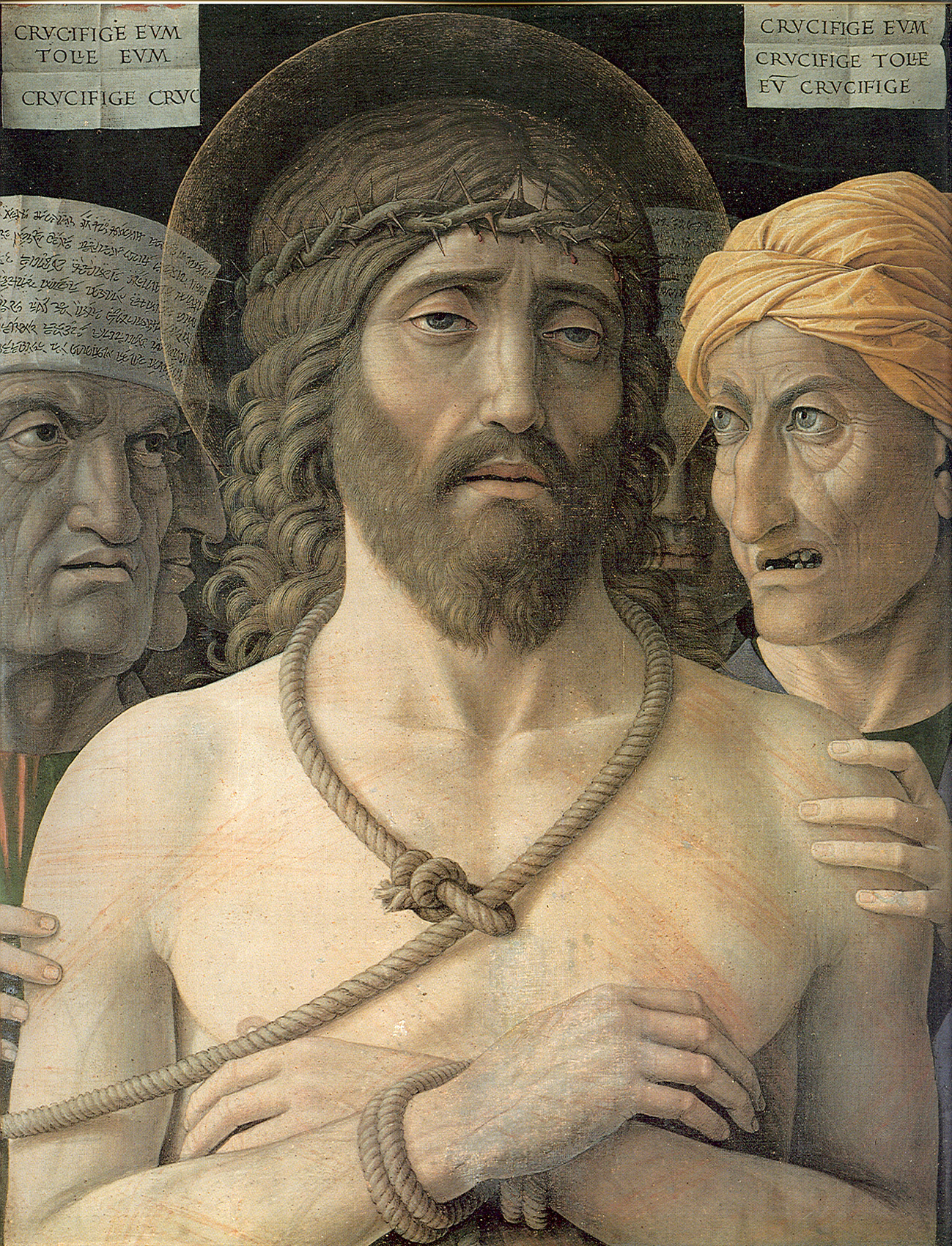
Mantegna, 'Ecce homo' (1500)
Father, forgive them, for they know not what they do. (Luke 23:34)


These words of Jesus hanging on the Cross reveal a profound truth about the present scene of his crowning with thorns. What must have pained our Lord above all is the knowledge that his own people, these sons and daughters of God, were tormenting him to death without knowing his true identity or the depth of his love for them. The worst pains we suffer are inflicted by those we love.


All the Sorrowful Mysteries invite us to weep for Jesus, in his terrible sufferings, but also to weep with Jesus. As the unruly crowd calls for his blood and looks on at this scourged and bleeding man – Ecce homo! Behold the man! – our Lord is silently looking back at them and loving them. He is grieving not for his own pains, but for the sins of his beloved people who have turned against him.

So it is not just the sheer cruelty that makes me want to recoil from this scene. It is also the dramatic, even tragic, irony of it all. The Roman soldiers are mocking Christ and, specifically, his claim to kingship. They have wrapped him in a robe of royalty, put a pathetic stick of authority in his hand, and a twisted crown of thorns on his head. I wince at the thought of those thorns – superfluous, barbaric cruelty. And this cruelty exacerbates the fact that the mockery is totally unjustified: for Christ is just, Christ is innocent, and Christ is king. He is true man – 'a man of sufferings and acquainted with grief' – and also true God, the God who looks upon us with infinite love despite our sins.

It is good to pray this mystery for all those in authority, for those suffering persecution or torture, and for those who do not recognise Christ as king.


Wednesday, July 16, 2014

2nd sorrowful mystery: the scourging at the pillar


The most shocking and realistic account that I know of the scourging at the pillar is the scene in Mel Gibson’s Passion of the Christ. The brutal treatment of Christ by the Romans as they scourge him is probably the most accurate and moving depiction of events that a film could capture. The implements of torture, even the brutish behaviour of the guards and their superior, is made so realistic that it is impossible not to be horrified at how this could be done to anyone. This ritualised mutilation of another human being was probably a regular occurrence in the Roman empire. The blood of Christ was on the faces of the men scourging him, and so much blood spilled on the courtyard it was cleaned by the women with cloths afterwards. As written in Luke 6:22, Blessed are you when men hate you, and exclude you and revile you on account of the son of man. Rejoice on that day and be glad, for great is your reward in heaven. 


Sunday, July 13, 2014

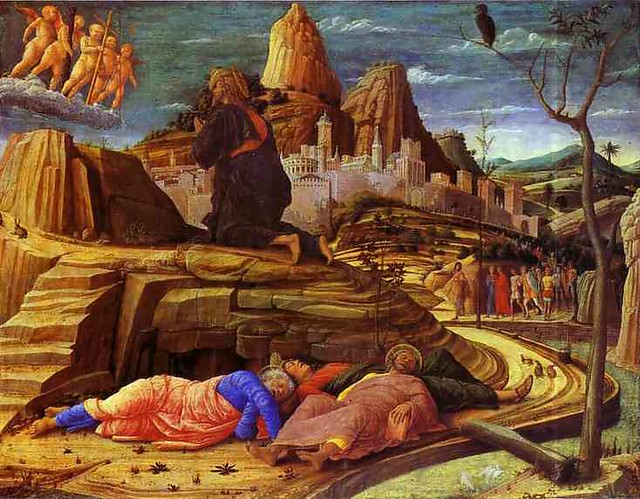
The First Sorrowful Mystery: The Agony of Our Lord in the Garden


Matthew (26: 36-46); Luke (22: 39-46)

Everyone, it is said, has their Gethsemane moment. The First Sorrowful Mystery then is a place of profound encounter.

In the Garden we see the Son of Man praying in solitude, his disciples a little way off. As Jesus contemplates his passion, which is to begin that very evening, his heart recoils from what is to be a cruel and ignominious death, he asks of the Father “if it be possible, let this cup pass from me; nevertheless, not as I will, but as thou wilt” (Matt. 26:39).

The natural, and in some sense praiseworthy, approach to this mystery is to try and associate ourselves as much as possible with Christ’s agony by placing ourselves in his shoes. We associate some mental anguish over some trial we have had, or are having, with Christ’s agony. However, Our Lord never considered acting against the Father’s will, he never thought that he might just run away or that he might call upon a legion of angels to deliver him (cf. Matt. 26:53). Our Lord was like the brave soldier who feared the battle but never contemplated desertion.

'Could you not watch with me for one hour?'

But for us, though we might often utter ‘Father, remove this cup from me…’ we always keep open the option of desertion. Most of us are more like the disciples in this mystery; we attempt to accompany the Lord’s agony but in fact we fall asleep. “The spirit indeed is willing, but the flesh is weak.”

So, as we begin the sorrowful mysteries we might ask, not so much for the strength to endure great spiritual ordeals, but rather, more modestly, we ask for the grace to be able to at least stay awake in the spiritual struggle that we might learn to complete our prayer and say ‘not my will but thine be done.’

Thursday, July 10, 2014

The Sorrowful Mysteries

Detail of the Agony in the Garden, Sacred Heart Chapel, Downside Abbey
Death, particularly a gruesome death, and the trials that lead up to it are not things that one would normally wish to contemplate; and yet, each Tuesday and Friday, millions of Catholics around the world will be thumbing their rosary beads doing exactly this. To what end?

Well, first, and more generally, the Rosary draws us into familiarity; familiarity with Christ and familiarity with Mary. It is that familiarity that builds within us the bonds of communion – we know Christ and we know the love of the Father He reveals to us, and there is great value in this.

But, second, and more particularly, contemplation of the Sorrowful Mysteries helps us better to follow Christ in one of His more challenging teachings:
“Jesus said to his disciples: ‘If any man will come after me, let him deny himself, and take up his cross, and follow me. For he that will save his life, shall lose it: and he that shall lose his life for my sake, shall find it. For what doth it profit a man, if he gain the whole world, and suffer the loss of his own soul?’” (Matthew 16:24-26).

Meditating upon the Sorrowful Mysteries prepares us for the struggles that we all must surely have in living as authentic Christians. Our cross, may not be the Cross of Calvary, but we cannot expect to be able to accept and bear whatever struggles we are presented with if we exclude all thought of suffering from our prayer lives. Nor can we make sense of our suffering unless we contemplate the redemptive suffering of Christ, the context for all human suffering . . . suffering that ends not with death, but with the Resurrection.

Each of us can draw upon our personal experience of suffering and use it to unite ourselves to Christ. Most of us will have had our Gethsemane moment, that experience of a sense of having been betrayed and the consequent hurt; the agony of something unpalatable that must be done despite our own desires and fears. Similarly we can also relate our physical sufferings to those of Christ along the way to Calvary.

13 The Crowning with Thorns
Crowning with Thorns: Downside Abbey
But it is not just the sufferings of Christ that we enter into when we contemplate these mysteries. We can unite ourselves to Mary as we draw upon that anguish of being impotent in the face of a loved one’s suffering - that profoundly human hurt that we experience in the face of the suffering of another that we can do nothing about; the beautiful desire of a mother to bear the sufferings of her child in his or her place. And finally, as we contemplate the crucifixion, along with the feeling of horror at the brutality of man to his fellow man; we might also be moved to gratitude, for Christ has taken the burden of our sin upon Himself and redeemed us.


Saturday, July 5, 2014

Fifth Joyful Mystery: The Finding of the Child Jesus in the Temple

How do we know if the room is too cold? There is a gradual feeling from an early point that the room is getting colder, but eventually there is a point where we just ‘know’ that we need to put on a jumper, close the window or put a heater on. The Finding of the Child Jesus in the temple is one of the first events in the Bible where we see those surrounding Jesus, start to get more insight into something profound about this boy from Nazareth. For the son of an artisan, not formally educated, Jesus somehow has the knowledge to have dialogue and debate with the Doctors in the temple. 

A tipping point for Mary and Joseph might have been the several days where Jesus was separated from them, and instead was residing in the temple (Luke 2:41-52). Once they discovered he was actually in discussion with those learned scholars rather that any act of disobedience, was this the point where the parents of Jesus slowly began to realise who Jesus was? Rather like starting to know that a room is starting to get cold, perhaps they started to realise what sort of role they would have in His life and ministry. This is the only scriptural account of the early life of Jesus mentioned in a gospel. I often find this Joyful mystery a useful meditation and prayer for educators and those involved in religious education.

Friday, July 4, 2014

Fourth Joyful Mystery: The Presentation of Jesus in the Temple

The Presentation, by Fra Angelico OP
Mary and Joseph take Jesus to the Temple in Jerusalem, forty days after his birth, 'to present him to the Lord', as the Law of Moses required (Luke 2:22). St Luke stresses that the parents fulfil all their religious obligations meticulously; and the offering of two birds shows their humble poverty. But the significance of the Presentation goes much further. As the prophet Malachi had announced (Mal. 3:1):

Behold ... the Lord whom you seek will suddenly come to his Temple.

Now it is two new prophetic figures, Simeon and Anna, who recognise that the Lord has indeed come to his Temple. They have been waiting patiently for the promised Saviour, the Messiah, and now they cradle him in their arms. Simeon gives thanks to God: 'my eyes have seen your salvation'. Indeed, he is holding Salvation in his very arms, for the baby is Yeshua or Jesus, which means Salvation.

This Saviour will be the fulfilment of the Jewish religion, with its Law and Temple, to demonstrate the glory of Israel. But he has also come as a light for the Gentile nations, and offers salvation to the whole world.

This salvation in Christ is tragically not recognised by all. Simeon predicts that Jesus would bring division; and the opposition to his divine mission would be a 'sword' to pierce Mary's soul. This loving mother would see her son suffer and die, as his infinite love carried him to the Cross.

The great joy of the Presentation, then, is already tinged with the anticipation of future sorrows. Salvation comes at a cost, as Jesus gives his life for us. But this, too, is a cause for joy. As we meditate on his Presentation, we rejoice that Salvation has come to us and has given his life for us.

Wednesday, July 2, 2014

Third Joyful Mystery: The Nativity

"And while they were there the time came for her to be delivered. And she gave birth to her first-born son and wrapped him in swaddling cloths, and laid him in a manger, because there was no place for them in the inn." (Luke 2:6-7)

As she placed her child in the manger and looked upon Him with a perfect mother's love, she could not yet have known how His perfect love for all mankind would transform the world.

As she wondered what the future might hold for this child of hers, perhaps her mind turned to those words of the angel, all those months before, and she contemplated what it might mean to be the Son of the Most High?

As she gazed upon Him with great joy and wonder, perhaps there was also a tinge of trepidation about their future, a future that would pierce her heart with sorrow and His hands and feet with nails. 

Love came into the world and Love would suffer for us; so that our sufferings would no longer be in vain, but might, like Mary's, unite us more closely with Him.


As she reflected on those who came to pay tribute to her son – the Shepherds and the Magi, the lowly and the rich, the Jew and the Gentile – could she have imagined that one day peoples of every nation would gather together in the name of her son?

As she cradled Him in her arms, little could she have known that this small weight would lift the heavy burden of sin from the world. And yet as she contemplated the Scriptures perhaps she wondered if He was the one spoken of in Genesis, the seed of the woman that shall crush the serpent's head?

Surely, though, as she pondered all these things in her heart, one thing she knew for sure: nothing would ever be the same again.

– Br Toby Lees OP

Sunday, June 29, 2014

Second Joyful Mystery: The Visitation of Mary to Elizabeth

After hearing the Angel's news, Our Lady carries Our Lord in her womb "with haste" into the "hill country" to visit Elizabeth, her cousin (Luke 1:39-56). Her selfless act of making such a journey is both a corporal and a spiritual mercy.

As a result, John the Baptist leapt in Elizabeth's womb, and Elizabeth spoke words of praise to her cousin that now form part of the Hail Mary, which forms the Rosary, and The Magnificat which we pray at Vespers. In this remarkable encounter, the Lord Jesus was present physically in nascent human form.

I was recently asked to take communion to a gentleman who couldn't get to Mass on account of his illness. The gentleman and his wife were incredibly grateful but it was I who had the greater debt to them for sharing with me their peace – a God-given grace in great adversity. I was very moved by the experience. When we undertake such tasks, in a modest way, we follow Mary's example.

When praying this decade, a good intention is to remember those who are unable to attend Mass, that heavenly banquet on earth.

Lord, help us to make known your presence. Help us to carry you, and be carried by you.

– Br Samuel Burke OP