Friday, October 24, 2014

The Godzdogz Team 2014-15

The Godzdogz Team, 2014-15

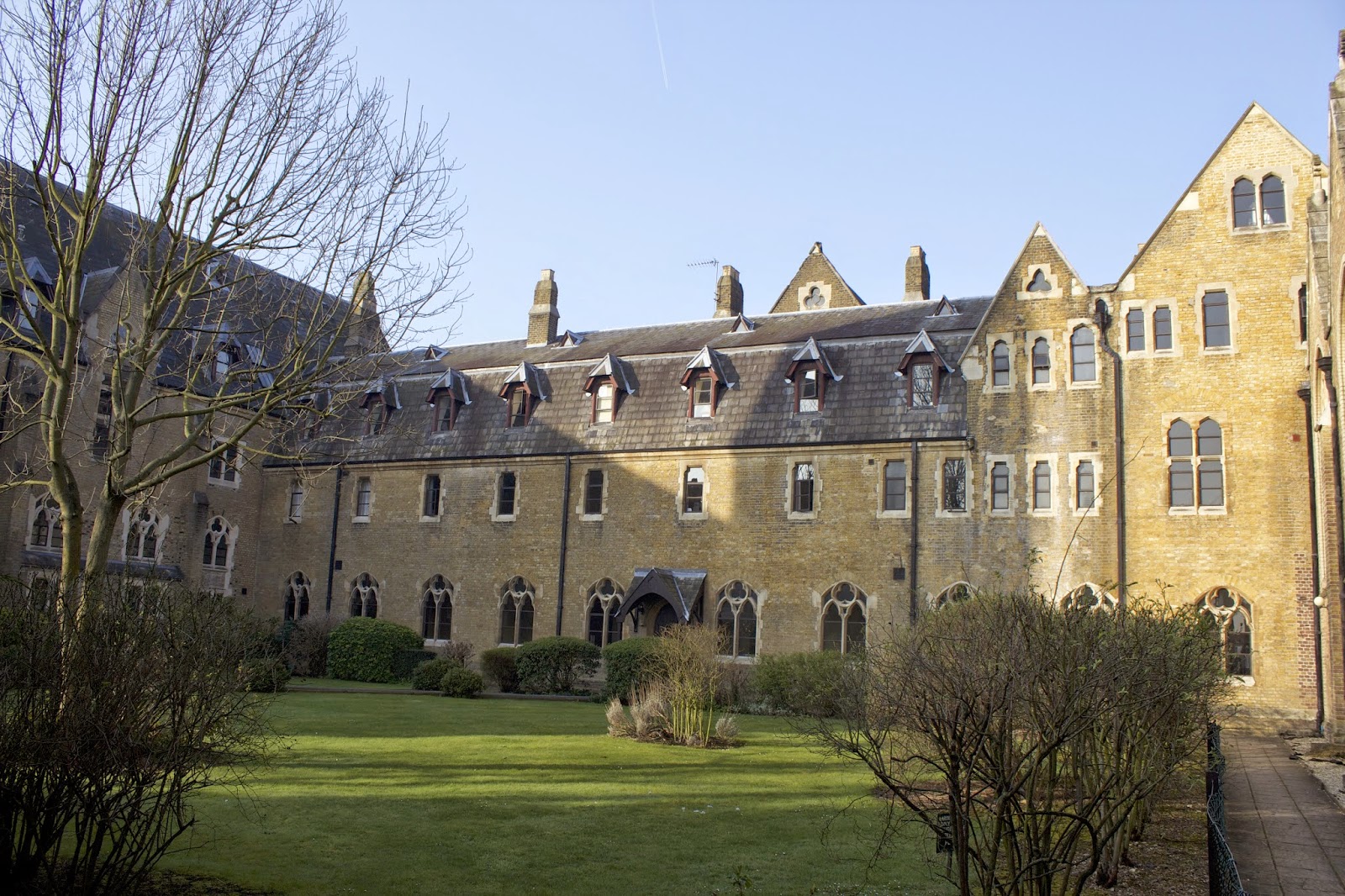
We are pleased that the Dominican community at Blackfriars has grown to 27 this year. The Godzdogz Team (i.e. the student brothers) is larger thanks to new vocations in the English Province. Earlier this month, Brothers Joseph Bailham OP and Christopher Pierce OP began their studies in the Blackfriars Studium, having made Simple Profession in Cambridge.

We also welcomed Br Richard Steenvoorde OP, who recently made Simple Profession in Zwolle for the Province of the Netherlands, having completed his novitiate in Cambridge. Br Jean-Baptiste Régis OP joined us from the Province of France, having made his Solemn Profession in Lille last month, and will study in Oxford for the next two years. From Poland, Br Mateusz Grzelczak OP has come for a year to continue his studies.

We also have more priests in the community. Fr Irenaeus Vincent OP has moved from London to continue his Doctoral studies. There are three priests from the Province of St Joseph (USA), two of whom are on sabbatical: Fr Albert Paretsky OP, Biblical scholar, and Fr Thomas Joseph White OP, director of the Thomistic Institute at the Dominican House of Studies in Washington. Fr Gregory Schnakenberg OP has begun a Master's in Medieval Studies at the University of Oxford.

Deo gratias.

Thursday, October 23, 2014

Dominican Priories: Oxford (Blackfriars Hall)

The plaque on the outside of Blackfriars highlighting its existence as a Priory, a Studium, and a Hall of the University

In a previous post, Br Oliver explained how Blackfriars in Oxford exists as a Priory, as well as a home to the Studium. Blackfriars is also home to Blackfriars Hall, which is a Permanent Private Hall (PPH) of the University of Oxford. Like the more familiar colleges of Oxford, such as Christ Church and New College, Blackfriars Hall can admit students for degrees from the University. PPHs are generally much smaller than colleges both in physical size and number of personnel, and tend to have a more religious character.

Blackfriars Hall was established in 1994 on 1st January. We Dominicans were involved in the life of the University long before this date (though admittedly with a substantial hiatus in between; but that was not our fault!). After our first priory in Oxford was established in 1221, Dominicans very quickly took up high-ranking positions within the University's theology faculty. 

The Aula at Blackfriars, which is where most lectures take place

The Hall offers an intimate and friendly academic setting for mature undergraduate and postgraduate students, who have the unique opportunity to be taught, particularly in the case of theology and philosophy students, by the brethren, and to study alongside the student friars, as well as the other religious and non-religious students in formation as part of the Studium. 

Before being accepted by the Dominicans, I was a postgraduate student in the Hall reading for my Master's in theology. It was a period in which I was privileged to have had the opportunity to get to know the brethren better and to see a little closer the life they lived, which without question contributed to my wanting to be a Dominican friar. The Hall serves as a special bridge between the religious world of the friars and the secular environment of a modern university, thus existing as a very unique and important form of outreach for us as friars in the English context.

Wednesday, October 22, 2014

Our Father: Hallowed be thy name

A Dominican friend from Panama suggested to me that the English translation of the Our Father is the worst of all of the modern languages. I have always disagreed with him, until pondering the use of ‘hallowed be thy name’ in the Lord’s prayer. How often do we ever hear the word ‘hallowed’ used in any other context than the Our Father? Hallowed is a strange word sounding a bit like like ‘halloween’ but not really having much other use than here in the Our Father. I would translate the Latin text ‘sanctificetur nomen tuum’ into English as ‘sacred is your name’ or perhaps ‘your name is most holy and sacred’. When we pray to God, perhaps no language can express the magnitude of sacredness and holiness of God.

In a letter to Proba by St Augustine, he ponders the purpose of praying. If the Lord knows what we need before we ask for it, then what is the point of approaching God who is all-knowing (omniscient) and omnipotent? If God knows what we want, what we need and can provide then do we really need to ask in the first place? This uber-sacredness of God, His hallowed name, is highlighted by St Augustine, who teaches that our Lord and God does not want to know what we want (as he cannot fail to know this), but instead wants us rather to exercise our desire through our prayers, so that we may be able to receive what he is preparing to give us. His gift is very great indeed, but our capacity is too small and limited to receive it. That is why we are told, Enlarge your desires, do not bear the yoke with unbelievers. The deeper our faith, stronger our hope, the greater our desire, the greater our capacity will be to receive that gift.

Just as sacredness or ‘hallowed-ness’ is difficult to imagine or perceive, it requires effort to remember just who and what God is. God is the highest of all that is sacred and holy, and the way for us to obtain a life of happiness in eternity. St Augustine reminds us that we are limited, but we can grow in our capacity to receive the gift of a life of happiness, through prayer. Yes, our understanding of the sacred is limited, but what we can do is try our best to have the sacred be exactly that. Sacred liturgy, music and artwork in our churches help direct us to the Almighty. The hallowed nature of Catholic churches needs to be maintained and promoted as being something that is not disposable, everyday or open to unthinking reform. This is partly why I despise some of the tacky and banal Church architecture of the mid to late 20th century. Such buildings do not represent hallowed ground or the sacred, they just look like some concrete community centre. Catholicism means turning our lives to God rather than selling out to worldly pursuits. We are taught to build up virtues that will serve us for life, rather than believing money will give us permanent happiness. To paraphrase Frank Underwood in the US series House of Cards, “Money is the McMansion in Sarasota that starts falling apart after ten years.” Hallowed is the old stone building that stands for centuries.


Tuesday, October 21, 2014

Our Father: Who Art in Heaven

How close is Our Father to us? It is a common experience in prayer, and in the spiritual life generally, to feel a great distance between God and us. This 'hole' in our spiritual life can be perplexing and painful, and sometimes it can lead us towards a despair, a fear that our God is not a God who loves us.

We cannot avoid this despair by denying that there is, in a sense, a distance between God and us. Indeed recognition of this reality is present in the prayer Our Lord taught us. Jesus reminds us that our Father is in Heaven whereas we are here on earth, a place where God's will is often rejected by those upon it.

How then can we make sense of this distance between God and us? Firstly we can continue to pray the Our Father! As we move through the prayer we remember that it is fitting that we should find the distance between God and us perplexing: we are not made for this world - we look forward to the kingdom. However, we can also look to the one who taught us the prayer.
As St. John wrote in his gospel 'God so loved the world, that he gave his only begotten Son that whoever believes in him should not die but have everlasting life.' It is God who bridges the gap between Heaven and earth, he is the one who came down from heaven to raise us up.

Thus, when we feel our painful separation from God we can meditate confidently over these words:


Our Father who art in Heaven, who came down to us to bring us back to you.

Monday, October 20, 2014

Dominican Priories: London


The Priory of Our Holy Father St. Dominic in Haverstock Hill, London, is the base of a vibrant and diverse preaching apostolate of the dozen or so Friars assigned there.
Attached to the priory is the Parish Church of Our Lady of the Rosary and St. Dominic, serving the local communities of Gospel Oak, Haverstock Hill, Chalk Farm and Belsize Park. The parish includes some of the most economically deprived areas in the country. The Church building is one of the largest in London. It runs 200 ft long, 80 ft wide and 100 ft high, and, as such, stands as a significant landmark for the surrounding area. 


Interior of St. Dominic's Church, looking down the nave
In 1862, the Dominicans purchased three acres of land in obedience to Cardinal Wiseman’s request that religious orders establish missionary foundations in London to serve the growing number of Irish migrants. The foundation stone of the church was laid the following August according to Gothic designs by Gilbert Blout. He died during construction in 1876 and the mantle was passed to a new architect, Charles Buckler. Buckler, a convert to the Catholic faith, had the advantage of having no fewer than three brothers who joined the Order and oversaw the remaining construction whilst making some significant alterations to the original plan. His revisions drew inspiration from Dominican churches in the Low Countries. After twenty years in the making, the vast church was consecrated in 1883 by which time his brother, Fr. Albert Buckler OP, was Prior. One of a number of impressive features of the Church is the side chapels around the perimeter, dedicated to the fifteen mysteries of the Rosary and paid for by local benefactors. Charles Buckler, the architect, paid for the Chapel of the Annunciation out of his own pocket - a token that demonstrates the fondness he clearly had for his great work.

Chapel of the Annunciation, St. Dominic's Church

Today, the parish is thriving. In addition to the provision of the sacraments, our ministry includes  pastoral work, and providing other opportunities for prayer and study. The parish also serves two primary schools, St. Dominic's and The Rosary School  The current Prior of the community, Fr. Timothy Calvert OP, also serves as Parish Priest - a task in which he is assisted by two of our former contributors, Fr. Gregory Pearson OP, and the newly ordained, Fr. Nicholas Crowe OP, amongst others. You may also recall that St. Dominic's hosted our Studentate Parish Mission, Pray 4, last year, which was a resounding success.

St. Dominic's Priory
Aside from Parish ministry, other brothers carry out their preaching mission in hospital chaplaincy at University College Hospital, and the nearby Royal Free Hospital; university chaplaincy at Imperial College (a position which our brother, Fr. Timothy Radcliffe OP, once held); school teaching and chaplaincy; and in studying towards postgraduate degrees. 

Our London priory has been the home of several notable Dominicans who have lived in our the Priory include Fr. Bede Jarrett OP, Fr. Vincent McNabb OP, Fr. [John Dominic] Alan Cheales OP, Archbishop Malcolm McMahon OP, and St. Dominic's is also the home of the present Prior Provincial, Fr. John Farrell OP.

On a more personal note, St. Dominic’s is one of the places where I came to know the Order. My housemates and I would rise early and get the number 46 bus from Grays Inn Road up to Southampton Road for the 7.30am Mass. I was always amazed at the edifying homilies given before sunrise. Apparently Friars at St. Dominic's eat Weetabix for breakfast! It was often on the bus back saying the Rosary that I prayed about my direction in my life. I will be forever indebted to the Church and community of St. Dominic’s for assisting me in the discernment of my vocation.


Sunday, October 19, 2014

"Our Father"

It is an act of audacity to call God ‘Our Father’. Although God as creator is in a sense ‘Father’ of the whole world that proceeds forth from his creative word, we can claim no natural right to address Him in the intimate and familial way in which the fatherhood of the Pater Noster speaks. It rolls off the tongue as perhaps the first prayer we memorise as children, but we only dare to make it our own because we have first been authorised and commanded to do so by Jesus Christ, who is the personal revelation of the Father in our world. To address God with such filial boldness is an act of fidelity to Christ, who instructed the disciples to pray in this way in response to their recognition of dependence and insufficiency. The Lord whom they seek is already the one who causes their seeking, and it is in response to their petition (itself already a prayer)—“Lord, teach us to pray” (Lk 11:1)—that Jesus teaches them the Our Father as an invitation into his own prayer life, a route into that communion which alone fulfils their deepest desires, the Son’s own relationship to God the Father.

The ‘Fatherhood’ which the Our Father speaks of is, therefore, not a generic image of Fatherhood, but the specific Trinitarian relationship of the Father and the Son, into which we are granted participation by the Holy Spirit. For this reason, Aquinas speaks of the words ‘Our Father’ as a nutshell summary of the entire Christian faith, words which cannot be uttered authentically without faith in the Triune God and the incarnation of the Son. Yet if they are a summary of the authentic doctrine of the faith, they are also a summary of the essential attitude and emotional disposition of Christian prayer (which Aquinas sees as the “interpreter of desire”): by addressing God as Father, we place ourselves in joyful obedience, humbly recognising the wonder of our own being and resting in the simple assurance of being loved into existence and loved into new life in Christ.
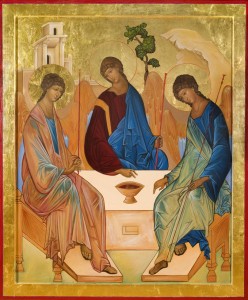
To pray Our Father, then, is part of our baptismal vocation. It is something given to us in that moment when we receive faith and are re-born anew by engrafting into Christ. It is not only because the Son alone can address the Father as ‘my Father’ that it is given to us to pray in the plural to Our Father, but also because our re-birth into the Son’s relationship to the Father is also the moment of our entry into the Church as the community of faith. For Christians, to be most fully a person is almost the opposite of being an ‘individual’. Baptism radically de-individualises us by drawing us into the communion of the Church, and the Christian always prays as a member of the Church, even when they do so in private. To pray Our Father is a reminder that we cannot ‘go it alone’, that wherever we go our connection to Christ and his Church abides, for we have been made an irreplaceable part of something bigger than ourselves upon which we depend for our own innermost identity. It is, therefore, most fitting that we pray Our Father at each celebration of Holy Mass, as the people of God are gathered—with the angels and saints—around the Eucharistic Lord, in anticipation of the Kingdom to come.

Friday, October 17, 2014

Our Father: a new commentary on the Lord's Prayer

It is not always easy to find the right words to pray. This was the problem facing Jesus's own disciples, when they said to him, 'Lord, teach us to pray, as John taught his disciples' (Lk 11:1). St Paul also recognised the difficulty, saying that 'we do not know how to pray as we ought, but the Spirit himself intercedes for us with sighs too deep for words' (Rom 8:26).

Jesus teaches his disciples to pray
in the Sermon on the Mount
It is a great blessing and a grace, then, that God has provided good words to use. Like a parent teaching a child to speak, to enlarge its vocabulary and say new things, God gives us new ways of sharing with him the deepest longings of our heart. The Scriptures are a useful place to find prayers and hymns which we can make our own, not least the Psalms, which form the backbone of the Church's public prayer in the Divine Office.

But the best prayer of all, because it comes straight from Jesus Christ in response to his disciples' request, is undoubtedly the Lord's Prayer, better known as the Our Father (cf. Mt 6:9-13; Lk 11:1-4. This is a prayer for all times and seasons, for all situations, and for all people. Above all, it draws us into the prayer of Christ himself, because we address (as he did) our prayers to our loving Father in heaven.


In this new series on Godzdogz, we hope to explore the rich spiritual and theological meanings of the Lord's Prayer. This is a prayer dear to countless generations of Christians before us, and it should be frequently on our lips. In commenting on the meaning of each phrase, our aim is to achieve a deeper understanding which will in turn deepen our prayer, through the Son, in the Spirit, to the Father.

Our Father, 
who art in heaven, 
hallowed be thy Name; 
thy kingdom come, thy will be done
on earth as it is in heaven. 
Give us this day our daily bread, 
and forgive us our trespasses, 
as we forgive those who trespass against us; 
and lead us not into temptation, 
but deliver us from evil. 

For the kingdom,
the power and the glory are yours
now and for ever.

Amen.