Friday, May 2, 2014

Our Lady of Częstochowa, Queen of Poland

Our Lady of Częstochowa
Devotion to Mary, the Mother of God has had a special place in the Catholic faith in Poland. The most important Polish Marian shrine, where is the famous icon of Our Lady, is Częstochowa, called also Jasna Góra (Bright Mountain). The origin of this image is unknown with absolute certainty. It is a typical painting of Byzantine tradtion dating from 6th - 9th century. Nevertheless according to legend the icon was painted by St. Luke on a cedar table top from the house of the Holy Family. It was brought from Jerusalem to Constantinople and then from Constantinople to Red Ruthenia (Western Ukraine). The icon came to Jasna Góra in 1382 when Władysław (Ladislaus), Duke of Opole, had seen it at the castle of Bełz and acquired it. The image was already treated with great reverence and honoured. The Prince left the icon under the protection of the Pauline Fathers (Order of Saint Paul the First Hermit) whom he had brought to Częstochowa from Hungary. In 1430 took place a sacrilegious attack and the icon was demaged. It was carefully restored and repaired, but the marks left by the sword slashes could not be completely removed and two scars can still be seen on the right check of the Madonna.


The chapel with the image of the Madonna
The portrait of Our Lady is black because of soot residue that discolors the painting. The soot is the result of votive candles and lights burning in front of the painting. For public view the holy icon is always presented in the chapel covered with a special and richly ornamented dress.
At the beginning the image was placed in the small chapel, but because of many pilgrims visiting this place, the chapel became very quickly too small. Therefore it was enlarged and became three-nave chapel. Since 1644 has remained like that today. There were built also a new church that became basilica as well as monastery and fortification. At the beginning of the eighteenth century was built the tower.
The icon is regarded as being miraculous and some of these many miracles have been associated with very important events in the Polish history when Poles in a special way solemnly dedicated themselves to Mary. Therefore Jasna Góra is also a very significant treasury of Polish history.


A view of the monastery at Jasna Góra
One of the greatest victories took place in 1655. A Swedish invasion, called the Deluge, moved through Poland and their first defeat was at Jasna Góra when they were unable to take possession of the mountain and its buildings and they were forced to retreat. Next year following the victory the king of Poland, Jan Kazimierz (John Casimir) made a vow in the Cathedral in Lwów (Lvov) putting his country under the protection of Our Lady and declaring Her to be "Queen of the Polish Crown".
In 1683 the defeat of the Turkish army at Vienna saved the Christianity in Europe. It was due to the intervention of the Polish army that was leading by king Jan III Sobieski (John III Sobieski) who went into battle in the name of Our Lady of Częstochowa at whose shrine he prayed before.
In 1920 Bolshevik invaders moved on Warsaw with the aim of taking the whole country that was on his way to make and spread the communist revolution in Europe. The people in Poland prayed fervently to their Queen and Mother. On 15 August, the Solemnity of the Assumption, the enemy retreated and this victory is called "The Miracle on the River Vistula".


The avenue leading to the shrine
After Second World War Poland had been almost for fifty years under Communist system. Primate of Poland, Cardinal Stefan Wyszyński, who was interned for three years (1953-1956), wrote the text of the national vows that were to be a kind of renewal of the royal vows made by Polish king, on its three hundreth anniversary. On 26 August 1956 the acting president of the Polish Episcopate proclaimed the vows, known as Jasna Góra, Vows of the Polish Nation, together with pilgrims (about one million) gathered at Jasna Góra Sanctuary.
Next year started the Great Novena, a nine years of fast and prayer, that was the preparations for the celebration of the Millenium of Polish Christianity in 1966. At that time the copy of the miraculous picture of Jasna Góra visited all Polish parishes. The communist authorities were very afraid, because people gathered and prayed together. To prevent and stop it they decided "to arrest" the picture, but it didn't work at all. However the image of the Madonna could not visit next places, nevertheless during this difficult time people were gathered together by empty frame of the picture that still visited Polish parishes.


The basilica at Jasna Góra
Jasna Góra is not only a place of pilgrimage, but also the custodian and protector of the nation's treasures. The kings and princes who honoured the shrine came bearing gifts, piligrims too in their own way have done likewise, also artists' skills are reflected in the decoration of the shrine and its surroundings. The shrine of Częstochowa demonstrates how devotion to Our Lady is part of the life of the Polish people. The invaders of Poland have long been aware that the strength of the Polish people lies in their faith expressed in their devotion to their queen. It is indeed fortunate that two recent world wars, a Nazi occupation and more recently a Communist government have left the shrine and its treasures unscathed.
Pope John Paul II said: "This sign of Mary, Poland's Queen, Our Lady of Jasna Góra, has been interpreted anew: We know the significance of this picture for us [...], what it became in our struggles for the nation's soul. [...] I think that this sign is meaningful for the future, too. Mary is the Queen of the Polish Crown. Mary is the Queen of the Polish matters, Polish efforts, Polish sufferings and Polish victories. [...] The past experiences teach us in whom we should seek support, who is the biggest ally of the Church and the nation. The relationship between the Mother of God, the Mother of the Church, the Queen of Poland, and the Church and nation in Poland is a kind of covenant."


The shrine and the monastery at Jasna Góra
In the recognition of the miraculous image Pope Clement  XI donated a crown and the holy icon was crowned in 1717. Pope Pius XI designated 3 May Solemnity of Our Lady of Częstochowa, Queen of Poland. This day has also a special importance and significance in the history of Poland. This is a Polish national feast and public holiday because of the declaration of the Constitution of 3 May that took place in 1791 and it was the first constitution in Europe and the second in the world.
Almost in all Polish churches and in homes of Polish people scattered throughout the world can be found the icon of Our Lady of Częstochowa and Mary is honoured as the Queen of country and of its people. In Poland Częstochowa is regarded the national shrine and the spiritual capital. Many Polish Catholics make a pilgrimage there every year. The shrine at Jasna Góra is also one of the most frequented Marian shrines in Europe.


Our Lady of Częstochowa, Queen of Poland, pray for us.
Mary, Queen of Poland, I am near you, I remember you, I watch.


Installation of Archbishop Malcolm McMahon OP as Archbishop of Liverpool

Yesterday, on the Feast of St. Joseph the Worker, Dominican Friars from across the Province flocked to Liverpool to join our brother, +Malcolm McMahon OP, for his installation as the ninth Archbishop of Liverpool. It was a very happy occasion for the Dominican family to celebrate his appointment and offer prayers for him and the Archdiocese of Liverpool as they embark upon a new mission.


Archbishop Malcolm joined the Order of Preachers in 1976, following studies in Engineering and a period working in the transport industry. He studied at Blackfriars, Oxford, and Heythrop College, London before being ordained a priest by Cardinal Basil Hume at St. Dominic's Church in Haverstock Hill, London, in 1982.

His early ministry as a Dominican Friar took him all over the English Province, including time at Holy Cross Priory, Leicester; St. Dominic's, Haverstock Hill; and St. Dominic's, Newcastle-upon-Tyne. In 1992, he was elected Prior Provincial of the English Province of the Order of Preachers and continued in that office for two terms until 2000.

In that same year, Pope John Paul II appointed him as the ninth Bishop of Nottingham. After 13 years as Bishop of Nottingham, Pope Francis appointed him as Archbishop of Liverpool. In addition to his pastoral responsibilities, Archbishop Malcolm serves as Chair of the Bishops' Conference Department of Education and Formation, the Catholic Education Service (CES), the Catholic Trust for England and Wales (CATEW). He is also National President of Pax Christi, the International Movement for Peace, and the Ecclesiastical Advisor to the Knights of St. Columba.

Details of the Mass of installation can be found here. They included some elements which reflected Archbishop Malcolm's Dominican character, such as the "Summae Trinitati" by Lay Dominican, James Macmillan and the communion hymn "Godhead here in hiding", a translation of Adoro Te Devote by St. Thomas Aquinas. 

In his homily, Archbishop Malcolm quoted St. John XXIII: "The secret of everything is to let yourself be carried by the Lord and to carry the Lord." In St. Joseph we have a wonderful example; he was carried in that he accepted God's plan for him, and "he literally carried the Lord as guardian teacher and guide of Jesus." The full text of his homily can be found here.

Please join us in praying for our brother, Archbishop Malcolm, and the Archdiocese of Liverpool in the days and weeks ahead.


Wednesday, April 30, 2014

Catholic Social Teaching: Economic Justice and the Dignity of the Worker


“Never discuss religion and politics”, they say. So one would appear to be straying into dangerous territory in seeking to discuss economic justice and the dignity of the worker in the context of Catholic Social Teaching; for if ever there was an area in which the taboo two meet head on, it is surely this?

In any event I often used to find at dinner parties that politics would come up, perhaps with the other guests hoping, in vain, that if they let me talk about politics they would not have to hear me out on religion. Conversation would inevitably involve one half of the table railing against the plight of the poor and the need for greater welfare provision, whilst the other half would talk about the evils of state welfare dependence, and need to empower people and reduce government intervention in people’s lives. Unwittingly, both positions point to the two pillars of Catholic Social Teaching: solidarity and subsidiarity.

Subsidiarity, implied throughout the whole of Catholic social theory and given its clearest expression in Pope Pius XI's encyclical Quadragesimo Anno, means that in the adjudication of matters political and economic, a preferential option should be given to the more local level of authority. The state should not interfere in matters in which people are competent to decide for themselves. Furthermore the state should not presume its citizens are incompetent to determine what is best for them just because they are poor as this undermines their intrinsic dignity.

However, subsidiarity must always be balanced by solidarity, which is to say, a keen sense of the common good, of the natural and supernatural connections that bind us to one another, of our responsibility for each other. The message of the parable of the Good Samaritan is not vitiated by subsidiarity. Nor, as many point out, should the state discourage the individual from helping others; the elimination of charity is not the aim of solidarity. Nevertheless, the concept of solidarity acknowledges that sometimes the government is the legitimate vehicle by which social solidarity is achieved. There are things that we cannot achieve as individuals at a small community level, but which we can achieve on a larger scale with combined efforts and resources. However, it must always be remembered that “solidarity is first and foremost a sense of responsibility on the part of everyone with regard to everyone, and it cannot therefore be merely delegated to the State” (Caritas in Veritate).

“Thus the principle of subsidiarity must remain closely linked to the principle of solidarity and vice versa, since the former without the latter gives way to social privatism, while the latter without the former gives way to paternalist social assistance that is demeaning to those in need” (Caritas in Veritate) . . . the aforementioned dinner party tension!

Where though does economic justice fit into all this, and what might the Church usefully have to say about it? Is the Church even qualified to have an opinion on such matters? Well, almost no one predicted the global financial crisis which came to a head in 2008, including most economists, although in an interview back in 1996 when asked his opinion, on the Western economic system and its then trajectory, one churchman gave the following perceptive analysis, showing that we might just be worth listening to on such matters:

As a matter of fact, I understand too little of the world's economic system to say. But it is apparent that in the long run it can't continue as it is. First of all, there is the inner contradiction of the indebtedness of states, which live in a paradoxical situation; for, on the one hand, they issue money and, in general, guarantee the value of money but, on the other hand, are actually bankrupt, if we judge in terms of the debts. There is, of course, also the debt disparity between North and South. All of this shows that we live in a whole network of fictions and contradictions and that this process cannot continue on indefinitely. 

"We have just witnessed [Spring 1996] this curious situation in America. Suddenly the state can no longer pay its debts and must close shop, so to speak, and furlough its civil servants, which is a crying contradiction because the state has the responsibility for holding the whole together. The incident has shown in a drastic way that our system contains gross mistakes and that a considerable effort is required to find the corrective elements.

This critique of the prevailing system is characteristic of much Catholic Social Teaching on economic justice. It is not prescriptive, respecting their legitimate autonomy on such matters; it does not give detailed requirements of how states are to organise themselves, but rather with the benefit of critical distance identifies trends; what is potentially positive in them; what is less desirable; and also where excesses may lead.

Seeking to proclaim the truth in and out of season, inevitably finds the Church often teaching against the prevailing consensus; accusations have been levelled that its teaching on economic justice has been both in favour of Marxism and unbridled capitalism. The truth though is that when the Church looks at economic justice it never does so from a purely economic point of view. This point is key. The Church refuses to see the human person as purely an economic agent or utility maximiser. We are so much more than this and public policy must take this into account, as Pope St John Paul II sets out in Centesimus Annus:
The economy in fact is only one aspect and one dimension of the whole of human activity. [Where] economic life is absolutised, [and] the production and consumption of goods become the centre of social life and society's only value, not subject to any other value, the reason [for this] is to be found not so much in the economic system itself as in the fact that the entire socio-cultural system, by ignoring the ethical and religious dimension, has been weakened, and ends by limiting itself to the production of goods and services alone.


All of this can be summed up by repeating once more that economic freedom is only one element of human freedom. When it becomes autonomous, when man is seen more as a producer or consumer of goods than as a subject who produces and consumes in order to live, then economic freedom loses its necessary relationship to the human person and ends up by alienating and oppressing him.


Thus any public policy which fails to take in account what it means to be human and to flourish fully as a human being, not just as an economic agent, is never going to benefit society truly. The idea that if we just get the economic system right everything else will take care of itself which seems relatively uncontested across all political parties at present is what Pope Francis rails against in Evangelii Gaudium. He asks the jolting question:
How can it be that it is not a news item when an elderly homeless person dies of exposure, but it is news when the stock market loses two points?

neatly illustrating the warped mentality that has led us in many cases to believe that we are ruled by the financial systems in place rather than their being at our service, as if somehow we did not have the free will to act differently and economic events just happen to us. We need to change, not just the system in the abstract.
He then goes to on to criticise the idea that if one segment of society gets richer everyone else will automatically benefit:

“. . . some people continue to defend trickle-down theories which assume that economic growth, encouraged by a free market, will inevitably succeed in bringing about greater justice and inclusiveness in the world. This opinion, which has never been confirmed by the facts, expresses a crude and naïve trust in the goodness of those wielding economic power and in the sacralised workings of the prevailing economic system. Meanwhile, the excluded are still waiting. To sustain a lifestyle which excludes others, or to sustain enthusiasm for that selfish ideal, a globalization of indifference has developed. Almost without being aware of it, we end up being incapable of feeling compassion at the outcry of the poor, weeping for other people’s pain, and feeling a need to help them, as though all this were someone else’s responsibility and not our own. The culture of prosperity deadens us; we are thrilled if the market offers us something new to purchase. In the meantime all those lives stunted for lack of opportunity seem a mere spectacle; they fail to move us.”

Some cheap headline seekers have sought to suggest that is the Pope saying that capitalism is wrong and advocating Marxism, however, this is badly to miss his point. What he is saying is that we can never delegate our responsibilities of justice, fairness and a concern for the poor, to the system. We, at an individual and a societal level, always have moral responsibilities to those around us, which no system, no matter how fair, will ever abrogate. As EF Schumacher wrote: “The economic problem . . . is a problem which has been solved already; we know how to provide enough and do not require any violent, inhuman, aggressive technologies to do so. There is no economic problem and, in a sense, there never has been. But there is a moral problem, and moral problems . . . are not capable of being solved so that future generations can live without effort.”

What particularly alarms me as we move beyond the economic crisis of 2008 is how wealth inequality is growing at an unprecedented rate once more, and there seems to be a presumption from some that if only the rich become even richer, the poor will eventually benefit. Eventually in and of itself is not good enough, irrespective of the absence of evidence that this will in fact eventually happen. Economic justice, not only demands that change occur to those structures of inequality that mean that those who were in large part responsible for the crash are the first to recover from it, but also that those currently reaping rewards do not ignore the plight of those less fortunate and assume that somehow they will be okay . . . eventually. We have a responsibility towards our fellow members of society that should compel us to do something now.

As the US Bishops have written on economic justice: “Our faith calls us to measure [the] economy not only by what it produces, but also by how it touches human life and whether it protects or undermines the dignity of the human person. Economic decisions have human consequences and moral content; they help or hurt people, strengthen or weaken family life, advance or diminish the quality of justice in our land.” We need as a society to become more keenly aware of all these aspects, and we need to do this quickly. At the same time as advocating for fairer systems, we must not lose sight of the fact that we can have an impact at an individual level too. We can think about where we shop and who benefits, if we have responsibility for setting somebody’s wages this also should give us pause for thought.

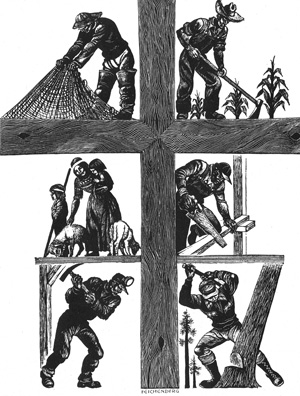
Today being the Feast of St Joseph the Worker, in this context, I want to reflect briefly on the dignity of the worker. The Church has always seen the dignity of work in and of itself. Work is not just viewed as a means to an end, but as something which has worth in and of itself. This is why we should never be content about having large numbers of people out of work, even if the benefits given to them were sufficient to support them and their dependents. There is a justifiable sense of self-worth to be derived from work and furthermore anybody who has ever watched The Jeremy Kyle Show will know that there is at least one good reason not to be idle at home during the day!
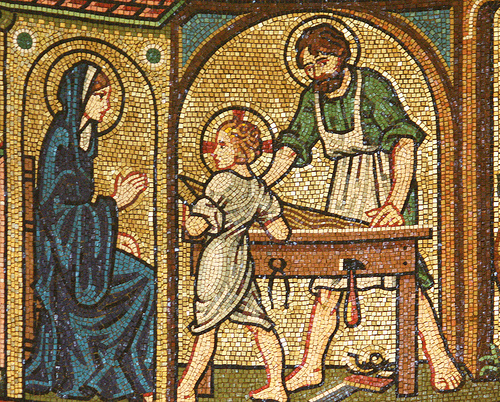
Mosaic of St Joseph the Worker, with Jesus and Mary
In Laborum Exercens, Pope St. John Paul II looks on work not just as a means of self-support but also as a contribution to society and one way in which Man is distinguished from the rest of Creation:

“Through work man must earn his daily bread and contribute to the continual advance of science and technology and, above all, to elevating unceasingly the cultural and moral level of the society within which he lives in community with those who belong to the same family. And work means any activity by man, whether manual or intellectual, whatever its nature or circumstances; it means any human activity that can and must be recognized as work, in the midst of all the many activities of which man is capable and to which he is predisposed by his very natures, by virtue of humanity itself. Man is made to be in the visible universe and image and likeness of God himself, and he is placed in it in order to subdue the earth. From the beginning therefore he is called to work. Work is one of the characteristics that distinguish man from the rest of creatures, whose activity for sustaining their lives cannot be called work.”

This is a very different conception of work and the worker from the mindset, all too prevalent, which sees the worker as a merely another production cost. Employers need to realise that their workers are human being with lives and aspirations outside of their work. Wages should never be viewed as just another necessary expenditure to be cut as far as possible for the sake of the profit margins. The argument that says paying higher wages, where people would work for less, is a dereliction of the duty to act in the interest of the shareholders rests on a selfish conception of the shareholder as one who is only interested in his own profits. If , though, we are to flourish fully as human beings this cannot be the dominant mindset. Nor is this pure pipedreaming, there are companies out there that treat staff equitably and continue to flourish in a difficult trading environment, John Lewis springs to mind.

The shrewd analyst who predicted the economic crash back in 1996 (Joseph Ratzinger) had something further to say on remedying the prevailing economic system:

“But I would like to add that we will not find [the corrective elements for our economic system] if there is no common capacity for sacrifice. For these correctives cannot simply be created by government prescription.

"This is the great test of strength for societies. We must learn that we cannot have everything we would like, that we must also go a notch below the standard that we have reached. We must once again find our way beyond what we currently possess, beyond the defence of our rights and claims. And this transformation of hearts is needed in order to make sacrifices for the future and for others. This, I think, will be the real acid test of our system.”

Christ crucified - the ultimate sacrifice
For the ultimate example of sacrifice, we need look no further that the inspiration behind all Catholic Social Teaching, Jesus.

Monday, April 28, 2014

Catherine of Siena

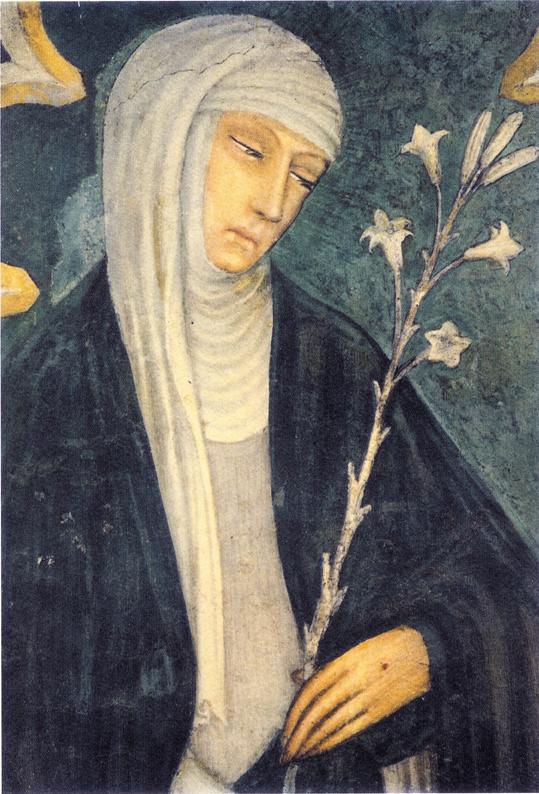
"Be who God meant you to be and you will set the world on fire." So was today's Dominican Saint, Catherine of Siena, quoted by the Anglican Bishop of London at a recent wedding. That the words of an illiterate Italian mystic of the fourteenth century, recorded by amanuenses, should be quoted at the wedding of the future King and Queen of an apparently post-Christian country is remarkable. Still more remarkable, however, is the influence that Catherine had in her own lifetime. Befriending popes and politicians through correspondence from the seclusion of her austere cell and through her adventurous travels, Catherine decisively engaged the political landscape of her day, playing an important role in resolving the Avignon schism. Catherine, then, had surely taken her own advice and discovered the gift and mystery of herself: daring to be a Daniel, speaking the truth to the powerful and mighty on behalf of the poor and marginalised, she was as concerned by the rights of political prisoners as she was by the unity of Christendom, and all this before her early death aged thirty-three.  

Without any lack of admiration for this great mystic and theologian of our Order, however, I must confess that I find Catherine's heavily stylised writings very difficult to digest. Some of the images she deploys, particularly to narrate her mystical marriage to Jesus, are, perhaps, not immediately engaging to today's reader of Anglo-Saxon temperament. Nonetheless, there can be no denying that Catherine's admonition to us to 'become who we are' resonates deeply with the spiritual longings of modernity, which seem to be governed by the un-ending quest for self-realisation and self-determination. Some might even see in Catherine a medieval anticipation of Dr. Seuss: "Be who you are and say what you feel, because those who mind don't matter and those who matter don't mind." 
Yet, for Catherine, self-realisation is emphatically not a matter of self-determination. If there is a single theme that unites her life and writings, it is that of discernment, the capacity to hear God's call in the individual particularity of daily life. Catherine's teaching on discernment is indebted to the thought of her brother, St Thomas Aquinas (mediated by her spiritual director, Raymond of Capua OP), and yet develops in a way that anticipates the later writings of St. Ignatius of Loyola, founder of the Society of Jesus. In an era when the spiritual vocabulary of many of her contemporaries had shifted to speak primarily in terms of the moral virtue of prudence, Catherine prefers the more old-fashioned category of discrezione, usually translated as 'discernment'. Whilst the English 'discernment' suggests some sort of introspective search for hidden signals from the divine, Catherine's discrezione (perhaps more adequately rendered as 'discretion') is a much more expansive and thoroughly bodily reality: morality and mysticism, thought and action, coinhere in obedience to truth. For Catherine, true discretion, as the pathway to self-realisation, is primarily a matter of obedience to God: we do not realise our own potential by inward discovery, but through reception of the gift and obligation of ourselves in being personally claimed by God. 
It was not, then, for simply historical reasons that Pope St. John Paul II named Catherine as a patroness of Europe in 1999. The crisis of European Christianity—perhaps even graver today than the crisis that faced the Church in Catherine's day—demands the type of spiritual reform and radical obedience that characterised Catherine's life and ministry. If Christianity is to be something other than an antiquarian curiosity, or one amongst a smorgasbord of options on the salad bar of postmodern spirituality, then we too—collectively and as individuals—must experience the gift of self-realisation through obedience to Christ. This liberating experience of obedience will be, as St John Paul II put it, "the new experience, the powerful experience, that will generate, through [us], a more just society and a better world."

Saturday, April 26, 2014

Divine Mercy Sunday

The Chapel of the Convent in Cracow - Łagiewniki
with tomb of Saint Sister Faustina
The first Sunday after Easter is Divine Mercy Sunday. This feast was inspired by a desire of Jesus which was conveyed by Sister Faustina. Jesus told her: "I desire that the Feast of Mercy be a refuge and shelter for all souls, and especilly for poor sinners. On that day the very depths of My tender Mercy are open. I pour out a whole ocean of graces upon those souls who approach the Fount of My Mercy. The soul that will go to Confession and receive Holy Communion shall obtain complete forgiveness of sins and punishment. On that day all the divine floodgates through which graces flow are opened. The Feast of Mercy emerged from My very depths of tenderness. It is My desire that it be solemnly celebrated on the first Sunday after Easter" (Diary 699). A special preparation for this Feast is the Novena to the Divine Mercy that begins on Good Friday and that includes the Chaplet to the Divine Mercy, which on each day should be offered in a special intention.

The Basilica of Divine Mercy in Cracow - Łagiewniki
In the revelations Jesus spoke also about the great promises related to this feast. The greatest of them is the grace of complete forgiveness of sins and punishment. "Whoever approaches the Fountain of Life in this day will be granted complete forgiveness of sins and punishment" (Diary 300). This promise is connected with a good confession, without any attachment to the smallest sin, as well as with a devotional act of sacramental penance and Holy Communion received on that day. "I want to grant complete pardon to the souls that will go to Confession and receive Holy Communion on the Feast of My mercy" (Diary 1109). This Feast is a day of special worship of God in the mystery of His mercy which is the source and motive of all His acts toward man, and particularly of the act of redemption, but it is also a day of special grace for all souls, and particularly for sinners who are most in need of God's mercy.

The interior of the basilica
A privileged time of the devotion to the Divine Mercy is the hour of Jesus' death - 3 pm. Jesus said to Sister Fasutina: "At three o' clock implore My mercy, especially for sinners; and, if only for a brief moment, immerse yourslef in My Passion, particularly in My abandonment at the moment of agony. This is the hour of great mercy for the whole world" (Diary 1320). Jesus expressed also a desire that those who worship Him should exercise mercy toward other people. In this way a soul glorifies and pays reverence to His mercy. There are three ways to do so: the first by act, the second by word,  the third by prayer. Thanks to this the worship of the Divine Mercy does not have only a devotional character, but is a deeply experienced form of Christian life. Jesus reminds us through Sister Faustina that exercising mercy is the basic Christian duty and a proof of love for Him as well.

Today in Rome there takes place the canonization of Blessed Pope John Paul II, and his beatification also took place on Divine Mercy Sunday, 1st May 2011. Since he had been bishop of Cracow he was a great promoter of cult to the Divine Mercy. As Pope he instituted Divine Mercy Sunday for the whole Church on the day of Sister Faustina's canonization, 30th April 2000. On 17th August 2002 Pope John Paul II consecrated the Shrine of Divine Mercy in Cracow - Łagiewniki (Poland) and solemnly entrusted the world to the Divine Mercy.


O God, merciful Father,
Who have revealed your love
in your Son, Jesus Christ,
and have poured it out upon us in the Holy Spirit,
the Comforter.
We entrust to You today the destiny of the world
and every man and women.
Bend down to us sinners,
heal our weaknesses,
conquer all evil,
and grant that all the inhabitants of the earth
may experience Your mercy.
May they always find the source of hope
In You, the Triune God.
Eternal Father,
For the sake of the sorrowful Passion,
and the Resurrection of Your Son,
have mercy on us
and on the whole world. Amen.

Friday, April 25, 2014

New series: Catholic Social Teaching

As Christians, we are hopeful of the establishment of God's kingdom and that his will is done on earth, as it is in heaven. The Church has a rich compendium of social teaching that has been developed over centuries. This teaching examines the moral dimension of human relationships and interactions in society. Catholic Social Teaching does not present a blueprint of policies for running society, but it does provide the principles to ensure that society can be organised and run in conformity with the dignity of the human person. Our social teaching is therefore not in conflict with political authority nor does it attempt to restrict the legitimate freedom of people to act in society. Instead it gives insights on how society can better respect the wellbeing of all people through proper cooperation and respect for the common good of all.


But we perhaps have a potential problem on our hands in addressing our readers. Who wants to think too much about politics, death or religion? Or indeed all of these combined! What is so important about our social teaching, is that it has brought about positive change for all of us in modern Britain, and has achieved lasting effects that benefit us today. Catholic Social Teaching has been, and remains, a great inspiration to many involved in politics.


A bit of history as part of introducing the series - the 1891 Papal Encyclical Rerum Novarum, on the Rights and Duties of Capital and Labour, was the first major encyclical to address the condition of workers and the duties of the owners of the means of production. The Church recognised that employment conditions of workers were degrading to the human condition, and negatively also impacted the family as well as other fundamental aspects of life. Everything from excessive working hours and unjust wage deductions, to unethical industrial practices and hazardous working conditions were the issues that had to be addressed at the time. Rerum Novarum also sees the first use of the term 'preferential option for the poor'. Although some aspects of Catholic teaching might parallel socialist ideology, Pope Leo XIII condemned both socialism as well as unfettered capitalism. The solutions presented to remedy the chronic working conditions of the poorest in society, included promoting trade unions and collective bargaining. Catholic solutions to the problems of industrialised society were to be gradual and peaceful rather than the revolutionary agenda proposed by Marxism. Such an astounding encyclical for its time was distributed initially to a small number of priests and religious superiors. At least as a Church nowadays we have practically unlimited access to what the Pope posts on Twitter, never mind being able to read and discuss the latest Papal encyclical!


Although the Church has historically opposed state intervention, the reality was that Catholics involved in politics since Rerum Novarum, favoured state intervention to regulate industry and to provide welfare and national insurance for the poor. It should be noted that working class Catholics formed the bedrock of the Labour Party in British industrial cities, particularly from the 1920s until the post-war period. Legislation on housing, healthcare, education, unemployment, and ownership of industry, drew inspiration partly from the principles of Catholic Social Teaching. For some reason, historians and the media today, pay remarkably little attention to the huge involvement of many Catholic working class activists and politicians in building the welfare state. Perhaps what causes discomfort to historians and today's media, is the notion that Catholics still held on to a deep conviction in their religion rather than support an atheist socialism?

Oh, the problems of mixing politics and religion! Over-simplifying the issues is often the trap that we can fall into when putting into practice what our rich and comprehensive Catholic Social teaching proposes. So, over the next few months, the Godzdogz team will cover some of the key areas of our rich social teaching to try and inform the debates:

  • Economic justice and the dignity of the workers 
  • Health and public services 
  • Education 
  • Law, Order and Constitutional issues 
  • Stewardship of creation and the environment 
  • International issues 
  • Right to life 
  • Marriage and the Family 


Wednesday, April 23, 2014

Alleluia Alleluia!

Christ is risen! Alleluia!
He is risen indeed! Alleluia, alleluia!

Here is a Polish setting of Alleluia, that word par excellence to express praise and love of God, especially in Eastertide.


A more familiar version would be the following, which I for one never tire of listening to.


But this has to be my favourite of all:


Happy Easter to all our readers!