Friday, February 29, 2008

St David's Day

St David in Cambridge
‘Do the little things in life’ (‘Gwnewch y pethau bychain mewn bywyd’) is a very common Welsh phrase, and one that has stood many in good stead. It originates in the words of their Patron, Dewi Sant, St David, whose feast we celebrate today.

In contrast to the other patron saints of the British Isles, we have quite an amount of information about the life of St David. This is largely due to the work of Rhygyfarch. He encouraged a life of great asceticism: the Monastic Rule of David insists that monks pull the plough themselves without draught animals; to drink only water; to eat only bread with salt and herbs; and to spend the evenings in prayer, reading and writing. Without possessions, they are to life a simple life for the glory of God.

Tradition and legend holds that David lived for over 100 years, dying on Tuesday 1 March, around the year 590. The monastery is said to have been ‘filled with angels as Christ received his soul’. His last words to his followers were in a sermon on the previous Sunday. Rhygyfarch transcribes these as ‘Be joyful, and keep your faith and your creed. Do the little things that you have seen me do and heard about. I will walk the path that our fathers have trod before us.’

As we journey towards Easter, we are grateful for the example of David. May his teachings on the little steps to heaven bring us also to share with him the same glory.

Thursday, February 28, 2008

The Sorrowful Mysteries

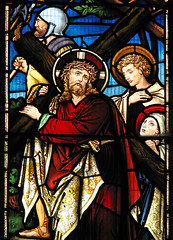
Christ carrying the Cross
I remember as a child picking up a book on the mysteries of the Rosary, and seeing the wonderful pictures that went with each decade. I still have that book today, and is still part of my rosary. I remember looking at the Sorrowful mysteries and thinking how cruel people were to Jesus. In times of trouble in my life when I had felt down I would take a decade of the sorrowful mysteries, in this case the “Carrying of the Cross,” and remind myself that everyone has a cross to bear, I’m not alone, even Jesus had a burden all through his passion. Even today I feel the same, when times are tough, I still take that decade and remind myself that I am not alone. Yet I still search for someone to help me carry that cross, which digs so firmly into me. I still look for someone to ease the pain of the weight of my burden. Even though my friends and family are nearby to listen to me, it is always this decade that helps me lift my cross and helps me move on with a lighter load. It is here that I find Christ carrying my cross with me. Let the sorrowful mysteries help you carry your burden, but also maybe you can help someone carry theirs. These mysteries are a road we must take to overcome our suffering and be with Christ on his cross, for it there that we find our salvation.

Quodlibet 9: Call no one on earth your father

I attended a social function recently. I noticed that some attendees addressed the Catholic priest as 'Mr'. They quoted the verse that says call no one Father etc. Could you help me understand the reasoning behind our use of Father as a form of address of our priests?


The passage from Matthew about calling no one on earth your father, as with all scripture, needs to be carefully interpreted. Surely Jesus did not mean that we now have to start calling our parents by their first names. Rather, Jesus is reminding us that there is only one source of our being, our Father in heaven. Titles can be dangerous because they can make us forget this, and they can foster a spirit of superiority and pride. Given this warning, why do we address priests as father? Well, the priest acts in the person of Christ. This means the priest has the authority to act in the power and place of the person of Christ himself. Therefore, by calling a priest father, we are really showing reverence to Christ.

Wednesday, February 27, 2008

The Fifth Mystery of Light - The Institution of the Eucharist

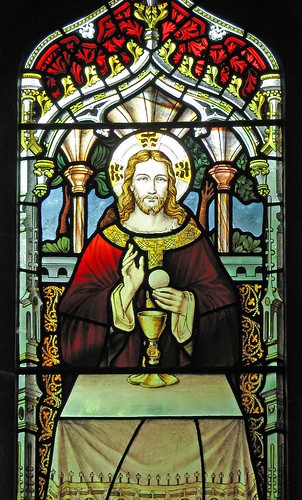
Christ saying Mass
Why is the institution of the Eucharist included as one the mysteries of light? St. Paul’s First Letter to the Corinthians 11:17 – 34, offers us an opportunity to explore the connection between the mystieries of light and the Eucharist. In this passage we see that St. Paul is addressing the problem of social divisions which have developed in the life of the Christian community since his first visit to the people of Corinth. Overall, the community seems to have forgotten that they are “one body” in Christ by their ill treatment of the poorer members of the community.[1] The wealthier Christians gathered early for the community meal, eating and drinking to excess while the poorer members of the Church such as slaves and others were not able to arrive early enough to partake of the meal.[2] Essentially, this type of behavior created tensions between the wealthy and the poor, even though both rich and poor had "put on Christ" through their acceptance of Paul's message. In verse 11:20 Paul states: “When you meet in one place then it is not to eat the Lord’s supper, for in eating and drinking each one goes ahead with his own supper, and one goes hungry, while another gets drunk.” The theological issue here seems to be the fact “those who gathered early for the community meal may have thought that they were gathering for the Lord’s Supper but their conduct seems to betray their membership in the church of God.” [3] Paul chastises the community for their behavior by recounting the institution of the Lord’s supper (23-26) to remind them that “whenever the new community celebrates the Lord’s Supper it becomes an announcement of the Lord’s death…For Paul the story of the crucified gives meaning to the meal and in turn prevents members from treating the poor as second class citizens.”[4] Ultimately, Paul reproves the Christian community at Corinth in order to persuade them to abandon their less than Christian pattern of behavior. In the mind of St. Paul, it seems that the institution of the Eucharist by Jesus on the night before he died was an act of total self-gift which we are called to emulate in our relationships with one another. The Corinthians, then and all who eat and drink the body and blood of Christ now, do so in order to become the living presence of Christ in the world; hence one body in Christ. By eating and drinking the body and blood of the Lord, we are not only nourished spiritually but we enter into relationship with Christ, and it is through our relationship with Him that we are transformed into persons who are better able to reflect and share the self-less love of Christ with our neighbors. In the end, St. Paul’s message to the Corinthians challenges us to realize that love of neighbor is the hallmark of the Christian life and that it (love of neighbor) originates in the Eucharistic action of the community as it gathers to hear the Word of the Lord and to receive the great gift of Christ in the Eucharist. Thus, meditating upon the Luminous Mysteries of the Rosary, we can see that the Insitution of the Eucharist is an important mystery of light because it is through our reception of the Eucharist that we are enlightened with the grace of God to recognize the face of Christ in the presence of the "other" in our midst. Approaching the mid-point of our Lenten journey of prayer, pennance and alms-giving, there are two important questions for our reflection: who are our "neighbors" and does our reception of the Eucharist make us more Christ-like, in our relationships or are we more like the Corinthians who failed to recognize the presence of Christ in the poor? As we ponder these questions, may Mary our Mother, through her intercession, help, guide and sustain us in our struggle to be that which we receive.
[1] Raymond F. Collins. Sacra Pagina Vol. 7 First Corinthians. (Collegville, Liturgical Press, 1999), p. 421.
[2] Raymond F. Collins, p. 418.
[3] Raymond F. Collins, p. 419, 21.
[4] Charles B. Cousar. The Letters of Paul. (Nashville, Abingdon Press, 1996), p. 139.

Tuesday, February 26, 2008

The Fourth Mystery of Light - The Transfiguration

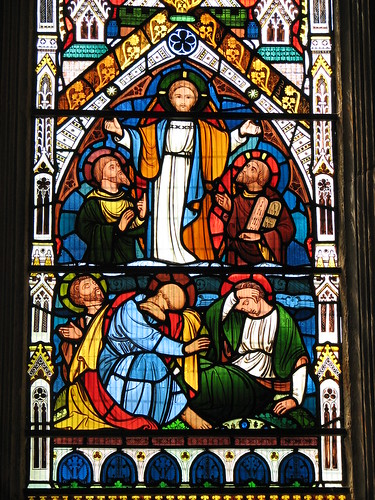
Transfiguration of the LordThe transfiguration of Christ is one of those moments in the gospel that is awesome, and yet elusive. In the gospel of St Matthew, chapter 17, the transfiguration is set six days after Jesus tells his hearers that following him involves the cross, the daily embracing of the cross. These are difficult words, for even the most faithful follower, it seems perhaps a bit gloomy. Is this all that being a disciple of Jesus means, the cross? Well, six days later Jesus, accompanied by Peter, James and John, ascends a high mountain. There Jesus appears in a glorified state, shining like the sun. He is no longer merely a man, but his godhead is, for a moment, revealed. Yet this moment of glory does not go on, it stops. The apostles are, naturally, reluctant to leave, and after what they saw it’s understandable. Yet Jesus has to move on, to a journey that will lead to another high place eventually. At this high place the glory of Jesus will not be exposed, but hidden in his powerlessness, in his bruised body and in his blood. In this high place the Apostles will not wish to delay, in fact most will not be there at all. In this high place Jesus will hang on the cross and die a most cruel and humiliating death. Yet when Jesus dies at this high place, the glory seen by the disciples at the previous place will not disappear again. By dying here, the glory of Jesus seen by the apostles will be fully realised, and will never fade away again.

Monday, February 25, 2008

The Third Mystery of Light – The Proclamation of the Kingdom and the Call to Repentance

The proclamation by Christ of the coming of the kingdom or reign of God, and his call to repentance, represent the third significant moment in the public ministry of Our Lord presented by the luminous mysteries of the Rosary. This mystery can sometimes seem a rather difficult one to contemplate since, unlike, for example, the Baptism of Jesus or the Wedding at Cana, it does not relate to one specific event in the life of Christ. Rather, Jesus’ announcement that the kingdom of God is close at hand, and his appeal to repent and believe the gospel, are central to the whole of his preaching ministry. Pope John Paul II points out in his Apostolic Letter on the Rosary, Rosarium Virginis Mariae, that with this third luminous mystery we contemplate ‘the inauguration of that ministry of mercy which [Christ] continues to exercise until the end of the world, particularly through the Sacrament of Reconciliation which he has entrusted to his Church’.

Perhaps one episode in the ministry of Jesus which we can focus on when contemplating this mystery is the Sermon on the Mount. This “charter of the Christian life”, it has been noted, describes the ways of the kingdom of heaven towards which the Holy Spirit wishes to lead the disciple of Jesus. The Beatitudes, for example, which are, at one level, a description of Christ’s own life, are also a list of the fundamental attributes required of the Christian disciple who seeks God and his kingdom. The kingdom of God belongs to the poor in spirit and the persecuted. Those who shall see God and enter his Kingdom are the pure in heart and the peacemakers. Jesus also teaches that it is the merciful who shall themselves have mercy shown to them. This reminds us of the 'Our Father' which occupies a central place in the Sermon on the Mount. In this prayer we seek not only the coming of the kingdom, that is, the rule of God in our lives, but also make the forgiveness we ask for in repentance conditional on our own willingness to forgive the wrongs done to us by others.

Sunday, February 24, 2008

The Second Mystery of Light - The Wedding at Cana


One of our brethren once told me that as a child he was always more frightened of Our Lady than of God. For this brother, Mary was very much the one watching over us, ready to rebuke. This account in the Gospel is quite a special one, which has attracted much reflection through the centuries, and been the subject for many artists, commentators and writers. The wedding feast at Cana is one of a small number of Gospel accounts where we have words that express directly something about the relationship between Jesus and his mother Mary, an insight into the love between a mother and her son. The message of this passage is often summarised by the words 'Do whatever he tells you'.

So why include such a Mystery in the Rosary? Well, it expresses a tender relationship between Jesus and his mother. And it shows us in particular Mary's role as the one who presents our needs to Jesus, and how powerful Our Lady's intercession is. But what is also shown is the place that Jesus should have in our lives. As Dominicans, we make Profession of obedience to God first of all, but also to Blessed Mary. By doing so we undertake that we will be obedient to the Mother of Jesus, who tells us that we should do whatever Jesus tells us to do. Obedience to Christ is a fundamental part of being a Christian. This obedience is the way by which we may be lead ever deeper into the life giving mysteries of God. In contemplating this mystery with Mary, we are given an example of Christian discipleship, and a reminder of the importance of Our Lady as the one who points beyond herself, guiding us to her Son.