Saturday, September 1, 2007

Credo 27 - ... and is seated at the right hand of the Father

Anthropologists have noted that in many cultures, the right side of the body is considered to be of greater importance and this is true of the cultural milieu of the Scriptures. Repeatedly in the Old Testament, the right hand is the one of victory, power, strength and the Gospels indicate that Jesus also employs such symbolism (see, for example, Matthew 5:29-30). As such, the right side of the body was understood symbolically to be good, precious, important. It is also the right hand that is associated with authority, might and dominion. Consequently, it is significant that Christ is raised to the right hand of the Father.

The key Scriptural text is Psalm 110:1 – “The Lord says to my lord: ‘Sit at my right hand, till I make your enemies your footstool’” – which the Church sings in her liturgy every Sunday. Inspired by this, we find nascent expressions of belief in Christ seated at the Father's right in the New Testament letters attributed to St Paul (e.g. Ephesians 1:20; Colossians 3:1). This psalm verse is the most cited Old Testament text in the New Testament and it also has the distinction of being the only one commented upon by Jesus in the Synoptic gospels (Mt 22:41-46; Mk 12:35-37; Lk 20:41-44). Here, the point being made is that Jesus, the Messiah, is both greater than David and is Lord. As we have seen earlier in this series of posts, to call Jesus ‘Lord’ indicates his divinity. Hence St John Damascene explains that this article of the Creed confirms the significance of the Ascension by confessing that Jesus, in his risen and glorified flesh, shares the Father’s “glory and honour of divinity”, which is also his from all eternity.

In addition, this article of the Creed also affirms Christ’s authority as Messiah, as revealed in the prophecy of Daniel: “And to him was given dominion and glory and kingdom, that all peoples, nations, and languages should serve him; his dominion is an everlasting dominion, which shall not pass away, and his kingdom one that shall not be destroyed” (7:14). Jesus himself alludes to this text and makes a connection to Psalm 110 in Mark 14:62 when he answers affirmatively that he is the Christ. As such, the authority given to Christ is for the establishment of God’s Kingdom: “a kingdom of truth and life, a kingdom of holiness and grace, a kingdom of justice, love, and peace” (Preface of Christ the King).

Finally, in the ‘Gloria’, we implore Christ, who is seated at the Father’s right hand, to receive our prayer and to have mercy on us. Such imagery of priestly intercession again finds a resonance in Psalm 110 which evokes the eternal priesthood of Melchizedek. Therefore, in affirming that Christ is seated at God’s right hand, we can call upon him as our mediator and our intercessor, for he is our great High Priest. Thus, when he comes as Judge and to rule over his Kingdom, as the Creed goes on to declare, we can rely on his merciful compassion: “For we have not a high priest who is unable to sympathize with our weaknesses, but one who in every respect has been tempted as we are, yet without sin. Let us then with confidence draw near to the throne of grace, that we may receive mercy and find grace to help in time of need” (Hebrews 4:15-16).


Tuesday, August 28, 2007

Dominican Pilgrimage to Lourdes (Part 1)

The Upper Basilica of Lourdes

This year some 20 Dominican friars of the English Province and over 120 parishioners, friends and benefactors went on Pilgrimage to Lourdes. We were joined by Bishop Malcolm McMahon OP of Nottingham, who is celebrating the Silver Jubilee of his ordination to the priesthood, and the Pilgrimage was led by the Prior Provincial, Fr Allan White OP.

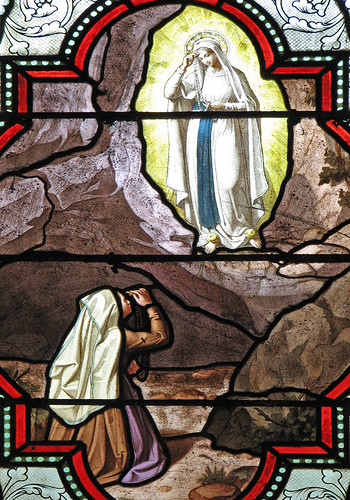
Our Lady says the Rosary with St BernadetteLourdes was originally a small unremarkable market town lying in the foothills of the Pyrenees. In 1858, Our Lady appeared eighteen times to a fourteen-year-old Bernadette Soubirous. Since the first apparition on 11 February, crowds have come to Lourdes and to the Grotto of Massabielle to fulfill the requests of Our Lady and in search of healing. We came to do the same.

During the 8th apparition of Our Lady to Bernadette, on Wednesday 24 February, Our Lady said: "Penance! Penance! Penance! Pray to God for sinners." The Sacrament of Reconciliation is an important part of a Lourdes pilgrimage, and we also walked the Stations of the Cross together in the pouring rain, as an act of penance.

During the 9th apparition, on Thursday 25 February, Our Lady said to Bernadette, "… go drink at the spring and wash there… ". Some pilgrims chose to wash in the baths in Lourdes, others to drink and wash from the taps near the Grotto. Both the baths and the taps are fed by the spring which Our Lady indicated to St Bernadette.

During the 13th apparition, on 2 March, Our Lady said, "Go and tell the priests that people should come here in procession…". It is from this request that the two processions of Lourdes were born. We led the Marian Procession on one evening, during which eight friars carried the statue of Our Lady as we prayed the Rosary. On another afternoon, we walked in the Eucharistic Procession.

To be continued...

Sunday, August 26, 2007

Credo 26: He ascended into heaven ...

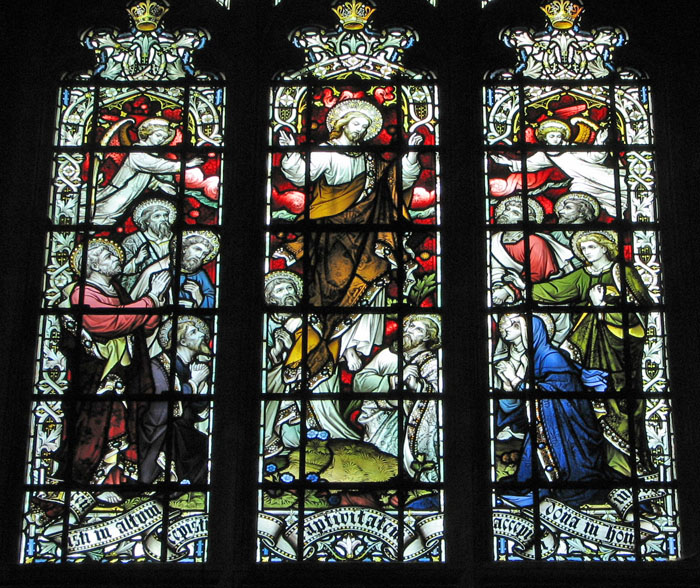
Ascension Hawkesyard'No one has ascended into heaven but he who descended from heaven, the son of man' (John 3: 13. RSV). The son of man must be understood here to mean Jesus the Christ. Rufinus, an early Christian writer, commenting on the Apostles' Creed, says, that when Jesus ascended to heaven He did not go to a place where God the Word had not previously been. For, He, Jesus, the Word Incarnate, had existed from all time with the Father, who is in heaven. What was new, is that, the Word made flesh is now seated in heaven, as had never happened before. It was the culmination of prophecy. King David uttered these words centuries earlier: ' The LORD says to my lord: " Sit at my right hand, till I make your enemies your footstool" ' (Ps 110:1). This ascension was a glorious ascension. The first man Adam, under the counsel of the evil one, dragged human beings captive down to hell; but, this Jesus, when he ascended to heaven restored human beings to heaven. All the heavenly host were astonished. The angels looked with awe as the Great I AM clothed in flesh made his way on high. How much more should we, who are the ones to have been redeemed, jump for joy!

Thursday, August 23, 2007

Credo 25: ... in accordance with the Scriptures.

In the First Letter to the Corinthians, St. Paul writes: 'If Christ has not been raised, then our preaching is in vain and your faith is in vain' (1 Cor 5:14). Strong words indeed. And St. Paul's writings are full of references to the resurrection. We should not be surprised, because his conversion on the road to Damascus was an encounter with the risen Christ, the reality of which forms the entire basis for his preaching missions around the Mediterranean.

Our faith is as nothing if the resurrection did not happen. Why so? Because we would have to admit that, without the resurrection, evil has triumphed - Christ has died and death is the end of the story. This would be against all Christ's works and teachings, and would mean that the promises of the Old Testament have not been fulfilled. It is only because of the resurrection that we can say that we see the truth of Christ's promises.

In the resurrection we see the most powerful manifestation of Christ's divinity. The resurrection shows us that he who claimed to be God, to be the 'I am', is who he claimed to be. In St. John's Gospel we read how Jesus said to his disciples 'when you have lifted up the Son of Man, you will know that I am he' (Jn 8:28). All that Jesus is and was predicted to be in the Old Testament is shown to be true at the resurrection.

And this has a profound impact for us. Right through the whole of the Scriptures, we find a witness to a God who keeps his promises. First we see that God makes the promise to Abraham, our father in faith, that he will be the father of many nations. Despite the fact that both Abraham and Sarah were very old, Abraham trusted in the promise given to him, and became the father of Isaac, the first in the line of the people of Israel. The Letter to the Hebrews praises Abraham's faith because "he considered that God was able to raise people even from the dead; hence he did receive Isaac back, and this was a symbol' (Heb 11:19) - a symbol of the resurrection of Jesus is what is meant.

With Jesus's preaching, we see how God's promises of a homeland and a people are extended beyond territory and beyond a single race, looking towards a kingdom in Heaven. We see in the resurrection how God fulfils his promises, how He fulfils what was written in the Scriptures. This then becomes the basis of our hope that we will one day join the saints in heaven in our true home, which is an eternity with God.

Monday, August 20, 2007

Credo 24 - On the third day He rose again ...

‘If Christ has not been raised, then our preaching is without substance, and so is your faith’ (I Corinthians 15:14). With these words Saint Paul reminds us that the reality of the resurrection of Jesus from the dead stands at the centre of all we believe and confess as Christians. Yet how firm are the foundations on which we base our faith in the resurrection? According to the Catechism of the Catholic Church, the New Testament bears witness to the mystery of the resurrection as ‘a real event, with manifestations that were historically verified'.

It is interesting to recall the reaction of the apostles when they first heard the news of the resurrection. Shocked and demoralised by the violence and suffering of the crucifixion, they considered the idea that Jesus had risen from the dead to be an impossibility. As Saint Luke tells us, when the women ‘returned from the tomb and told all this to the Eleven and to all the others […] this story of theirs seemed pure nonsense, and they did not believe them’ (Luke 24:9,11).

Yet this initial dismissive reaction was to change radically when the risen Christ appeared to the disciples and - by allowing himself to be touched and by eating with them - demonstrated the continuity between his risen, albeit glorified, body and the body that had been tortured on the cross. The Gospels build up a series of ‘signs’ which testify to the historicity of the resurrection. We read of the empty tomb, the appearances of Jesus first to Mary Magdalene and the holy women, and then to Peter and the twelve disciples. Saint Paul tells the people of Corinth that Jesus appeared to more than five hundred of the brethren, most of whom were still alive when Paul was writing his letters.

Thus the faith of the first disciples in the resurrection comes about through their direct experience of and encounter with the risen Christ. The resurrection is not a product of the credulity of Christ’s followers or some sort of invention in order to continue the ‘cause of Jesus’. It is the source of our own future resurrection from the dead. As Saint Paul says, Christ has risen from the dead ‘as the first-fruits of all who have fallen asleep’ (1 Corinthians 15:20). This is described in the beautiful ancient homily that is read on Holy Saturday when Christ descends among the dead to call them to new life: ‘Arise from the dead; I am the life of the dead. Arise, O man, work of my hands, arise, you who were fashioned in my image. Rise, let us go hence; for you in me and I in you, together we are one undivided person’.

Saturday, August 18, 2007

The prophet's word of truth

Br Romero Radix OP is currently doing a summer placement in a London hospital under the direction of Fr Peter Harries OP. This is the reflection Br Romero has written for this week's edition of St Dominic's Newsletter, the weekly newsletter of St Dominic's Priory, London

The king’s leading men wanted to put Jeremiah to death on account of the word of God he had spoken. The king was Zedekiah. The people of Jerusalem were under serious threat of being taken captive to Babylon. Jeremiah had told the king God’s words were these: ‘you shall be delivered into the hand of the king of Babylon.’ Furthermore, if any one should remain in the city he would die by the sword or famine or pestilence, but those that go forth to the Chaldeans – that is the Babylonians - shall live.

The king’s leading men did not like this. They said that Jeremiah’s words were disheartening the remaining soldiers in the city. This is the heart of the matter. What God had in mind and what they had in mind were two different things. What they wanted was in conflict with what God had planned. They did not like God’s plan. They were not willing to accept it. They were not willing to change.

Now, of what relevance is this text to us, today? Well, with the advent of Christ the ministry of the prophet was not abolished. Paul tells us that ‘some He made prophets, some evangelists, some teachers, and some apostles – for the building up of the saints’. So, if we as the body of Christ are to be built up, we have a duty and a responsibility to find out the prophets’ words for our time and to receive them with open hands. To do this, first we must ask ourselves who are the prophets of our time? What are the issues with which they concern themselves? And, what has been our response to their words? These questions are worth serious consideration on our part. It frequently resurfaces in my consciousness that we belong to a community that spans the entire globe. This being the case, we have a great responsibility to remain constantly aware of the issues that are affecting our brothers and sisters around the world – to keep praying for them sincerely and fervently.

So, there is the office of the prophet, but people we live with and work with can also be prophetic. God’s word can be brought to us by many different messengers as a wife to a husband or a child to a parent. What is our response when they tell us something that we do not want to hear, or something that we are not pleased with? Do we sometimes dismiss them outright?

Jeremiah teaches us that God's words are not always what we would want to hear, or what will please us. This being the case, whenever somebody tells us something we do not like, we must always be open to the possibility that it might be the truth. If we never leave a space for this possibility we are operating from pride. This may result in serious division in a home or a work place, and derail us from walking according to God’s will for us.

It is true that Jesus in the gospel from Luke today says that he did not come to bring peace on earth, but, rather division. He says, ‘for from now on a household of five will be divided: three against two and two against three; the father divided against the son, son against father, mother against daughter, and daughter against mother …’

These sayings are striking, but to say that they are inevitable in every family would be to limit the power of love. Granted, divisions might arise, but as Paul says, in every way and as much as is possible try to live at peace with everyone. If indeed we are trying our utmost, then we will always be open to whatever, however displeasing, someone has to say. In this way, we keep ourselves open always to God.

Interestingly, sometimes what we think is displeasing and negative and disheartening is not. Jeremiah was bringing the king’s leading men good news, for he was giving them a word by which their lives would be preserved. But, they could not receive his words because all they had in mind were their ideas. With Jeremiah to learn from we can avoid this mistake.

God bless you
Romero Radix o.p

Thursday, August 16, 2007

Credo 23: He suffered death and was buried

During Holy Week we hardly give ourselves time to allow the reality of Jesus’ death to sink in. We move quickly from Good Friday to the Easter Vigil and there is no liturgical action for Holy Saturday itself. The time between his burial at sundown on Friday and the dawning of resurrection faith early on Sunday morning gets no particular attention.

But Jesus really did die. His life came to an end, he breathed his last and his body was placed in a tomb. Revelation 1:19 puts it this way: I was dead but now I am to live for ever and ever and I hold the keys of death and of the underworld.

Jesus was dead. We believe so strongly that Jesus was not an ordinary human being that his death can be made to seem like no big deal. An early Christian heresy asserted that Jesus did not really die but this is to deny the full human reality of his experience.

Jesus died and dwelt in the kingdom of the dead. Early creeds speak of this as the ‘descent into hell’. This was not an invention by people who felt Jesus must have been up to something while his body was in the tomb. Belief in the descent into hell is based on New Testament texts which teach that his salvation is of cosmic significance, that ‘in the spirit he went to preach to the spirits in prison’ (1 Peter 3:19). In the Eastern Church there are no icons of the resurrection which do not include this moment of Christ breaking open the doors of hell in order to lead the dead forth into freedom and life.

As an article of the creed the descent into hell is a mystery of faith and a moment in the paschal mystery. As such it teaches us something about God and something about human salvation. It illustrates the lengths to which God is prepared to go to achieve the redemption of the human race. It teaches us that God was prepared to let his Son go into a far and foreign country, to the place of sin and death, to the place which is furthest from God, in order to save whatever could be saved within creation.

Saint Paul says that God made the sinless one into sin so that in him we might become the goodness of God. Jesus Christ, innocent and sinless, entered fully into a human experience marked by all the consequences of sin. He suffered and died. He came to know what alienation from God means ('my God, my God, why have you forsaken me'). Jesus went to the borders of existence, to a place which is almost, but not quite, the place of non-being. It is as if—and we are straining language here—God allows himself to be stretched and pulled apart in order to reach the last and least traces of what can be saved.

Love is the reason for this journey. In his first encyclical letter, on the mystery of love, Benedict XVI speaks about God 'turning against himself in giving himself'. He refers to Hosea 11:8-9 in which God argues with himself about justice and mercy ('but I am God and not man'). The Pope refers also to the mystery of the cross on which 'life's champion is slain' (Deus caritas est, paragraphs 10 and 12). How can it be that the living God enters the kingdom of death? Love is the answer to this question.

Jesus’ being among the dead teaches us that the salvation he won is of cosmic significance. His salvation reaches ‘to the ends of the earth’ (Isaiah 49:6) and his victory is acknowledged ‘by all beings in the heavens, on earth and under the earth’ (Philippians 2:10). The ends of the earth are not only every place and time but every aspect and corner of the human world, every relationship and group, every project and plan, every thought and desire, every darkness and desolation, every experience of emptiness and despair, every joy and delight, every confusion and distress, every disappointment with God or even rejection of Him, every experience of God-forsakeness—all of this is included in ‘the ends of the earth’. Nothing of it is now foreign to Jesus and so none of it falls outside the care of God. He even died ... and dwelt among the dead.

An early Christian story says that Jesus entered the place of the dead with his cross, the weapon of his victory, the great sign of love that will draw all people to him. Having released those who were inside he decided to leave his cross standing in the centre of hell, a sign that even those who pass that way do not find themselves in a place which is unknown to him.