Wednesday, June 27, 2007

Credo 11 Christ ... eternally begotten of the Father...


When we think about Jesus, we probably think about a man who lived 2000 years ago somewhere in the Near East. We might think about this man in a very special way. Nevertheless, Jesus appears to be a human being with flesh and bones who most of the time delighted in the company of his fellow men and shared his love with them. Apparently, he enjoyed good food. In the end, he died a terrible death. Like everybody’s life, Jesus’ life underwent a lot of changes and excitement and ceased at the end.
If we think about God, we think differently. The first thing which is said about him is that he is the powerful creator of heaven and earth, and their unmoved first cause. God sustains everything which surrounds us, and is present in the innermost core of our hearts. He is so big, so timeless and mysterious that we can hardly grasp him, not to speak about painting accurate pictures of him.
Now let us turn to today’s line of the Creed. It states that Jesus and God are the same. A human being is also divine and God becomes a human being.
This sounds nonsensical indeed. How can somebody be born and yet also be timeless, die and yet be eternal, be truly human and yet truly divine? Is that not as absurd as saying that a number, let us say the number 127 is a living creature? And that my neighbour’s parrot Polly is a number?
From our point of view, Jesus was a man who was born around 2000 years ago. From God’s point of view, nothing changed at all. It is not as if his Incarnation involved him changing his Divine state. The thing that really changed was his creation. Let us shortly go back to our example with numbers and animals. No animal will ever be a number. By definition, numbers have no body. Numbers and animals are mutually exclusive regarding their categories of being. If we consider the Son, eternally begotten of the Father, now become flesh, we recognize that this is not the case with God and the human being. There is now something divine in every human being: 'acknowledge your dignity', Pope Leo the Great says, the dignity humans now have because God has lived as one of us. The Christian God is a God with a human face.

Saturday, June 23, 2007

The Nativity of John the Baptist

Readings: Isaiah 49:1-6; Ps 138:1-3, 13-15 R)v. 14; Acts 13:22-26; Luke 1:57-66,80

Today’s feast gives us an unusual perspective into the intersecting point between the Old and New Testaments. We might begin by remarking how unusual it is to celebrate the birthday of a saint rather than, much more typically, remembering them on the anniversary of their death. Also, it would seem strange to remember a saint in the liturgy by hearing about the lives and struggles of their parents. A great deal hinges for us on understanding properly the role of Zechariah in today’s Gospel. He is a priest of the line of Abijah and shares a name with a prophet of the kingdom of Judah. In quite significant ways he stands for the religion of the Old Testament: he and his wife Elizabeth ‘were worthy in the sight of God, and scrupulously observed all the commandments and observances of the law’ (Lk 1:6). But there is something missing, they are a childless couple: infertility has accompanied their apparent faithfulness, and in their advanced age there seems no hope for offspring.

The fruitlessness of Zechariah and Elizabeth stands for the aridity of the religion of Israel, and for its thirst for Jesus, the one whom John the Baptist will herald. This thirst, however, is unacknowledged. The loss of hope in the future has hardened Zechariah’s heart and when he hears joyous but unexpected news from the angel Gabriel, he is slow to believe. Like his religious tradition, he is punished for his hesitation and lack of self knowledge by his speech being taken from him.

Hope and the power of proclamation are returned to Zechariah when he is able to name his son with a name that has been previously unknown in his family. A place in the tradition is found for the one who prophesies the fulfilment of the religion of Israel. Zechariah acknowledges his destiny and that of his family line and the way is opened for new life for his entire people.

The point is further developed in the piece from Isaiah that we have for today’s first reading. It is not enough for religion to remain static, to shore up its ruins against fear of being overwhelmed by the happenings of life. True service of God does not require that we consolidate, rather it is the case that we are enjoined to pass on what we have been given. The Church is asked by the Lord to become ‘the light of the nations so that my salvation may reach to the ends of the earth’ (Is 49:6).

The birth of the prophet of Christ is particularly symbolic for Christians for it is the same nativity that we try to engender in our own spirits. Humanity has been raised to God in Christ, yet very often we are as closed to that reality as Israel was to the advent of the Lord. We experience particular moments in our lives when we are challenged to broaden our vision, to leave safe waters, just as Zechariah was. Sadly, of our own powers, we often judge wrongly in our response and lose the power to tailor language to reality, in a way resembling Zechariah dumb struck. Our comfort is that, in prayer, it is the spirit who speaks through us, and just as John’s father was brought to wisdom by God through a slow and exacting process, we know that the same work is being done in our hearts. The assent of Zechariah to the new name, John, finds an echo in our assent to the great name that John was the first to preach and which always challenges us to deeper integrity and wisdom.

Tuesday, June 19, 2007

Recent Events at Blackfriars

On 11 June, Fr Thomas Crean's book A Catholic replies to Professor Dawkins was launched at Blackfriars, Oxford. Fr Thomas, who is a member of the Dominican community in Cambridge, explained that he had written the book in an accessible way to help those who may have been perplexed by arguments made by Richard Dawkins in his book The God Delusion.

A Catholic Replies to Professor Dawkins is published by Family Publications and may be purchased here. Alternatively, you could ask your nearest bookseller to stock it.

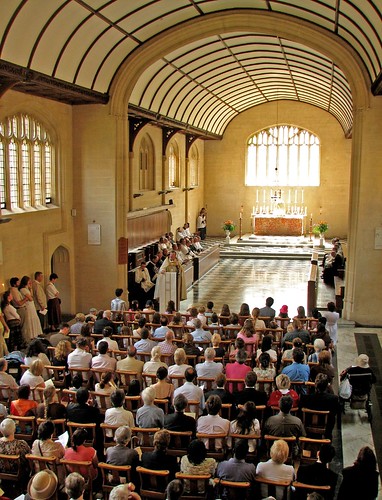
Below are photos from the book launch:


On Friday 15 June, Blackfriars Hall marked the end of the academic year with a Garden Party. After a formal photo with our visiting students, all relaxed with a glass (or more!) of wine, as well as some strawberries and cream. The end of the year is poignant as people move on to new things and the year's events are recalled. As if on cue, the Lord sent showers of blessings and we moved the party indoors. Below are photos from this event:


To find out more about opportunities for study with the Dominicans at Blackfriars Hall in Oxford, click here.

Saturday, June 16, 2007

Kiss me with the kisses of your mouth ...

11th Sunday in Ordinary Time

Readings: 2 Samuel 12:7-10, 13; Psalm 32; Galatians 2:16, 19-21; Luke 7:36-8:3

"O truly necessary sin of Adam... O happy fault, that merited so great a Redeemer!"
These words from the 'Exsultet' express the mystery of sin which, according to mystics like Julian of Norwich and the Church Father, St Irenaeus, is in some way 'necessary'. For Irenaeus, sin is an important aspect of divine pedagogy - not that God actually instigated sin directly, but he set up the world in such a way that sin was extremely likely to take place, and could be treated as one possible way of making Adam realise his dependence on God. St John Damascene considers that God permits people to fall into the more obvious kinds of carnal sin as an antidote to pride. The Desert Fathers particularly taught that where sin existed, grace abounded still more (see Romans 5:20). One of the Tempter's greatest feats is to convince the sinner that he is unworthy or should be too ashamed to approach God. Yet, it is surely those who have sinned who most need Christ, the heavenly physician.

This is strikingly expressed by Macarius' story of a monk who could not get the better of his sensual temptations. This monk prayed:
"Lord, whether I want it or not, save me, because dust and ashes that I am, I love sin; but you are God almighty, so stop me yourself. If you have pity on the just, that is not much, nor if you save the pure, because they are worthy of your mercy. Show the full splendour of your mercy in me, reveal in me your love for men, because the poor man has no other refuge but you."
The woman in today's Gospel knew this too, and she came to Jesus, full of love, because she was full of sin. As she recognised the depth of her sin, she also learnt that she needed Christ's forgiveness and, in gratitude for God's tender and fathomless mercy, she responded with extravagant gestures of love - washing Christ's feet with her tears, wiping them with her hair, kissing them continuously and anointing them with costly ointment.

This is only fitting because God first loved us and is prodigal with His love for us: God has anointed and kissed us sinners.

In the Song of Songs, the poem opens with the lines: "You have kissed me with the kisses of your mouth" and mystics like St John of the Cross and the Church Father, Origen, have understood this as referring to the coming of Christ: "No, let [God] not speak to me through His servants, angels or prophets! Let Him come himself and kiss me with the kisses of His mouth!", and Christ comes to us in the Eucharist. Moreover, the Fathers have considered this verse to reveal the Trinity: God the Father is the the source of Love, the mouth is His only Son, Jesus Christ, and His kiss is the Holy Spirit. As such, the kiss that unites Father and Son in love is bestowed on us to unite us in that same divine love. Likewise, the Spirit is the "sweet anointing from above" that has caused us to be adopted as sons and daughters of God. Thus God has kissed and anointed us with his grace.

These past Sundays, we have been celebrating these great gifts of God's love - from Pentecost to Corpus Christi - and today's Gospel indicates the response of faith and love that we sinners can offer to God whose mercy endures forever.

Thursday, June 14, 2007

Sacred Heart

Friday after the second Sunday after Pentecost

Readings: Ezekiel 34:11-16; Psalm 22; Romans 5:5-11; Luke 15:3-7

The subject today is the heart of Jesus. The heart can be understood to be that from which flows, among other things, our emotions. Jesus, being man would have no doubt, experienced the flow of emotions. So, what were his emotions like? Well, Jesus was also God. The God of Abraham, Isaac, and Jacob. The reading from Deuteronomy 7:6-11 tells us what the nature of God's heart is like. It reads: 'for you are a people holy to the LORD your God; the LORD your God has chosen you to be a people for his own possession ... it was not because you were more in number ... it is because the LORD loves you.' Notice that when the LORD loves you he possesses you. The love of God consumes.

Now, this possessiveness of God towards those whom he loves should not surprise us. For, God said in his commandment to his beloved people, 'you shall not make for yourself a graven image, or any likeness of anything that is in heaven above, or is in the earth beneath, or that is in the water under the earth; you should not bow down to serve them; for I the LORD is a jealous God.' At first glance this word 'jealous' might connote a negative image of God. Somewhat, in the sense of, a child has a teddy bear, plays with it all day, and refuses anyone else a play with it. We might says this child is selfish.

However, there is another way of looking at it. Something might be so precious to you that you simply do not want to lose sight of it. You want it always in your sight because you do not want anything to happen to it. What is more comforting to know than that the almighty, sovereign God of heaven and earth is at every moment of the day wanting to play with you. That he wants you all by yourself. Some way in scripture it says, what God is there like ours, what God is so near to his people.

The truth is, brothers and sisters, the depth of this love is too deep for our finite minds to comprehend. How can this be true? Paul, an apostle of Jesus Christ, says in Romans chapter 5 'while we were yet helpless, at the right time Christ died for the ungodly. Why, one would hardly die for a righteous man - though perhaps for a good man one would dare even to die. But God showed his love for us in that while we were yet sinners Christ died for us.'

God is still jealous for his people. His heart, in that of Jesus Christ, has not changed. The question is: are we willing to, do we want this type of love to cover us? Do we want to be so possessed? Or, are we to afraid to lose ourselves? Today that choice is yours.

Sunday, June 10, 2007

Oxford's Corpus Christi Procession

Sweet Sacrament Divine

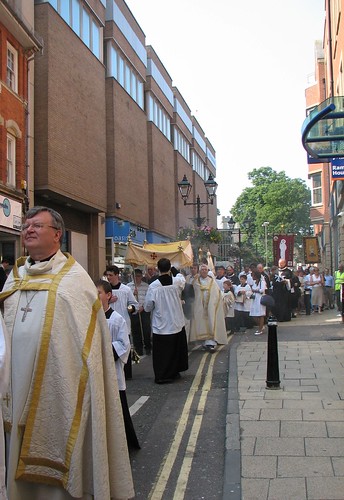
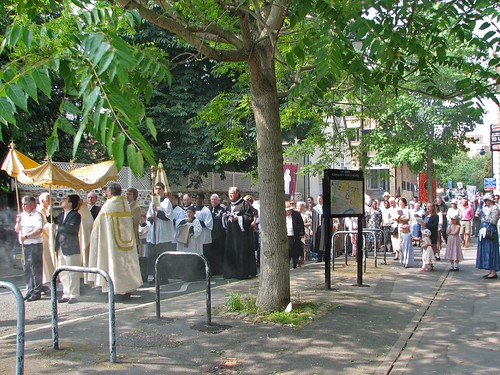
Each year, the North Oxford Deanery organises a Eucharistic Procession to mark the Feast of Corpus Christi. The Blessed Sacrament is carried from the Oxford Oratory to the Oxford University Catholic Chaplaincy, pausing at Blackfriars Priory where a sermon is preached.

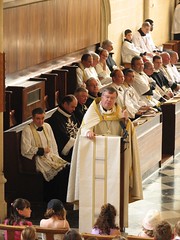
Bishop Kenney preaching This year, Bishop William Kenney CP, auxiliary bishop of Birmingham, led the procession and preached the sermon at Blackfriars. The bishop encouraged us in our act of witness to the city of Oxford and echoed Pope Benedict's recent document Sacramentum Caritatis exhorting us to live a Eucharistic life, marked by a concern for the needs of the world:

"The first and fundamental mission that we receive from the sacred mysteries we celebrate is that of bearing witness by our lives. The wonder we experience at the gift God has made to us in Christ gives new impulse to our lives and commits us to becoming witnesses of his love."

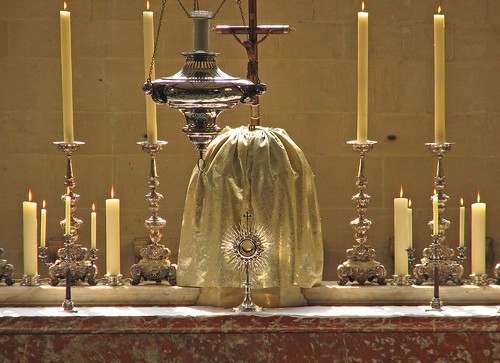
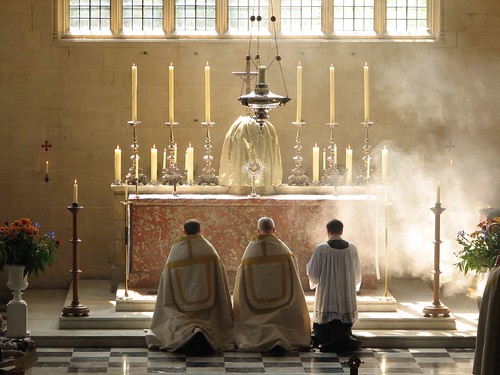
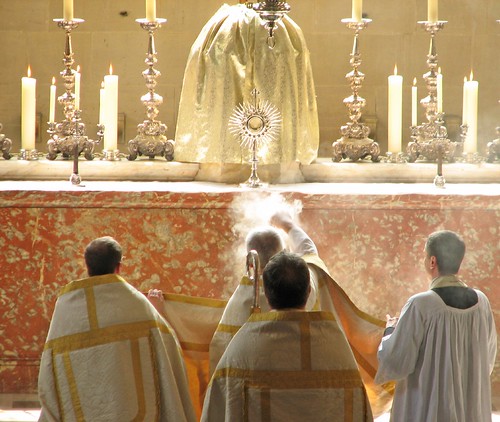
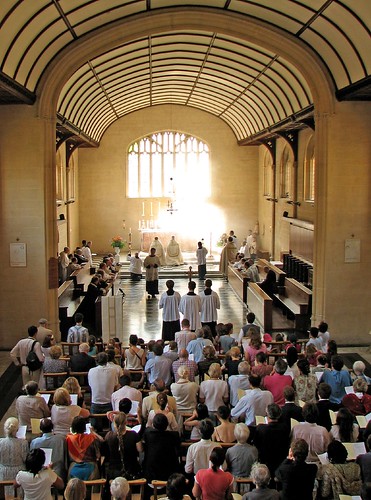
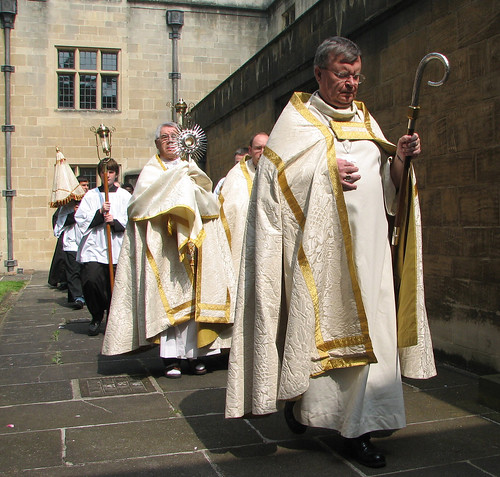
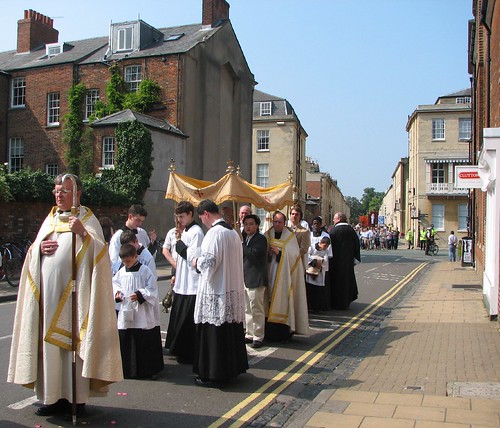
Below are more photographs from the celebration, with verses from the Sequence hymn 'Lauda Sion' by St Thomas Aquinas, which was sung by a schola of Dominican friars as the Blessed Sacrament was carried into the church:

Bishop Kenney preaching

Down in adoration falling...

"On this altar of the King this new paschal offering brings an end to ancient rite."

Offering incense to the Sacrament


Clouds of Incense

"Shadows flee that truth may stay, oldness to the new gives way, and the night's darkness to the light."

Carrying the Lord

Bishop Kenney in procession

"Flesh from bread, and blood from wine, yet is Christ in either sign, all entire confessed to be."

Processing to Gloucester Green


Taking the Lord to the streets of Oxford

"Hail! Bread of the angels, broken, for us pilgrims food, and token of the promise by Christ spoken, children's meat, to dogs denied!"

Passing St Ebbe's

"'The bread I will give is my flesh, for the life of the world' (John 6:51). In these words the Lord reveals the true meaning of the gift of his life for all people. These words also reveal his deep compassion for every man and woman... In the Eucharist Jesus also makes us witnesses of God's compassion towards all our brothers and sisters... Keeping in mind the multiplication of the loaves and fishes, we need to realize that Christ continues today to exhort his disciples to become personally engaged: "You yourselves, give them something to eat" (Matthew 14:16). Each of us is truly called, together with Jesus, to be bread broken for the life of the world." - Sacramentum Caritatis, 88.

The Feast of Corpus Christi

Readings: Gn 14:18-20; Ps 110:1, 2, 3, 4; 1 Cor 11:23-26; Lk 9:11b-17

There are two questions that are often asked about the feast of Corpus Christi. The first is: When and where did the feast originate? The history goes as follows. The feast of Corpus Christi originated in the thirteenth century, when Robert de Torote, bishop of Liège, instituted the festival in his Belgian diocese. He had been persuaded to do so after the Prioress of a nearby monastery, Blessed Juliana, received a vision. Its spread to the universal Church was thanks to the archdeacon of Liège, a man named Jacques Pantaléon, who became Pope Urban IV. The celebration of the feast was finally confirmed by the Council of Vienne early in the fourteenth century.

So then to the second question: Why should we celebrate such a feast? It is because of the important place that the Eucharist has in our lives as Catholics. In the Eucharist, when the bread and wine are consecrated, we believe that they cease to be bread and wine. After the consecration, the elements make present that same sacrifice of Calvary where Jesus gave himself for us all. Here we have Christ truly present, body and blood, soul and divinity. On Corpus Christi, in a special way, we are reminded of the grace which flows from the Eucharist, and of the reality of what we receive at Mass each time we receive communion. It’s something that we are all familiar with, but how often do we receive communion and forget to pause and think about what, or more precisely, who we have received? At the feast of Corpus Christi, we can resolve to consider anew the great gift of receiving Christ in the Eucharist, the strength and the hope that Christ brings us through the sacrament. We are also able, through processions and periods of adoration, to renew our sense of awe and wonder at the real presence, and to proclaim to those who are not Catholics this source of grace, and its power in our lives.

Today’s Gospel serves to remind us of how Jesus provides for our needs with a generosity that springs for his great love for us. His feeding of the five thousand was a manifestation of his love for the people, a love which lead him to provide for their needs. The depth of his love was shown most clearly in his suffering, death and resurrection, through all of which he accomplished the will of the Father and brought us into new life. The feast is a small way by which we acknowledge with gratitude the love which is made present for us in the Eucharist, a love which continues to nourish as sustain us throughout our lives.

O sacred banquet, in which Christ is received,
the memory of his Passion is renewed,
the mind is filled with grace,
and a pledge of future glory is given to us.