Wednesday, June 30, 2010

A-Z of the Mass - He Placed Himself in the Order of Signs

During the summer months we will be offering an A-Z of the Mass, a series of reflections on different aspects and moments of the Mass. Here we give a general introduction to the sacramental system which is at the heart of the Catholic faith.

Poetry, symbol and ritual are essential parts of the celebration of Catholic faith. If our gatherings involved just words and ideas they would become tedious and boring, a kind of committee meeting—and this happens sometimes when liturgies get overloaded with explanations and commentaries on what is going on. A good symbol needs little commentary. Where a lot of explaining is required, the symbol is a weak one.

Poetry, symbol and ritual are parts of human culture everywhere. These are ways in which human beings communicate with each other, celebrate and share life together, express their convictions and values, mark the fact of belonging to one another. Go to Old Trafford or White Hart Lane on a Saturday and you will see a powerful human gathering involving poetry, symbol and ritual. Part of the delicacy of God’s love is that God adapted himself to our needs, revealing the mystery of his life in ways that would reach us. The Welsh poet David Jones speaks of this by saying that our Lord ‘placed himself in the order of signs’, not for his own sake but for ours, since these are the ways in which we share meaning, hope, conviction and life.

The history of Israel is a series of events and words. The exodus from Egypt, entry into the promised land, exile to Babylon, return to Palestine ... all these great events are moments in the story of God’s relationship with Israel. The significance of each moment is interpreted by teachers and prophets. The life shared between God and God’s people is celebrated and renewed in the rituals and liturgies which recall those events and make their power effective again. When a Jewish family gathers to celebrate the Passover it is not just to recall a historical moment but to experience anew its meaning and power for believers today.

Christians have made their own this Jewish understanding of rituals which re-enact great historical events. For Christians the great event now is of course the life, death and resurrection of Jesus Christ. The meaning and power of ‘the mysteries of Christ’ are not only recalled but are made present for us in the rituals of the Church, especially in the great central liturgies which we call the sacraments. Sacraments are signs or symbols, ‘outward signs of inward grace’ in the classical definition going back to Saint Augustine. But the sacraments are not just ‘things’—the consecrated bread and wine, the blessed water, the hallowed oil. It is better to think in terms of ‘sacramental liturgies’, the events of baptism, confirmation, the Mass, anointing, marriage and so on. Each of these involves words, ideas, symbols, silences, gestures, songs, physical elements, an agreed order in which things happen when the people of God come together.

When David Jones spoke of our Lord ‘placing himself in the order of signs’ he took it to mean a further emptying of himself by the Son of God. Not only did he become human like us, not only did he accept death on the cross, but he put himself, his life and teaching, at our disposal. He placed himself in our hands. It may seem scandalous that we should think this way but it is true that he has handed himself over completely to the disciples making us the ministers of his teaching and life.

This is all ‘for us and for our salvation’. Thomas Aquinas says that the sacraments of the Church mark the most significant moments and relationships in our spiritual lives in a way that parallels the moments and relationships of our physical lives. Just as we are brought to birth, grow to maturity and are daily nourished in order to live physically, so we are baptised, confirmed and fed with the Eucharist in order to live spiritually. Just as we take remedies against illness and the threat of death, so the sacraments of penance and anointing restore us to health and strengthen us for dying. Just as there is marriage and government in any human community, so there are the sacraments of marriage and holy orders to structure the life of the Church.

There is a sense, of course, in which Christ remains hidden in the sacraments, ‘beneath’ or ‘within’ the signs. For the moment this is how he is available to us, this is where we encounter him. But in the kingdom of heaven it will not be so. When we are face to face with Him, enabled to see him as He really is, there will then be no need for sacraments. For now, though, God’s kindness and wisdom have established this ‘order of signs’, simple and ordinary symbolic rituals, through which we are in touch with God and God with us.

Monday, June 28, 2010

Garden Parties

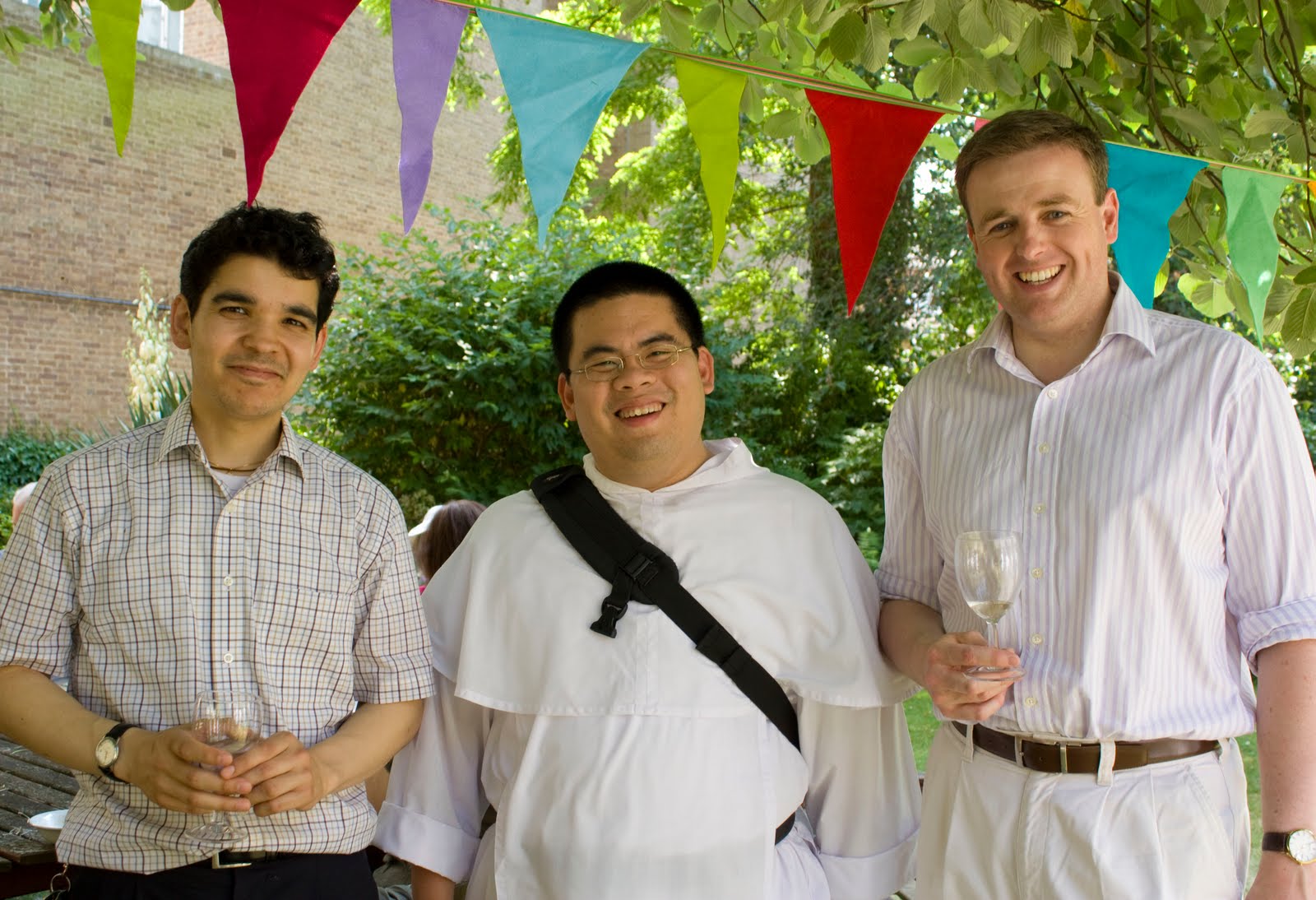
The recent weather has been quite ideal for that great English institution, the garden party. Strawberries and cream are de rigueur and a refreshing drink lubricates the conversation. Here in Blackfriars, Oxford, we have had two garden parties. The first was to mark the end of the academic year. The Blackfriars Hall Garden Party is a good chance for students and tutors to unwind and catch up with friends before they scatter for the long vacation.


Blackfriars Priory also had a garden party on Sunday 27 June, one of a series of events to thank our benefactors who support us throughout the year and particularly with the recently-completed Priory Renewal project. It was a good occasion to meet people from our various Mass congregations. Families came on the hottest day of the summer (so far!) to chat with us and to enjoy the sunshine. Provision was even made for those who wanted to watch the unfortunate England-Germany World Cup match!


Vamos a Madrid - Join us for World Youth Day 2011!


Join the Dominican students of Godzdogz, other English Dominican friars, and millions of young Catholics for World Youth Day 2011 in Madrid. For more information on our specially-tailored Dominican pilgrimage to WYD 2011 email wyd@english.op.org.

Wednesday, June 23, 2010

Vocations Story: Br Robert Gay OP

When did you first start thinking about religious life?

I was in a bookshop in Canterbury, before I became a Catholic, and I came across a book by the late Cardinal Basil Hume OSB called Searching for God. It is a collection of talks he gave to the novices and juniors of Ampleforth when he was Abbot of that monastery. This was actually one of the first Catholic books that I had read, and so my journey towards Catholicism and my journey towards religious life were very much linked.

In that case, what was it that attracted you to Catholicism?

I came across a group of Italian Erasmus students as a PhD student, and they were Sunday Mass goers. One week I went along with them, and to put it simply, I didn't stop. At the time, I wasn't quite sure why, I was simply captivated by what happened at the altar and impressed by the priest's homily. Later I came to realize that it was the real presence of Christ that was drawing me in. It seemed to me that if this was true, if Christ was really present sacramentally, then this must make a difference to my entire life. So it was natural that I should begin to consider both becoming a Catholic and also the possibility of a call to religious life.

What happened next?

I was received into the Church at Wye College in Kent, then two weeks later I followed my supervisor to Glasgow where he had a new position, but after three months a serious fire in my lab stalled my PhD. This gave me a lot of time to think about the future in a prayerful way, to ponder what I was doing and why. I began to attend daily mass, and a local prayer group in which I began to see and understand the importance and value of the pastor in a Christian community. I began to recognize the importance of being guided in the spiritual life. I suppose the crunch moment came on Vocations Sunday, when I found myself at Westminster Cathedral for Mass. Bishop George Stack gave an excellent homily, and the liturgy was beautiful. Afterwards, while I was praying, I remember thinking that it was a shame that more people didn't offer their lives to Christ as priests and religious. Then it occurred to me that it was people like me that needed to make that gift of their lives, perhaps God was calling me?

How did you respond to this insight?

I went and had a chat with the curate of my parish and he became my spiritual director. He asked me all the right questions. In the process my understanding of my own vocation began to slowly take shape. I realized then that I did not feel tied to a particular place, neither a particular monastery nor a particular diocese. This seemed to rule out the stability of the monastic life, yet there were elements of Benedictine life in particular that I found very attractive: the prayer, the community life, the study. But in addition to these points I wanted an apostolate, I could only see myself as a Benedictine up to a certain point. My spiritual director suggested that I research some other religious orders, and I came across the Dominicans via the internet.

What was it about the Order that attracted you?

I could tell from the photographs on the website that there was common prayer as there were photographs of the brethren singing in choir. At the same time the descriptions of their work included hospital chaplaincy, prison chaplaincy, the kind of apostolic outlet that I had been looking for. At this point I stopped looking at other Orders. It seems very bold looking back, but I honestly felt as soon as I saw the Dominican website that this was exactly the life that I had been looking for, and that either I had a vocation to be a Dominican, or I didn't have a vocation at all.

What was your next move?

I got in touch with the vocations director, and I spent about a year visiting Dominican houses up and down the country. I remember attending morning prayer at Blackfriars ,Oxford. I was very impressed by the beauty of the Church, with the morning sun streaming through the windows, and the energy of the prayer. The community looked dynamic, there was a good mix of ages among the brethren in choir, and they certainly sang lustily!

What really impressed me during my time visiting Dominican houses was my sense that the desire to study and preach the Gospel was very much alive. At that time I was reading Timothy Radcliffe's book Sing a New Song and you could see that the brethren were striving for the ideals of Dominican life that Timothy described in his book. Of course, the communities weren't perfect, but I got the sense that the Order was a place for passionate people. At the same time, there was a real humanity about the brethren. I immediately felt at home, even on very short visits. I was struck by how joyful the communities were.

Have you any more thoughts on vocation that you would like to share?

I think that it is important that every young person takes the time prayerfully to discern their vocation, whatever that may be. It is so important for the future of the Church that young people have the courage to ask themselves: 'what is it that God wants me to do with my life?' If we take Christ seriously and really listen to his particular call for our lives, then we can end up in places that we never expected. The natural response is to say: 'surely this does not apply to me,' but we must take the question seriously. Finding what God wants from us is to find our home - the place where we can flourish. It seems like a risk, and like the disciples we seem to be 'casting into the deep' but that risk helps us to learn to live in a way that is God-filled and life-giving. I can honestly say that there is nothing I have given up as a religious that I have not received back with interest. If we give our life to Christ and believe in his love and transforming grace, then we who are ordinary people can do extraordinary things for his sake.

Br Robert has recently been appointed vocations promoter for the English Province. He will be ordained to the priesthood in July.

For more information about the Dominican vocation see here

Tuesday, June 22, 2010

Dominican Priesthood

Our Dominican brother Anthony Fisher, Bishop of Paramatta, gave a talk to the friars of the Irish Province on 'Priesthood in the Dominican Order' as they gathered to reflect on Dominican Priesthood at the end of the Year for Priests.


The text and more details are available here.

H/T to Dominican Interactive

Wednesday, June 16, 2010

Quodlibet 31 - FAQs about the Dominican habit

Godzdogz has received a range of questions about the form and colour of the Dominican habit, when and how it is worn, and who may use it. This post will attempt to answer these questions.

Firstly, the word 'habit' comes from the Latin habitus which, among other things, simply means clothing. However, the religious habit is not just clothing but also has a symbolic value. As the Dominican Constitutions §51 says, the habit is worn "as a sign of our consecration". Therefore, it is both a reminder to the brother of the consecrated life to which he has vowed himself, and also a sign to others of his commitment to Christ and the vows he has taken. So, the Dominican historian, William Hinnebusch says that "its cloth, colour, and cut expressed the poverty, chastity and obedience [the friar] had promised".

The habit is placed under the section on 'Regular Observance' in the current Constitutions, and it is described thus: "The habit of the Order comprises a white tunic, scapular and capuce, together with a black cappa and capuce, a leather belt and a rosary" (§50). An appendix (3) then details tailoring instructions on the length of the habit and the proportions of each part of the habit in relation to the others. The appendix, however, does not detail the textile to be used, nor details like how the cappa is fastened, nor the type and colour of one's shoes, nor the colour of the Rosary or even how many decades it should have. So, these matters are left to one's personal preference.

It may be necessary to explain the terms used by the Constitutions.
The tunic is a long ankle-length garment, with long sleeves that can be simply folded up, or have buttons to hold those folds in place.
The scapular is a long piece of cloth with a hole cut in the middle for the head; the cloth then hangs over the shoulders and covers the front and back of the tunic. It should be about a hand's width from the bottom of the tunic, and wide enough to cover the "juncture of the sleeves with the tunic".
The capuce is a hood attached to a circular piece of cloth that falls over the shoulders and comes down to a point in the small of the back. This hood used to be simply attached to the scapular (like a Carthusian's habit) but at some point it became detached from the scapular and evolved into a rather elegant shoulder-cape with hood.
The black cappa, from which we get the name Black Friars, is just a large cape that covers most of the white habit. It was worn for warmth and when travelling. This too had a hood that became detached, resulting in a black capuce.
The entire Dominican habit thus has five items of clothing, plus a leather belt and the Rosary.

The same habit is worn by all Dominican brothers. Until Vatican II, non-clerical brothers (lay brothers) like St Martin de Porres wore a habit that did not have a black cappa and the scapular was black rather than white.

Traditionally the cappa was worn "during the winter and during certain liturgical services, when [the friar] heard confessions, preached, met the laity, or left the priory". In the English Province, it is worn in choir from All Souls Day (2 November) until the Gloria of the Easter Vigil, and on other liturgical occasions such as professions, funerals and in processions.

The Dominican receives the habit at the start of the novitiate, and is eventually also buried in one. Regarding its use, the Constitution only says that it should be worn inside the convent, "unless, for a good reason, the prior provincial shall have determined otherwise" (§51). As for wearing the habit outside the convent, one typically follows the custom of a local priory, and it is for the prior provincial to give directives in this matter if necessary. In the English Province, a brother is left to decide prudently whether or not to wear the habit on the streets. Most friars will wear the habit whenever they are engaged in work for the Order, such as giving talks and retreats, teaching, on pilgrimages, etc.

The current law does not mention what material the habit has to be made of. It used to stipulate wool, and in the English Province, we currently have our habits made from a wool blend, and a cappa of 100% wool. These habits are currently made by two lay Dominicans and they source the materials for us. People often wonder why there are cream and white habits. This comes down to sheer practicalities: the availability of material, and the tailor. Some habits, which tend to be worn in the summer, are from the tropics. An example is the habit of our brothers in our Vicariate in Grenada and Barbados which tends to be of lightweight white cotton. Brothers are generally supplied with one habit on beginning their novitiate and they can ask for another at their profession if they need one. However, if they need lighter-weight habits they will have to find someone to make them. The result is an interesting mixture of habits from different places and tailors when we sit in choir! This lack of uniformity is not new. Hinnebusch notes that in the Middle Ages "shades and colours varied from province to province, even from house to house".

Finally, some people wonder about whether we use our hoods (capuce) to cover our heads, and if so, when. We no longer have any customs or rubrics about their use, so that they are raised, if an individual brother so desires, for purely practical reasons: to keep the head warm in the winter, to minimize distractions during private prayer, to keep the head dry when it is raining. However, a fuller answer with historical explanations can be found at the Dominican Liturgy site.

There is then notable freedom in the use of the habit. Ultimately, I think it should help form us in the observance of our vows of poverty, chastity and obedience, and be used accordingly. So, the early Dominicans emphasized in their stories, the Vitae Fratrum that the habit was sacred and was a sign of salvation. No matter how much or how little a friar wears the habit, I think it still holds true that all Dominicans love the habit. Like our brothers down the ages, we affirmed in our legends that "Mary endorsed it [and] Dominic wore it", and because of it we are still known in England as 'Black Friars'.

Monday, June 14, 2010

Quodlibet 25 - Happy Dominicans?

A Godzdogz reader has asked us: which qualities make a person successful or happy in their Dominican life?


I think that a person will be happy in their Dominican life for two reasons: firstly, because it is their vocation, and secondly, because they live out their Dominican vocation as fully as possible.

The reason for mentioning the first point is that sometimes people join the Order, and then find out that they are unhappy or unfulfilled in some way. This might be for a variety of reasons, but one might be that they are not called to a life in the Order, and that their vocation lies elsewhere. The reason for the novitiate and the years of initial formation in simple vows is to learn about the life, to live it, and to discern more clearly if this is the Lord's will. A person will be 'successful' as a Dominican if the life and the preacher's mission is a source of joy.

The Lord seems to call a broad range of people to the Order, so it is hard to give a list of qualities that make a good Dominican. I suppose what is fundamental is that someone should be open to prayer, both in common and private. Our vocation is discovered and nourished in the encounter with God in prayer. Then there should be a desire to want to discover the Lord in other people, both in religious community and in the people that we serve in various ways. A good Dominican will be happy when he is on his own with the Lord, and when he is in the company of others. The next thing is that there should be a passion for studying and communicating the message of the Gospel in many ways. This mission requires a certain personal flexibility, so that we can adapt ourselves to the needs and challenges of the mission.

The second point I made at the beginning was that a Dominican will be happy and successful in the mission if they live out the life as fully as possible. I think that in various ways, we all struggle at times to live Dominican life to the full. There may be times when we are lazy, poorly motivated, or not as prayerful as we should be. We may find things difficult in community, perhaps because we have hurt or been hurt by our brothers. Being happy and successful in our life and mission demands that we learn from these experiences, and grow and develop through the grace that the Lord offers us.