Showing posts with label A-Z of the Mass. Show all posts

Monday, October 4, 2010

A-Z of the Mass: Conclusion

For theologians such as Pope Benedict XVI the mystery of the Eucharist is intimately bound up with the mystery of our union with Christ. Participation in the Mass, then, should have a positive impact on an individual's subjective response to grace. The whole point of worship is to be raised up in Christ and transformed toward His level. Yet somehow our everyday experiences of liturgy can seem far removed from such elevated claims. We do not often feel like we have shared in the eternal and infinite love of the Trinity. We rarely get a 'kick' out of going to Mass.

In God Still Matters, Herbert McCabe OP points out that to call a Mass dull is not necessarily a criticism. He contrasts the immediate pleasure of drinking good Irish whiskey with the more sustained satisfaction of living in a comfortable and tastefully furnished room. For McCabe, good liturgy is more like this second kind of satisfaction. Sunday Mass rarely takes one's breath away, but if one is deprived of decent liturgy for a sustained period of time one begins to notice an important gap in one's emotional and spiritual life.

This summer we have tried through our A-Z of the Mass to draw attention to some of the dimensions and symbols of the Mass that perhaps go unnoticed. We have tried to offer some fresh perspectives on our 'well furnished room' in the hope that it might aid a deeper participation in the Eucharistic mystery. This mystery is 'the source and summit of Christian life' (Lumen gentium §11). Paying close attention to what we do and say on a Sunday morning is not navel gazing. Our communion with Christ is what vivifies and sustains our mission to the world. As Presbyterorum ordinis, Vatican II's decree on the ministry and life of priests, puts it:

The other sacraments, and indeed all ecclesiastical ministries and works of the apostolate are bound up with the Eucharist and are orientated towards it. For in the blessed Eucharist is contained the whole spiritual good of the Church, namely Christ himself, our Pasch (PO §5).


Sunday, October 3, 2010

A-Z of the Mass: Z - The Eschaton

In the Book of Revelation, the last letter of the Greek alphabet, Omega, is symbolic of the end of the universe, understood as the consummation of history and the second, definitive coming of Christ. So, as we come to the end of the (admittedly, Latin) alphabet, it can remind us to consider the ways in which the Mass relates to the end of time, the eschaton.

St Thomas Aquinas teaches us that the sacraments, as signs, have a triple function, pointing to the past, the present, and the future. Pointing back to the mysteries of Christ’s human life, and especially to his Passion, they make present the sanctifying grace, that sharing in the life of God, which Jesus won for us through those mysteries and gives to us now in the sacraments. Past and present are very closely linked, because it is through his Passion – his sharing in human realities even unto death – that Jesus won for us a share of his divine reality, something we receive through outward, physical signs appropriate to our human nature (a unity of soul and body). Present and future, though, are also very tightly bound, for the grace we receive in the sacraments is but a foretaste of that fullness of sharing in God’s life to which we are all called after this earthly life. Indeed it is the pledge of that fulness and the means Jesus freely gives to us that we might obtain it.

Since in the sacraments we are already given a share in the life of God, which is what is promised to us at the consummation of all things when God will be all in all (1 Cor 15:28), it is not untrue to say that the Eschaton, as well as the Cross, becomes present for us at Mass. The Body and Blood of Christ, which demonstrate his humanity and his suffering, and which we receive at Mass, are now glorified in heaven: indeed, the Christian tradition sees the whole celebration of the Divine Liturgy as a participation in the heavenly liturgy. In the Eucharist we 'taste on earth the gifts of the world to come'. And each of the acclamations after the Consecration includes a reference to past, present and future, for example, 'Christ has died, Christ is risen, Christ will come again'.

So at Mass time in a sense stops. We are participating in the eternal worship of God, the inner life of the Trinity in which the Son eternally offers himself in love to the Father, bringing together and going beyond every moment in the existence of the universe. Aware, as best we are able, of this quite literally awesome gift of God, as we take part in the Mass, ‘let us,’ in the words of the Byzantine liturgy, ‘who mystically represent the cherubim ... lay aside all cares of life, that we may receive the King of all, escorted invisibly by ranks of angels. Alleluia!’

Monday, September 27, 2010

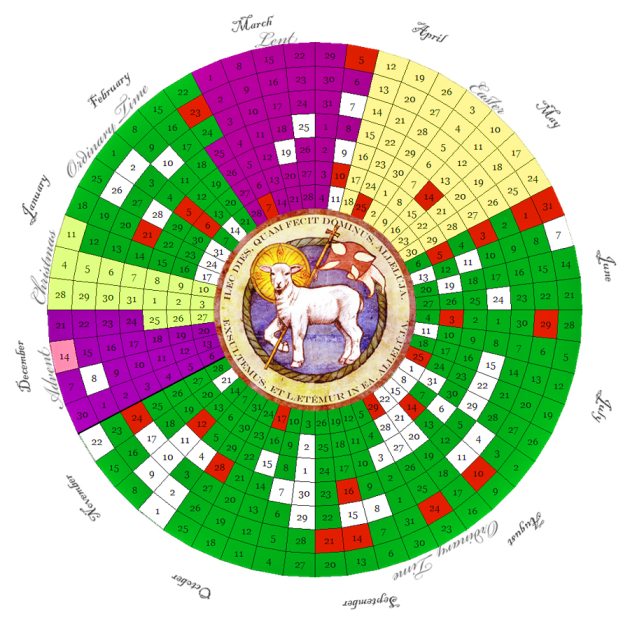
A-Z of the Mass: Year, Liturgical

Just as the world has the natural cycle of the seasons throughout the year, so the Church also celebrates with quiet, deliberate rhythm the seasons of the liturgical year. Unlike the endless cycle of pagans, the Church's year regards time as linear. It has a beginning and will have an end. Whilst we may represent the calendar as a circle, it is better to think of it as a spiral. The passing hours allow us time to meditate on sacred things as we await the return of the Lord. Throughout the year our minds are raised to the sacred mysteries through the tones of the Church's liturgy, the seasonal changes and the decor of our sacred places

The focus is the year is Christ and the salvation he brings. Therefore the year begins with the season of Advent, a season where we remember the world's waiting for a saviour. This is a penitential season, reflecting the fallen pre-incarnation world. The liturgical colour is violet and the Gloria is omitted from the Mass. During this period we ourselves prepare to receive Christ and look towards His second coming. During Christmastide we rejoice in the Word made Flesh. The penitential seasons of Lent and Passiontide turn our minds to the Cross. Again the liturgical colour is violet, the Gloria is omitted and now even the joyful acclamation of 'Alleluia' is silenced.

The Easter Triduum is the most sacred period in the Church's year. Beginning with the celebration of the Lord's Supper and the institution of the Eucharist, the Church is then physically stripped of all decoration and the Blessed Sacrament is removed, as we begin to follow Jesus to Calvary. No Mass is celebrated on Good Friday or Holy Saturday as we commemorate the death of the Lord and await his resurrection.

The Easter Vigil is a liturgical explosion as we celebrate the resurrection. As the Gloria resounds, the darkness of the Church is expelled, the veils removed and the bells ring to herald Christ's victory over death and sin.

We of course celebrate the other mysteries of our faith throughout the year: the Ascension and Pentecost; the Immaculate Conception and Assumption of Mary; and all the Church's feasts, but we must remember that our celebrations are not dry commemorations. The liturgical year allows us to celebrate and understand more fully the entire mystery of Jesus Christ, from his incarnation and birth until his ascension, the sending of the Holy Spirit, and the expectation of his return in glory. During the course of a year, the paschal mystery of Jesus — his passion and death, his resurrection and ascension, his sitting at the right hand of the Father and sending of the Spirit with the Father — is viewed from different angles, in different lights.All these moments make up one unified mystery which cannot be divided.

Sunday, September 26, 2010

A-Z of the Mass: Exit

Following the Prayer after Communion and the blessing, we come to the dismissal, which is given by the deacon or, in his absence, by the priest. The familiar Latin dismissal Ite Missa Est to which the people respond Deo Gratias, ‘thanks be to God’, is an ancient formula. The exact translation is often disputed because of the significance the word missa came to have as the technical name of the Eucharistic Liturgy in the Roman Rite. If, however, we interpret missa as dismissal, we end with something akin to ‘Go, it is the dismissal’. When Mass is celebrated in the vernacular there are a number of options available but what is perhaps more interesting is what the dismissal has come to signify, what it really means to those present.

Many have come to regard dismissal as implying mission, as not simply an ending but a starting point. As such, we should be struck by the power of this instruction as we are duly sent forth, as disciples of Christ, to bear witness to the faith in the wider world, to share the gifts and blessings which have been bestowed upon us in the Mass, and in doing so to draw others to the truth of the faith. We are, all of us, called to share in this mission, in many and various ways under the guidance of the Holy Spirit. In this way the Mass can, for each of us, mark a new departure where public worship leads definitively into Christian mission as we seek to live out our faith in our homes, workplaces and communities, and encourage others to do the same.

Tuesday, September 21, 2010

A - Z of the Mass: Wine and Wafer

In understanding the Eucharist, it is important to appreciate the difference between signs and symbols. When we see a road sign giving directions to a particular place, the fact that the sign might be green, metallic and rectangular doesn't tell us anything about the place it points to. A symbol also signifies something, but in contrast to a pure sign, the form of the symbol is crucial. The wine and wafer used in the celebration of the Eucharist are deeply symbolic and so it is very worthwhile to meditate on why Christ comes to us under these appearances.


To begin with, there are many references in the Old Testament. The fact that Jesus used bread and wine in the institution of the Eucharist is reminiscent of the bread and wine offering of Melchizedek in the book of Genesis; Jesus is the one spoken of in Psalm 109, You are a priest forever, a priest like Melchizedek of old. In the book of Exodus the Israelites ate bread at the Passover on the night before they were liberated and they were sustained with bread from heaven in the desert. Another reference is given in Leviticus 23, where the Israelites are commanded to offer the first fruits of bread and wine once they have entered the promised land.

In the New Testament, apart from the institution of the Eucharist itself, there are also many other references to bread and wine. In Jesus' first miracle he brings festive joy to a wedding by turning water into wine. In the desert he feeds the multitudes with bread saying, I have compassion on the crowd, because they have been with me now three days, and have nothing to eat; and I am unwilling to send them away hungry, lest they faint on the way (Matt: 15:32). In the Lord's Prayer, bread is spoken of as our most basic human need. Jesus' teaching also suggests how bread and wine point to his Passion: Unless a grain of wheat falls into the earth and dies, it remains alone; but if it dies, it bears much fruit (John 12:24). He also talks of himself as the true vine saying, every branch that does bear fruit he prunes, that it may bear more fruit (John 15:2).

Through the ages the Church has continued to reflect on the significance of bread and wine. The bread and wine are symbols of unity. Many grains go to make the one bread, and many grapes go to make the one cup. Bread and wine also result from a synthesis of gifts - the fertile ground below, and the sun and rain from above, and just as we have a part to play in the making of bread and wine, we play a part in forming the body of Christ, the true vine.

As bodily creatures, we need to use our senses in order for the transcendent mystery of the Divine life to be accessible to us. There is a distance between the symbol of bread and wine and the reality they symbolize – what looks like bread is not bread, what tastes like wine is not wine – but through the words and gestures of the Mass, these symbols transcend themselves and communicate the reality to us that God loves us, He nourishes us, transforms us, and makes us one with Him.

Wednesday, September 15, 2010

A - Z of the Mass: Vestments

Clothing is important. It covers our nakedness, keeps us warm and protects us from the elements. But clothing also indicates the role of a person, his or her dignity and status in a community; clothing has a practical as well as a symbolic function. Both these aspects are found in the Christian tradition. St Augustine said that clothing alleviates the shame and nakedness of fallen humanity and St Paul likens baptism and the conferral of baptismal grace and our Christian dignity to being clothed in Christ (see Galatians 3:27). St John in the Apocalypse speaks of those who have conquered sin and death as clothed in white robes (see Apoc 3:5, 7:9).

The white robe has a particular resonance for Christians. It is given to the newly-baptised in the baptismal rite, and from this ancient usage is derived the monastic habit, as well as the liturgical garment called the alb. The name of this garment, whose form resembles the ancient undergarment called the tunica, points to the very fact that it is a white garment. For alba means white in Latin. This simple white garment is a reminder of our baptismal dignity, of the purity of those who are washed in the blood of the Lamb, as well as a sign of our willingness to follow Christ, and to die with him, even in martyrdom.

As a sign of our common baptism, then, it is "the vestment common to ministers of every rank" (GIRM §298). There was a time when the newly-baptised adults of the early Church would wear this garment to church every day during the Easter octave. For this reason, the Sunday after Easter Sunday was called Dominica in albis, since it was only on that day that the newly-baptised removed their white garments, presumably for practical reasons. This practice, and its Biblical origins, shows that liturgical vesture had a symbolic purpose very early on.

Over the alb, the liturgical ministers of the early Church initially wore their best formal clothing. This was secular clothing which had insignia that mirrored the rank or office of secular and civic offices in the Roman state. It is not entirely clear how the insignia and garments of Roman officials and judges came to be adopted by the clergy. Some suggest that from the 4th century, after the peace of Constantine, clergy were given ranks equivalent to Roman officials and judges. In any case, it is after the 4th century that garments specially reserved for the liturgy are mentioned, as opposed to simply the best formal clothing one had. What may have contributed to this distinction was a shift in fashion: the Germanic breeches had come to be adopted by secular society, and the clergy retained the older form of Roman secular garments. In time these developed in shape and form, and came to have specific Christian significance attached to them to separate them from secular garments. Hence, St Jerome said that "the Divine religion has one dress in the service of sacred things, another in ordinary intercourse and life".

It is sometimes said that the Church's adoption of vesture was influenced by pagan practices. However, it is noteworthy that the emperor Julian the Apostate (d.363) complained that the Christians dressed up in special clothes to worship God. Moreover, we have seen that symbolic clothing is mentioned in the New Testament, and of course, it is mentioned at length in the Old Testament with regard to the priests and ministers of the Jewish Temple.

Vestments are part of the liturgy's communication through symbols. The colour of the vestments which were codified in the 12th century, and made obligatory in 1570, form part of this communication. As the General Instruction of the Roman Missal §307 says: "Variety in the color of the vestments is meant to give effective, outward expression to the specific character of the mysteries of the faith being celebrated and, in the course of the year, to a sense of progress in the Christian life". As such, the colour of the vestments is not chosen on the whim of the celebrant, but according to the Church's liturgical calendar. For example, red is worn for feasts of martyrs and apostles as a symbol of their blood shed for Christ.

The colour and beauty of vestments also dignify the celebration of the liturgy, and they underline to the solemnity of the occasion. General Instruction §306 is noteworthy in this regard: "The beauty of a vestment should derive from its material and design rather than from lavish ornamentation. Representations on vestments should consist only of symbols, images, or pictures portraying the sacred. Anything out of keeping with the sacred is to be avoided". As such, a vestment that is nobly simple (as Vatican II puts it) should have a fine shape and form, be well-tailored, and be made from a precious and beautiful fabric. An interesting consideration of the development of the chasuble (the Mass vestment worn by a priest), and what constitutes a good 'traditional' chasuble can be found in this article.

Liturgical vesture also serves to show the diversity of ministries in the liturgy. As General Instruction §297 says: "In the Church, the Body of Christ, not all members have the same function. This diversity of ministries is shown outwardly in worship by the diversity of vestments. These should therefore symbolize the function proper to each ministry".

Above all, as we have already seen, vestments are a sign of being clothed in Christ, and are a sign of eschatological glory. So, vanity or mere convenience are both attitudes that are antithetical to their symbolic value. As the then Cardinal Ratzinger said: "What is merely private, merely individual, about [the priest] should disappear and make way for Christ ... Vestments are a reminder of ... this transformation in Christ. [They] are a challenge to the priest to surrender himself to the dynamism of breaking out of the capsule of self and being fashioned anew by Christ and for Christ. They remind those who participate in the Mass of the new way that began with Baptism and continues with the Eucharist, the way that leads to the future world already delineated in our daily lives by the sacraments".

Monday, September 13, 2010

A-Z of the Mass: Unity

'Now you are the body of Christ and individually members of it' (1 Cor 12:27).

On the road to Damascus the Risen Christ declared to Saul that in persecuting the Church he was persecuting his Lord (Acts 9:4-5). Paul's later writings, particularly his first letter to the Corinthians, show Paul developing and exploring the implications of this revelation. The Church is one body, its different members bound together through and in Christ. This unity is achieved through faith and the sacraments. These two 'supernatural agencies' move forward hand in hand for the sacraments at once signify the grace which is the inheritance of faith, and cause and contain that same faith. Sacraments are perfect signs of God's action which bring about the very things that they signify.

The Eucharist is the perfect sacrament of the Lord's passion in as much as it contains the very Christ who himself suffered. When we consume this Christ, when we sacramentally receive his body and blood, we are signifying our unity with Christ and each other, and actually bringing about this same unity by binding ourselves to the sacrifice of the cross. The Church, according to St. Augustine, is one because it has one sacrifice. This one sacrifice is the sacrifice of Christ handed over bodily to the Church. Lumen Gentium described this gift as the 'source and summit of the Christian life'. Whilst Eucharistic communion is not the whole of our communion with God, and does not do all the work of our spiritual life, it is a definite communion with the Christ who shed his blood for us, and a foretaste of the communion we will share with him in heaven.

The Eucharist is, then, the sacrament of unity. Unfortunately the schisms and reformations that have torn the body of Christ over the centuries have cloaked this fundamental character of the sacrament. The painful reality is that despite the ecumenical work of recent decades, when we come to the altar the various Christian denominations must go their separate ways. Whilst the sacrifice of the cross belongs to the whole world, its sacramental re-presentation cannot be separated from the Church, the mystical body of Christ, that offers this sacrifice. It is indeed a tragedy that not all Christians are in communion with one another, but the solution is to redouble our efforts to found our faith on truth, to found our faith on Christ. To paper over cracks superficially and pretend there is no problem is easier in the short term, but ultimately it will be counterproductive.

Sunday, September 12, 2010

A-Z of the Mass: Transubstantiation

In its decree on the Eucharist, the Council of Trent says that the change (conversio) of the bread and wine into the Body and Blood of Christ, a change that has always been accepted by the faith of the Church, is 'appropiately and properly called transubstantiation'. This change is brought about by the words of Christ and the action of the Holy Spirit. To the question 'what is it?' of the consecrated bread or the consecrated wine, St John Chrysostom and St Ambrose, for example, who are both quoted in the Catechism of the Catholic Church, will already have replied 'it is the Body of Christ, it is the Blood of Christ'. For John Chrysostom, the words of Christ spoken by the priest 'transform the things offered' and Ambrose says that 'by the blessing, nature itself is changed'.

The term 'transubstantiation' emerged only in the middle ages as Catholic theologians continued to reflect on the mystery of this change. In particular they were thinking about the 'is' in the words of Christ spoken by the priest - this is my body, this is the cup of my blood - and came to believe that the least inadequate way to talk about this, in order to give due weight to the mystery believed in faith, was to talk about the substance of the bread being changed into the substance of the Body of Christ, the substance of the wine being changed into the substance of the Blood of Christ.

Thomas Aquinas uses the term transubstantiation to talk about the change. The mode of Christ's presence under the Eucharistic species is unique and raises the Eucharist above all the other sacraments: for Aquinas that presence is the perfection of the spiritual life and the end to which all the sacraments tend. The term 'substance' serves then to underline the reality of this presence (not that the presence of Christ in other ways in the Eucharist and in the Church is not real): a substantial presence is presence in the fullest sense by which Christ, God and man, makes himself wholly and entirely present (so Pope Paul VI).

According to the Catechism of the Catholic Church §1380 it is highly fitting that Christ should have wanted to remain present to his Church in this unique way. Since Christ was about to take his departure from his own in his visible form, he wanted to give us his sacramental presence; since he was about to offer himself on the cross to save us, he wanted us to have the memorial of the love with which he loved us to the end, even to the giving of his life. In his Eucharistic presence he remains mysteriously in our midst as the one who loved us and gave himself up for us. As the Welsh poet David Jones put it, 'he placed himself in the order of signs'. He remains with us under signs that express and communicate His love, and does so particularly in what Catholics call the sacratissimum, the most holy sacrament.

Thursday, September 9, 2010

A-Z of the Mass: Stipend

One frequent caricature painted by those hostile to the Church is to suggest that the whole 'operation' is a money-making scheme by the clergy. They will often hold up the example of Mass stipends. A Mass stipendsis an offering given to a priest by an individual or a group so that he may say Mass for the donor's intention. Today this offering is usually money. It is an ancient practice going back to the early Church when people would give the priest bread and wine, some of which was used during the Eucharist. What remained was used for the support of the clergy and the poor.

One might still ask is the donor "buying the Mass"? If this was the case then this would be a form of simony: trafficking, for money, in "spiritual things". This is certainly not the case. No amount of money can buy the sacraments and the Church has regulated the practice so that not even the slightest appearance of profit or scandal will be attached to the Blessed Sacrament.

By making an offering the donor expresses their desire to share in the fruits of the Mass. It is also an expression of their wish to help the Church support her ministries. In many ways it shows the Church as a community in action. It is also often the case that the intentions of the donor are acts of charity. This is especially true of Masses offered for the dead.

Mass Stipends are not a money-making initiative: if they were, they would not be a very good or efficient way of scamming people! They are an example of the people of God supporting each other, both spiritually and materially, following the example of the apostles. Despite all of this, I have never met a priest who would not willingly offer Mass for someone stipend or no stipend. The priority is always the intention of the one who requests a Mass.

Wednesday, September 8, 2010

A-Z of the Mass: Rubrics

“It’s not in the rubrics!” If you like to get a warm discussion underway in a religious house this is always a good way to make a start. The interpretation of the finer points in the rubrics has long been a subject for lively conversation, and rather fittingly it is a mark of how important they are in the life and worship of the Church. Suffice it to say that we will here treat the general idea of rubrics rather than begin a discussion of the minutiae.

The word rubric is said to derive from the Latin rubrica which was originally used to signify the red earth used by carpenters to mark their saw lines and subsequently by jurisconsults of the ancient world to mark, in red, the titles of their legal pronouncements. It followed that in the Church this custom was adopted to identify not the formulae of prayers but the rules and instructions given for their recitation. The explicit use of the term appears in some fourteenth century Church manuscripts and has been very much a part of ensuring that a correct explanation of the use of liturgical texts is maintained ever since. Hence we hold to the phrase “Lege rubrum si vis intelligere nigrum”, read the red if you would understand the black.

Observing the rubrics as laid down by the authority of the Church, is then, a vital part in regulating the public worship of God and ultimately in ensuring, particularly during the Mass, that all due reverence and honour are given to the Blessed Sacrament. It is for this reason that the rubrics, found for example in the Roman Missal, tend toward precision, but we must readily guard against celebrating the rules for themselves or allowing them to obscure the very reason for their function.

The rubrics themselves tend to fall into three working categories, those which regulate the Divine Office, those of the Mass, and those pertaining to the administration of the sacraments. The rubrics are to be seen as intertwined with Church dogma, enabling us to express appropriately, as they do, what we really believe as members of the Church. From this standpoint it is easy to see that their proper observance is essential and as such rubrics are not options (unless they are stated as such) but prescriptions that should be carefully followed in order to fully and truthfully express our faith in our public worship. As such, we should always be mindful of Canon 846 in the Code of Canon Law which states, “The liturgical books, approved by the competent authority, are to be faithfully followed in the celebration of the sacraments. Accordingly, no one may on a personal initiative add to or omit or alter anything in those books.”

If we follow this prescription, then we obediently offer to God worship that is deemed by his Church fitting and proper, and ensure that all due reverence and honour are maintained for those vital elements of the faith which we express in our public worship as a Church.

Saturday, September 4, 2010

A-Z of the Mass: Qurbana

What on earth, you may well be asking, does Qurbana mean? Admittedly, the letter Q did present something of a challenge when we were selecting subjects for our A-Z of the Mass, and we ended up casting our net wider than 'Mass' in the stricter sense of the celebration of the Eucharist in the rites of the Latin Church: just as, for example, the Eucharistic celebration of Byzantine Christians is customarily known by a different name, the Divine Liturgy, so the Holy Qurbana (Syriac for ‘sacrifice’ or ‘offering’) is the name given to the celebration of the Eucharist in Churches of the Syriac tradition.

Because of the predominance of the Latin Church, and its use of the Roman Rite, which is, of course, the rite of the Pope, the Bishop of Rome, it is very easy for us to forget that several other Churches, with different liturgical traditions, are in communion with the Pope, and so form part of the Catholic Church. In fact, there are 22 distinct Eastern Catholic Churches, the majority of which belong to the Byzantine liturgical tradition; besides this, and the Syriac tradition already mentioned (which has two branches, Eastern and Western), there are also Armenian, Coptic, and Ethiopian Catholics.

What are the differences, then, between the Mass which most of us are used to and the Eucharistic liturgies of the Eastern Catholic Churches? It is difficult to generalise over such a broad range of traditions, but suffice it to say that, on a superficial level, Eastern Eucharistic celebrations can seem very different indeed. The texts of the liturgy differ widely, as do the arrangement of the church and sanctuary, and the vestments of the priests and ministers. The Preparation of the Gifts, for example, varies greatly, happening at different stages in different rites, though often involving a procession to the altar at the beginning of the Liturgy of the Eucharist. Many Eastern Churches use leavened bread for the Eucharist, and the manner of receiving Holy Communion can vary quite widely: the Byzantine custom, for example, is for the laity to receive a small piece of the Host, soaked in the Precious Blood, on a spoon, while in the Syro-Malabar rite communicants receive the Host in the hand and drink from the Chalice afterwards, much like the contemporary practice of Latin Catholics, at least in England.

Behind the many outward differences, however, we can see a common structure to all Eucharistic liturgies, which may be outlined very broadly as the gathering of the community; the Liturgy of the Word focused on readings from Scripture and culminating in the Gospel; the Liturgy of the Eucharist, at the heart of which is the Eucharistic Prayer, during which the elements are consecrated; the Communion rites, during which priest and people receive Holy Communion; and thanksgiving and dismissal at the end.

This, of course, is unsurprising, because, despite all the apparent differences, any celebration of the Eucharist, whether it be called Mass, Divine Liturgy, or Holy Qurbana, whatever the particularities of the rite used, is a celebration of the central sacrament of our Christian life, in which Christ’s Body and Blood, offered to the Father once for all upon the Cross, are made present for us, and we, the Christian faithful, are invited, in Holy Communion, to be united with that Sacrifice. This central truth, which is conveyed in different ways in the different Eucharistic liturgies, according to the different cultures in which they originated, is what unites Catholics of whatever rite, all over the world: ‘we who are many are one body, for we all partake of the one bread’ (1 Cor 10: 17).


Thursday, August 26, 2010

A - Z of the Mass: Prayers

Prayer is the raising of one's heart and mind to God, and whilst this doesn't have to be restricted to a particular time or place, the prayers said during Mass are of fundamental importance to the Christian life. To many Christians, this would be a controversial statement. After all, Jesus said 'when you pray, go into your room and shut the door and pray to your Father who is in secret' (Matt. 6:6). Should we not think that the heartfelt and spontaneous prayers said in private are of more value than the formulaic recitations said during Mass?

Well, we need to remember that our prayers have value because we pray in and through Christ. When we pray with our own words, for it to be true prayer, Christ will be praying within us - there is a unity between our words and Christ's. And this unity can be even more perfect if we pray with the words that Christ Himself actually gave us. When we pray the Our Father and when we participate in the celebration of the Eucharist, we are doing what Jesus commanded us to do.

Christian prayer is a remembrance of God, a memorial, and the Eucharist reveals the meaning of Christian prayer as a memorial of Christ's sacrifice on the cross. Christ, our great High Priest and our Intercessor bears in Himself before the Father all the prayers of the Church. Our prayer ascends to God with those of the angels and the saints, and the Son of God, in virtue of His sacrifice, grants our prayer in the unity of the Father and the Spirit. So whilst we should still make time for private prayer, we should not forget that it is Christ revealed to us in the Eucharist, who allows all our prayer, whether in private or public, to be a time when our hearts and minds are truly raised to God.

Sunday, August 22, 2010

A - Z of the Mass: Offerings

The Holy Sacrifice of the MassAt the centre of the Eucharistic action is the idea of offering. As the Catechism says: "The Eucharist is the memorial of Christ's Passover, the making present and the sacramental offering of his unique sacrifice, in the liturgy of the Church which is his Body" (§1362). An offering is something freely given to another, in this case God, and it has a sacrificial element which is perfected if it is given out of love. St Thomas cites St Augustine saying that "'Christ offered Himself up for us in the Passion': and this voluntary enduring of the Passion was most acceptable to God, as coming from charity" (ST III 48,3). The Mass is the sacramental sign of the one Sacrifice of Christ's Passion, such that Christ's perfect offering on the Cross is made present in the perfect offering of the Mass. Again, as the Catechism (quoting the Council of Trent) says: "The victim is one and the same: the same now offers through the ministry of priests, who then offered himself on the cross; only the manner of offering is different" (CCC §1367). So, the ordained priest, acting in the person of Christ, offers the Body and Blood of Christ, the "acceptable sacrifice", to the Father.

We share in Christ's offering in at least three ways. Firstly, gifts of bread and wine - the elements necessary for the Eucharist - are brought up during the Offertory, and, as the General Instruction to the Roman Missal (GIRM) says: "it is praiseworthy for the bread and wine to be presented by the faithful". In some places, it is still possible to follow the ancient practice of giving to the priest bread and wine actually produced by the faithful. This liturgical action, which has a very practical origin, is a sign of our participation in the self-gift of Christ. Moreover, as the Catechism notes: "The presentation of the offerings at the altar takes up the gesture of Melchizedek and commits the Creator's gifts into the hands of Christ who, in his sacrifice, brings to perfection all human attempts to offer sacrifices" (CCC §1350).

Secondly, in some countries, other food and fresh produce are also offered during the Offertory. Most typically, money is taken up in a collection during the Offertory. Whether in kind or in cash, these offerings support the work of the Church and her ministers. However, they are also a sign of all that is important to us, and vital for our livelihood; we give these back to God in thanksgiving. Procession of GiftsMoreover, as Pope Benedict XVI said: "In this way we also bring to the altar all the pain and suffering of the world, in the certainty that everything has value in God's eyes... [This gesture] enables us to appreciate how God invites man to participate in bringing to fulfilment his handiwork, and in so doing, gives human labour its authentic meaning, since, through the celebration of the Eucharist, it is united to the redemptive sacrifice of Christ" (Sacramentum caritatis, §47).

Thirdly, in the Mass the Body of Christ, meaning the entire Church, is offered to the Holy Trinity. So, the Catechism says: "The Church which is the Body of Christ participates in the offering of her Head. With him, she herself is offered whole and entire. She unites herself to his intercession with the Father for all men" (CCC §1368).

The offering of the Church, of which we are members, has an implication for us. If we are to actually participate in this sacrificial action of the Church, the 'entire Christ' - Head and Body - then, we have also to offer our hearts, our very lives to God. This interior participation in the Eucharist is vital, and it is the essence of the 'active participation' called for by Vatican II. Therefore, "Christians, in all their actions, are called to offer true worship to God. Here the intrinsically eucharistic nature of Christian life begins to take shape. The Eucharist, since it embraces the concrete, everyday existence of the believer, makes possible, day by day, the progressive transfiguration of all those called by grace to reflect the image of the Son of God"(Sacramentum caritatis, §71). In this way, our lives become an offering, as Christ's was. As St Paul said: "I appeal to you therefore, brethren, by the mercies of God, to present your bodies as a living sacrifice, holy and acceptable to God, which is your spiritual worship" (Romans 12:1).

Wednesday, August 18, 2010

A-Z of the Mass: 'N'

There are a number of places in the rite of the Mass where the designations 'N', or 'N and N', appear. This is to indicate that certain individuals should, or may, be named at these places. The ones who should be named are the Pope and the Bishop in whose diocese the Eucharist is being celebrated. Thus in the second Eucharistic Prayer we say:

Lord, remember your Church through the world;
make us grow in love,
together with N our Pope,
N our Bishop, and all the clergy.

In the third and fourth Eucharistic Prayers it is phrased slightly differently but the point is the same: we are in communion with the local bishop, and with the bishop of Rome, and we acknowledge this during the Mass. So we know where we are and who we are associated with in the celebration. Our communion in the Body and Blood of Jesus is a communion also in the Church which is Christ's body, and so we acknowledge the faith we share and the obedience we give to those who have been entrusted with preaching the gospel and serving the Church's unity.

In the first Eucharistic Prayer there is also a naming of the Pope and the local Bishop though coming now before the consecration. But there are two other namings here. One is of those who are alive and for whom the community wishes particularly to pray:

Remember, Lord, your people, especially those for whom we now pray, N. and N.

The other is a naming of the dead for whom the community wishes particularly to pray:

Remember, Lord, those who have died and have gone before us marked with the sign of faith, especially those for whom we now pray, N. and N.

It is rare to hear anybody actually being mentioned by name at these points. It may be that over time these commemorations of the living and the dead in the Roman Canon made the 'prayer of the faithful' or 'bidding prayers' less necessary. Experience now is that individuals, living and dead, will often be mentioned in the prayer of the faithful rather than during the Eucharistic Prayer. But it does still happen, where particular intentions are remembered at a celebration of Mass, for example, the anniversary of a couple's marriage, or the anniversary of somebody's death.

In a Funeral Mass the individual or individuals who have died should be mentioned by name in the Eucharistic Prayer: 'Remember N whom you have called from this life' (EP II), 'Remember N. In baptism he/she died with Christ: may he/she also share his resurrection' (EP III). This may well be experienced as the most urgent naming that we do, as we ask God to remember the one who has died and to enter that person's name in the book of the living.

The first Eucharistic Prayer gives us a list of saints and martyrs who are to be mentioned by name. These are the most important saints of the early Church: Mary, Joseph, John the Baptist, Stephen, the apostles, and other confessors and martyrs, many of them Roman saints. The third Eucharistic Prayer gives the option of naming a saint, 'Saint N', the saint of the day or a patron saint. It has become customary also for the second and fourth Eucharistic Prayers to include the naming of a particular saint (or even saints).

The Church is a community of people, not a philosophy or an ideology. The holiness of the Church is found in the lives of individual men and women, and the responsibility for teaching and governing the Church is entrusted to individual men. Naming such individuals in the course of the Eucharist reminds us of the communion we share, a faith and a way of life that is not abstract but is seen in the virtues, needs, and responsibilities of individual Christians. We must eat and drink while 'discerning the body', Paul says when he speaks about the Eucharist in 1 Corinthians 11. It is clear that he means both the Body of Christ present in the bread of the Eucharist and the body of the believers who through participation in the Eucharist become 'one body, one spirit in Christ'.

Sunday, August 15, 2010

A-Z of the Mass: Memorial

'Do this in memory of me'

One of the themes running through the writings of Herbert McCabe OP is the idea that when we talk about God we stretch our words to breaking point. Our language is deepened as we wrestle with the mysteries that underpin our faith. A good example of this is our use of the word 'memory.'
Sanguis ChristiSocieties, clubs and associations up and down the country exist to 'remember' the lives and works of particularly worthy individuals. The Church is fundamentally different from such institutions. We do not come to Mass simply to learn about Christ and try to imitate him, as we might study the works of Aristotle for instance, or Marx. We come to Mass to share in the life of the living God. We come to Mass to renew our communion with Christ and each other.

This communion was made possible by concrete historical events, the death of our Lord Jesus on the cross and his resurrection on the third day. But these particular historical events are unique in the sense that they cut through space and time, they transcend space and time. At the mass Christ's sacrifice at Calvary is re-presented. It becomes present. Our 'remembering' of the past, then, is also a 'remembering' of the present and - most radically - a 'remembering' of the future.

In his 1968 book Law, Love and Language Herbert McCabe argues that in the Eucharist the future world is made present to us, we belong to the future, hence the close connection made in the New Testament between the Eucharist and the Resurrection. This contact with the future shapes our entire Christian outlook. Gospel-centred lives will never be wholly explicable in terms of the values of 'the world' because Christians are looking forward to a world in which all men and women are united in Christ. In McCabe's own words: "The business of the Church is to 'remember' the future. Not merely to remember that there is to be a future, but mysteriously to make the future really present."

Wednesday, August 11, 2010

A to Z of the Mass - Language

Clearly, language plays an important part in the celebration of the Eucharist: after all, we say that it is the words spoken by the priest (its ‘form’) over the bread and wine (its 'matter') that effect the sacrament in which Christ is really present under the appearances of that bread and wine. But how do we dare claim such power for these words, elements of human language? And why these words in particular? And what about the rest of the liturgical rite of the Mass, also composed of various texts? After all, is God not beyond language, limited as it is by the boundaries of the human mind? How can any prayer we say, with any form of words, be worthy of any response from God, let alone the gift of the Body and Blood of Christ which He gives us in the Eucharist?

In brief, yes, God is beyond our language. We cannot praise or thank him as we ought. It is because of this gap, however, this distance from Him, that He sent his Son into the world to become a human being like us: Jesus calls us to unite us to himself, the Word made Flesh, and by his Spirit to come to participate in the eternal love which the Son speaks to the Father and the Father to the Son.

Thus, as our humanity is raised up to God through the Incarnation, so our human language is raised up, and made capable in the sacraments of pointing to something beyond itself, bringing about something which it is not fully able to describe. At the consecration of the Mass it is Jesus who speaks the words of institution through the priest as his instrument: they are truly his words, given to the Church at the Last Supper and handed down in the gospels and the tradition of the Church.

The various other texts which constitute the different rites of Mass have also developed within the tradition of the Church. By using these texts, ordered and selected according to a set pattern, we remember and signify that every celebration of the Eucharist is an action of the whole Church, not of some individual or special group: it is language which makes human beings capable of society, and through a particular use of language that something can be said on behalf of a society as a whole.

Our language, then, is not capable of speaking definitively about God, or of expressing the praise and thanks which is his due, but through the Incarnation, God elevates our speech so that, by the power of the Word made flesh, Christ’s Body and Blood can be made really present, under the appearance of bread and wine, by the speaking of words. These words form part of a rite given to us by the Church, to whom Jesus gave the command to celebrate the Eucharist.

Sunday, August 8, 2010

A-Z of the Mass: Kneeling

Kneeling at Mass can be a controversial and divisive issue among liturgists and I have no intention of wading into the debate. However I think that kneeling and all our liturgical postures contain deep meaning and significance. First, kneeling is not something that we normally do in day to day life. When we kneel we are physically demonstrating that what happens at the Mass is sacred and different from the rest of our daily lives. Furthermore kneeling is a sign of adoration and reverence.

We kneel during the Eucharistic prayer as this is the most important part of the Mass; it is when Our Lord becomes present in the Blessed Sacrament. Many would argue that this is an innovation of the medieval ages, when people would adopt similar postures in the presence of their social superiors. This might be the case, but if one is willing to kneel before a king is it not acceptable to kneel before the King of kings?

Kneeling is also a posture of humility and penance. Often in the Old and New Testaments we see individuals get on their knees to demonstrate their remorse. Humility is not a prized virtue in our society which often focuses on putting one’s self at the centre of life, rather than God. Christianity, on the other hand, has always prized humility as the way to Heaven, in imitation of Christ who humbled himself to come among us as human in order to restore us to communion with God.

Kneeling is also a posture of intimacy. When Christ was suffering the agony in the garden he shared his intimate prayer with the Father on his knees.And it is also a gesture of trust. We are vulnerable and at a disadvantage physically but we can trust in God, and the Blessed Sacrament is the embodiment of that trust.

The Catholic Encyclopedia includes a very interesting article on kneeling. You can read it on the New Advent website, here.

Wednesday, August 4, 2010

A-Z of the Mass - Jewish Synagogue Worship

When we assist at the Holy Sacrifice of the Mass, it is perhaps, easy to forget how much in our liturgy we draw from our Jewish heritage. Both our buildings and the liturgical functions that we celebrate within them resonate strongly with this heritage. In particular, we see many liturgical similarities between what was known as the Mass of the Catechumens, now known as the Liturgy of the Word, and Jewish synagogue worship. For Jews, as for Catholics, prayer and worship do not necessarily have to take place within a purpose built structure, but these structures represent a good starting point to examine that which best exemplifies the liturgical tradition and function of each faith, providing as they do, a common place of worship where members of each faith may gather in praise of God.

Jewish synagogue worship can be seen to arise in the wake of the Babylonian destruction of the first Temple constructed by Solomon. Though a second and grander construction was built by Herod in the first century, the legacy of the exile remained and the organised worship that had flourished during this period, synagogue worship, became a permanent part of Jewish religious life. Even after the return to Israel this form of ritual worship was enshrined for the simple reason that all could not reach the Temple. The synagogue became the local house of worship and over time many aspects of Jewish liturgical ritual developed and became formalised. Much was naturally modeled on Temple worship, the buildings faced east towards Jerusalem and each contained a Torah Ark. In this the scrolls of the Torah were kept – this was to be reminiscent of the Ark of the Covenant where the Ten Commandments were held in the Holy of Holies, the inner sanctuary of the Tabernacle, in the First Temple. Each synagogue also contained a bimah, a raised platform from which the scriptures were read by those competent to do so and from which teaching and instruction were given. Above all, synagogue worship, in contrast to the sacrificial forms of Temple worship, was characterized by the recitation of prayer, the reading of scripture, and the chanting of the Psalms.

As with worship in the Catholic Church, synagogue customs and traditions varied from place to place though the central tenets and core beliefs remained the same. The Diaspora was at the heart of this variety which ultimately gave rise to the Sephardic and Ashkenazi forms of Judaism. After the destruction of the Second Temple by the Romans, the synagogue, with its didactic rather than sacrificial emphasis, became the central forum of all Jewish worship. Today we can see much of our Christian heritage reflected in the forms of Jewish worship and we hold much in common such as our reverence for scripture as the revealed Word of God. Our differences remain clear but it is important to reflect upon what we have inherited in order to better understand the true significance of that heritage. How else are we truly to understand Christ as the fulfilment of the Old Law, the Mass as a true sacrifice, and the inexhaustible richness of the Eucharist as the very ‘source and summit’ of the Christian life?

Sunday, August 1, 2010

A-Z of the Mass: Incense

“For it came to pass, when the flame went up towards heaven from off the altar, the angel of the Lord ascended in the flame of the altar” (Judges 13:20).

The burning of incense is rich in symbolism. The above verse from the Book of Judges describes the incident when Samson's father Manoah makes a burnt offering before the angel of the Lord. The angel represents an intermediary function between God and man, and rises up to heaven in flame and smoke. This incident is alluded to in Eucharistic Prayer I when the priest says “Almighty God, we pray that your angel may take this sacrifice to your altar in heaven.” The burning of incense is a symbol of prayer going up to the Lord and being borne before Him by intercessory angels. The smell of incense is pleasing to the Lord and represents the achievement of a peaceful relation between God and man.


In the temple of Solomon, there was an altar in front of the Holy of Holies on which incense was burnt every morning and evening. The incense marked the presence of God. This is also true in the Mass: we acknowledge the presence of God in the incarnate Word proclaimed in the Gospel, the presence of God in the action of the priest, the presence of God in the sanctification of the people, and the presence of God in the Eucharistic species. This is something quite remarkable. In the Old Testament, there is the marvellous saying “What great nation is there that has a god so near to it as the Lord our God is to us, whenever we call upon him?” (Deuteronomy 4:7). How much truer this is for us! The burning of incense represents the fulfilment of the prophecy in the book of Malachi: “From the rising of the sun to its setting my name is great among the nations, and in every place incense is offered to my name and a pure offering; for my name is great among the nations, says the Lord of hosts” (Malachi 1:11).

Wednesday, July 28, 2010

A - Z of the Mass: Homily

The word 'homily' comes from the Greek homilia and means discourse, speaking together or in communion. Hence, in 1 Corinthians 15:33, homilia is translated as colloquia in St Jerome's Vulgate. The word connotes a familiar conversation between a pastor and his flock, using words and images that they will recognize. So, in Luke 24:14, on the road to Emmaus, the Lord is said to be "discussing as they went all that had happened", and the Greek word that 'discussing' translates is homiloun.

PraedicareThe 2nd-century Church Father, Origen distinguished between logos (sermo) and homilia (tractatus). The former was more structured and formal, following the style of classical rhetoric, while the latter was more direct and free. So, the homily was a popular exposition, or commentary, and application of the Scriptures. The aim of the homily is to explain the meaning of the Scriptures in both its literal and spiritual senses (see Catechism of the Catholic Church, 115-119), so as to stir people's faith, and that we might all recognize Christ in the Breaking of Bread.

Although the word sermon is often used for the preaching delivered during the Mass, there is a distinction between sermon and homily that is maintained today. Sermon is more broad, and refers to any form of preaching that is not necessarily connected to the Scriptural readings of the Liturgy, and that can be heard outside the context of the Mass. So, for example, sermons can be found on Godzdogz delivered by Dominican students during Lent or Advent. However, only ordained ministers, and ordinarily the principal celebrant of the Mass, may preach within the context of the Mass. However, he may also call on one of the concelebrants, or the deacon of the Mass to perform this ministry. This liturgical preaching is more often called a homily to emphasize that it is intimately connected to the readings and prayers of the Mass.

The intimate connection between the homily and the Liturgy is emphasized by Vatican II. According to Sacrosanctum Concilium, the Constitution on the Sacred Liturgy, the homily is "part of the liturgical service" and should "draw its content mainly from scriptural and liturgical sources, and its character should be that of a proclamation of God's wonderful works in the history of salvation, the mystery of Christ, ever made present and active within us, especially in the celebration of the liturgy" (SC §35). As the homily is an integral part of the Liturgy, the General Instruction of the Roman Missal says that it is "strongly recommended" at every Mass, especially during the seasons of Advent, Lent and Easter, and on Sundays and Holy Days "[the homily] may not be omitted without a serious reason" (see GIRM §§29, 55, 65-66).

The importance of the homily is clear from its aims stated above. As the General Instruction says, "it is necessary for the nurturing of the Christian life" (GIRM §65).