Thursday, June 30, 2011

The Most Sacred Heart of Jesus

I have never really supported the 19th century representation of the Most Sacred Heart of Jesus, standing with a open wound in his chest, where his heart is visible, or even with his heart removed from the body, maybe held in his own hand. It is not that I haven’t got the point – Christ offering his heart by love towards humanity – but I can’t help seeing it as a violation of the body, a disturbing image that removes me from the meditation on love. But popular devotions find their expression according to their own time and place, and one may ask how our time would like to represent this devotion today. Historically, the devotion to the Most Sacred Heart spread rapidly from the 17th century, but can be traced back to Benedictine and Cistercian monasteries in the 11th and 12th century.

Apart from the representation mentioned above, the devotion to the Sacred Heart has an intimate beauty, a deep meditation on the self-giving of Christ, given to humanity so that we may follow in his foot-steps. As Christ empties himself through his all-embracing love, so are we called to give ourselves, both in prayer and in charity towards our neighbour. The devotion is deeply connected to the Eucharist, and as the heart, often connected to love and goodness, the deep centre of our existence, so is the Eucharist the place where grace and love are transmitted to believing humanity. The heart also signifies trust and openness, values that John Henry Newman must have thought of when he was elected Cardinal, citing St Augustine as he chose the motto Cor ad cor loquitur, Heart speaks unto heart. For this is the profound mystery of the Incarnation. God unites with humanity, and comes so close to us that he reaches us from within, from one heart to another.

We may not always be aware of it, but this intimacy is present also in the Old Testament. The relation between Israel and the Lord carries within it a paradox. The people of God address themselves to the Lord whose name they cannot even mention. Still, the Psalms expresses all the dimensions of human life, from celebration, joy, peace, happiness, to frustration, sorrow, anger and despair; all through it is a most intimate language, seen in the word ‘You’. Whether it is in anxiety – My God, my God, why have you forsaken me (Ps 21,1) – or in thanksgiving – You make your saving help my shield,and your right hand sustains me; your help has made me great’(Ps. 18,36) – we always find the deep trustful way of talking with God expressed through an unreserved ’You’.

This intimate dialogue is ultimately revealed in the Incarnation, but we shall not forget that the people of the old covenant are living in God’s immediate presence. As we meditate on the gift of receiving the heart of Christ in our own lives, we may cite an old rabbinic prayer that expresses the infinite communion between God and man, between the Lord and his people:

"Where I wander –You!
Where I ponder –You!
Only You, You again, always You!
You! You! You!
When I am gladdened –You!
When I am saddened –You!
Only You, You again, always You!
You! You! You!
Sky is You! Earth is You!
You above! You below!
In every trend, at every end,
Only You, You again, always You!You! You! You!"

Wednesday, June 29, 2011

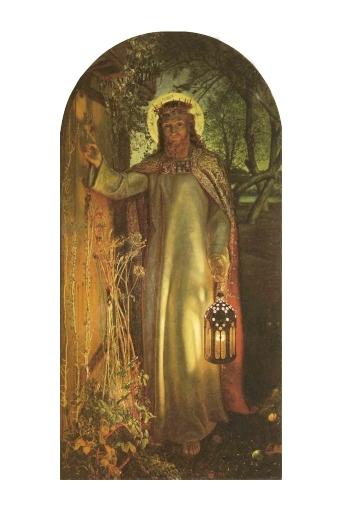
Art of the Redemption 10: The Light of the World by William Holman Hunt

“Behold, I stand at the door and knock; if any man hear my voice, and open the door, I will come in to him, and will sup with him, and he with me” (Revelation 3:20).

In a contemporary review, the nineteenth century preacher and social reformer George Dawson described The Light of the World, as a sermon on canvas and stated; “Such a picture explains the true uses which art had in the Middle Ages. With many people, nowadays, paintings are only the last touch of ornament given to their houses; but in the Middle Ages the painter occupied the place preachers would occupy now.” In viewing this painting one is inclined to agree with Dawson’s enthusiastic pronouncement on Holman Hunt’s work. It is no mere ornamentation but a beautiful sermon on the mission of Christ.

Thus, central to the painting is the patient figure of the risen Lord, lantern in hand, knocking upon and waiting without, the tightly shut door. A door long closed with rusting hinges, surrounded by brambles and ivy. This door represents the firmly closed door of the soul. There is no handle on Christ’s side, for the door must be opened from within. Christ holds in his hand the lantern of the Church which illuminates the way and which is bound tightly to his wrist with cords. Upon his head are two crowns; one of thorns the other of gold. The former symbolises his Passion and the latter his heavenly glory; interestingly the thorns have begun to bud showing the new life flowing from Christ’s sacrifice. The face of Christ shows a measure of sadness as he continues to knock and to wait, but it is also patient and full of kindness. Christ knows the night may be long but he is not about to walk away.

There are numerous other fascinating details, rich in religious significance, which deserve closer inspection and which make it well worth the journey to see the original if possible. In particular pay attention to the bat, the robe, the apples, and the jewelled clasp – see what you will make of them! The work is open to the public at Keble College, Oxford. Later versions painted by the artist are to be found in St Pau'ls, London and the Manchester Art Gallery.

Tuesday, June 28, 2011

Solemnity of St Peter and St Paul


Most of the prominent people in the New Testament get a feast day to themselves, so why do Peter and Paul, certainly the two most prominent people in the Acts of the Apostles, share a feast day here? Certainly each deserves proper liturgical focus in their own right and in fact there are separate feasts as well: the Conversion of St Paul (25 January) and the Chair of St Peter (22 February).

However, they are combined here because they were both martyred in Rome during the persecution by the Emperor Nero. The slim evidence that there is does not point to them sharing the same date of execution, but very strong evidence establishes the fact that these two apostles died for the faith in Rome in the mid 60s, having spent at least some time ministering there. There is good archaeological evidence to support the cult of these apostles from extremely early times, and this date is known to have commemorated them from 258 AD at the latest.

This double martyrdom, supported by a period of ministry that preceded it, was seen as hugely significant in the early church. It made Rome unique. No other city or local church could claim to be the place of final ministry and martyrdom of two apostles. It was very much at the heart of the pre-eminence given to the Church of Rome, and the reason given for it. St Clement, c. 96 AD, St Ignatius, c. 110 AD, and St Irenaeus and Tertullian, both later in the second century, all refer to this. Though there (almost) certainly were Christians in Rome before either Peter or Paul was there in person (indeed Paul wrote to them before he went there), their ministry and especially their martyrdoms were seen as giving a secure foundation to the church there. Without intending it, Nero was an instrument of providence by which Rome was established as the centre of the universal or Catholic Church, in effect making Catholicism Roman.

Tertullian later reflected that ‘the blood of the martyrs is the seed of the church’ by which he meant that this witness in death both encouraged the faithful to remain so, and also invited, even challenged, their persecutors to accept the faith. At the centre of their lives was something more important than life and indeed something that transformed death. No doubt the presence, ministry and fidelity unto death of Peter and Paul strengthened the rest of the Christian community in Rome to be faithful unto death – and many were indeed faithful, in this persecution and in others that followed it. Since that time, right down to today, there has always been a Christian community in Rome, true to the teaching of these apostles.

We too today have the chance to be part of the Church and to be in communion with the church founded on their witness unto death. To really live in the grace of that communion is to be willing to witness to the Gospel each and every day in our lives and in whatever death God sends us, peaceful or violent. For strength, then, let us be encouraged by the example and prayers of St Peter and St Paul and all the Roman martyrs who followed them, and with them let us look to Jesus Christ ‘the faithful witness, the first born form the dead, the highest of earthly kings’ (Rev 1:5).

Monday, June 27, 2011

Oxford's Corpus Christi Procession

The sun came out just in time for North Oxford Deanery Corpus Christi procession, led by Bishop William Kenney CP, auxiliary bishop of Birmingham. The Blessed Sacrament was carried from the Oxford Oratory to the Oxford University Catholic Chaplaincy. The route was broken by a stop at Blackfriars where Bishop Kenney preached a sermon reminding the faithful of the humanity that is so integral to the Eucharistic altar.

Here are some photos from the day:


Sunday, June 26, 2011

Corpus Christi

Readings: Deuteronomy 8:2-3; Psalm 147; 1 Corinthians 10: 16-17; John 6: 51-58


Economic doom and gloom has filled the media with stories of protests and demonstrations in recent weeks. This is the bread and butter of politics. When resources become scarce we band together and fight for our own interests. In different ways, the ideologies of left and right are based on conflict and competition. We fight to preserve our way of life. One of the ways in which we do this is by taking to the streets.

One could interpret the traditional Corpus Christi processions in this manner: as a show of strength from a Church intent on preserving its power and prestige in the world. This, I think, is to misunderstand the sacrament and today's solemnity. The Eucharist is the sacrament of Christ's sacrifice on the cross. It is the sacrament of Christ's atonement, or 'at-one-ment', through which we become one with God and one with each other. Where secular political ideologies are about groups and individuals preserving their own interests, protecting their own lives in opposition to competitors and rivals, the Eucharist is about reconciliation. The Eucharist is about communion, or common union. Instead of fighting to save his life, Christ gave his life as a gift for others. In the Eucharist we accept this gift of Christ's life and identify ourselves with his sacrifice.

With this background in mind, the symbolism of a Corpus Christi procession becomes all the more powerful. When we leave the privacy and safety of the four walls of our church and the comfortable arrangements that we have grown familiar with, when we follow the Blessed Sacrament through the streets of cities like Oxford, we make a statement about the Christian life. Our faith is not a private affair, separate and distinct from how we live in 'the real world'. The whole of our lives ought to be Eucharistic, this means offering our lives as a sacrifice for others that builds communion, that leads to reconciliation.

This reconciliation can only happen if we, and the society around us, like the people of Israel in our first reading, recognize that man 'does not live on bread alone' (Deuteronomy 8:3). As a society we are condemned to never ending strife and struggle for our 'daily bread', which although necessary offers a temporary satisfaction and a temporary life, unless we see these material goods against the horizon of the Body and Blood of Christ. This is the 'living bread', the food and drink that gives eternal life. Only God can satisfy all our desires, and God offers himself to us as a gift in the Eucharist that we celebrate today. It is a gift that puts all material goods into perspective, and it is a gift that we must share with our neighbours.

Friday, June 24, 2011

Eucharistic FLASH MOB

The Franciscans in Preston organised a Eucharistic flash mob in the centre of Preston on Ascension Thursday 2011. I for one found this very inspiring and it is certainly in the spirit of "New Evangelization"


Thursday, June 23, 2011

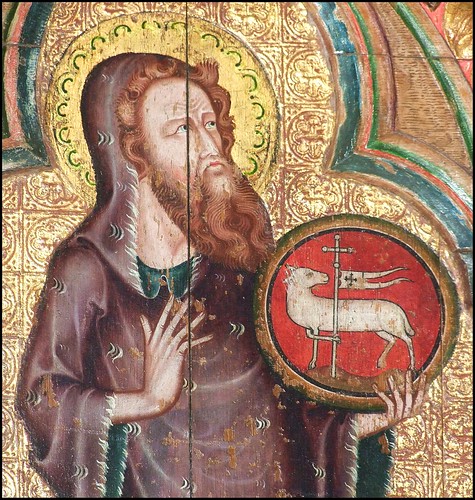
Saints This Month: St John the Baptist (24th June)

As we celebrate the Nativity, or  Birthday, of St John the Baptist, the Church’s liturgy draws our attention in particular to his place in God’s eternal plan. ‘The Lord called me before I was born, from my mother’s womb he pronounced my name,’ we hear in the first reading from Isaiah (49:1). The events surrounding his birth also draw people’s attention to his special role: his father Zechariah’s dumbness and the subsequent return of his speech make the family’s neighbours wonder, “What will this child turn out to be?” (Lk 1:66).

All of these signs, in the life of John the Baptist and in the Church’s reflection upon it, highlight his place at the culmination of the chain of Old Testament prophets, those called by the Lord to proclaim his word to the people of Israel. John was not only to speak the word, calling people to repentance and reconciliation with the Lord, he was the one who would point to the Word of God made flesh, saying, “Behold, the Lamb of God, who takes away the sins of the world” (Jn 1:29).

Because of this great privilege of John’s, Jesus himself says, “Truly I say to you, among those born of women there has arisen no one greater than John the Baptist” (Mt 11:11). And yet he then goes on to say, “he who is least in the kingdom of heaven is greater than he”. The transformation wrought by Jesus through his death and resurrection, which has enabled us to enter that kingdom through our baptism, has raised human existence to another level.

It was that transformation which John hinted at as he pointed out the Lamb of God who takes away the sins of the world; in a world where so many have still not heard this good news, we who have heard are called, even as we try to understand it more fully ourselves, to imitate St John the Baptist, drawing people’s attention not to ourselves but to Christ and the great gift of salvation which he holds out to all the world.