Saturday, August 14, 2010

Mother of Redeemed Humanity

Readings: Revelation 11:19, 12:1-6,10; Psalm 44; 1 Corinthians 15:20-26; Luke 1:39-56

A glorious reflectionElizabeth calls Mary “the mother of my Lord”, and her use of the word ‘Lord’ is significant because it refers to God, the Lord whom Mary praises in her ‘Magnificat’. And so, every time we pray the ‘Hail Mary’, we repeat the words of both Gabriel and Elizabeth, and we echo Elizabeth’s greeting when we call Mary “Mother of God”. But it’s not because Mary is Mother of God that we celebrate today’s feast. No, we celebrate Mary’s Assumption, when “the ever Virgin Mary, having completed the course of her earthly life, was assumed body and soul into heavenly glory” because Mary is ‘Mother of Man’, the Mother of Humanity.

Jesus Christ, after all, is not just “true God from true God”, but also true man, fully human. And the defining characteristic of humanity is to be a unity of rational soul-and-body. The human body, then, is ensouled, and it is sacred from conception to the grave. And so, when we speak of Christ becoming human, we say that “the Word became flesh, and dwelt among us”. The eternal Word took his flesh from the Virgin Mary, fashioning a body for himself in her womb, with a human face that is in her image and likeness. And so, although Mary is called ‘Mother of God’, she is also rightly called ‘Mother of Man’, since she is Mother of Jesus Christ who is true man, the second Adam.

St Paul alludes to this in the second reading. Sin and death affect all human beings because Adam stood for humanity. Christ became Man so that he could represent humankind, uniting humanity to his divinity. By his love and obedience even to the point of death on the Cross, Christ overturned the disobedience of Adam. So, by his Incarnation and death, Jesus redeemed humanity, and became a second Adam who gives us life because as God-Man he was victorious over death. As Paul says, Christ is the first to rise from the dead. But all human beings will share in his victory “in their proper order”. And the first after Christ to experience the resurrection of the flesh is Our Lady.

If we look at our first reading, it is interesting to note that the writer of the Apocalypse models Mary after the first Mother of Humanity. Like Eve in Genesis, she is called ‘Woman’, and she is subject to the pangs of childbirth. So, Mary fully shares our human condition. However, she is surrounded by heavenly signs: the sun, stars, and the moon, and these speak of her union with God through grace, and her heavenly destiny. So, if Christ is the second Adam, then the second Eve is Mary, because she is, as I’ve suggested, the Mother of Man. But she is not the Mother of fallen humanity, as Eve was. No. She is the Mother of true man.

What does it mean to be truly human? It is sometimes said that to err is human, but actually to sin is to be less-than-human because sin de-humanizes us and deforms us, and we fail to be truly made in the image of God. It is Christ, the second Adam who restores the beauty of the image of God in us. By his grace, he remakes us in his image as true man, and the first person to receive this grace in its fullness is Mary, who is thus immaculate and all beautiful. This is why she can be called the Mother of true man: we mean that Mary is the Mother of Redeemed Humanity, of all people who are united to Christ in baptism, and who are promised a share in his divine life. In short, Mary is called ‘Mother of the Church’.

Dormition of the Virgin MaryAs Mother of the Church, then, Mary is our Mother, and she is the first in the Church to benefit from Christ’s promises. She is the first to receive the grace of divine adoption, so in today's psalm she is called ‘daughter’. And today we celebrate that she is the first to rise body and soul into heaven to be with God. So, the eternal life that was promised to her by her adoption as a child of God, a sharer in the divine life, was fulfilled at the end of her earthly life. So too with us … When our earthly life is ended, we hope that the promise given to us in baptism will be fulfilled by God’s grace, so that we too will be assumed body and soul into heavenly glory!

Sometimes people speak as if heaven is a place for spirits only, or we might be tempted to think that we are souls trapped in bodies. Our society today often shows a contempt for the human body, or it uses it as a sex object, or treats it as a commodity. Drug abuse, pornography and prostitution, embryonic stem-cell research, the sale of human organs, and so on, are all examples of the denigration of the body, and ultimately of the human person.

But our faith teaches, and this feast reminds us, that the resurrection of the dead will take place in the flesh, and so we should revere the human body. As the Church Father Tertullian said: Caro cardo salutis: “the flesh is the hinge of salvation”. We believe in God who is creator of the flesh. We believe in the Word made flesh in order to redeem the flesh. We believe in the resurrection of the flesh, which is the fulfillment of both the creation and the redemption of the flesh. Therefore, we celebrate Our Lady’s Assumption because this event is the fulfillment of God’s promise to redeemed humanity. So, it is because Mary is ‘Mother of Man’ that we celebrate this feast.

As we wait for God’s promise to be fulfilled in us, waiting for the resurrection of our flesh, let us make the words of our Mother to be our own words, since what God has done for Mary, he will also do for us: “My soul proclaims the greatness of the Lord and my spirit exults in God my saviour; because he has looked upon his lowly servant. Yes, from this day forward, all generations will call me blessed, for the Almighty has done great things for me”!

Wednesday, August 11, 2010

A to Z of the Mass - Language

Clearly, language plays an important part in the celebration of the Eucharist: after all, we say that it is the words spoken by the priest (its ‘form’) over the bread and wine (its 'matter') that effect the sacrament in which Christ is really present under the appearances of that bread and wine. But how do we dare claim such power for these words, elements of human language? And why these words in particular? And what about the rest of the liturgical rite of the Mass, also composed of various texts? After all, is God not beyond language, limited as it is by the boundaries of the human mind? How can any prayer we say, with any form of words, be worthy of any response from God, let alone the gift of the Body and Blood of Christ which He gives us in the Eucharist?

In brief, yes, God is beyond our language. We cannot praise or thank him as we ought. It is because of this gap, however, this distance from Him, that He sent his Son into the world to become a human being like us: Jesus calls us to unite us to himself, the Word made Flesh, and by his Spirit to come to participate in the eternal love which the Son speaks to the Father and the Father to the Son.

Thus, as our humanity is raised up to God through the Incarnation, so our human language is raised up, and made capable in the sacraments of pointing to something beyond itself, bringing about something which it is not fully able to describe. At the consecration of the Mass it is Jesus who speaks the words of institution through the priest as his instrument: they are truly his words, given to the Church at the Last Supper and handed down in the gospels and the tradition of the Church.

The various other texts which constitute the different rites of Mass have also developed within the tradition of the Church. By using these texts, ordered and selected according to a set pattern, we remember and signify that every celebration of the Eucharist is an action of the whole Church, not of some individual or special group: it is language which makes human beings capable of society, and through a particular use of language that something can be said on behalf of a society as a whole.

Our language, then, is not capable of speaking definitively about God, or of expressing the praise and thanks which is his due, but through the Incarnation, God elevates our speech so that, by the power of the Word made flesh, Christ’s Body and Blood can be made really present, under the appearance of bread and wine, by the speaking of words. These words form part of a rite given to us by the Church, to whom Jesus gave the command to celebrate the Eucharist.

Sunday, August 8, 2010

A-Z of the Mass: Kneeling

Kneeling at Mass can be a controversial and divisive issue among liturgists and I have no intention of wading into the debate. However I think that kneeling and all our liturgical postures contain deep meaning and significance. First, kneeling is not something that we normally do in day to day life. When we kneel we are physically demonstrating that what happens at the Mass is sacred and different from the rest of our daily lives. Furthermore kneeling is a sign of adoration and reverence.

We kneel during the Eucharistic prayer as this is the most important part of the Mass; it is when Our Lord becomes present in the Blessed Sacrament. Many would argue that this is an innovation of the medieval ages, when people would adopt similar postures in the presence of their social superiors. This might be the case, but if one is willing to kneel before a king is it not acceptable to kneel before the King of kings?

Kneeling is also a posture of humility and penance. Often in the Old and New Testaments we see individuals get on their knees to demonstrate their remorse. Humility is not a prized virtue in our society which often focuses on putting one’s self at the centre of life, rather than God. Christianity, on the other hand, has always prized humility as the way to Heaven, in imitation of Christ who humbled himself to come among us as human in order to restore us to communion with God.

Kneeling is also a posture of intimacy. When Christ was suffering the agony in the garden he shared his intimate prayer with the Father on his knees.And it is also a gesture of trust. We are vulnerable and at a disadvantage physically but we can trust in God, and the Blessed Sacrament is the embodiment of that trust.

The Catholic Encyclopedia includes a very interesting article on kneeling. You can read it on the New Advent website, here.

Saturday, August 7, 2010

St Dominic's Day in Newcastle

St Dominic's feast day (8 August) falls on a Sunday this year, but our parishes and churches which have St Dominic as their patron are able to keep the feast as a solemnity. fr Lawrence Lew OP who is serving as a deacon in St Dominic's Parish in Newcastle-upon-Tyne, preached the following homily this weekend:


Readings: Isaiah 52: 7-10; Psalm 96; 2 Timothy 4:1-8; Luke 10:1-9

On the very day that Saint Dominic died - 6 August 1221 - the Dominican friars, in their distinctive black and white habits, first stepped onto the shores of England. Eighteen years later, in 1239, when they had come to maturity in this land, they arrived in Newcastle. And so the distinctive colours of black and white were first brought to the streets of this great city by the Black Friars, and those colours are still so prominent in Newcastle, thanks (it is said) to Dominican influence!

Whenever I see the people of Newcastle in their black and white habits during a match day, I feel the city comes alive with excitement, and above all, there is a sense of urgency in the movements of those who are heading over to St James’ Park. And who can forget the eruption of joy when each goal is scored? The whole city resounds with it!

Excitement, joy, and above all, urgency are three elements that we find in today’s readings. And it’s not just during the football season, or any other kind of season, but every day. So, St Paul says, “be urgent in season and out of season”. The image used in the Gospel is also striking … imagine fields and fields of crops ripe and ready to be harvested, and if this is not done quickly and efficiently, then the crops would spoil, rot, and be wasted. So, there is an urgency about the task at hand. In fact, the task is so urgent that nothing must get in the way, neither luggage nor even other people. Think of the urgency of people rushing to get to the stadium for the kick-off.

The Gospel’s urgency is not a chilly single-mindedness, like you might get on the Metro at the rush hour. Neither is there a sense of stress, or weariness, perhaps like harassed mums who have to rush their kids from school, to rugby practice, to music classes, while fitting in the shopping in between. No. There is an air of excitement, anticipation, and joy in our readings today, just as you might find on a match day, and the prophet Isaiah encourages us to shout, and sing for joy, like those football fans whose team has just scored a winning goal.

But there are three questions that you might ask, just as I did when I first came to Newcastle and there was a game on at St James’ Park. Why this urgency? What’s all the excitement about? And why should we celebrate like we’ve had a little too much Brown Ale?

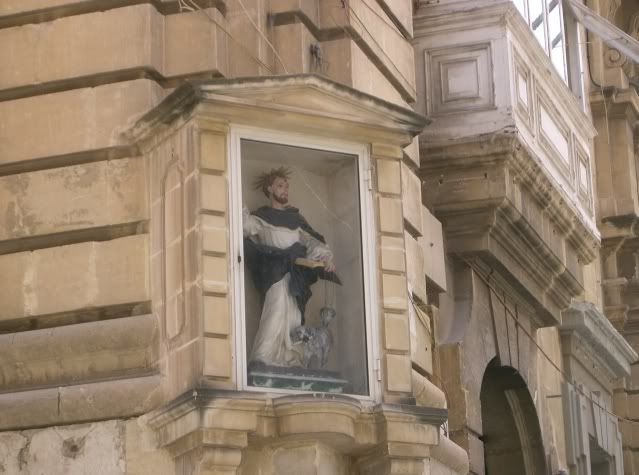
Our Father, Saint DominicFirstly, there’s urgency because there’s a real hunger, and a great need in our world, and yes, in this very city, this parish, today. And when someone is in desperate need, it would be heartless to just dilly-dally. St Dominic saw in his time that people were being misled by all sorts of false ideas that de-humanized them, and denigrated the goodness and holiness of God’s creation. He experienced for himself the real need for well-trained, sound teachers of the Truth, and he saw how desperate people were for the Gospel of Jesus Christ. The Good News, that should be heard, and preached, and experienced by the world as Good News! And I’m sure you’ll agree that there is still the same need today. This is not because the first Black Friars were unsuccessful, but because each age has different challenges, temptations and difficulties, and each generation is called to respond to the needs of the day, and to preach the Word of God in that situation.

In our internet and media-dominated age, we rightly rejoice in the freedom of information, but a lot of that information is also de-formation. Like St Paul in our second reading, St Dominic saw that people just believed what suited their desires. Now that we’re becoming more conscious about healthy eating, and a healthy lifestyle, we know that what we desire is not always what we need. We need to eat well, and choose well; avoid junk food, and choose the healthy alternative. The same is vital not just for our body but for our whole being. We need to be conscious of the ‘healthiness’ of the things we feed our minds; what we read, and see, and the ideas we have. Some ideas, are objectively good and universally true, while other ‘junk’ ideas are ultimately rotten for us as individuals, and as a society. Except that the Gospel is not merely a healthy alternative. It is not an option. The Gospel is the answer to humankind’s needs, to our hunger and restlessness, and our deep longing for love.

So, the need to preach salvation in Jesus Christ is as urgent as ever. For what do we mean when we talk about salvation? The word comes from the Latin ‘salus’ which in day-to-day Latin just means ‘health’. So, our whole being - body and soul - needs to be healthy: our minds are starving for truth, our wounded human nature cries our for healing by God’s love, and our souls yearn for the grace of the living God, who is active in the sacraments. Our generation, here, today, now is being called to share the Good News with our peers, families, friends, colleagues, that Christ is God’s answer to our deepest human needs. The need is great, and if we can perceive this need, how can we be so heartless as to dilly-dally, and not sense the urgency of it?

The answer to the second and third questions - why is there such excitement, and joyful celebration? - is related to this urgency. There’s excitement because although the need is great, the answer is even greater. And those who would preach the Gospel, the labourers in God’s vineyard, know this. They know that God’s grace is powerful and the Truth of the Gospel is beautiful. And they know this because they have experienced it firstly in their own lives. No one recommends a wine without first tasting it himself. So, an effective preacher doesn’t just preach truths about God, but he or she preaches a wine of truth which they have actually savoured themselves, and which they have drunk with living faith and joy. This image of wine and drunkenness was loved by the early Dominicans because they were inebriated by the love of God - by the Eucharist and the Spirit of Pentecost - and so they could not help but rush out to proclaim the Gospel, and Christ’s teachings in the Church, to be Good News.

St Dominic's Priory churchThis excitement and joy, and an awareness of the urgency of the mission is what caused St Dominic to send out his brothers even into hostile territories, “like lambs among wolves”. So they came even here to the limits of Hadrian’s Wall, and then beyond. And these men first walked the streets of Newcastle in their black and white colours with a buzz of excitement, urgency, and resounding shouts of joy. They shouted with joy that God had comforted and redeemed his people in Christ, and that because of Jesus, the kingdom of God, God’s salvation, had come to humanity.

We still shout this out every time we gather for Mass! And by God’s grace, may we also become drunk on the wine of Christ, so that we will follow in the footsteps of our Holy Father Dominic and our ancestors, and each in our own way proclaim the Good News in word and example; in a way that answers the urgent needs of our contemporaries

Wednesday, August 4, 2010

A-Z of the Mass - Jewish Synagogue Worship

When we assist at the Holy Sacrifice of the Mass, it is perhaps, easy to forget how much in our liturgy we draw from our Jewish heritage. Both our buildings and the liturgical functions that we celebrate within them resonate strongly with this heritage. In particular, we see many liturgical similarities between what was known as the Mass of the Catechumens, now known as the Liturgy of the Word, and Jewish synagogue worship. For Jews, as for Catholics, prayer and worship do not necessarily have to take place within a purpose built structure, but these structures represent a good starting point to examine that which best exemplifies the liturgical tradition and function of each faith, providing as they do, a common place of worship where members of each faith may gather in praise of God.

Jewish synagogue worship can be seen to arise in the wake of the Babylonian destruction of the first Temple constructed by Solomon. Though a second and grander construction was built by Herod in the first century, the legacy of the exile remained and the organised worship that had flourished during this period, synagogue worship, became a permanent part of Jewish religious life. Even after the return to Israel this form of ritual worship was enshrined for the simple reason that all could not reach the Temple. The synagogue became the local house of worship and over time many aspects of Jewish liturgical ritual developed and became formalised. Much was naturally modeled on Temple worship, the buildings faced east towards Jerusalem and each contained a Torah Ark. In this the scrolls of the Torah were kept – this was to be reminiscent of the Ark of the Covenant where the Ten Commandments were held in the Holy of Holies, the inner sanctuary of the Tabernacle, in the First Temple. Each synagogue also contained a bimah, a raised platform from which the scriptures were read by those competent to do so and from which teaching and instruction were given. Above all, synagogue worship, in contrast to the sacrificial forms of Temple worship, was characterized by the recitation of prayer, the reading of scripture, and the chanting of the Psalms.

As with worship in the Catholic Church, synagogue customs and traditions varied from place to place though the central tenets and core beliefs remained the same. The Diaspora was at the heart of this variety which ultimately gave rise to the Sephardic and Ashkenazi forms of Judaism. After the destruction of the Second Temple by the Romans, the synagogue, with its didactic rather than sacrificial emphasis, became the central forum of all Jewish worship. Today we can see much of our Christian heritage reflected in the forms of Jewish worship and we hold much in common such as our reverence for scripture as the revealed Word of God. Our differences remain clear but it is important to reflect upon what we have inherited in order to better understand the true significance of that heritage. How else are we truly to understand Christ as the fulfilment of the Old Law, the Mass as a true sacrifice, and the inexhaustible richness of the Eucharist as the very ‘source and summit’ of the Christian life?

Sunday, August 1, 2010

In Case of Heresy Break Glass!


All credit to The Crescat

A-Z of the Mass: Incense

“For it came to pass, when the flame went up towards heaven from off the altar, the angel of the Lord ascended in the flame of the altar” (Judges 13:20).

The burning of incense is rich in symbolism. The above verse from the Book of Judges describes the incident when Samson's father Manoah makes a burnt offering before the angel of the Lord. The angel represents an intermediary function between God and man, and rises up to heaven in flame and smoke. This incident is alluded to in Eucharistic Prayer I when the priest says “Almighty God, we pray that your angel may take this sacrifice to your altar in heaven.” The burning of incense is a symbol of prayer going up to the Lord and being borne before Him by intercessory angels. The smell of incense is pleasing to the Lord and represents the achievement of a peaceful relation between God and man.


In the temple of Solomon, there was an altar in front of the Holy of Holies on which incense was burnt every morning and evening. The incense marked the presence of God. This is also true in the Mass: we acknowledge the presence of God in the incarnate Word proclaimed in the Gospel, the presence of God in the action of the priest, the presence of God in the sanctification of the people, and the presence of God in the Eucharistic species. This is something quite remarkable. In the Old Testament, there is the marvellous saying “What great nation is there that has a god so near to it as the Lord our God is to us, whenever we call upon him?” (Deuteronomy 4:7). How much truer this is for us! The burning of incense represents the fulfilment of the prophecy in the book of Malachi: “From the rising of the sun to its setting my name is great among the nations, and in every place incense is offered to my name and a pure offering; for my name is great among the nations, says the Lord of hosts” (Malachi 1:11).