Showing posts with label sin. Show all posts

Monday, January 27, 2014

St. Thomas Aquinas

St. Thomas, the Angelic Doctor.
Today marks the feast of St Thomas Aquinas, Dominican friar and Doctor of the Church. Born in 1225, St Thomas joined the Order of Preachers at around nineteen or twenty years of age. After a remarkable career of teaching, preaching and indeed writing, St. Thomas died in 1274, asking in death only that he be granted Jesus Himself. Pope Pius XI advised Christians seeking wisdom to “Go to Thomas.” Was this good advice? To find out we shall consider the Angelic Doctor’s thought on a topic that affects every one every day of their life on earth: sin.

Sin is an ever present reality; it is something we just can’t seem to escape. Even the blessed apostle Paul suffered from the thorn of sin. He did the things he hated and did not the things he loved (Romans 7:15). We, like St Paul, often fall short, we fall into situations which stir up in us conflict, by instinct we call this sin, but what exactly is it?


St Thomas identifies sin as an act, willed by a human being, which is contrary to the eternal law. More simply, it could be said a sin occurs when a person chooses, instead of God, some lower good. Sin is what happens when we forget about God, or in the most grievous cases, when we chose to act against Him. Since it is seemingly ever before us, how then, are we to deal with it?

Well, in fact, it is not man who deals with sin, it is God. As Jesus said, He came ‘to give His life as a ransom for many’ (Matt. 20:28). This redemption was achieved on the Cross. Man had isolated himself from God, and was incapable of healing that wound. It was for this reason that the Son became incarnate, by becoming man He could offer to the Father an infinite act of love, which would always be more pleasing to the Father than any sin. St. Thomas demonstrates that Jesus’s sacrifice on the Cross was an act that not only atoned for all man’s failings, but merited for each man salvation. ‘Grace was bestowed upon Christ… the Head of the Church that it might overflow into His members’ (IIIa, q.48 a.1).

The forgiveness of sins comes from Christ’s passion and death, though we continually stumble and even fall, we never lose hope in the infinite merits of our Redeemer, who nailed our sins to his Cross. However, St. Thomas would not want Christian reflection to stop there. The Cross is not only in our past, it is our hope for the future. Thomas remarks that Jesus did not only merit for man salvation, He also offered the perfect example of what it means to be truly human. Sin, Thomas says, is contrary to human nature because it isolates us from our creator, and to know Him and love Him, and to dwell in His love is our purpose. Christ manifested the meaning of our lives through His constant obedience to the Father.

Jesus’s action was our instruction, as the Dominican scholar Torrell puts it. Thus, when we read the words ‘take up your Cross and follow me’ (Matt. 16: 24) we realise this is a genuine invitation. It is an offer, to let our lives be Christianized so that from our flesh might be driven the thorn of sin.

In this context, the value of the sacraments Christ instituted for His Church becomes all the more apparent. When we sin, we turn to God and ask for His forgiveness in the confessional. It is our own Gethsemane moment, a chance to reflect on our sins, and the sins of all, and walk the way of the Cross, the path of humble obedience. Echoing our Lord we have the privilege to say ‘not my will, but yours be done’ (Luke 22:42).
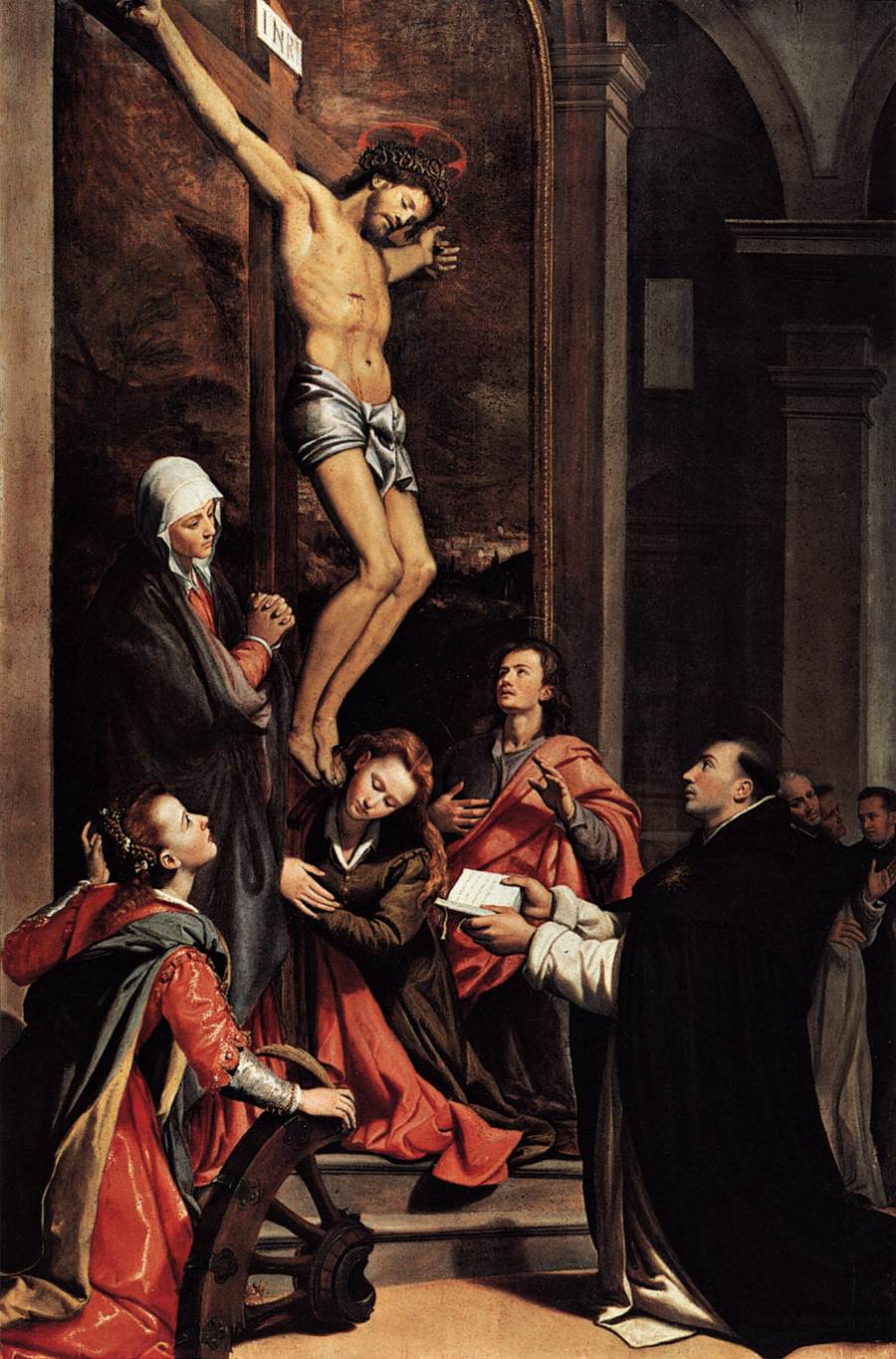

The sacraments, both signposts to Heaven and channels of grace, are in a sense like the footprints of Christ, spread behind and before us. As we trod in them we walk as Christ walked, and we follow him up Calvary to the place where Sin was destroyed and the Resurrection won.

This, I think, would be St. Thomas’s advice for the sinner. Do not fear. For God has sent to us the Redeemer. Let us neither despair of our sins nor boast of our virtues. Rather, let our glory be the Cross. When we can say that, as the apostles did, then we can follow Christ wherever He may lead us. Of course, it isn’t always easy, but that is why we have the Church and her sacraments, and that is above all why Our Lord has made present every day in every part of the world that saving sacrifice, whereby we are fed with His Body and Blood. Salvation has been given us and the bed of Faith made fertile so that grace might abound, all we need do is keep our trust in God and beseech the merits of the Passion.

St. Thomas said all theology was found in the Psalms, well, in times of adversity and doubt we can sing with the psalmist: ‘hope in the Lord, I will praise him still’ and that is the answer to sin. 

Friday, February 24, 2012

Saturday after Ash Wednesday


When reading the Gospel, I often make the mistake of identifying with the one Jesus encourages and praises, and seeing someone else as the one Jesus admonishes and corrects. It is a convenient strategy for glorifying my actions and rationalizing my judgment of others.

Rather than reading the Gospel with a sincere heart, I use the Gospel to support my own decisions. Instead of letting the Word of God form me, I rework the Word of God and gratify myself with my good works. However, when I am humble enough to see myself even in the least appealing Gospel characters, then the Word of God becomes an examination of conscience. I finally listen to what Christ is saying.

Jesus’ call for Levi’s conversion is an example of humble acceptance. Levi invites Jesus to his home for a meal, inviting other tax collectors and sinners. When the Pharisees criticize Jesus, he tells them he came to heal sinners, not the righteous. If we think Jesus is praising anyone in this story, then we need to read it again.

Jesus’ comment could be just as critical of Levi as it is of the Pharisees. Levi and his guests need healing. They are spiritually ill. The Pharisees and scribes, too, are ill. The difference between these two groups is humility. The Pharisees and scribes wonder why Jesus does not call them to follow him as disciples, or why he does not compliment them for their faithful adherence to the Law. In fact, Jesus is not concerned with their outward devotion. He is calling them to the same healing, the same contrition of heart, to which he calls all people. His rebuke of their criticism is not a dismissal. He does not intend to send them away angry. He calls them to recognize their spiritual illness and to return to God in humility. Unlike Levi, they are too proud to admit that they fail to live up to God’s expectations.

Depending on where we are in our conversion, we may assume that Jesus is either calling us to follow Him as a disciple or calling us to healing. This “either/or” mentality creates a false disparity. We all are called to healing…and we all are called to discipleship. One does not necessarily precede or overshadow the other.

Until we enter the Glory of Heaven, we continually have sin or some other weakness in our lives needing God’s healing. No matter how far we travel with the Cross on our shoulders, we are always Jesus’ disciples. We should not think there is a time when we will not need to follow Christ’s examples or not need to ask for God’s healing.

Let us deepen our call to discipleship this Lent. But let us not lose sight of our own weaknesses. Every time we enter the Scriptures, it should be a time with the Divine Physician. Let Him show us were we can grow, and let us accept the grace of His continual healing.

Monday, December 5, 2011

Second Week of Advent - Tuesday: it is not the will of your heavenly Father that one of these little ones be lost.

Readings: Isaiah 40: 1-11; Psalm 95; Matthew 18: 12-14

We grow up as Christians with many images of God (and Christ) that we find in the Gospels and the Epistles relating God to the Church. Some of the most common ones are: the corner stone to the edifice, the vine and its branches and many others. One image of God that people might forget is the one of the Good Shepherd. A good shepherd attends to his flock (as a shepherdess does to hers). The First reading starts by these very encouraging words:”Comfort, give comfort to my people, says your God. Speak tenderly to Jerusalem, and proclaim to her that her service is at an end, her guilt is expiated; Indeed, she has received from the hand of the LORD double for all her sins.” The Gospel is concluded by words even more consoling”…it is not the will of your heavenly Father that one of these little ones be lost.” What marvellous words to listen to during Advent! It is consoling to know that our God loves us and takes care of us. So, we should not fear God. It would be sad to spend our lives living in fear of a God who created us out of love.


Countless people in the Church are afraid of God because they see themselves as nothing else but sinners. This mind-set influences every action they perform. They would spend their entire life seeing sin and punishment everywhere. But as they would not be able to avoid sinning – in my mother tongue Kinyarwanda it is said that a saint sins seven times in one day – they would spend their whole life in terror and self-hatred. They forget that the God who will judge them is also a caring God, full of gentleness towards God’s people, just as a shepherd cares about the flock. Are usually children terrified by the idea that their caring parents are going to punish them? The fear of punishment might even lead to deceit and thus to more sins.


It happens that non-Christians accuse Christians of not being happy people. They experience that terror displayed by some Christians and rightfully make their conclusions. This is because some Christians expect the king who is to come to be merciless. Today’s readings remind us that our King is a Good Shepherd and is different from others kings. “That imagery [of kingship] is meant to keep the human kings in check” (Schneiders, S. God is more than two men and a bird. US Catholic, May 1990. 20, 22-27. p. 23). Christ who is being born on Christmas is gentle and humble. He chose to be born among sinners because he knew they needed someone to help them live their lives with the joy of knowing that he understands their limitations. That is why he gave us the image of a gentle and caring shepherd, who goes to look for the stray sheep.

Today, let us pray that we may understand that God is Love and that our lives are not a difficult course created by God to test our fidelity. May Christ, our expected king, bring us that hope and happiness he used to give to all those who met him.

And as we celebrate St Nicholas today, I would like to wish a happy feast to our brother Nicholas Crowe OP. May he continue to be inspired by the humble and generous saint.