Showing posts with label Women in the OT. Show all posts

Thursday, September 27, 2012

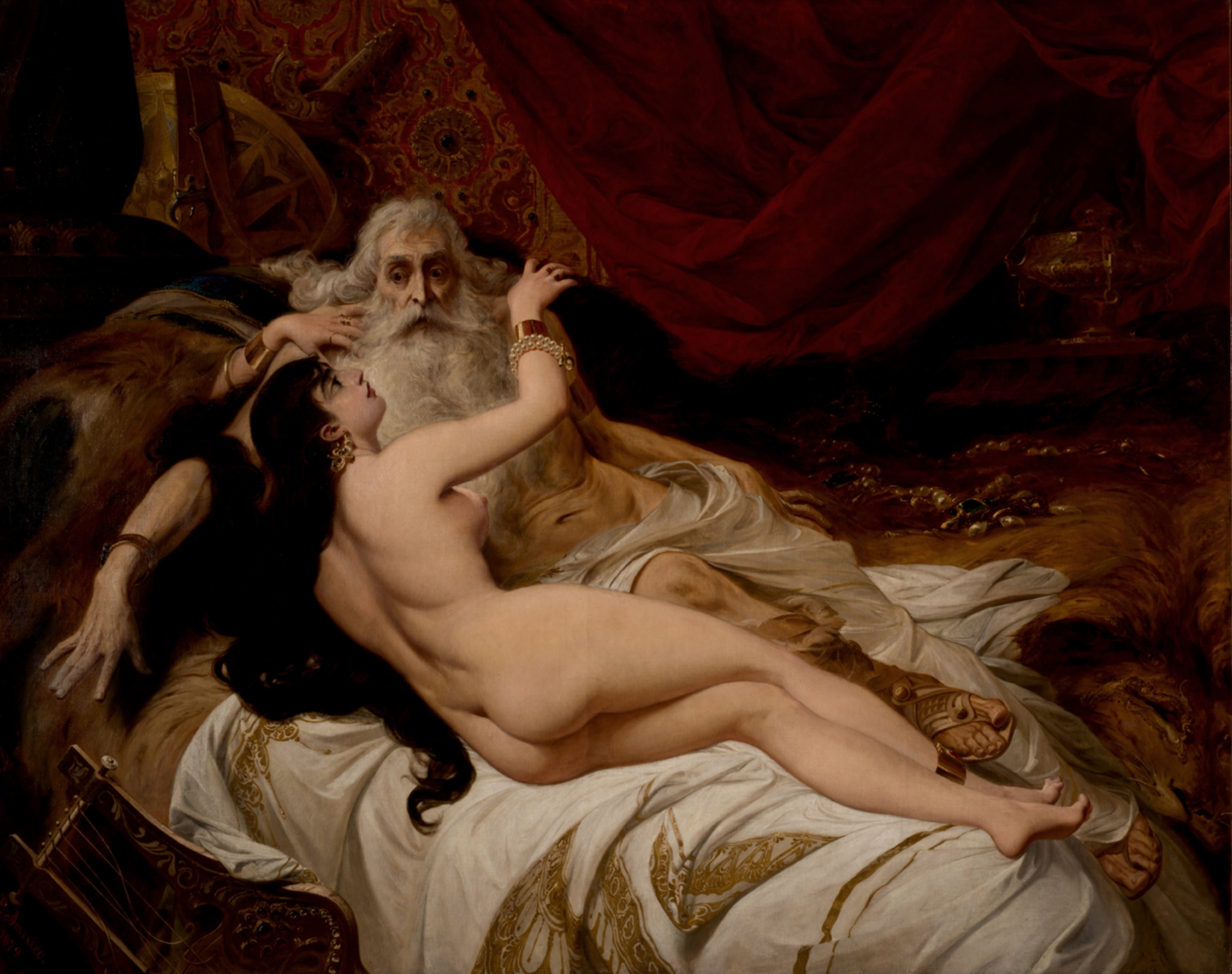
Susannah

Daniel 13:1-64. 

The account of Susannah has an unusual textual history. Although we now only have it in Greek versions of Daniel, the original may have been in Hebrew, but if so it was cut from the final version of the Hebrew text, fixed perhaps in the years after the emergence of Christianity. The Septuagint (LXX) canon, ie the Greek language canon – the one New Testament writers typically draw on – determined the Catholic Old Testament canon, one rejected by the Protestants, in favour of the Hebrew canon which in the case of Daniel stops at ch 12. Daniel 13 is highly unusual in that the text that was reproduced in most manuscripts and so the popular one came from a third century figure, Theodotion, and it is longer and more vivid than the LXX text, but tells the same story. Most Bibles translate the longer version. 

Although it is set in the events of the Babylonian exile of the 6th century BC, there are very good reasons for placing the writing of the Book of Daniel during the vicious persecution of Jews by Antiochus Epiphanes IV between the years 167-164 BC. It is thus a late text. It portrays characters who are true to their Jewish faith and trust in God, despite false accusations and real threats of death, and whom God vindicates. It expresses a conviction about God’s transcendence and foreknowledge and so God’s control of history, notwithstanding human freedom. In this way it encourages God’s people to keep faith, despite what is going on around them, and even to be willing to die than abandon God and his ethical and religious demands. It exhorts and inspires them to look to God for deliverance. We see all these themes in the story of Susannah, a story also designed to tell us about the youth of Daniel and of his wisdom and righteousness.

Susannah is a beautiful but very virtuous and pious Jew, married, with a family, and of high standing in society. Two Jewish elders lust after her. When they know that she is alone bathing in a garden, and thus has no witness to defend her, they demand that she sleep with them, making it clear to her that if she refuses they will have her condemned for adultery, since they will accuse her falsely of sleeping with a young man who escaped but whose sexual relations with Susannah they witnessed and interrupted. Susannah decides to accept death (the penalty for adultery) rather than sin in the eyes of the Lord by having sex with them. But she appeals to God in prayer, giving a loud shout (vv 23-24). Since they are elders in good public standing, she is duly condemned, not attempting a defence, but confidently turning to God (v 35). After her condemnation she prays more explicitly, protesting her innocence to God and putting her faith in God who knows all things before they happen, accepting death, but protesting her innocence and making clear that false evidence has been given (vv 41-43). Then the young Daniel intervenes, having first dissociated himself from the judgement of guilt. He interviews each elder, traps them and exposes their testimony as false. Susannah is set free and the elders are executed, and the people gave thanks that the life of the innocent Susannah had been spared.

The text was much commented on, not least in the early Christian centuries. In this context of persecution and in the original Jewish one of persecution, the character of Susannah shows the reader how one is to present oneself when attempts are made to force one to deny one's faith and also its moral requirements, and how to deal with false accusation and when faced with death. Not even care and concern for one’s family – Susannah was a wife and mother – permits one to deny God in any way. Susannah models trust in God and the conviction that God will vindicate his faithful, whether in this life or eternity (another theme in the book of Daniel). She thus models how to be a witness and, if the situation requires it, how to be its fullest expression, a martyr. She was thus a figure to help God’s people face persecution and be faithful in it.

Susannah, whose name means ‘lily’, is a model of sexual purity, in the married form. Since such married sexual fidelity was seen in the Old Testament as an expression of God’s covenant with his people, and their breaking it portrayed as sexual infidelity, it has been suggested that the story of Susannah was also seen as an allegory of the importance of wider religious fidelity to God, with the added warning that temptation can come from people or religions that appear upright at first (the corrupt elders). In the early Church Susannah was seen as a model of the persecuted Church. She is a very apt model for the virgin martyrs in particular, of whom there were many.

But she was also seen as a type of Jesus himself. Both were arrested in a garden. Both were falsely accused. Both were put on trial (twice). Neither of them really gave evidence in their own defence. Rather they both trusted in God, and each is recorded as praying to God for vindication. Up to 30 similarities have been noted, including verbal ones. The parallels are closest in Matthew’s Gospel and it has been suggested that Matthew actually used the story of Susannah to structure his passion account. Whether this is true or not, Susannah may well be the first woman to be explicitly recognised as a type of Christ.

This Christocentric note may well be an appropriate point on which to end a series on Old Testament women. All of the Old Testament looks forward to its fulfilment in Jesus. The grace given to all the people we have looked at came from him. In his blood their errors can be forgiven. It is the life of Jesus, supported by that of Mary, that casts full light on their significance, interpreting them most fully and truly, and in whose life that their virtues, faith, hope, love and prayers come to fullest meaning and focus.

Monday, September 24, 2012

Women of the OT: The Bride in the Song of Songs

The Song of Songs – a Hebrew idiom meaning 'the greatest song' – is one of the most intriguing books in the Old Testament. There is little scholarly consensus regarding its authorship, date, and structure. At one end, some argue its eight short chapters form a narrative unity; others claim to discern up to eighty separate sources. Certainly, the book seems fragmentary, even fitful, but that is perhaps fitting to its alluring subject: sexual love. Against many protests – owing to the book's sensuous themes and lack of mention of God – both Synagogue and Church incorporated this book into their Scriptures, on the grounds of tradition, and it even became one of the five megilloth (scrolls) read publicly at great feasts: the Song of Songs at Passover, thereby coinciding with the Christian celebration of Our Lord's sacrifice at Calvary.


The book consists in a dialogue between a male 'Lover' and a female 'Beloved', interspersed with a Chorus of the 'Daughters of Jerusalem'. The Beloved, the Bride, is identified by the Chorus as 'the girl of Shulam' (7:1), which could refer to Abishag of Shunem or indicate 'she who belongs to Solomon'. Indeed, the Lover is called 'king' (1:4, 12) and then clearly revealed as 'Solomon' (3:7, 9, 11). Interestingly, the word for Beloved, ra 'yati – variously translated as 'my darling', 'my love', or 'sweetheart' – occurs nine times in the Song but nowhere else in the Bible.


The exact identity of this woman of Shulam will remain mysterious, but that does not prevent us going deeper into the message of the Song. In a literal-historical analysis, the Song is simply about the delight of two lovers in each other's presence, including their physical union. It employs evocative metaphors to describe physical beauty, both male (5:10-16) and female (4:1-7; 6:4-7; 7:1-6): gazelles, doves, sheep, pomegranates, etc. The Bride describes herself as 'black but beautiful...as the tents of Kedar, as the curtains of Solomon' (1:5), her sunburnt complexion the result of hard work in the fields (1:6). To a modern non-rural readership, these descriptions may seem exotic and unfamiliar, but the comparison of the Bride's hair to 'a flock of goats surging down Mount Gilead' would probably resonate with some modern advertisers!

So, this glorification of sex is full of earthy realism and steers a middle ground between two extremes. On the one hand, there have been cultures and communities throughout history that have denigrated sex, even to the point of declaring it evil. Of course, it was to combat this Manichaean idea that the material world (therefore, sex) is evil that St Dominic founded our Order of Preachers; and the Song is unambiguous scriptural vindication of the true Catholic position. On the other hand, ancient Israel was surrounded by fertility cults that divinised sex, with elaborate mythologies about God having a consort. The Jewish tradition firmly rejected these cultic ideas and instead praised earthly realities for what they are: very good things that God has given to us, to be enjoyed in their proper context (cf. Gen. 2-3). The goodness of sexual companionship in marriage is matched by fertility, evoked by 'mandrakes': 'I shall give you the gift of my love' (7:13-14), which could be the gift of offspring.

Nevertheless, spousal love does have a valid religious interpretation beyond the purely physical. The Bride sings that 'Love is strong as death...Many waters cannot quench Love, neither can the floods drown it' (8:6-7). The triumph of Love opens up questions about the divine power which can save us from that ultimate enemy, which is Death. Quite naturally, then, allegorical interpretations began to identify the Lover and Beloved with God and his People (for the Jews), or (for Christians) Christ and his Church or Christ and the individual soul. Following the prophetic tradition of Hosea and Malachi (Mal. 2:14), and St Paul's teaching on the Church (Eph. 5:25-32), Hippolytus, Origen and the Fathers explored this loving covenant relationship through the tender images of the Song. This tradition reached its apogee in St Bernard's sermons. Bernard emphasises that Love is the only way to God, a path that is both affective and ascetic. The 'kisses' of the Bride and Groom are compared to kisses on Christ's feet, hands and mouth, which represent the three stages of mystical union with the Divine: purgative, illuminative and unitive.

It's true that the allegorical interpretations can be excessively far-fetched and may detract from the vivid realism of the literal text. But neither should we simply wallow in this love poetry without opening our hearts to what it teaches us about God, who is the God of Love (1 Jn. 4:8). In his beautiful encyclical, God is Love, Pope Benedict XVI points out (§6) that the Song begins using a word for an insecure, 'searching' kind of love (dodim) and moves on to the love that is a discovery of the other and a gift of self (ahabĂ , or agape in Greek). This love is tender, it delights in the other and creates a true harmony of persons. As Benedict says, 'Love now becomes concern and care for the other. No longer is it self-seeking, a sinking in the intoxication of happiness [as the Bride cries, 'I am sick with love!' (5:8)]; instead it seeks the good of the beloved: it becomes renunciation and it is ready, and even willing, for sacrifice.'

This beautiful communion of two self-giving persons in marriage is indeed a fitting reflection of God's love for us – and what our love for God should be. As St Paul writes, 'He who is united to the Lord becomes one spirit with him' (1 Cor. 6:17). The Christian mystics are right to say that marital and sexual bliss, so wonderful in itself, pales in comparison to the glorious union that the redeemed enjoy with God in heaven.


'The Voice of the Beloved', from Daniel-Lesur's haunting evocation of The Song of Songs

Monday, September 17, 2012

Women of the OT: Queen Esther

Queen Esther by Edwin Long in 1878
When we talk about Esther in the Book of Esther, we can’t ignore many other characters in the book as they seem to play roles almost as  important as hers. The hero of the Book of Esther is a Jewish woman who lived in Susa and became queen when she was chosen to be the wife of King Xerxes (Ahasuerus) of Media and Persia. During a banquet of six months, when the Queen Vashti refused to appear into the presence of King Xerxes (Ahasuerus) wearing the royal crown, the king, advised by his ‘wise men’ in the council, decided to depose her and to choose another queen, a much more beautiful woman, a virgin young woman! Esther was chosen.


In the beginning, the personality of Esther does not count that much; her uncle and adoptive father Mordecai is the one who is mentioned as a prominent servant at the king’s court. When he discovered a plot of two eunuchs to kill the king, he informed him and he was rewarded. Later Esther was chosen among other beautiful virgins – as she was beautifully formed and lovely to behold (Esther 2:7) – to replace Vashti who had disobeyed to the king’s orders. The king also raised Haman the Agagite above all the other fellow officials. Later, Haman and Mordecai did not get along and a serious conflict arose between them.

The Book of Esther presents two causes of the conflict between Mordecai and Haman: in Chapter A:17 (Prologue to the Book of Esther) we read that Haman wanted to harm Mordecai because of the two eunuchs the latter had accused before the king and the beginning of chapter 3 of the same book informs us that it was due to the fact that Mordecai refused to kneel and bow down to Haman. Haman decided to exterminate the Jews. Esther, helped by her uncle, manages to inform the king of Haman's wicked plans, and Haman and those who had joined him in his wicked plans are the ones to be exterminated. Nowadays, a holiday called Purim commemorates that event and it has very ‘happy’ celebrations, including sharing food, dressing up as for a carnival and… burning the images of Haman! Actually, the aim of the whole book seems to be the explanation of the origins of that feast which might in fact have more pagan origins than Jewish ones.


Queen Esther and Mordecai by Lilian Broca.
An important point is to be raised: the King who ordered the execution of Haman could not completely reverse the first decree to exterminate the Jews: he just gave them his support by a parallel decree, ‘drafted by Mordecai’, which allowed them to defend themselves because “whatever [was] written in the name of the king and sealed with the royal signet ring [could not] be revoked.” (Esther 8:8). In the end, the role of Esther, helped by the God of her community, seems to have been to bring the king and his governor to her side, the Jewish people.


Another side of Esther’s personality is that she represents people who, despite being far from their homelands – refugees, captives and others – manage to overcome their condition and become part of the host society and sometimes enter its leadership. Esther also has inspired the Jewish community which has been threatened throughout centuries in many places like Europe in the Middle Ages and during the Second World War and in today’s Middle East. Many are Jews who saw Esther story as a sign that God is always on their side in their conflicts against other nations.

In the same way that I strongly believe that Scripture tells us what is good and advisable to be done, it also presents examples of actions and reactions that might not be pleasing in the eyes of God. If it is written that the Jewish community in the kingdom of Media and Persia took revenge by killing those who wished to wipe them from the surface of the earth – or probably of Persia – it gives us at the same time an occasion to consider doing better than them. That is why we could not read the story of Esther and apply it to our lives leaving out the rest of the Holy Scriptures. In these days, as both nations, Israel and Iran (which was part and centre of the Persian empire), tend to settle on unsympathetic relations and belligerent moods, the story of Esther might not encourage in the resolution of the conflict. The Book of Esther thus reminds us that we should pray so that it does not end in blood as it is described in Esther's story.

The role played by Esther seems to be that she tried to always seduce the king by her unbelievable beauty any time she appear before him. Seduction appears to be her strength throughout the whole story. Her uncle Mordecai knew about that advantage and he encouraged her to appear before the king. However, she is also portrayed as a prayerful and courageous woman, who took the risk, first of all of appearing before the king without permission, and of revealing her race to the king, knowing that she could be killed. Carey A. Moore, in his contribution to the Anchor Bible series, wrote a book with the title Esther. In his comments, he wrote that “[h]aving carefully prepared herself spiritually (1v 16) and physically (v 1) for her ordeal, Esther now stood radiant, but nonetheless unsummoned, in the inner court before the king. The magic of her beauty, which had captivated the king from the very beginning (v 17), apparently saved her, although according to Addition D 8 God was responsible.” (1971:57). Esther’s beauty tells us that, God is the creator of beauty and beauty is a good thing. This tells us God endows with various and different gifts. But those do not suffice without God's help and we always need to turn to God in order to be able to use fruitfully those gifts.

Friday, September 14, 2012

Women of the OT: Queen Vashti


Found at the beginning of the Book of Esther, the story of Queen Vashti has largely been overshadowed by the more prominent queen after whom the book is named. Many would see her as a figure whose purpose is to ‘pave the way’ for Esther but the manner in which she does this has caused no little controversy among commentators. Vashti is a heroine to some and a disobedient villain to others.

Vashti is the queen of the all powerful King of Media and Persia, Ahasuerus, and we meet her at the close of a great and opulent festival which lasts for six months. The festival allowed the King to show, “the riches of his royal glory and the splendour and pomp of his majesty”, (Esther 1:4) and was for the enjoyment of his princes, nobles, governors and army chiefs and their staffs. The festival ends with a final banquet lasting seven days; “royal wine was lavished according to the bounty of the king.” (Esther 1:7) No ‘austerity measures’ there. In addition, Queen Vashti also held a “banquet for the women of the palace.” (Esther 1:9) On the last day the king sent for Vashti whilst he was ‘merry with wine’, requesting that she appear before the court, “with her royal crown, in order to show the peoples and the princes her beauty; for she was fair to behold.” (Esther 1:11) Vashti refused the king’s command and the king was, “enraged and his anger burned within him.” (Esther 1:12)

We are not explicitly given Vashti’s reasons for refusing the king’s request and opinion is divided on both her reasoning and whether she acted fittingly as queen. Of course, she could have been simply trying the patience of the king, testing his authority; on the other hand she could have considered his request to have been vulgar, distasteful and demeaning. There is the question then as to whether her refusal was fitting even if her stance was fortified by moral principle. Should the duty of obedience to the king go before principled moral action? We can see many parallels here to situations that may arise in our own lives and opinion will always be divided.

The king, in his anger and aided by his officials, determines that Vashti shall be replaced by another; not least for fear that her behaviour will cause other women to revolt against their husbands and masters. Letters were sent to every province, “that every man be lord in his own house.” (Esther 1:22) It is probably fair to say that Vashti was not surprised by this outcome and that she placed her own principles of decency and morality above that of obedience to husband and king. We read at the beginning of chapter two that the king, “remembered Vashti and what she had done and what had been decreed against her.” (Esther 2:1) One may surmise that after his anger abated and his decision had been decreed he mused on this episode with the utmost seriousness. He does not exactly declare his culpability in the matter, and he could not undo what had been done, but we certainly find no mention of any similar episode with his next queen Esther. In fact far from that we read that he treats her seriously and with kindness and concern; indeed, he offers to grant her ‘half his kingdom’.

Monday, September 10, 2012

Women of the Old Testament: Judith

The book of Judith is a carefully crafted work that combines a good story with a powerful theological punch. The opening chapters set the scene: King Nebuchadnezzar of Nineveh and Assyria determines to punish the vassal states on his western border after they fail to send soldiers to support him in his war against King Arphaxad. He orders his General Holofernes to take his huge army and go and plunder the cities of Syria, Moab, Ammon, Judea, and Egypt, expunging the local religions as he goes so that all might worship Nebuchadnezzar as a god. Holofernes obeys and sweeps all before him until he reaches the borders of Judah. Here, to his surprise, he finds that the House of Israel has mobilized for war. The Jews, we are told, had only recently returned from exile and were determined that the temple of God should not be desecrated again. They fortified the hill villages and the narrow passes through which the invaders must pass, and then by prayer and fasting implored God to come to their aid. 

Before commencing his attack, Holofernes decides to seek the advice of Israel’s neighbours, all of whom have already surrendered to him. Achior the Ammonite briefly outlines the history of Israel, the people of God, and concludes that if Israel has been faithful to God’s commands then any attempt to conquer that land will fail. God, Achior claims, will protect his people. If, however, Israel has sinned and followed false gods, then God will allow them to fall into the hands of their enemies. Holofernes himself will to some extent become an instrument of God’s vengeance. The dramatic tension is thus established: has Israel been faithful? Will God protect or condemn his people? (Judith 5: 20-21). 

Holofernes has no time for Achior’s advice and lays siege to Bethulia, a city on top of a mountain that if captured would allow easy access to Jerusalem, the Israelite capital and the location of the temple. After 34 days Bethulia began to run out of water and the desperate populace begged Uzziah, who ruled the city, to surrender lest they be forced to watch their own children die of thirst. Thus far Uzziah’s decision making has been impeccable. He has acted prudently by human standards by fortifying the strategically important hill country, and he has commended both himself and his people to God in his prayer. Yet even Uzziah’s faith is running low: Give God five more days, he tells the people, and if he has not acted in this time then we will surrender (Judith 7: 30-31). Uzziah, it seems, is not prepared to trust in God to the bitter end. When the suffering becomes too great he will take his chances with Holofernes. 

At this point we are introduced to the very beautiful and virtuous widow Judith. Before continuing his narrative, the author takes great care to inform his reader that Judith is both prudent of heart and discerning in judgement. This is significant as it highlights the contrast between the worldly wisdom of Uzziah which is willing to contemplate surrender, to the faith filled wisdom of Judith who will trust until death. Judith rebukes Uzziah and the elders for caving in to the peoples weakness by setting God a deadline. This, she claims, is to put God to the test. The truth of the matter, according to Judith, is that God is putting Israel to the test so that the nation’s faithfulness might be made manifest. In other words, just as Abraham was asked to sacrifice his son Isaac, Israel is being asked to sacrifice her very existence. Judith is confident that Israel will be redeemed just as, ultimately, Isaac was redeemed and a ram died in his place. The wisdom, the prudence, of Judith is to view the sufferings of this life against the horizon of God’s fidelity and his promises. 

Uzziah accepts the rebuke, but points out that he has already given the people his promise and so God must act soon. Judith therefore comes up with a plan. She makes herself beautiful (the vulgate suggests that because her motives were pure, God even added to her beauty), left the city with Uzziah’s blessing and made her way to the enemy camp. After persuading the amorous Holofernes that she was a defector and gaining the General’s trust, she eventually finds herself alone in his tent while the great man lay on his bed ‘overcome’ with wine. With two blows from Holofernes’ own sword, she cut off his head and escaped with her maid back to the Israelite city. The next day the Israelite army came out of the city to attack and the Assyrian’s discovered that their leader was dead. In panic the Assyrians fled, pursued by the Israelites who plundered their camp.  After this there was peace in Israel until Judith's death many years later.

Beneath the pacy narrative of the book of Judith there is, then, a subtle reflection on the fidelity of God to his promises and the role that trials and sufferings play in both purifying and manifesting our faith. There is also a reflection on the nature of true wisdom and this, perhaps, is the key to unlocking the somewhat unusual conclusion to this work. The Old Testament typically associates an abundance of offspring as a blessing from God, indeed, to be a childless is usually presented as something of a curse. Yet the wise and beautiful Judith seems to be childless and, despite having many potential suitors, she chooses not to remarry. Instead, as an old woman, she set her maid free and distributes her wealth to her kinsman and her dead husband’s kinsman. Judith, it seems, died with nothing but her hope and trust in God. We seem to have in Judith, then, an anticipation of the celibate widows of early Christianity who devoted themselves to prayer and good works. These widows of the early Church were themselves an embryonic expression of what would become known as the religious life, that is, the life of monks, nuns, friars, sisters etc, the life of poverty, chastity and obedience. The author of the book of Judith may then be making a similar point to St. Paul in the first letter to the Corinthians (1:23). Total dedication and fidelity to God may look like foolishness by worldly standards, but viewed against an eternal horizon, it is the only rational way to live.

Wednesday, September 5, 2012

Women of the OT: Sarah, the Daughter of Raguel

The Book of Tobit is not one of the best known books of the Bible, not least, I suppose, because it is not found in the Hebrew canon and therefore not recognised as Scripture by Protestants. Thus, not so many people, perhaps, have heard of Sarah, the daughter of Raguel, as of some of the other women we have looked at in our series so far.

In fact, though, Sarah plays a central role in the story related in the book, which relates something of God’s providence, as well as helping us think about the question of suffering, a little like the book of Job.

Sarah is Raguel’s only child, and has been married seven times, but on each occasion her husband died on their very wedding day. The distress this obviously causes her is only made worse by the abuse she suffers from her fathers’ maids, who accuse her of killing them all. This is how she is first presented to us in the book, intending to kill herself because she can’t bear it any more (Tob 3: 7-10).

Instead, though, she decides to pray to God: she stills sees no way out of her situation other than death, which is what she asks the Lord for, but for her father’s sake she at least doesn’t take her own life.


This prayer of Sarah’s in fact takes place at the same time as the prayer of Tobit, who is also in great suffering and also asks for his life to be ended: instead, these two seemingly unrelated situations both end up being solved when Tobit’s son Tobias, seeking to restore his family’s fortunes by reclaiming some of his father’s money, ends up marrying Sarah (and surviving), as well as finding the way to heal the blindness with which his father has been afflicted.


Sarah’s terrible experience of the loss of seven husbands is not, and cannot be fully explained – though it’s attribution to the demon Asmodeus affirms that it really is an example of evil in the world, and doesn’t merely seem to be bad. On the other hand, the joint solution of Sarah’s and Tobit’s problems gives us a glimpse of one tiny aspect of the workings of God’s Providence, showing how he can draw good out of seemingly terrible situations. Sarah’s prayer in her distress is not exactly the height of piety – it’s near desperation, and concern for her father, rather than high religious sentiment that brings her to turn to the Lord – but even so, that desperate cry for help finds an answer she could hardly have dreamt of, and reminds us too of the value of prayer, however imperfect it might seem.

Sunday, September 2, 2012

The Queen of Sheba

1 Kings 10:1-13.

The visit of the Queen of Sheba from afar to King Solomon to hear his wisdom has been made very well known by the use that Jesus made of it (Mt 12:42 & Lk 11:31). Sheba is mentioned rarely in the Bible, indicating it was on the extreme age of the area that with which the Jews had contact.

The original journey and meeting of the two leaders was, it seems, made for pragmatic earthly reasons – but the Oriental and Jewish understanding of wisdom covers, and is probably rooted, in such pragmatic good sense. It was a meeting of two leaders and their retinues to come to a trade agreement. We have just been told that Solomon, in whose reign Israel reached its maximum size, controlled the land at the head of the Red Sea (1 Kings 9:26-28). He equipped a fleet there and had a lot of influence on trade routes that passed through or near his expanded territory. The exact location of Sheba is disputed but it is most probably in Arabia. It presumably made use of the Red Sea and other trading routes that Solomon controlled. It was beholden on other states and traders to make trading arrangements with him for the good of their own exports and wider economies. Such meetings involved impressing each other with the quality of one’s court, and exchanging gifts, all of which happens in 1 Kings 10:1-13, but a deal also had to be struck. Part of this involved asking policy questions, listening to an assessment of political and economic issues: raising such issues would certainly be included in the ‘difficult questions’ and other ‘things on her mind’ in our text. She, and her officials, may also have asked ‘obscure riddles’ as this was part of Oriental diplomacy in this period. A king was a judge and expected to be wise, and in many cultures was seen as an instrument of divine teaching, even perhaps of divine revelation. As well as testing his political, economic and practical wisdom, these more obscure puzzles gave further indication of a king’s intelligence and wisdom. The Queen was impressed on all fronts - he literally took her breath away - and made a deal with Solomon. It appears that he got huge payments (as the more powerful monarch - v 10) but she got what she wanted in trade terms too (v 13). The passage and this principal reading of it make good sense of its location amidst other passages about the trade expansion and riches of Solomon.

The story tells us other things too. It is interesting that a woman ruled a kingdom, something unusual in that period, though not unheard of in parts of Arabia. She was not a Jew. Her comments to Solomon show her to be remarkably familiar, for a foreigner, with aspects of the Jewish religious view and its view of the purpose of kingship (v 9). She notes both that is a result of Yahweh’s favour and everlasting love that Solomon reigns and importantly she stresses that he has been made king to minister justice and righteousness. These are the key principles of the covenant and of his role within it especially in the Deuteronomistic understanding of it. Prophets often insisted upon them and kings in general neglected them.

Her mention of them is impressive and perhaps ironic, given the narrative development. The very next chapter tells of the fall of Solomon. He is enticed by the religion of foreign women. It is also clear that he exploited his people to make his court as impressive as it was. One is left wondering if the Queen of Sheba sensed the dangers and was giving him a hint, put in a diplomatically wise and subtle way, to be careful. Certainly she did him no harm, unlike these other women, and may have had a truer grasp of the heart of divine wisdom than Solomon, at least as he deteriorated in his later years. All this makes her an impressive figure, one to be commended, and not just for going to such efforts to listen to wisdom.

Jesus himself commends her: the people of his own day are more interested in seeing signs than hearing wisdom, a fact made more shocking by the superiority of the wisdom of Jesus over that of Solomon. Not only does the Queen of Sheba put them to shame: Jesus says she is competent to judge them. High praise indeed and perhaps indicative that she did see the flaws in the attitudes and policies of Solomon. At any rate she not only listened to and recognised wisdom: she had wisdom.

Wednesday, August 29, 2012

Women of the OT: Abishag the Shunammite

Abishag the Shunammite makes her appearance in the twilight years of King David’s life: a young woman, she cherishes and serves the dying King, whose enfeebled condition - lying in bed, unable to get warm, and surely close to death - contrasts with the beauty and energy of the youthful virgin. Somewhat passively (and no doubt with considerable horror), Abishag finds herself caught up in the royal politics concerning succession. The heir-apparent to the throne, Adonijah, David’s eldest remaining son after the deaths of Absalom and Amnon, inappropriately attempts to seize power from the weakened King, and is ultimately passed over in favour of the younger Solomon. After Solomon’s accession, a smarting Adonijah asks for Abishag’s hand in marriage. Bathsheba, the Queen Mother, intercedes for him with the King, but Solomon responds by having Adonijah put to death. 

At first glance, we might feel rather sorry for Adonijah. Abishag is, after all, a woman whose beauty is renowned throughout the land, and it seems quite natural that Adonijah - who has lost his inheritance - would want her hand in marriage. The earlier story of Absalom’s rebellion (2 Samuel 16:21-22), however, reveals the true nature of Adonijah’s request: the ‘possession’ of the royal harem was an oblique claim to the Davidic throne, and thus an act of treason against Solomon, and of blasphemy against the will of God expressed through the prophet Nathan. It is interesting to speculate why Bathsheba was apparently willing to make intercession for Adonijah, despite the insult it implied to her son the King. One theory could suggest tension in the royal harem between the Queen Mother Bathsheba and Haggith, the mother of Adonijah. Haggith too would have lost considerable status as a result of her son’s folly. There is, however, no evidence within the text that Haggith is involved in any way in Adonijah’s rather inept political manoeuvring. 

Abishag’s story is written in few words, but it is easy to imagine that she would have been a very significant figure in the last days of David’s reign. Conscious of this, some readers have sought to extend her role beyond where she is explicitly mentioned, finding her as the one beloved by Solomon in the Song of Songs (1:5, 6:13). The story of a May-December romance, of a beautiful young woman caught up in the politics of an Ancient monarchy, ending in the death of her hapless suitor, has of course excited writers of fiction over the centuries. Perhaps we can even see a reflection of Abishag, the jilted virginal bride, in Miss Havisham of Charles Dickens’ Great Expectations. These fictional expansions should not be allowed to detract, however, from the very human and personal relationship that Abishag shared with David. Perhaps what makes her most extraordinary is also that which makes her profoundly ordinary: that she loves, that she cherishes and that she serves a fellow human being in his time of profound need. We do not have to look to the ancient world to see such extraordinary lives of heroic charity: a brief glance around the pews of our Churches will no doubt reveal many such ‘hidden’ saints.

Sunday, August 26, 2012

Women of the Old Testament: Bathsheba

Bathsheba ('daughter of the oath') is one of only five women to be mentioned, albeit indirectly as 'the wife of Uriah', in St Matthew's genealogy of Jesus (Mt 1:6). As a wife of King David and mother of King Solomon, Bathsheba is a direct ancestor of Our Lord. She thus holds a unique place in Israel's history, which is the history of our salvation. The story of David and Bathsheba teaches us about the importance of right conduct, how the Lord is displeased with sin, and how we suffer as a result of our own sin and folly.


Yet Bathsheba, in the Old Testament as in the Gospel genealogy, seems to have a largely indirect role and could easily be overlooked as a passive victim. Her story is principally related in 2 Samuel 11 and is not a happy episode. King David is lazing at the palace, instead of leading his soldiers in the war against the Ammonites, when he spies from his roof a very beautiful woman bathing. He lusts after her, despite learning that she is Bathsheba, the wife of Uriah the Hittite, a brave and loyal soldier. David nevertheless calls her, seduces (or rapes) her, and she becomes pregnant. David is unable to cover up his adultery, since Uriah honourably refuses to lie with his wife during the campaign season, and the king resorts to murder: he ensures that Uriah is placed in the front of the battle line, and thus gets him killed (2 Sam. 11:14-17). Finally, David takes Bathsheba as (another) wife.


But David's wicked actions displease the Lord, who is the God of righteousness. Nathan the prophet speaks God's word of rebuke to David, and the king is full of remorse. This is the moment immortalised in the soulful words of Psalm 50 (51), the Miserere Mei, famously set to the beautiful music of Allegri (video below), as David acknowledges his sin before God and begs for forgiveness. Although this repentance is met with God's forgiveness, David has already set in motion a chain of events that will overtake him. Having raised the sword against Uriah, David receives Nathan's prophecy: 'therefore the sword shall never depart from your house, because you have despised Me, and have taken the wife of Uriah the Hittite to be your wife' (2 Sam 12:10). David now becomes the victim in the story - the victim of his own sin. His child from the adulterous relationship with Bathsheba dies. Later one of his own sons, Absalom, will indeed raise the sword against him, in a conspiracy that leads to civil war (2 Sam. 15-20). Absalom even sleeps publicly with David's concubines to shame him, as he had shamed Bathsheba and Uriah (2 Sam. 16:22).


It is David who plays the central role in all of this; Bathsheba is but a victim on the sidelines. Although we're not told whether she refuses and rebukes David, as the lust of Amnon is explicitly refused by his sister Tamar (2 Sam. 13:12-14), we can probably assume that Bathsheba is as blameless as Tamar, as much an upright woman as her husband, Uriah, is an upright man.

It is only in David's old age that Bathsheba seems to come into her own. She had given birth to four other sons - Solomon, Shammua, Shobab and Nathan - and now she takes the initiative to secure Solomon's accession to the throne (1 Kg 1:11-31). Bathsheba's evident resolve and faithful commitment, as both wife and mother, indicate that throughout these narratives she maintains her dignity and uprightness. As a result, she truly deserves her place in Our Lord's genealogy.


Monday, August 20, 2012

Women of the Old Testament: Hannah


The story of Hannah, found in the first book of Samuel, is both moving and inspiring. The wife of Elkanah, Hannah is forced to endure the humiliation of being unable to bear him a child. Added to this shame, Hannah also has to endure the ridicule of Peninnah, Elkanah’s other wife, with whom he has had children. “So it went on year after year; as often as she went up to the house of the Lord, she used to provoke her.” (1 Samuel 1:7) Yet Elkanah would seem to have been a good and loving husband; he said to her, “Hannah why do you weep? And why do you not eat? And why is your heart sad? Am I not more to you than ten sons?”


On one of their yearly visits to the Sanctuary at Shiloh, Hannah went to the Temple and poured out her heart silently to God.  She did so with great emotion; so much so that Eli the High Priest thought that she may be drunk and questioned her. When he realised she was in earnest he left her saying that her prayer would be answered; “Go in peace, and the God of Israel grant your petition which you have made to him.” (1 Samuel 1:17) Her prayer, indeed her vow, was that she be granted a son and in return she would offer that child for service in the temple when it was weaned. We see in this vow, not only Hannah’s great faith in God, but also her selflessness. If God were to make her the gift of a child then she would make God the gift of that child’s service for life.

God does indeed grant her the gift of a child, whom she names Samuel, or son of God; a fitting reward for her faith, patience and perseverance in prayer. We understand from the Law in Leviticus that Hannah could have fulfilled her vow, upon reflection, by offering money for the support of the priests and the Temple at Shiloh. Indeed, she could have done less as her pledge was known only to God and her husband. However, Hannah with the support of Elkanah, honours her pledge literally and presents Samuel to Eli after weaning. “For this child I prayed; and the Lord has granted me my petition which I made to him. Therefore I have lent him to the Lord; as long as he lives. He is lent to the Lord.” (1 Samuel 1:27-28)

But Hannah’s blessing did not cease there. God was to bless her further by giving her three more sons and two daughters. But perhaps the greatest blessing was to see Samuel ‘grow in the presence of the Lord’ and to become the last of Israel’s judges, a great prophet, and wise counsellor to its first two Kings, Saul and David.

Thursday, August 16, 2012

Women of the Old Testament: Ruth

Thus far Godzdogz's series on the women of the Old Testament has often had cause to draw attention to the courage and leadership shown by the women of Israel in furthering God's plan of salvation. These virtues are once again on show in the book of Ruth, yet it is striking that they are conditioned and to a certain extent distorted by the context of extreme vulnerability in which they are manifested. A famine drives Elimelech, his wife Naomi, and his two sons from their home in Bethlehem into the plains of Moab - beyond the Promised Land. Here the family settles, and Elimelech dies. His sons,  by now married to Moabite women, die ten years later leaving their mother Naomi and their wives Ruth and Orphah as unprotected widows. Alone and isolated, Naomi decides to return to Judah and gives her daughters in law leave to return to their families. Orpah departs, but Ruth refuses to abandon Naomi declaring: 'Your people will be my people and your God will be my God' (Ruth 1:16). Ruth the Moabitess refuses the security that a return to her own family would offer and risks becoming an unprotected and unsupported young women in a foreign land, all so she might herself support the now-elderly Naomi. 

Ruth and Naomi return to Bethlehem (which means 'house of bread') just as the barley harvest it beginning. Ruth goes out to scavenge for ears of corn, hoping that 'some man might look kindly' on her (2:2). By chance she chooses the field of Boaz, a kinsman of Elimelech and one who has a right of redemption over the land of Elimelech and Ruth as the widow of Elimelech's son. Boaz allows Ruth to take what she needs from the field, offers Ruth food and water, and orders his men not to molest her because he has heard of Ruth's kindness to Naomi. Ruth therefore works in Boaz's field until the end of the harvest. When all the work is finally finished Ruth hides, at her mother in law's instruction, until a 'happy' Boaz has finished eating and drinking and has gone to lie down. There, in what is something of a euphemism in ancient Hebrew, Ruth 'turned back the covering of his [Boaz's] feet' and lay down with him (3:4).

In a highly patriarchal society, Ruth needs the assistance of men if she is to provide for her own needs and the needs of Naomi. As a foreigner in Judah, she did not have the family connections that might have mitigated this vulnerability.  She must gain a husband, she must marry into the people People of God if she is to survive. She therefore chooses to risk her reputation and her dignity by offering herself to Boaz. If Boaz had taken advantage of her desperation and made it known, the consequences could have been disasterous for Ruth. Instead, Boaz acts justly. The nexts morning he moves quickly to claim his right to redeem Elimelech's land and marry Ruth after a kinsman with a prior claim  renounces this right on the grounds that it would threaten his own inheritance. The fact that another man was offered Ruth and did not take her for financial reasons suggests that marrying Ruth involved some sacrifice for Boaz, and gives us some idea of the risk Ruth ran when she came to him. Nevertheless, with all legal obstacles removed Boaz takes Ruth as his wife and she bears him a son who was named Obed. This boy would grow up to be the father of Jesse, and Jesse would become the father of King David.

The book of Ruth offers, then, a rich commentary on the difficulties that surround doing what is right in a  world twisted by ethnic, economic and gender inequality. Yet when we view this book in the context of the whole canon of scripture, a deeper significance emerges. Matthew's gospel includes Boaz and Ruth in the genealogy of Christ himself. Even in the midst, then, of the moral ambiguities and struggles that arise in situations that have been complicated by sin, God is still able to further his plan of salvation. Ruth the Moabitess, the pagan, in desperation married Boaz and became a member of God's people at least partly through a kind of sexual coercion. She herself would no doubt have admitted that this is not the ideal way to go about finding a husband, yet God used this marriage to prepare his people for the coming of his Son the bridegroom. For Ruth, entry into the people of God was fraught with risk and humiliation. For us it is a gift, the fruit of Christ's marriage to the Church. Ruth had to stoop low to enter the promise, we must not ask the vulnerable of our own society to do the same. 


Sunday, August 12, 2012

Naomi - widow and match-maker

Naomi is a major character in the Book of Ruth. This short book is an endearingly told account of how Ruth, a Moabite woman and widow of a Jew (Naomi’s son Mahlon) commits herself to the Jew Naomi, helps to provide for Naomi and finds a Jewish husband, Boaz, who thus provides for her and continues the family line of Naomi as well as his own. It is a finely constructed story, and has a higher dialogue-to-descriptive-action ratio than any other historical book in the Old Testament. All this helps to give us a sense of human realism and a more developed sense of the main characters (Naomi, Ruth and Boaz) than in many other texts. Lots of theological issues are thrown up in the narrative, showing it to be rich and subtly suggestive religious text, not just a romantic novella. The developments in Naomi’s life are inextricably bound up with the actions of Ruth (see next blog post) and Boaz, so it is artificial to look at her in isolation, but I will attempt some comments.

Naomi moves from a perceived situation of being judged negatively by God to being seen as blessed. She sees herself as judged negatively, ie punished, by God: she left for Moab due to a famine with a husband and two sons and came back with none of them (1:20-21). Such a view expresses a conventional Old Testament interpretation of suffering, but not the only one. We are not told the cause of her guilt unless it perhaps consists in going to Moab and marrying her children to Moabite (not Jewish) women (See Dt 23:3). She had proposed a change in name: she should now be called ‘Mara’ meaning ‘bitterness’ rather than Naomi which means ‘my sweetness’. When Ruth and Boaz, blessed by God (4:13), have a child (Obed), and Naomi cares for him, the village women see her as blessed by God (4:15). In a way she can now be renamed Naomi.

However, it is not really her own religious uprightness or moral standing that is instrumental in bringing about this transformation, but rather that first of Ruth (in choosing YHWH as her God out of loyalty to Naomi) and then of Boaz. Naomi has a part of play but she acts at a rather more practical and pragmatic level – and on occasion in what could be called a worldly manner in its negative sense. Certainly she shows concern for Ruth but this is at a human level, and not seemingly motivated by spiritual aspirations, let alone by consistent religious and moral orthodoxy. This can be illustrated from aspects of the story.


Naomi tries to persuade her widowed daughters-in-law to go back to their own people and by implication their gods – if she hopes that YHWH will bless them - in order to find new husbands (1:9-17). Naomi, then, has not despaired of God blessing others, but she does not think God will bless her. She feels a certain hopelessness and helplessness that Ruth seeks to put aside. It is Ruth, not Naomi, who suggests working in the fields of Boaz (2:2) to provide for them both. Naomi does care about Ruth but at a practical level – and arguably at risk to her religious integrity. She know how insecure life can be for a woman especially an unmarried one. She is happy to make use of religious laws to help Ruth in this regard (The situation as it plays out seems to combine aspects of Levirate Law and the role of a family redeemer of property but not in the detailed forms codified in Old Testament texts (Dt 25:5-10 and Lev 25:23-25 respectively). But she combines this with an exploitation of sexual arousal that goes beyond the religious moral convention of the day. She is clearly not convinced that Boaz has yet shown sufficient interest or action towards Ruth. Her instruction is that Ruth makes herself sexually available to him. Naomi tells Ruth to wash and perfume herself but hide her identity, to then wait for Boaz to have had a good deal to drink and then, in effect, to get into his bed, if at the bottom of it (3:3-4). This is highly sexually provocative – even if it may suggest other contractual possibilities about redemption. One may seek to avoid this interpretation but that is to be prudish. (It also has similarities with the story of Judah and Tamar (Gen 38) to some extent.) Ruth goes along with this, raising a question about her own integrity. Boaz is explicit about acting with due moral decorum. The fact that she leaves early in the morning (3:14), only highlights that all know that the action is liable to start rumours, or worse. Nonetheless this night encounter does stir Boaz to take the legal action that leads to his marriage to Ruth. It is quite possible that it is a conviction about the strength of sexual desire, which Naomi now presumably thinks is aroused in Boaz, that leads Naomi to assure Ruth, when she comes home, that Boaz will speedily resolve the matter and marry her (3:18). In fact, Boaz, seems, to show restraint and act with high levels of integrity if also legal cunning.

Naomi then is an ambiguous character. She has a certain warmth and evokes good reactions from those around her. She lives in a religious world, and makes use of its provisions for securing marriage and property. But she lacks a certain religious zeal. At the same time she engages in a very sexually provocative, and religiously and morally questionable, form of match-making. In this way she tries to take religious matters into her own hands. But at the same time she has accepted God’s judgement on her. Her religious attitudes and piety are far from unambiguous. How much does that matter? Perhaps there was sufficient sincerity in this that God was able to ‘redeem her’, working amidst the rather more dubious aspects of her conduct, to bring out a good outcome, one in which she herself is blessed as well. Or did God bless her for other reasons? How do we interpret the many mixed religious and profane motives we find around us, and even in our own hearts and lives?

Wednesday, August 1, 2012

Women of OT: Delilah


The history of Samson and Delilah has fascinated readers throughout the ages. Peter Paul Rubens found the motif of Samson lying in Delilah's arms worth  spending twelve months finishing a painting.

In this picture, the atmosphere in the room contains all that we feel when we hear about the deceitful intentions of Delilah, as, having failed three times, she finally discovers the secret of Samson's strength. By cutting off his hair, the Philistines are free to do with him as they like. What happened to Delilah afterwards the story does not tell. We only know that what seems to start out as passionate love story - possibly with mixed motives - ends up with Samson being blinded, tortured and put to a slave's work before the grande finale when he tears down the columns of the temple, resulting in the death of 3,000 men and women. From this perspective, Samson is the good guy, falling for the conspiration executed by Dalilah and her fellow people. This is what Neil Sedaka sang about in the sixties, when he composed the hit Run Samson, Run:

Oh Delilah made Sammie's life a sin
And he perished, when the roof fell in
There's a moral, so listen to me pal
There's a little of Delilah in each and every gal

Neil Sedaka makes it sound so simple, so straight forward. Delilah is the femme fatale who through seduction and betrayal becomes responsible for Samson's death. But the story suffers from some logical weaknesses that forces us to pose some embarrassing questions.

Dalilah tries repeatedly to uncover the secret of Samson's strength. And every time he has given her an answer, she follow the instructions and then tests out his strength in order to see if he has revealed the truth. Was Samson so naive that he did not know what was at stake? Of course Samson is aware of what is going on. He has many enemies. Giving up the secret of his strength is surely risking his own life. Why should Delilah want to know from where Samson had got his strength? Her question to Samson even says explicitly that she wants to know how he may be bound in order to be controlled (16.6). And why does Samson finally reveal the secret? He must have known that by revealing the secret he is risking it all? He has been cheated before, when his first wife told the men of her people the answer to the enigma about the lion and the honey (14.10-20).

The story of Samson and Delilah is not a story of an honest (but incredibly stupid) man and a wicked woman. It is more a story of a game where passion, sex, power and control is the key motivation. In the book 'Sacred Witness - Rape in the Hebrew Bible', Susanne Scholz cites Lori Rowlett' view that the story of Samson and Delilah is a tale of bondage and degradation. Samson is playing with fire, knowing that the game with Delilah might become deadly. We find ourselves face to face with some of the darkest forces that live in us human beings. Because as the human nature carries within it an almost limitless will to live, it also consist of a hidden side, a death wish that might be suppressed but rarely not totally removed. The story of the relation ship between Delilah and Samson is a reminder of forces sometimes life-threatening, sometimes beyond our control. It is these same forces that Lars Von Trier wanted to expose in his theatrical movie Antichrist. Interpreting the Biblical story about Samson and Delilah in this way brings the human reality to the surface. Not always pleasant. Not always calming and comforting. But it certainly gives an ever valid presentation of the forces that lives in us, sometimes strengthening us, sometimes threatening us.

As for Neil Sedaka, I think he should have added another last verse in his song, making the story of Samson and Delilah complete:

Oh Samson felt tempted by a dark desire
At the sight of Delilah his blood went on fire
So listen to the truth my friend, and don't be shy
There's a little bit of Samson in every guy.

Wednesday, July 25, 2012

Women of the OT: Deborah

We are told relatively little about Deborah in the Old Testament. However, the little we do learn comes to life when we see Deborah in context, as part of a broader picture of God guiding and teaching his people. The book of Judges begins with two prologues. The first is more historical in tone and gives an account of the conquest of the Promised  Land after the death of Joshua. In broad brush-strokes it summarises how the twelve tribes, strengthened by God, claimed one victory after another over the local Canaanite tribes. However, rather than dispossessing these conquered peoples as the Lord commanded, Israel instead enslaved her neighbours and subjected them to forced labour. For this disobedience, Judges tells us, God withdraw his support for Israel's armies. Instead, the nations became Israel's "oppressors" and their gods "snares" (Judges 2:1-5).

The second prologue offers a theological interpretation of this history. In an analysis that has echoes of Eden and the fall of Adam, we read that after the death of Joshua Israel succombed to the temptation of idolatry. The enslavement that followed is the inevitable result of worshipping a false god. Israel's military victory over the Canaanite tribes, like their escape from Egypt, had not been by their own strength but by the power of God. On her own, Israel was not able to resist her enemies: to be free, she must be obedient to God's commands. Yet God did not abandon his people to slavery. He raised up Judges, charasmatic leaders that would recreate Israel's freedom and call her back to odedience to the covenant. Yet just as the people went astray after the death of Joshua, so they continually went astray once more after the death of a judge.

It is against this axis of obedience and freedom vs sin and slavery that we best understand Deborah. We meet her in chapter 4 of the book of Judges, the fourth Judge to be identified by name and the second to have their story told in detail. We are told that she was a prophetess who sat under a palm tree in the highlands of Ephraim. There the people would come to her for justice. The fact that a woman was treated with such esteem and respect must surely tell us something about the quality of her judgements and decisions: Deborah must have had a profound insight into what was truly right and just, a profound insight into the true meaning of the law; her judgements must have been liberating.

In Judges 4:6 Deborah summons Barak from Kadesh in Naphtali and orders him to attack Sisera, the commander of the army of Jabin King of Canaan. Jabin was at this time cruelly oppressing Israel. Barak refuses to go unless Deborah comes with him. He perhaps understands that victory is impossible unless God fights for Israel and wants the prophetess Deborah to be at his side discerning the will of God. Deborah agrees and the battle is won. Sisera dies at the hand of Jael, another women, who drives a tent peg through his temple while he sleeps. As well as offering a liberating vision of the law, then, Deborah also offers her people military liberation from an oppressing enemy.   

Deborah's authority to lead in matters of law and war stemmed not  from her social status or institutional position, but directly from God. Like the other judges, she was blessed with charismatic gifts that enabled her to liberate her people, and crucially the people of God recognised that she had been given this authority and followed her.  The problem was that though they followed her, they did not learn. Her teaching was not internalized. Whilst Deborah's victory gave Israel forty years of peace, after her death the people sinned once more and became oppressed.

Sunday, July 22, 2012

RAHAB THE PROSTITUTE

Joshua 2:1-24, 6:17-25. (See also Matthew 1:5, Hebrews 11:31 & James 2:25.)

Rahab’s story is told in the book of Joshua. She is a prostitute in Jericho. The spies who Joshua sent to spy out the land and the city lodge with her. The king of Jericho mounts a search for them, having heard the spies are with her. She hides them, throws the Jericho authorities off their trail, and gives them good advise on how to escape, at the same time striking a deal with them by which she and her father’s family can have their lives saved when the Israelites attack and take the city. The spies insist that anyone staying in her house during the attack will be protected, and this will be indicated by a red sash that she will hang in the window (ch 2). This all comes to pass (ch 6).

These bare narrative bones do not tell us much by which to explain the inclusion of this episode in Sacred Scripture or her wider significance in texts of faith. Is she any more than a worldly woman looking after her own self-interest and that of her nearest relatives, even at the ‘cost’ of betraying her own city and wider ethnic group? Does her ‘virtue’ lie only in reading correctly (as it turns out) the political and military situation that is unfolding and choosing to side with the side she thinks will be victorious?

It is possible that the material about her reflects an alternative account, and thus a different source, about the fall of Jericho than the miraculous, and liturgically presented dramatic version that now dominates the book of Joshua, by which, obeying divine instructions, the walls come tumbling down after Joshua’s troops have marched around the city with the Ark of the Covenant. The story involving Rahab points to an initiative by Joshua (2:1), reminiscent of the spying trip he himself had made earlier (Numbers 13), and one in which the rope from the window may well have provided troops with an easy, unresisted, entrance to the city in order to sack it. This truly would be information the spies would not want passed back to the king of Jericho. None of this helps to explain Rahab’s inclusion or significance in a sacred text, but it would explain the ongoing presence of such Canaanite groups in the land (6:25), despite the general instruction that such peoples were to be wiped out (6:17-18 and elsewhere).

If such a theory of Rahab’s active role has some merit it has been worked into the wider concerns and reflections of the book of Joshua as we now have it. These put the emphasis on the Lord’s sovereignty. As such the Lord, not Joshua, is the true leader of the conquest. Palestine belongs to the Lord and he gives it to those whom he pleases. He makes covenant with this chosen people and only such people are to inherit it, and then only if they keep the terms of the covenant, other peoples coming under divine judgement. This judgement (which need not be seen as arbitrary but one reflecting God’s awareness of human sinfulness in general) and the total destruction of such peoples that expresses it are to prevent the (re)contamination of the covenanted people of Israel. Within such a theological view, the fact of the survival of Rahab and other such groups needed explaining.

Rahab is presented as grasping this theological overview and to acting upon it. She has a profound grasp of it, though the reason for this is not given. She knows of God’s saving action at the Red Sea, and thereafter against other nations (2:10). She recognises the Lord’s power and sovereignty. Crucially she then appeals for her family in terms of a kindness to be remembered and acted on (2:12), using the term ‘hesed’ which the Bible often uses of God’s mercy, at the heart of the covenants God makes with his people. The pact she makes with the spies has a covenantal form, binding both parties to certain actions and certain penalties.

Rahab, then, is presented as a woman of faith and righteousness, one who had a true sense of God and divine power, and who chose to enter into covenant with such a God and his covenanted people. As such she had every reason to live in the land with those Israelites who kept the covenant, despite her different ethnic origins and indeed her sinful past. God has chosen her, just as God chose the Israelites. Her faith and inclusion among those who inherit the land point to divine favour, if one that has to be co-operated with, but one capable of wiping away the impact of a sinful past. Ethnicity and sin are not barriers to being chosen and blessed by God. Rahab moved from being a prostitute to being a faithful believer, believers who came to be portrayed as the spouse of their God, bound to God in covenant.

This reflection on Rahab had already taken place by the time the account of her life is written down in the book of Joshua. It is also found in the New Testament which mentions her no less than three times. One can well imagine that the close, and often transforming, relationships that Jesus had with prostitutes, may have been a stimulus for this notable inclusion of her in the seminal texts of the Church. The Letter to the Hebrews (11:31) notes her faith in receiving the spies. James (2:25) notes that her faith was real because it issued in the good deed of helping the spies escape. The other reference to Rahab is in Matthew’s Genealogy of Jesus (1:5). Though it is not extant in our records of that period, Jewish thought by the time of Jesus, aware of her high standing as a heroine of the Jewish faith, must have already included her in the genealogy of David (quite probably drawing on 1 Chronicles 4 & 5). Mathew could not have made a persuasive argument from her if he had originated the idea. Matthew’s point is to see in Rahab something of the situation of Mary. Both share faith, issuing in good deeds, and are persons who take the initiative, over and above their peers, in co-operating with God. Rahab did this despite her sexual past and was still part of the line that led to the Messiah. Matthew is most probably offering assurance to anyone worried about the timing of the pregnancy of Mary, beginning as it did before she came to live with Joseph, that this ought not disturb their faith, let alone destroy it. The Jews had learned not to be scandalised by Rahab and Christians ought not to be scandalised by when God acted to bring about the Incarnation in Mary.

Therefore, Rahab, despite the brief incident in which she features, is a very important figure for our own faith. We should not overlook the relatively brief reference to her. Nor should we be dismissive of prostitutes or others in sexually irregular situations. We often do not know the circumstances that led to their situation and should avoid judging them as persons. It is often abuse and other hardships in life that leads to such lifestyles. God knows the hearts of all, and is able to stir up a response to grace, and one that saves. He did it with Rahab, he did it through the ministry of Jesus, he did it in the lives of many saints, and he seeks to do it again in our day. Are we open to this? Nor should we despair of our own sexual tensions and difficulties: God loves us in the totality of who we are, and can work with all of who we are, transforming it, to God’s greater glory and serving his purposes. Like Rahab, let us have faith in the mercy of God and act in such ways that this may be a blessing to others.