Showing posts with label Greene anniversary. Show all posts

Wednesday, June 8, 2011

Graham Greene Anniversary 3: The Heart of the Matter

Set in a British colony in West Africa during the Second World War, The Heart of the Matter deals with the life of the small British community, focussing in particular on the character of Scobie, the Deputy Commissioner of Police. As in many of Greene’s novels, we are presented with the complexity of life and the moral challenges it presents, as flawed human beings struggle to live with each other and themselves.

Scobie comes across at the start of the novel as an upstanding policeman, committed to his job when many around him seem to be in it for the bribes. However, he no longer loves his wife Louise – no longer enjoys her company – and yet at the same time feels an enormous sense of responsibility towards her, and pity for the situation in which she finds herself because of this lack of love. When he again misses out on promotion, she refuses to put up with the conditions in the tropics any longer, and insists on moving to South Africa. Unable to get the money together, Scobie finds himself obliged by his sense of responsibility to borrow it from an unscrupulous businessman, and break his own moral code on account of his perceived responsibility for his wife’s happiness.
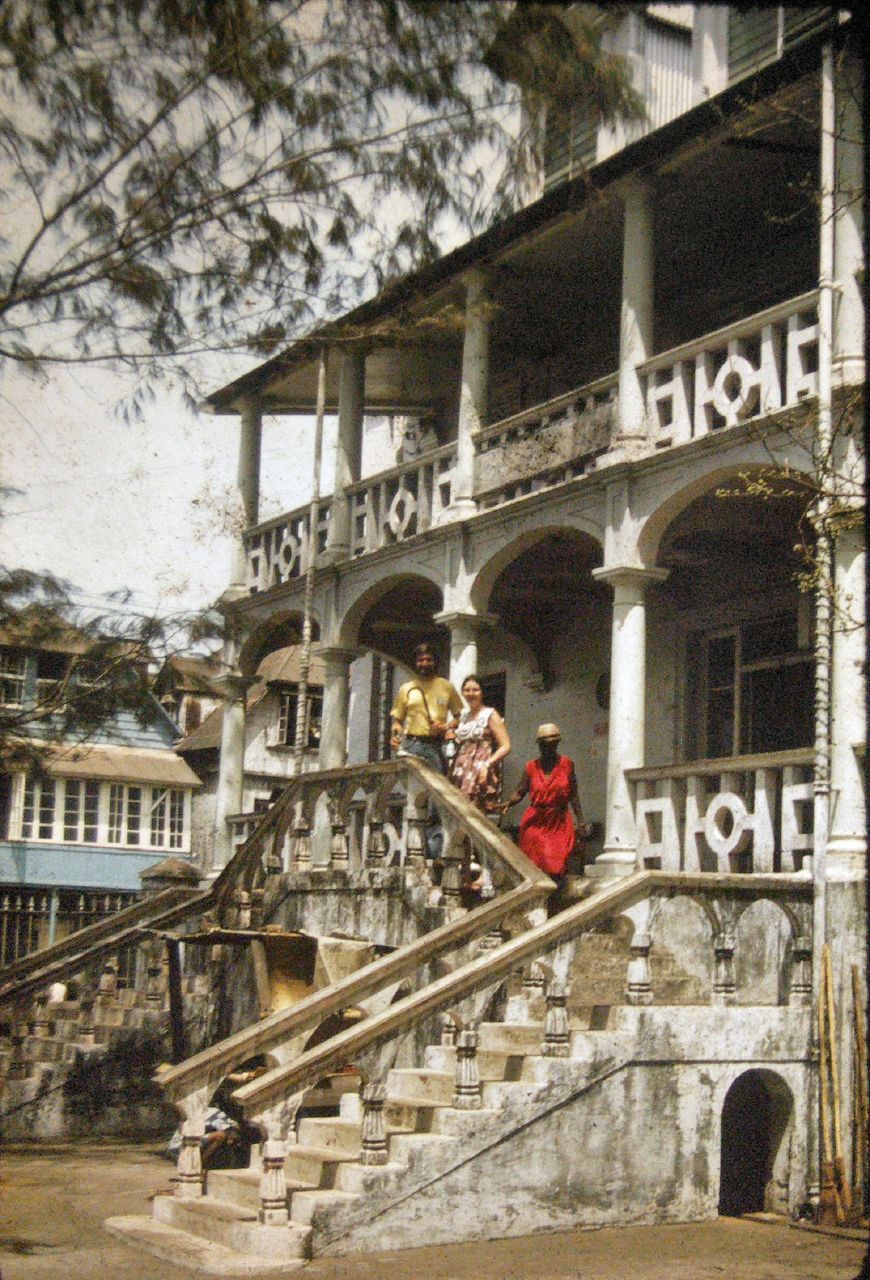
This initiation into 'shady dealings' can be seen as one of the turning points in the book; during his wife’s absence, Scobie finds himself drawn into both an adulterous affair and further underhand operations. The initial spark of love he thinks he has experienced with Helen, his mistress, turns out to go the way of his marital love, and become very quickly a sense of responsibility.

On his wife’s return, Scobie finds himself in an even more complicated moral situation. He had become a Catholic in order to marry his wife, and is now put in a position where, in order to maintain his wife’s happiness (which, with his sense of responsibility, he feels bound to do), he receives Holy Communion in a state of mortal sin: lacking contrition for his adultery, he is unable to seek absolution. The paradoxical situation in which he has placed himself leads, in the end, to disastrous consequences.

Greene himself, in the book’s preface, describes Scobie as a ‘weak man with good intentions doomed by pride’. He pursues what he sometimes even recognises as impossible aims solely by his own efforts, and when confronted with the contradictions and failures this presents, he comes to the 'flip side' of pride: despair, in which the enormity of his failure seems beyond even God’s redeeming power. Greene offers no easy answers to the problems, but presents us with a compelling account of the results, in a relatively ordinary life, of the primeval sin.

Thursday, June 2, 2011

Graham Greene Anniversary 2: The End of the Affair

'This is a record of hate far more than of love.' So muses our narrator, as he begins to relate the story of how he came to be conversing, one rain-soaked evening on the Common, with the husband of his former lover. Maurice Bendrix is a man in hate, and there in the rain we are gathered into his loneliness to begin a journey which draws us into the depths of love, jealousy, and desire. a journey which forces us to question with our narrator that much pondered theme of Greene’s work; what is it that makes us human?

It is June 1946; six years after the beginning of the adulterous affair, nearly two years since its unexplained, sudden ending. A chance meeting with Henry, the dull and inattentive husband of Sarah Miles, reignites the jealousy and passion within Bendrix for his lost love, as he hears of how Henry suspects Sarah of some current infidelity. A chain of events is thereby set in motion as Bendrix pursues his quarry, determined to understand why Sarah ended the affair and who has replaced him in her affections. Bendrix is meticulously calculating in his methods – he engages a private detective to follow Sarah – and we begin to see, in his pursuit, the complex nature of the obsession that drives him. Closely interwoven in Bendrix are the book's opposing themes of love and hate, and we may even begin to warm to him in the depths of his suffering. Greene wants us to see the centrality of suffering in the human experience, to see pain as indispensible to a life fully realised. As Bendrix dryly states; 'happiness annihilates us: we lose our identity'.

Following the novel's multilayered and fractured nature, we dance back and forth in time as Bendrix relates the events of the passionate affair and its mysterious ending. On gaining possession of Sarah’s diary through his private snoop, he finds the reason why it abruptly ended, but his confusion is only exacerbated as we too are invited, to read her journey of the last few years. 'It’s a strange thing to discover and to believe that you are loved, when you know that there is nothing in you for anybody but a parent or God to love.' Dismissing the reasons for Sarah’s abandonment of him, Bendrix sets out to reunite the pair. They begin again, but the affair is short-lived and brought to a tragic close. In the emotional debris that remains, hatred starts to give way to hope and to love, but love of a different kind. One starts to question who in this novel is really being pursued, and by whom?


To say more would be to spoil a beautifully crafted and profoundly moving read, for those not acquainted with this, the last of Greene’s overtly ‘catholic’ works. It is also not the place to pour over the apparent parallels between the book and the author’s own life. Let it suffice to end on a warning; Greene does not attempt to provide us with easy answers to life’s struggles. But, in the midst of the rain and suffering and hate, we too glimpse transcendent moments of pure love. But, like the characters, we too are left with more questions than we might find comfortable with The End of the Affair.

Saturday, May 14, 2011

Graham Greene Anniversary 1: The Power and the Glory

The English novelist Graham Greene died on 3 April 1991. Godzdogz is marking the 20th anniversary of his death with a series of reflections on his novels. Greene was a Catholic, and many of his greatest works deal with 'Catholic' issues. Br Nicholas Crowe opens the series with an account of what many regard as Greene's greatest work.

Graham Greene’s The Power and the Glory is set in 1930s Mexico at a time when the revolutionary government was aiming to stamp out the Catholic Church. The persecution was fiercest in Tabasco province, a state which Greene had explored in 1938 after his review of a Shirley Temple film provoked a law suit from 20th Century Fox that obliged him to flee the UK. Greene was impressed during his stay in Mexico by the raw and simple faith of the peasants, indeed he later claimed that their example had been instrumental in leading him to ‘live like a Christian’. The fruit of this sojourn was The Power and the Glory, published in 1940, a novel that shows all the power and depth of a spiritual awakening and is one of Greene’s most important works.

Greene tells the story of the ‘Whiskey Priest’ whose real name the reader never discovers. This priest is an alcoholic who, in a moment of drunken loneliness, has fathered an illegitimate child. His need for alcohol and his fear of capture continually lead him into shamefully humiliating situations, and at first glance he appears a dismal failure both as a priest and as a man. Yet as the novel progresses one comes to recognize that God’s grace is made perfect in weakness. Almost by accident, the Whiskey Priest stayed serving his people in the teeth of persecution while his brother priests fled, married, and accepted government pensions, or were captured and shot. It is only when the sterile and pristine Lieutenant who has pursued him from village to village begins to shoot the peasants who have offered him refuge that the Whiskey Priest turns his mind to escape.

Henry Fonda in The Fugitive, John Ford's 1947 film of the book
Greene paints a painfully vivid portrait of a man weighed down by his own demons and a terrible sense of sin, struggling to do his duty, striving to do what is right. The tale of Juan, as related by a pious mother to her children, is offered to us as a foil to this anti-hero: Juan was a perfect child, he was a perfect priest, and when he faced the firing squad without a tremor of fear or doubt he died a perfect death. Juan is a tedious and unattractive figure, and his martyrdom is a sentimental fiction. The Whiskey Priest, in contrast, is a character one cannot help warming to and pitying. When the soldiers come for him he is so frightened that he cannot stand, yet he is the true saint.

Greene dedicated The Power and the Glory 'For Gervase', that is Gervase Mathew OP (d.1976). An English Dominican who lived for many years at Blackfriars, Oxford, he was a member of the famous ‘Inklings’, a group that included J.R.R. Tolkien and C.S. Lewis.