Saturday, February 7, 2009

Friars’ Passions 11 – A Pilgrim’s Progress

In viaFrom the time, as a teenager, that I joined a walking team attached to my cadet squadron, I have nurtured a great love of the outdoors coupled with a real enjoyment of the physical challenges it can pose. Whilst almost obsessive about walking and hiking as a youth, in latter years my enjoyment from this pursuit is derived less and less from the sense of the distance achieved and more from the beauty of that which I discover en route. At least, that is what I tell myself if I have to keep stopping. Having done a great deal of walking both here and abroad I find the real lure is the time it forces you to set aside to think and to pray. If you are out for a long hike it is almost impossible not to pray, to start to think about all that makes up our lives, to work through problems and difficulties or simply give thanks for the time away from all the distractions of modern life and the quiet beauty of our surroundings.

My most memorable trip, just before I entered novitiate, gave me the chance to do just that. I took two weeks off from work and walked the last 200 mile stretch of the Camino de Santiago de Compostela with a good friend (who was also about to take a plunge in life and get married), and it was perhaps one of the most testing and rewarding experiences of my life. With all we needed strapped to our backs we set off for two weeks into some of the most breathtaking scenery I’ve come across, met some wonderful people and enjoyed many both prayerful and hilarious moments! The utter simplicity of our daily, pilgrim existence was remarkably comforting. We slept in refugios (huts with bunk beds), ate the wonderful local food and walked - simple and cathartic. I remember one moment as I sat on a mountain looking at the clouds driving through the valley beneath me and feeling utterly at peace, utterly calm. In those sort of extraordinary moments it is much easier to feel closer to God and although the challenge is to appreciate and give thanks for his presence wherever we find ourselves, it is those sorts of moments that can provide forceful yet sublime reminders of His great presence. Immersing ourselves in the beauty of Creation can give us the courage we need for the road ahead. If it is answers you are looking for, as St Jerome advised in the 4th century, solvitur ambulando – and he was right!

Friday, February 6, 2009

On the Areopagus - 4 Glorify God in your body

According to recent statistics, almost US$100 billion worldwide is spent on this, and almost 5 million websites disseminate it; that's almost a fifth of the entire internet. 42.7% of internet users patronise this industry, and according to the BBC, 74% of cases undertaken by family therapists and counsellors are directly affected by it. The issue at hand, which is silently entering our homes through the internet, is pornography.

The word itself, often used so nonchalantly, occurs several times in St Paul's letters, especially to the Corinthians. It comes from the Greek porneia, meaning sexual immorality. St Paul explains to the Christians of Corinth: "Shun immorality. Every other sin which a man commits is outside the body; but the immoral man sins against his own body. Do you not know that your body is a temple of the Holy Spirit within you, which you have from God? You are not your own; you were bought with a price. So glorify God in your body" (1 Cor 6:18-20).

We believe in a God who loved us so much that he became human, taking his body from the virginal flesh of Mary; whose body was broken and raised on the Cross for our salvation; whose body - still bearing the marks of the nails and lance which pierced his body - was raised from the dead in glory. Jesus gives us his body in the Eucharist as an abiding memorial of his suffering love for humanity, through baptism we are incorporated into his body, the Church, and through sharing in his Eucharistic body and blood we share one life with Him. Until he returns in glory, Christians are the body of Christ and, with our own human bodies, we continue his work of salvation in the world, longing in hope for the raising and glorification of our bodies when we will be eternally united with God.

So, the body is central and sacred in our Faith. So too is sex, which is the union of the bodies of two persons in a love so fruitful that a third person is created. This beautiful and privileged act of sexual love, which mirrors the fecundity of the Trinity itself, is sacred to Christians. Sexual immorality, seen in this light, is not something private that is done in front of a computer: it affects families, real relationships, and deeply wounds the person. It also makes God's Spirit, who dwells in our bodies as in a temple, sad. It harms the body of the Church of which every one of the baptised is an integral member.

Pornography falls disastrously short of the great good that is sex; it twists the truth about sex - which is good, normal, and healthy - and makes it a secret compulsion, prone to all manner of deviation, and ultimately unhealthy and de-humanising. Research has shown that what begins as 'soft core' becomes increasingly 'hard core', as one's threshold for sexual titillation incrementally pushes the boundaries. Pornography has been shown to be addictive, and every addict needs more to achieve a 'high'.  Some people might think I am overstating the point and regard pornography instead as just some 'harmless fun'. But as C. S. Lewis noted back in 1955, "everyone knows that the sexual appetite, like the other appetites, grows by indulgence... There are people who want to keep our sex instinct inflamed in order to make money out of us. Because, of course, a man with an obsession is a man who has very little sales-resistance."

Others argue that pornography celebrates the body and our sexuality, or that sexual enjoyment of the body does not harm our soul or person. However, Pope Benedict XVI, in his letter on God's love (Deus caritas est), has noted that "Eros, reduced to pure 'sex', has become a commodity, a mere 'thing' to be bought and sold, or rather, man himself becomes a commodity. This is hardly man's great 'yes' to the body. On the contrary, he now considers his body and his sexuality as the purely material part of himself, to be used and exploited at will. Nor does he see it as an arena for the exercise of his freedom, but as a mere object that he attempts, as he pleases, to make both enjoyable and harmless. Here we are actually dealing with a debasement of the human body: no longer is it integrated into our overall existential freedom; no longer is it a vital expression of our whole being, but it is more or less relegated to the purely biological sphere" (para.5). For a Christian, then, the body communicates and our bodily actions are like sacramental signs. It is body language that, at best, reveals the self-gift of love.

A Quiet Corner...The ever-burgeoning sales figures of the pornography industry, and the increasing numbers of young men and women who casually engage in viewing and participating in internet pornography, both testify to the truth of what the Holy Father and C. S. Lewis have said. The statistics also point to the deep loneliness and desire for love that lies at the core of our humanity. Blessed Teresa of Calcutta called this loneliness, so prevalent in the West, the greatest poverty in the world. Such profound loneliness cannot be assuaged or solved by a retreat into pornography or casual sex. Indeed, this only deepens the wound and widens the gap between persons. A person who is ensnared by pornography needs to be rid of this false love and learn how to connect with people in real relationships, to experience the vulnerability of loving another person, and to give himself in love rather than take and possess via the realm of pornographic fantasy. So, fr Timothy Radcliffe OP says that "the first step in overcoming lust is not to abolish desire, but to restore it, liberate it, discover that it is for a person and not an object."

Ultimately, the fundamental human desire is for God. As the psalmist says: "O God, you art my God, I seek you, my soul thirsts for you; my flesh faints for you, as in a dry and weary land where no water is" (Ps 64:1). To our bodies which long for God, Jesus gives us his body and blood in the Eucharist and his Spirit as living water to vivify our souls. Fed by his body, we become part of his body, the Church, and our bodies - now united to Christ in the Church - become temples of the Holy Spirit. Hence, St Paul strongly reminds the Corinthians about the Eucharist and Christ's gift of his body to us. He also reminds them of the meaning of communion and the fellowship of love that the Eucharist entails. Thus, the Eucharist teaches us how to love. Communion in the Church teaches us how to love. Christian friendship, which is the basis of our communion with God and one another, teaches us how to love. Learning how to love and be loved is not easy, but it can be done. There are examples of love and friendship all around us, not least in one's parents.

Sacred Heart of Jesusfr Timothy exhorts us to "have the nerve to live through the crises of love, the turmoil of infatuation, the piercing of our heart, through into the deep and calm water of mature, adult, holy love". Pornography is not 'adult material'. It is for emotional infants, caught in a world of fantasy and false relationships, who dare not set out on this adventure of love and journey into the heart of a God who desires us more than we could ever imagine. Mature, adult, holy love communicates the gift of a person to another, glorifying God with one's body so that, at the end, God may glorify that body at the resurrection of all the baptised.

Therefore, Pope John Paul II said, "'Rise, let us be on our way.' "Let us go forth full of trust in Christ. He will accompany us as we journey toward the goal that he alone knows." It's never too late; now is the acceptable time of our salvation and liberation from the chains that may still bind us.

Thursday, February 5, 2009

Friars' Passions - 10 Laudate Dominum, Omnes Gentes

Languages have fascinated me ever since I was a child: I always enjoyed discovering new words in English, as well as studying various foreign languages at school, and my parents still tell the story of the time when, aged 10, I spent most of my pocket money during a family holiday to Wales on a Welsh-English dictionary! The ways in which different languages work and express various ideas provides a fascinating insight into different ways of thinking about the same concept, while of course being able to speak a foreign language also creates huge opportunities for discovering different cultures through literature and conversation with speakers of that language.

Pursuing my interest in languages, I studied French and Russian at university before joining the Order. I have been able to continue my academic study of languages, since we have to learn Latin, New Testament Greek and Hebrew as part of our training. However, knowledge of languages can also play a further and deeper role in my Dominican life: it improves, I hope, my ability to preach, both by giving an insight into different ways of thinking and of explaining things, and also by increasing the number of people with whom I can communicate.


Wednesday, February 4, 2009

On the Areopagus - 3 Reflections on Hope

Pope Benedict XVI, in a greeting to young people in 2008, challenged them as Christ’s disciples to “show the world the reason for the hope that resonates within you. Tell others about the truth that sets you free.”


One of the pastoral roles undertaken by Dominican students in Oxford is to guide a youth group in the Oxford Priory known as 'Catholics Anonymous'. In Advent 2008 the young people of this group took up the Holy Father's challenge and they shared their reflections on the Joyful Mysteries of the Rosary during the course of a service of prayer in Blackfriars priory church. The service consisted of readings from the scriptures for each mystery, followed by a reflection, and the praying of the mystery itself accompanied by appropriate musical accompaniment that was conducive to prayer and meditation.


The youth group shared their reflections on the mysteries of our faith which were a fruit of their contemplation. These reflections were insightful and thought-provoking, often concentrating on the theme of the hope which our faith in the new-born Christ gives us. One reflection spoke of “the very fragility of this hope, of this state of life, the fact that hope, and patience is often all we have”. Going on to wonder about how the great saints appear so secure in their faith and knowledge despite their human limitations, the reflection went on to say: “But these ultra-pious Saints lived in Advent too, they didn’t know either. Perhaps theirs was an example of astonishing hope, or astonishing trust, but it was not a sign of divinity… Hope then, is the only true compass and our need to live in hope, rather than doubt, seems to lie at the centre of both the Christian life and, when I look again, the Joyful Mysteries”.

Looking at the Visitation, another reflection spoke about the audacity of Mary’s hope: “Doing and proclaiming true good in a society which may frown upon it would make politicians and princes shrink, but filled with the Holy Spirit, Mary proclaims it with fervour, conviction and joy, sure in the hope that all generations will call her blessed”.


We thank our young people for their generosity in giving their time and efforts into organising such a wonderful and prayerful service, which was an inspiration to the friars and laity who attended and which helped us to look afresh at the mystery of the Incarnation.

fr David Barrins OP who has guided the youth group since it began in 2007

St Paul concludes his letter to the Philippians - the community he seemed to love more than any of the others - encouraging them as follows: Rejoice in the Lord always; again I will say, Rejoice. Let all men know your forbearance. The Lord is at hand. Have no anxiety about anything, but in everything by prayer and supplication with thanksgiving let your requests be made known to God. And the peace of God, which passes all understanding, will keep your hearts and your minds in Christ Jesus (Philippians 4:4-7).

Tuesday, February 3, 2009

Friars' Passions - 9 Wanderlust

Travelling has been a part of my life since I was 10 years old. From that age, I began to sing in a cathedral choir in Germany, sometimes every weekend. Over the course of several years, we would often go on extended trips touring throughout Germany. It was sometimes very exhausting – but it was wonderful to see so many different parts of my country: from the Alps to the seaside, through the former “German Democratic Republic” and along the Rhine. But I realise now, looking back, that the most important thing was not to see lovely and interesting places, but to meet people in those places, and to be there with friends. It forms you as a group to have such common experiences, good or even bad. And after my time in school, I continued to travel throughout Europe. It was not the fancy destinations which attracted me, but to go to nice places with friends, to spend time together – on which to think back and say “do you remember...?!”

Needless to say the possibilities of travel have changed since I joined the Order. As a religious I have not only the duties of a student but I am part of a community with responsibilities therein. I cannot do or not do whatever and whenever I want, but I have to be considerate of my brethren and need, of course, the permission of my superiors. And I am also a bit less “flexible” in terms of money. On the other hand, even in the Order, many opportunities to travel do arise, and I have met a lot of people from all over the world. It was often not a holiday in the strict sense, e.g., an international Dominican study week in Dubrovnik, a pilgrimage to Calaruega (Spain), the birthplace of St Dominic, a journey with the studentate to Bologna, where St Dominic is buried, but also proper "holidays" with brothers in Salamanca or hiking in the Tatra Mountains. In all these places we have not simply been tourists, but were Dominicans, with Dominicans.

And even if we are separated by language and nationality, it becomes always apparent, that we are one Order. An older brother once told me: “we are suffering from Babel’s confusion of tongues.” Possibly we can help a little bit to overcome the fragmentation of the world and come to the unity to which we are called by God. That may sound too sophisticated, but it is very simple: it means to accept and cultivate friendship when it is given to us.

Monday, February 2, 2009

On the Areopagus - 2 We have a Gospel to proclaim!

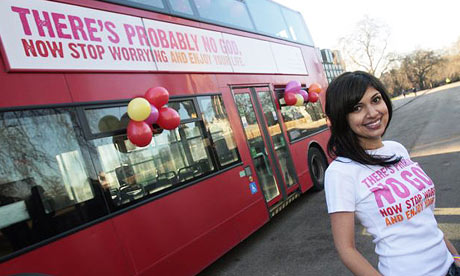
On 6 January 2009, the British Humanist Association launched its 'atheist bus advertising campaign'. Originally intended for just a few buses, with a budget of just £5,500, the Association rapidly received over £130,000, enabling 800 buses around the country to carry the slogan: "There's probably no God. Now stop worrying and enjoy your life". 

What has prompted this campaign? Ariane Sherine, who created the campaign, said that she was moved to respond in this way by certain high-profile Christian campaigns that declared that "failing to believe in Jesus will condemn you to hell". She added: "There's no doubt that advertising can be effective, and religious advertising works particularly well on those who are vulnerable, frightening them into believing."

Much has been made of the slogan's lack of certitude, that there is probably no God, which some say is, technically, agnosticism rather than atheism. However, what bothers me is the second half of the slogan, for it is based on the premise that belief in God, or even the existence of God (however probable), gives rise to anxiety and fear, and is a barrier to enjoying life. If this is true, then the Gospel is bad news rather than good news, and I am in the wrong place! 

Adoration of the Magi (Comper)
On the contrary, those of us who have just celebrated Christmas - the feast of Love incarnate - know that our God is a God of unconditional love and it is He who causes us to enjoy life even more. Ironically, the atheist bus campaign began on the feast of the Epiphany, the day when the Gentile wise men came in search of Love incarnate and found him in the babe of Bethlehem, cradled in the arms of his mother. Those magi who scanned the heavens looking for portents and signs recognized Jesus as the Sign, the sacrament of divine Love. Those who would be wise, who sought meaning and happiness in life, discerned that our humanity was graciously elevated by the coming of Christ, who by his incarnation has joined us to divinity and so assured us eternal life, happiness and peace with God. 

Like those magi, all humanity still seeks to love and be loved. We seek happiness, the enjoyment of life, goodness, truth and beauty. In this we are in agreement with Ms Sherine. And why not? For all human beings are born with this longing for love. However, where we may differ from Ms Sherine is where we find this life-fulfilling love. St Augustine said, "You have made us for yourself, O God, and our hearts are restless until they find their rest in you". So, we Christians find love in God. It is He who holds us in being and brings us to perfection, fulfilling our deepest desires. 

In Jesus Christ who is God incarnate, "perfect love made flesh and blood", the wise men sought and found what all humankind seeks. Others who refused to see this truth sought to kill Him or to deny His existence. Why? Rowan Williams says that "in a world of blocked choices, wrong turnings and drastically false accounts of who and what we are, love of this sort is not going to look obvious or natural. It will seem to be against the grain." And so, frightened by such perfect love and goodness, some seek to kill it while others deny it.

The reality of our human condition is that we live in a world of fear, uncertainty and worry. In a time of war and terrorism, famine and drought, climate change and economic volatility, it is somewhat naive and blase to say, 'stop worrying and enjoy your life'. Clearly, we all live with suffering and hardship, human wickedness and fear. In a sense, we already live in 'hell', that is to say, a world where God is absent because sinful humanity excludes Him. The atheist campaign seems to take the proverbial ostrich-like approach in answer to our woes: pretend it is not so, live it up, take refuge in fleeting pleasures and enjoyment. The Christian approach is to acknowledge the reality of God-given life which is essentially good but because of sin is lacking in truth, goodness and beauty. The reality of our estranged human condition is called original sin, and God Himself has come to free us from sin and give us a share in his divine life: this is good news! 

Christians down the ages have all lived in times of upheaval and been persecuted for their faith. It is not so much failure to believe in Christ that condemns one to hell, but often Christians who have faith have suffered 'hell' on account of their faith; many still die for following the Gospel. In doing so, they imitate Jesus Himself who "descended into hell" for our sakes. Moreover, they remained steadfast in faith and knew a deep unshakeable joy that overcame all temporal worries because they knew the love of God for them. St Paul thus said: "I am sure that neither death, nor life, nor angels, nor principalities, nor things present, nor things to come, nor powers, nor height, nor depth, nor anything else in all creation, will be able to separate us from the love of God in Christ Jesus our Lord" (Romans 8:38f). Therefore, as Herbert McCabe OP puts it, "Christianity is a wisdom concerned with how to love oneself, and how to rejoice in being". We rejoice in being alive and we learn to love ourselves because we recognise that we are first loved into being by God. I repeatedly experienced this joy in the lives of destitute Filipino Catholics living in the most terrible slums of Manila, and their example of love, peace and happiness amazed me and deepened my faith. 

We believe that Christ has come to give us fullness of life. Life itself and all enjoyment, pleasure and the goodness of creation are held in being by God and come from God. Faith in Jesus Christ and knowing Him as our Saviour, our Brother, and our Friend does not threaten our enjoyment of life. On the contrary, Jesus brings our life to perfection, gives us lasting happiness, and fills us with God's goodness. Hence, Aquinas said that the pleasures we experience on earth will be even more pleasureable in heaven: with God, we enjoy life more! 

This, surely, is the Gospel that we believe, and we need to proclaim it. The atheist bus campaign suggests that all too often some Christians have not been preaching good news but scare-mongering. Let us stop doing that, and proclaim a gospel that liberates us from fear, makes us more fully human, offers certain hope and brings true peace and happiness. 

Sunday, February 1, 2009

Friars' Passions - 8 Cricket

My interest in Cricket started during my teenage years. Growing up in rural Wales, the sport of preference was Rugby, so I had little opportunity to play Cricket. My interest grew from watching England playing test matches on the television. As many people will know, cricket is a very complicated game, and test matches are played over a five day period. There is a lot to learn before gaining an idea of what is going on. As I learned about the rules, the various techniques and so on, I became fascinated by the game.

There are several things that I love about it. The first thing is that within a five day game, there are lots of little battles that go on: the contest between the bowler and the batsman and the little psychological games that go on between the two, the strategies and planning by the fielding side to get a particular batsman out, and so on. I have learned to appreciate the great skills of a bowler at the top of his game, and to see the beauty of the perfect shot played by a batsman. I also love the various statistics that come with the game, which are indicators of the strengths and weakness of particular players and teams. It is an analyst's paradise! Cricket is not always a high octane, fast paced game, though there are moments of great excitement. However there is an underlying subtlety that is part of its charm for me. Underneath the seemingly sedate pace, there is much strategy and planning, and the team who plans well, holds its nerve, has patience and executes its plans with skill usually comes out on top.

It may sound strange, but I do find similarities between cricket and the Christian life. Living a good Christian life is not always a source of instant gratification. Developing the virtues that make us good followers of Christ does not neccessarily give us much of a buzz or adrenaline rush most of the time. But it does open our eyes to that subtle beauty that is the life with Christ. The more we strive to live in Christ, and to learn about God and what he has done for us through Christ, the more we see a whole range of possibilities opened to us. Through perseverance, we come to see how being a Christian brings us a deep and subtle joy.