Monday, February 12, 2007

Worthy Successor of St Dominic

"The Rule of the Friars Preachers. And this is their Rule: to live virtuously, to learn, to teach."

These words of Jordan of Saxony reveal a friar whose experience of the Dominican life, as much as his studiousness, informs his conduct in regular observance. Born in Burgberg, Westphalia at the end of the twelfth century, he received the habit from Bl Reginald of Orleans (whose feast we celebrated yesterday) on 12 February 1220, becoming Provincial of Lombardy only one year later and then first successor to St Dominic as Master of the Order not long after. We can only imagine the weight of such a task as the new order lost its founder. And yet, there is only a hint of this apprehension in Jordan’s own writings:

"I had only been in the Order one year and had not struck root as deeply as I ought to have done. I was to be placed over others as their superior, before I had learned to govern my own imperfection."

(Libellus on the Beginnings of the Order of Preachers)

Jordan oversaw the refinement of the Constitutions and began many traditions that are still observed in the Order today: for instance, encyclical letters from the Master to the brethren and the singing of the Salve Regina after Compline. There are many stories and words from and about Blessed Jordan, who guided his brothers and sisters in the footsteps of Dominic for fifteen years and drew over a thousand novices in the Order. He is, for this reason, the patron of Dominican Vocations and after Compline on Wednesdays at Blackfriars we pray to him for "talented and devoted men and women to consecrate their lives to God".

It has been said that "Jordan who, more than any one man after St Dominic himself, created the spirit of the Order, gave to it a joy and an informality in its daily life which are amongst its greatest treasures, for they enshrine and express a whole theology of religious life." This spirit of joy and laughter is shown in just one story from his in the 'Lives of the Brethren', the Vitae Fratrum:

"When on his way home to his convent with a fresh batch of novices, as they were all saying Compline together, one of them fell to laughing, and the rest catching on joined in right heartily. Upon this one of the blessed Master’s companions made a sign for them to be quiet, which only set them off laughing more than ever. When the blessing had been given at the end of Compline, the Master turning to this friar rebuked him sharply: ‘Brother, who made you their master? What right have you to take them to task?' Then addressing the novices very gently, he said, ‘Laugh to your heart’s content, my dearest children, and don’t stop on that man’s account. You have my full leave, and it is only right that you should laugh after breaking from the devil’s thraldom, and bursting the shackles in which he held you fast these many years past. Laugh on, then, and be as merry as you please, my dearest sons.’ They were all very much relieved on hearing him say so…"

Jordan and two of his confreres were killed in a shipwreck on 13 February 1237 returning from the new priory in Acre in the Holy Land. This would have seemed a tragedy for the Order were we not assured of his continued love and intercession from heaven. We thank God for the gift of so worthy a successor to St Dominic. Br Lawrence at Oxford has written this prayer to Jordan:

May Blessed Jordan of Saxony pray for the Order of Preachers today and always, and grant an increase of vocations to the Dominican Family. May he stir up the hearts of young men and women, as once he did on this earth, with a fervour for Truth, to give themselves in its service in the Order of Preachers. May he clothe us, his brothers and sisters, with his zeal and passion for Christ the Word, and may he give us cause joyfully to laugh in his company for ever. Amen.

Blessed Jordan, pray for us.

Saturday, February 10, 2007

The two ways

Sixth Sunday in Ordinary Time - 11 January 2007

Readings: Jeremiah 17:5-8; Psalm 1; 1 Corinthians 15:12, 16-20; Luke 6:17, 20-26

A common way of moral teaching in the ancient world is in terms of ‘two ways’, one leading on to success and happiness, the other to disaster and disappointment. It is used also in the Bible, which speaks of a way that carries a blessing and leads to life, and a way that carries a curse and leads to death. One is the narrow way of which Jesus speaks, leading to life, and the other is the broad way, leading to death. To place your trust in flesh and in what the world can offer is a way that leads to death, Jeremiah says. It means living, sooner or later, in a parched land. To place your trust in the Lord is to be like a tree planted near life-giving water, able to send its shoots to the water to find nourishment. Such a tree blossoms, and bears fruit.

The form of the beatitudes given in the gospel of Luke follows this pattern of ‘the two ways’. Those who are poor and hungry, weeping and rejected, are blessed, Jesus says. Those who are rich and well fed, laughing and well thought of, are in difficulty. The true prophets experienced the former whereas the false prophets experienced the latter. People experiencing the former are obliged to place their trust in God and so they are like trees planted near life-giving water. People experiencing the latter find their meaning and significance in the world and will find themselves, sooner or later, living in a parched land. Somebody more beautiful will come along, or someone richer, or someone more influential, or someone younger … but the wise person finds the meaning and significance of their lives at some deeper place, where the divine water is to be found.

The paradox expressed in the beatitudes and woes of Luke 6 is most dramatically enacted in the paschal mystery of Christ. He is the seed sown in the ground. But the ground in which it is sown is watered from a divine source so that he springs to life again, life more abundant and more glorious. As Paul says in the second reading, Christ has been raised from the dead as the first fruits of those who have died. So when he speaks about the poor and hungry, about those who weep and are persecuted, he speaks about himself. And he knows the meaning and significance human life contains when it remains in touch with the divine water, blossoming (albeit in hidden ways) and bearing fruit (fruit that will last).

Reproduced with permission from The Pastoral Review, January-February 2007

Tuesday, February 6, 2007

Commemoration of our Deceased Parents

On 7 February each year Dominicans pray for their deceased parents. The conventual Mass is offered for them and the Office of the Dead is sung. Here one of the brothers reflects on the significance of this annual liturgical commemoration:

Death leaves all kinds of unfinished business. When we die most of us will not have become all we should have been - there will have been words of tenderness and forgiveness never spoken, damaging relationships never mended, kinds of trust never learnt. We will have not changed in ways in which we might have changed. So we will die still in need of spiritual healing. The time between death and the vision of God – the time that we call purgatory - essentially is a time for this kind of healing.

It is difficult to hold onto any picture of the beyond. Experience of the death of a loved one brings home all the strangeness of death. An actual death makes it perfectly clear how little we know. But it is possible to make a guess what this time – if it is a time - will be like. The poet Dante wrote a long poem about purgatory - the poem is, in effect, a long guess. Dante thought that this period of being between worlds would be both painful and acutely joyful. He thought the pain and the joy would be God’s way of touching parts of ourselves that we have hardened and brutalised. The pain would be bitter-sweet, it would be suffered in the knowledge that it was a way of undoing all the self-inflicted effects of sin, in the knowledge that it was God’s way of loosening our sclerotic hearts. Above all, purgatory would be a place of renewal. It would be a place of renewed sociability, of remaking the bonds between people, which had been broken by sin. It would also be a place of renewed and purified community with God.

There is a lot of sense and wisdom in Dante’s vision of the healing flames. If purgatory is a place of healing, it must be a healing that can penetrate human nature through and through, and perhaps all real healing like all real change involves something bitter-sweet.

Today we are praying especially that that healing will come home to our dead parents, whose lives are now a mystery to us, but who claim our time and attention. Perhaps we are likely to know our parents’ need for healing best of all. It is easy to know the weaknesses and failures of those we have lived with. But knowledge of someone’s weakness – especially when it is mixed with gratitude to that person – should be a cause of love and nothing else. Our prayer for our dead parents is the best expression which we can give of that love.

Saturday, February 3, 2007

By grace I am what I am

Fifth Sunday in Ordinary Time - 4 February 2007

Readings: Isaiah 6:1-8; Psalm 137; 1 Corinthians 15:1-11; Luke 5:1-11

There is nothing wrong about feeling unworthy in the presence of God. In fact it seems like a healthy reaction. Which of us, faced with the glory of God’s perfect love, would feel able to stand? Isaiah experienced that glory in a vision he had in the Temple at Jerusalem, and felt unworthy. Peter experienced it in his encounter with Jesus, and felt sinful. They fell to their knees, dismayed by their poverty.

That Peter reacted to Jesus as Isaiah did in the Temple reminds us of something central to the New Testament. God’s dwelling is not now a religious building in a particular place: God’s dwelling is Jesus Christ. The glory experienced by Isaiah is hidden within Jesus. Our dealings with God, and God’s dealings with us, take place now through the body of Jesus Christ. It is because we have been made members of that body through baptism that we have access to the Father when we pray in the name of the Son. But Peter has not yet learned all this. For the moment all he knows is that the power of God is working through Jesus and he is not worthy to stand in its presence.


Saint Catherine of Siena, a great mystic of the 14th century, quotes God saying to her ‘I am He who is and you are she who is not’. Saint Paul puts it like this in the second reading today: ‘by grace I am what I am’. If he worked harder than any of the other apostles, it was ‘not I but the grace of God that is with me’. This is a lesson that is learned only with great difficulty. Isaiah has a burning coal placed against his lips: thus purified he can speak the Word of God to the people. Peter has many trials and difficulties to undergo in following Christ. Paul too gained his wisdom through much suffering. And of course Jesus himself, although he was Son, learned obedience through what he suffered.

Like Peter we are invited to ‘put out into the deep’, to be courageous and generous in our efforts at following Christ. We will fail often, and perhaps seriously, as Peter did. But we are in good company, for so many have walked this path before us, the path to our true identity: ‘by grace I am what I am’.

Reproduced with permission from The Pastoral Review, January-February 2007

Thursday, February 1, 2007

Sequence for Candlemas


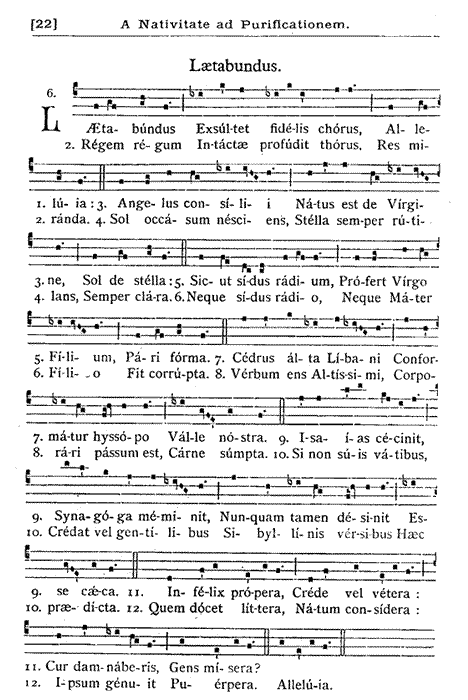
In the 9th and 10th centuries, there arose a new form of hymnody, the Prose or Sequence which was sung after the Gradual (the anthem between the Epistle and Gospel at Mass). In the Dominican Missal, the Sequence Laetabundus, may still be sung at the Third Mass of Christmas, the Epiphany and Candlemas. It begins thus:

"Let the faithful choir
Joyfully rejoice,
Alleuia!

The womb of the undefiled one
Has brought forth the King of kings:
A thing of wonder..."

There were quite a number of sequences written to celebrate the Incarnation of Christ, but the most famous Nativity sequence is this one. It was once sung all over Europe - the oldest surviving manuscript evidence is from the 11th century - being especially popular in England and France. Unlike other early sequences, it was written in rhymed stanzas and this came to influence later hymns and verses.

This Sequence is believed to survive today only in the Dominican liturgical books and the recording above is from Blackfriars, Oxford. The Latin words and music may be found here and a full translation here.

Wednesday, January 31, 2007

Dominican Mottos: Veritas

Dominicans have a few mottos which encapsulate their purpose and mission. Frequently cited is veritas (truth). The other two most commonly quoted are laudare, benedicere, praedicare (to praise, to bless, to preach) and contemplare et contemplata aliis tradere (to contemplate and hand on to others the fruits of contemplation).

VERITAS

According to the Bible, God is the source of truth: ‘The sum of thy word is truth’ (Ps 119:160), ‘I the Lord speak the truth, I declare what is right’ (Is 45:19). He guides his people in his truth: ‘Lead me in thy truth, and teach me’ (Ps 25:5); ‘Teach me thy way, O Lord, that I may walk in thy truth’ (Ps 86:11). St Thomas Aquinas states that there ‘not only is truth in [God], but he is truth itself, supreme first truth’ (Summa Theologiae I.q16.a5).


In Jesus Christ the whole of God’s truth became manifest, ‘full of grace and truth’ (Jn 1:14). He came as ‘the Light of the world’ (Jn 9:5) and as ‘the Truth’ (Jn 14:6) to testify to this: ‘For this I was born, and for this I have come into the world, to bear witness to the truth’ (Jn 18:37). His disciples continue in his word because ‘the truth will make you free’ (Jn 8:32).


To follow Christ is to liv
e by the Spirit he sent, ‘the Spirit of truth’ (Jn 14:17; 15.26; 16:13), who bears witness to Jesus and sanctifies the disciples in truth (Jn 17:17). Loving the truth (2 Th 2:10) and ‘speaking the truth in love’, they grow into the fullness of their head, Christ (Eph 4:15). To be a Christian is to be a member of Christ’s body (Rom 12:5; 1 Cor 12:27; Eph 5:30) — the Church (Col 1:24) — which is ‘the pillar and bulwark of the truth’ (1 Tim 3:15).


The
Catechism teaches us that human beings naturally tend toward the truth; they are morally bound to seek truth, to adhere to the truth once they come to know it, and to direct their whole lives in accordance with what the truth demands (n. 2467).

The conviction that God is our beginning and our end, that we come from him and are going to him, that he himself is truth and that truth will set us free, is the ground of all Dominican action. As the hymn Adoro te devote (allegedly by St Thomas Aquinas) says, ‘Truth himself speaks truly, or there’s nothing true’. In the final analysis everything is about love: who we love and how much. But in order to love God and our neighbour better, we must know God and ourselves better. Love is served by knowledge.


St. Dominic sought ‘the salvation of souls’ by preaching truth to his hearers. He
instituted study as Dominican asceticism so that we might preach truth soundly and convincingly. St. Thomas Aquinas, like every good Dominican, firmly believed that there was all truth somewhere but also that there was some truth everywhere. He took all objections seriously, carefully distinguishing any truth in it from its error. This is the basis of the modern theological use of the term ‘dialogue’: the pursuit of truth is a shared journey of discovery.


Dominicans cannot be interested in quashing their opponents. They seek to buil
d with everyone on the same edifice of truth. Our pursuit of truth necessarily entails that we should also explain and defend the truth, in the old-fashioned sense of the word ‘apology’. Pope Honorius III, who officially approved the Order, told St. Dominic that he was ‘convinced that the brothers of your Order will be champions of the Faith and true lights of the world’.


The great Dominican St. Catherine of Siena summed up our ideal with her prayer ‘God grant that I may always be a lover and proclaimer of truth, and that for the sake of truth I may die’ (Letters, 277). In this love for truth, the great model for Dominicans is Our Lady, Mary, the mother of Jesus. She opened her heart and mind to the truth God sent her (Lk 1:38; 2:19, 51) and sought God’s will for herself and others (Gn 2:5) in spite of the pain it brought her personally (Lk 2:35; Jn 19:25). Recognising her son as Truth, Mary pondered his words (Jn 2:4) and the events of his life (Lk 2:19, 51).

This reflection, written by Fr Leon Pereira OP, is available in leaflet form at Blackfriars, Oxford

Sunday, January 28, 2007

New Navigation Icons

SITE ICONS

'Godzdogz' has undergone a slight modification: four new 'Icons' have been placed in the Sidebar on the right. Clicking on them will take you to the relevant sections of this blog with archived content. Exciting new content to come will be posted regularly each week, tagged and placed in each of these four sections, so please do take the time to explore them, and check back regularly.